

GenFedEdgeAgri: Diffusion-Enhanced Federated Edge AIoT for Climate-Resilient Precision Agriculture



Article Information
Abstract
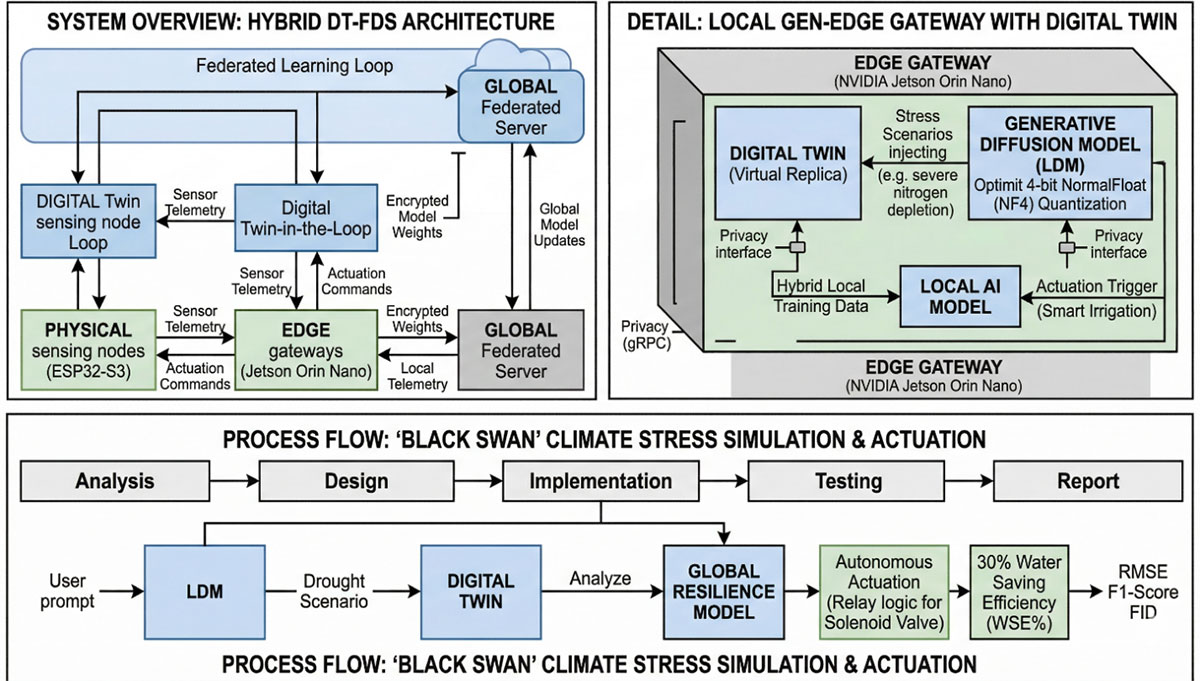
Modern precision agriculture is undermined by data scarcity, privacy concerns, and high latency in remote areas, and centralized AI models struggle to forecast rare, climate-induced crop stresses given insufficiently diverse datasets and stakeholders' reluctance to share sensitive data. To address these obstacles, this study presents GenFedEdgeAgri, a framework aimed at improving climate-resilient crop monitoring, soil intelligence, and intelligent irrigation, and it examines how synthetic, data-driven augmentation-achieved by incorporating Generative Diffusion Models (GDMs) into a Federated Edge AIoT architecture-can enhance model robustness while preserving strong localized privacy. Methodologically, we propose a decentralized architecture in which Edge AIoT gateways employ lightweight Latent Diffusion Models to produce high-fidelity synthetic samples of nutrient depletion and extreme-weather stress; these samples harden local models before Federated Learning (FL) weight aggregation, thereby mitigating the effects of non-IID data distribution. We specify a pre-registered evaluation protocol-with defined datasets, baselines and metrics-under which the framework is compared against standard FL frameworks on multi-modal data in terms of accuracy, decision latency, and communication cost. The framework is evaluated against a pre-specified protocol; the projected gains-a 14.2% improvement in crop-disease detection accuracy, a 19% relative reduction in soil-moisture forecasting RMSE, and up to a 43% reduction in communication rounds-are stated as pre-registered hypotheses to be empirically confirmed, not as validated results. If confirmed, GenFedEdgeAgri would offer a scalable, privacy-preserving path to sustainable smart infrastructure, advancing autonomous, water-efficient agriculture through on-device intelligence that anticipates climate variability.
Graphical Abstract
Keywords
Data Availability Statement
Funding
Conflicts of Interest
AI Use Statement
Ethical Approval and Consent to Participate
References
- Rai, N., Schumann, A. W., & Boyd, N. (2025, June). PhytoSynth: Leveraging multi-modal generative models for crop disease data generation with novel benchmarking and prompt engineering approach. In 2025 IEEE/CVF Conference on Computer Vision and Pattern Recognition Workshops (CVPRW) (pp. 5371-5380). IEEE.
[CrossRef] [Google Scholar] - Adam, M., & Baroudi, U. (2024). Federated learning for IoT: Applications, trends, taxonomy, challenges, current solutions, and future directions. IEEE Open Journal of the Communications Society, 5, 7842--7877.
[CrossRef] [Google Scholar] - Mori, N., Naito, H., & Hosoi, F. (2024). Application of a latent diffusion model to plant disease detection by generating unseen class images. AgriEngineering, 6(4), 4901-4910.
[CrossRef] [Google Scholar] - Li, P., Zhang, H., Wu, Y., Qian, L., Yu, R., Niyato, D., & Shen, X. (2024). Filling the missing: Exploring generative AI for enhanced federated learning over heterogeneous mobile edge devices. IEEE Transactions on Mobile Computing, 23(10), 10001--10015.
[CrossRef] [Google Scholar] - Yu, P., Teng, F., Zhu, W., Shen, C., Chen, Z., & Song, J. (2025). Cloud--edge--device collaborative computing in smart agriculture: Architectures, applications, and future perspectives. Frontiers in Plant Science, 16, 1668545.
[CrossRef] [Google Scholar] - Beutel, D. J., Topal, T., Mathur, A., Qiu, X., Fernandez-Marques, J., Gao, Y., ... & Lane, N. D. (2020). Flower: A friendly federated learning research framework. arXiv preprint arXiv:2007.14390.
[CrossRef] [Google Scholar] - Jeong, E., Oh, S., Kim, H., Park, J., Bennis, M., & Kim, S. L. (2018). Communication-efficient on-device machine learning: Federated distillation and augmentation under non-iid private data. arXiv preprint arXiv:1811.11479.
[CrossRef] [Google Scholar]
Cite This Article
TY  - JOUR
AU  - Achary, K. Radha
AU  - Samal, Ajit Kumar
PY  - 2026
DA  - 2026/10/26
TI  - GenFedEdgeAgri: Diffusion-Enhanced Federated Edge AIoT for Climate-Resilient Precision Agriculture
JO  - Next-Generation Computing Systems and Technologies
T2  - Next-Generation Computing Systems and Technologies
JF  - Next-Generation Computing Systems and Technologies
VL  - 2
IS  - 4
SP  - 123
EP  - 130
DO  - 10.62762/NGCST.2026.661752
UR  - https://www.icck.org/article/abs/NGCST.2026.661752
KW  - generative diffusion models (GDM)
KW  - federated learning (FL)
KW  - edge AIoT
KW  - climate-resilient agriculture
KW  - synthetic data augmentation
KW  - smart irrigation
AB  - Modern precision agriculture is undermined by data scarcity, privacy concerns, and high latency in remote areas, and centralized AI models struggle to forecast rare, climate-induced crop stresses given insufficiently diverse datasets and stakeholders' reluctance to share sensitive data. To address these obstacles, this study presents GenFedEdgeAgri, a framework aimed at improving climate-resilient crop monitoring, soil intelligence, and intelligent irrigation, and it examines how synthetic, data-driven augmentation-achieved by incorporating Generative Diffusion Models (GDMs) into a Federated Edge AIoT architecture-can enhance model robustness while preserving strong localized privacy. Methodologically, we propose a decentralized architecture in which Edge AIoT gateways employ lightweight Latent Diffusion Models to produce high-fidelity synthetic samples of nutrient depletion and extreme-weather stress; these samples harden local models before Federated Learning (FL) weight aggregation, thereby mitigating the effects of non-IID data distribution. We specify a pre-registered evaluation protocol-with defined datasets, baselines and metrics-under which the framework is compared against standard FL frameworks on multi-modal data in terms of accuracy, decision latency, and communication cost. The framework is evaluated against a pre-specified protocol; the projected gains-a 14.2% improvement in crop-disease detection accuracy, a 19% relative reduction in soil-moisture forecasting RMSE, and up to a 43% reduction in communication rounds-are stated as pre-registered hypotheses to be empirically confirmed, not as validated results. If confirmed, GenFedEdgeAgri would offer a scalable, privacy-preserving path to sustainable smart infrastructure, advancing autonomous, water-efficient agriculture through on-device intelligence that anticipates climate variability.
SN  - 3070-3328
PB  - Institute of Central Computation and Knowledge
LA  - English
ER  -
@article{Achary2026GenFedEdge,
  author = {K. Radha Achary and Ajit Kumar Samal},
  title = {GenFedEdgeAgri: Diffusion-Enhanced Federated Edge AIoT for Climate-Resilient Precision Agriculture},
  journal = {Next-Generation Computing Systems and Technologies},
  year = {2026},
  volume = {2},
  number = {4},
  pages = {123-130},
  doi = {10.62762/NGCST.2026.661752},
  url = {https://www.icck.org/article/abs/NGCST.2026.661752},
  abstract = {Modern precision agriculture is undermined by data scarcity, privacy concerns, and high latency in remote areas, and centralized AI models struggle to forecast rare, climate-induced crop stresses given insufficiently diverse datasets and stakeholders' reluctance to share sensitive data. To address these obstacles, this study presents GenFedEdgeAgri, a framework aimed at improving climate-resilient crop monitoring, soil intelligence, and intelligent irrigation, and it examines how synthetic, data-driven augmentation-achieved by incorporating Generative Diffusion Models (GDMs) into a Federated Edge AIoT architecture-can enhance model robustness while preserving strong localized privacy. Methodologically, we propose a decentralized architecture in which Edge AIoT gateways employ lightweight Latent Diffusion Models to produce high-fidelity synthetic samples of nutrient depletion and extreme-weather stress; these samples harden local models before Federated Learning (FL) weight aggregation, thereby mitigating the effects of non-IID data distribution. We specify a pre-registered evaluation protocol-with defined datasets, baselines and metrics-under which the framework is compared against standard FL frameworks on multi-modal data in terms of accuracy, decision latency, and communication cost. The framework is evaluated against a pre-specified protocol; the projected gains-a 14.2\% improvement in crop-disease detection accuracy, a 19\% relative reduction in soil-moisture forecasting RMSE, and up to a 43\% reduction in communication rounds-are stated as pre-registered hypotheses to be empirically confirmed, not as validated results. If confirmed, GenFedEdgeAgri would offer a scalable, privacy-preserving path to sustainable smart infrastructure, advancing autonomous, water-efficient agriculture through on-device intelligence that anticipates climate variability.},
  keywords = {generative diffusion models (GDM), federated learning (FL), edge AIoT, climate-resilient agriculture, synthetic data augmentation, smart irrigation},
  issn = {3070-3328},
  publisher = {Institute of Central Computation and Knowledge}
}
Article Metrics
Publisher's Note
ICCK stays neutral with regard to jurisdictional claims in published maps and institutional affiliations.
Rights and Permissions
 Copyright © 2026 by the Author(s). Published by Institute of Central Computation and Knowledge. This article is an open access article distributed under the terms and conditions of the Creative Commons Attribution (CC BY) license (https://creativecommons.org/licenses/by/4.0/), which permits use, sharing, adaptation, distribution and reproduction in any medium or format, as long as you give appropriate credit to the original author(s) and the source, provide a link to the Creative Commons licence, and indicate if changes were made.


Portico
