


Melatonin Mitigates Postharvest Enzymatic Browning and Preserves Quality in Cut Narcissus tazetta 'Shahla-e-Shiraz'



Article Information
Abstract
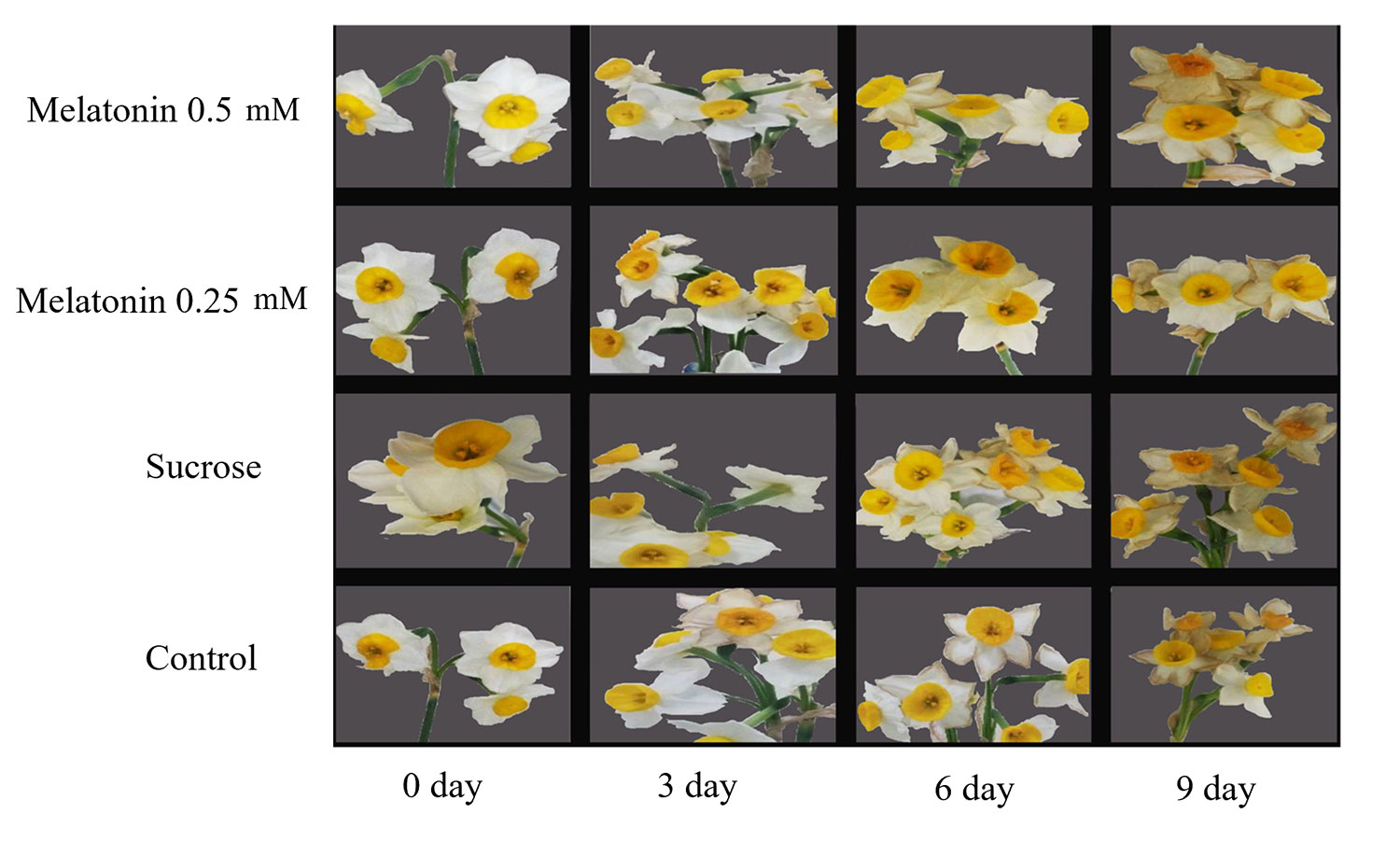
Petal browning is the primary limiting factor compromising the postharvest quality of narcissus (Narcissus tazetta L.) cut flowers. This study investigated the effects of melatonin (0.25 and 0.50 mM, each in 2% sucrose), compared with a control (distilled water) and sucrose alone (2%), on color stability, browning development, water status, membrane integrity, and browning-related enzyme activities of cut narcissus flowers during vase life. Melatonin treatment reduced the total color change ($\Delta E$) and delayed the progression of petal browning throughout the vase period. The lowest polyphenol oxidase (PPO) and peroxidase (POD) activities were observed in flowers treated with 0.25 mM melatonin. Furthermore, treatment with 0.25 mM melatonin resulted in higher relative fresh weight (RFW), relative water content (RWC), and membrane stability index (MSI) compared with untreated flowers. Principal component analysis (PCA) revealed that PC1, explaining 58% of the total variance, was positively correlated with quality parameters and negatively correlated with $\Delta E$ and browning, confirming the integrated protective role of melatonin. These findings demonstrate that melatonin treatment preserves the appearance quality of cut narcissus flowers by delaying senescence and the browning process, offering a promising and eco-friendly postharvest approach for maintaining the commercial value of cut flowers.
Graphical Abstract
Keywords
Data Availability Statement
Funding
Conflicts of Interest
AI Use Statement
Ethical Approval and Consent to Participate
References
- Gul, F., & Tahir, I. (2013). An effective protocol for improving vaselife and postharvest performance of cut Narcissus tazetta flowers. Journal of the Saudi Society of Agricultural Sciences, 12(1), 39-46.
[CrossRef] [Google Scholar] - Heidari Krush, G., & Rastegar, S. (2023). $\gamma$-Aminobutyric acid (GABA) inhibits the enzymatic browning of cut Narcissus tazetta cv. `Shahla-e-Shiraz' flowers during vase life. Journal of Plant Growth Regulation, 42(4), 2602-2612.
[CrossRef] [Google Scholar] - Shahabi, M., & Rastegar, S. (2023). Maintaining the postharvest quality and reducing the browning of Narcissus cv. 'Shahla-e-Shiraz' cut flowers using sodium nitroprusside. Journal of Horticultural Science, 36(4), 777–789.
[CrossRef] [Google Scholar] - Li, X., Lu, M., Tang, D., & Shi, Y. (2015). Composition of carotenoids and flavonoids in narcissus cultivars and their relationship with flower color. PLOS ONE, 10(11), e0142074.
[CrossRef] [Google Scholar] - Vehniwal, S. S., & Abbey, L. (2019). Cut flower vase life - influential factors, metabolism and organic formulation. Horticulture International Journal, 3(6), 275-281.
[CrossRef] [Google Scholar] - Gün, S., & Öztürk, B. (2020). Effects of salicylic acid and citric acid treatments on some parameters of Narcissus tazetta L. during vase life. Journal of Agricultural Faculty of Gaziosmanpaşa University, 37(3), 202-207.
[CrossRef] [Google Scholar] - Moon, K. M., Kwon, E. B., Lee, B., & Kim, C. Y. (2020). Recent trends in controlling the enzymatic browning of fruit and vegetable products. Molecules, 25(12), 2754.
[CrossRef] [Google Scholar] - Nath, P., Pandey, N., Samota, M., Sharma, K., Kale, S., Kannaujia, P., ... & Chauhan, O. P. (2022). Browning reactions in foods. In Advances in food chemistry: Food components, processing and preservation (pp. 117-159). Singapore: Springer Nature Singapore.
[CrossRef] [Google Scholar] - Moradinezhad, F., Bayat, H., & Dorostkar, M. (2023). Effects of active and passive modified atmosphere packaging on the vase life and quality of Narcissus (Narcissus tazetta L.)'Shahla'cut flowers. Journal of Horticultural Research, 31(2), 45-54.
[CrossRef] [Google Scholar] - Mazrou, R. M., Hassan, S., Yang, M., & Hassan, F. A. S. (2022). Melatonin preserves the postharvest quality of cut roses through enhancing the antioxidant system. Plants, 11(20), 2713.
[CrossRef] [Google Scholar] - Hosseini, N., Jabbarzadeh, Z., & Amiri, J. (2025). Eco-friendly extension of postharvest longevity in Alstroemeria cut flowers using melatonin and putrescine treatments. Heliyon, 11, e42343.
[CrossRef] [Google Scholar] - Lezoul, N. E. H., Serrano, M., Ruiz-Aracil, M. C., Belkadi, M., Castillo, S., Valero, D., & Guillén, F. (2022). Melatonin as a new postharvest treatment for increasing cut carnation (Dianthus caryophyllus L.) vase life. Postharvest Biology and Technology, 184, 111759.
[CrossRef] [Google Scholar] - Wang, Y., Liu, X., Sun, M., Zhu, W., Zheng, Y., Zhu, S., ... & Yu, X. (2024). Melatonin enhances vase life and alters physiological responses in peony (Paeonia lactiflora Pall.) cut flowers. Postharvest Biology and Technology, 212, 112896.
[CrossRef] [Google Scholar] - Ichimura, K., & Goto, R. (2000). Effect of gibberellin A$_3$ on leaf yellowing and vase life of cut Narcissus tazetta var. chinensis flowers. Journal of the Japanese Society for Horticultural Science, 69(4), 423-427.
[CrossRef] [Google Scholar] - Aghdam, M. S., Jannatizadeh, A., Nojadeh, M. S., & Ebrahimzadeh, A. (2019). Exogenous melatonin ameliorates chilling injury in cut anthurium flowers during low temperature storage. Postharvest Biology and Technology, 148, 184-191.
[CrossRef] [Google Scholar] - Pathare, P. B., Opara, U. L., & Al-Said, F. A. J. (2013). Colour measurement and analysis in fresh and processed foods: A review. Food and Bioprocess Technology, 6(1), 36-60.
[CrossRef] [Google Scholar] - Kar, M., & Mishra, D. (1976). Catalase, peroxidase, and polyphenoloxidase activities during rice leaf senescence. Plant Physiology, 57(2), 315-319.
[CrossRef] [Google Scholar] - Chance, B., & Maehly, A. C. (1955). Assay of catalases and peroxidases. Methods in Enzymology, 2, 764-775. http://dx.doi.org/10.1016/S0076-6879(55)02300-8
[Google Scholar] - Singh, A., Kumar, J., & Kumar, P. (2008). Effects of plant growth regulators and sucrose on post harvest physiology, membrane stability and vase life of cut spikes of gladiolus. Plant Growth Regulation, 55(3), 221-229.
[CrossRef] [Google Scholar] - He, S., Joyce, D. C., Irving, D. E., & Faragher, J. D. (2006). Stem end blockage in cut Grevillea `Crimson Yul-lo' inflorescences. Postharvest Biology and Technology, 41(1), 78-84.
[CrossRef] [Google Scholar] - Chakrabarty, D., Verma, A. K., & Datta, S. K. (2009). Oxidative stress and antioxidant activity as the basis of senescence in Hemerocallis (day lily) flowers. Journal of Horticulture and Forestry, 1(6), 113-119. https://academicjournals.org/article/article1379686997_Chakrabarty%20et%20al.pdf
[Google Scholar] - Verdonk, J. C., van Ieperen, W., Carvalho, D. R., van Geest, G., & Schouten, R. E. (2023). Effect of preharvest conditions on cut-flower quality. Frontiers in Plant Science, 14, 1281456.
[CrossRef] [Google Scholar] - Xie, J., Qin, Z., Pan, J., Li, J., Li, X., Khoo, H. E., & Dong, X. (2022). Melatonin treatment improves postharvest quality and regulates reactive oxygen species metabolism in "Feizixiao" litchi based on principal component analysis. Frontiers in Plant Science, 13, 965345.
[CrossRef] [Google Scholar] - Madebo, M. P., Zheng, Y., & Jin, P. (2022). Melatonin-mediated postharvest quality and antioxidant properties of fresh fruits: A comprehensive meta-analysis. Comprehensive Reviews in Food Science and Food Safety, 21(4), 3205-3226.
[CrossRef] [Google Scholar] - Hou, X., Liu, W., Zuo, W., Zhang, R., Zou, Q., Zhang, S., ... & Chen, X. (2022). Analysis of enzymes and phenolic metabolites which affecting the anti-browning property of 'Shannongsu'pear. LWT, 168, 113919.
[CrossRef] [Google Scholar] - Luo, T., Yin, F., Liao, L., Liu, Y., Guan, B., Wang, M., ... & Shuai, L. (2021). Postharvest melatonin treatment inhibited longan (Dimocarpus longan Lour.) pericarp browning by increasing ROS scavenging ability and protecting cytomembrane integrity. Food Science & Nutrition, 9(9), 4963-4973.
[CrossRef] [Google Scholar] - Marak, K. A., Mir, H., Siddiqui, M. W., Singh, P., Homa, F., & Alamri, S. (2024). Exogenous melatonin delays oxidative browning in litchi during cold storage by regulating biochemical attributes and gene expression. Frontiers in Plant Science, 15, 1402607.
[CrossRef] [Google Scholar] - Zhang, Y., Huber, D. J., Hu, M., Jiang, G., Gao, Z., Xu, X., ... & Zhang, Z. (2018). Delay of postharvest browning in litchi fruit by melatonin via the enhancing of antioxidative processes and oxidation repair. Journal of Agricultural and Food Chemistry, 66(28), 7475-7484.
[CrossRef] [Google Scholar] - da Costa, L. C., de Araujo, F. F., Ribeiro, W. S., de Sousa Santos, M. N., & Finger, F. L. (2021). Postharvest physiology of cut flowers. Ornamental Horticulture, 27(03), 374-385. https://www.sidalc.net/search/Record/oai:scielo:S2447-536X2021000300374/Description
[Google Scholar] - Lone, M. L., Ul Haq, A., Farooq, S., Parveen, S., Altaf, F., & Tahir, I. (2025). Flower senescence: A comprehensive update on hormonal regulation and molecular aspects of petal death. Postharvest Biology and Technology, 220, 113299.
[CrossRef] [Google Scholar] - Lone, H. Y., Aftab, M., Tantray, W. W., Wani, A. A., Zargar, M. A., & Tahir, I. (2025). Melatonin regulates oxidative stress to delay senescence in Hemerocallis fulva L. Ornamental Horticulture, 31, e312832.
[CrossRef] [Google Scholar] - Ehsanimehr, N., Hosseinifarahi, M., Abdipour, M., Eshghi, S., & Jamali, B. (2024). Improving postharvest quality and vase life of cut rose flowers by pre-harvest foliar co-applications of $\gamma$-aminobutyric acid and calcium chloride. Scientific Reports, 14(1), 14520.
[CrossRef] [Google Scholar] - Wang, B., Huang, A., Liu, L., Li, Y., Zhang, H., & Wang, L. (2024). Effects of an exogenous melatonin treatment on the physiological indexes and storage duration of cut chrysanthemum flowers. Horticultural Science and Technology, 42(5), 533-548.
[CrossRef] [Google Scholar] - Farooq, S., Lone, M. L., Ul Haq, A., Parveen, S., Altaf, F., & Tahir, I. (2024). Signalling cascades choreographing petal cell death: Implications for postharvest quality. Plant Molecular Biology, 114, 63.
[CrossRef] [Google Scholar] - Liu, Z., Luo, Y., & Liao, W. (2024). Postharvest physiology of fresh-cut flowers. In Oxygen, nitrogen and sulfur species in post-harvest physiology of horticultural crops (pp. 23-42). Academic Press.
[CrossRef] [Google Scholar] - Wei, J., Li, D. X., Zhang, J. R., Shan, C., Rengel, Z., Song, Z. B., & Chen, Q. (2018). Phytomelatonin receptor PMTR1-mediated signaling regulates stomatal closure in Arabidopsis thaliana. Journal of Pineal Research, 65(2), e12500.
[CrossRef] [Google Scholar] - Parveen, S., Altaf, F., Farooq, S., Lone, M. L., Ul Haq, A., & Tahir, I. (2023). The swansong of petal cell death: Insights into the mechanism and regulation of ethylene-mediated flower senescence. Journal of Experimental Botany, 74(14), 3961-3974.
[CrossRef] [Google Scholar] - Zhao, J., & Hu, J. (2023). Melatonin: Current status and future perspectives in horticultural plants. Frontiers in Plant Science, 14, 1140803.
[CrossRef] [Google Scholar] - Ali, M. A., Nasser, M. A., Abdelhamid, A. N., Ali, I. A., Saudy, H. S., & Hassan, K. M. (2024). Melatonin as a key factor for regulating and relieving abiotic stresses in harmony with phytohormones in horticultural plants—a review. Journal of Soil Science and Plant Nutrition, 24(1), 54-73.
[CrossRef] [Google Scholar]
Cite This Article
TY  - JOUR
AU  - Shahabi, Moazameh
AU  - Rastegar, Somayeh
PY  - 2026
DA  - 2026/10/14
TI  - Melatonin Mitigates Postharvest Enzymatic Browning and Preserves Quality in Cut Narcissus tazetta 'Shahla-e-Shiraz'
JO  - Plant Innovation Journal
T2  - Plant Innovation Journal
JF  - Plant Innovation Journal
VL  - 1
IS  - 2
SP  - 126
EP  - 137
DO  - 10.62762/PIJ.2026.660022
UR  - https://www.icck.org/article/abs/PIJ.2026.660022
KW  - browning
KW  - color change
KW  - cut flower
KW  - membrane stability
KW  - postharvest quality
AB  - Petal browning is the primary limiting factor compromising the postharvest quality of narcissus (Narcissus tazetta L.) cut flowers. This study investigated the effects of melatonin (0.25 and 0.50 mM, each in 2% sucrose), compared with a control (distilled water) and sucrose alone (2%), on color stability, browning development, water status, membrane integrity, and browning-related enzyme activities of cut narcissus flowers during vase life. Melatonin treatment reduced the total color change ($\Delta E$) and delayed the progression of petal browning throughout the vase period. The lowest polyphenol oxidase (PPO) and peroxidase (POD) activities were observed in flowers treated with 0.25 mM melatonin. Furthermore, treatment with 0.25 mM melatonin resulted in higher relative fresh weight (RFW), relative water content (RWC), and membrane stability index (MSI) compared with untreated flowers. Principal component analysis (PCA) revealed that PC1, explaining 58% of the total variance, was positively correlated with quality parameters and negatively correlated with $\Delta E$ and browning, confirming the integrated protective role of melatonin. These findings demonstrate that melatonin treatment preserves the appearance quality of cut narcissus flowers by delaying senescence and the browning process, offering a promising and eco-friendly postharvest approach for maintaining the commercial value of cut flowers.
SN  - 3142-7596
PB  - Institute of Central Computation and Knowledge
LA  - English
ER  -
@article{Shahabi2026Melatonin,
  author = {Moazameh Shahabi and Somayeh Rastegar},
  title = {Melatonin Mitigates Postharvest Enzymatic Browning and Preserves Quality in Cut Narcissus tazetta 'Shahla-e-Shiraz'},
  journal = {Plant Innovation Journal},
  year = {2026},
  volume = {1},
  number = {2},
  pages = {126-137},
  doi = {10.62762/PIJ.2026.660022},
  url = {https://www.icck.org/article/abs/PIJ.2026.660022},
  abstract = {Petal browning is the primary limiting factor compromising the postharvest quality of narcissus (Narcissus tazetta L.) cut flowers. This study investigated the effects of melatonin (0.25 and 0.50 mM, each in 2\% sucrose), compared with a control (distilled water) and sucrose alone (2\%), on color stability, browning development, water status, membrane integrity, and browning-related enzyme activities of cut narcissus flowers during vase life. Melatonin treatment reduced the total color change (\$\Delta E\$) and delayed the progression of petal browning throughout the vase period. The lowest polyphenol oxidase (PPO) and peroxidase (POD) activities were observed in flowers treated with 0.25 mM melatonin. Furthermore, treatment with 0.25 mM melatonin resulted in higher relative fresh weight (RFW), relative water content (RWC), and membrane stability index (MSI) compared with untreated flowers. Principal component analysis (PCA) revealed that PC1, explaining 58\% of the total variance, was positively correlated with quality parameters and negatively correlated with \$\Delta E\$ and browning, confirming the integrated protective role of melatonin. These findings demonstrate that melatonin treatment preserves the appearance quality of cut narcissus flowers by delaying senescence and the browning process, offering a promising and eco-friendly postharvest approach for maintaining the commercial value of cut flowers.},
  keywords = {browning, color change, cut flower, membrane stability, postharvest quality},
  issn = {3142-7596},
  publisher = {Institute of Central Computation and Knowledge}
}
Article Metrics
Publisher's Note
ICCK stays neutral with regard to jurisdictional claims in published maps and institutional affiliations.
Rights and Permissions
 Copyright © 2026 by the Author(s). Published by Institute of Central Computation and Knowledge. This article is an open access article distributed under the terms and conditions of the Creative Commons Attribution (CC BY) license (https://creativecommons.org/licenses/by/4.0/), which permits use, sharing, adaptation, distribution and reproduction in any medium or format, as long as you give appropriate credit to the original author(s) and the source, provide a link to the Creative Commons licence, and indicate if changes were made.