

A Multimodal Ensemble Learning Framework for Early Detection of Adolescent Depression Using Multi-Source Real-World Data





Article Information
Abstract
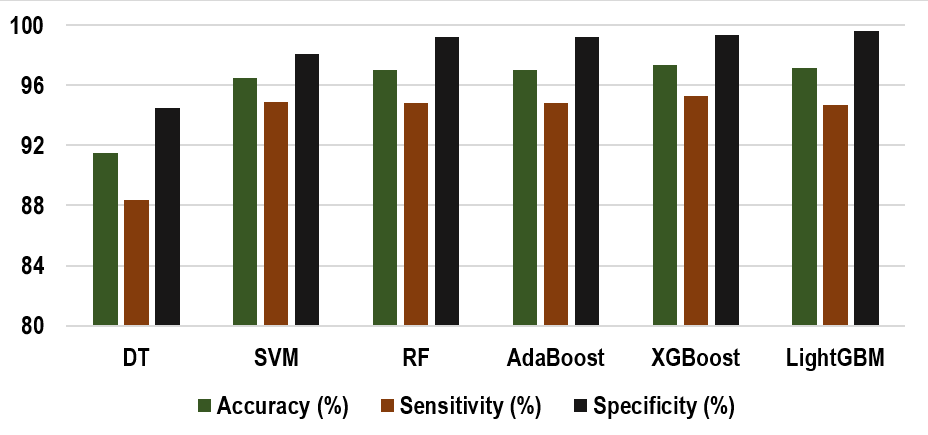
Depression and academic stress undermine students' attendance, performance, and retention, yet educational institutions lack reliable early-alert tools. Because about three-quarters of lifetime psychiatric conditions emerge before age 25, timely automated screening is critical for early intervention. This paper proposes a multi-source ensemble learning framework for distinguishing {\it depression} (DP) from {\it non-depression} (ND) using 1,547 harmonized samples drawn from six real-world sources: occupational surveys, student academic stress records, Twitter sentiment data, Reddit depression posts, fine-grained emotion corpora, and behavioural monitoring signals. Academic stress and behavioural records serve as the core educational sources, while the remaining sources broaden linguistic and affective coverage. Six {\it machine learning} (ML) classifiers were benchmarked under 10-fold cross-validation: {\it decision tree} (DT), {\it support vector machine} (SVM), {\it random forest} (RF), {\it adaptive boosting} (AdaBoost), {\it extreme gradient boosting} (XGBoost), and {\it light gradient boosting machine} (LightGBM). RF performed best, achieving 97.996% accuracy, the highest sensitivity (96.741%), only 6 false positives, and 25 missed DP cases. LightGBM recorded the highest specificity (99.615%), making it suitable for precision-oriented screening, whereas the boosting ensembles performed comparably to the linear SVM and all ensembles clearly outperformed the DT baseline. These findings support ensemble learning, particularly bagging, for heterogeneous, multi-source student mental health data and suggest practical value for counsellors and student support services in identifying at-risk students early.
Graphical Abstract
Keywords
Data Availability Statement
Funding
Conflicts of Interest
AI Use Statement
Ethical Approval and Consent to Participate
References
- Uhlhaas, P. J., Davey, C. G., Mehta, U. M., Shah, J., Torous, J., Allen, N. B., ... & Wood, S. J. (2023). Towards a youth mental health paradigm: a perspective and roadmap. Molecular psychiatry, 28(8), 3171-3181.
[CrossRef] [Google Scholar] - Kessler, R. C., Amminger, G. P., Aguilar-Gaxiola, S., Alonso, J., Lee, S., & Üstün, T. B. (2007). Age of onset of mental disorders: a review of recent literature. Current Opinion in Psychiatry, 20(4), 359-364.
[CrossRef] [Google Scholar] - McGorry, P. D., & Mei, C. (2018). Early intervention in youth mental health: progress and future directions. Evidence-Based Mental Health, 21(4), 182-184.
[CrossRef] [Google Scholar] - Treatment for Adolescents with Depression Study (TADS) Team. (2004). Fluoxetine, cognitive-behavioral therapy, and their combination for adolescents with depression: Treatment for Adolescents with Depression Study (TADS) randomized controlled trial. Jama, 292(7), 807-820.
[CrossRef] [Google Scholar] - Vyas, N. S., Birchwood, M., & Singh, S. P. (2015). Youth services: meeting the mental health needs of adolescents. Irish Journal of Psychological Medicine, 32(1), 13-19.
[CrossRef] [Google Scholar] - McGorry, P., Trethowan, J., & Rickwood, D. (2019). Creating headspace for integrated youth mental health care. World Psychiatry, 18(2), 140-141.
[CrossRef] [Google Scholar] - Yung, A. R., Yung, A. R., Pan Yuen, H., Mcgorry, P. D., Phillips, L. J., Kelly, D., ... & Buckby, J. (2005). Mapping the onset of psychosis: the comprehensive assessment of at-risk mental states. Australian & New Zealand Journal of Psychiatry, 39(11-12), 964-971.
[CrossRef] [Google Scholar] - Weisz, J. R., McCarty, C. A., & Valeri, S. M. (2006). Effects of psychotherapy for depression in children and adolescents: a meta-analysis. Psychological Bulletin, 132(1), 132-149.
[CrossRef] [Google Scholar] - Appleton, R., Barnett, P., Clarke, C., Yang, J., Begum, S., Edbrooke-Childs, J., ... & Johnson, S. (2025). Approaches to early intervention for common mental health problems in young people: a systematic review. BMC medicine, 23(1), 651.
[CrossRef] [Google Scholar] - Torous, J., Myrick, K. J., Rauseo-Ricupero, N., & Firth, J. (2020). Digital mental health and COVID-19: using technology today to accelerate the curve on access and quality tomorrow. JMIR mental health, 7(3), e18848.
[CrossRef] [Google Scholar] - Domhardt, M., Steubl, L., & Baumeister, H. (2018). Internet-and mobile-based interventions for mental and somatic conditions in children and adolescents. Zeitschrift für Kinder-und Jugendpsychiatrie und Psychotherapie, 48(1), 33-46.
[CrossRef] [Google Scholar] - Ho, T. Q. A., Le, L. K.-D., Engel, L., Le, N., Melvin, G., Le, H. N. D., & Mihalopoulos, C. (2025). Barriers to and facilitators of user engagement with web-based mental health interventions in young people: a systematic review. European Child & Adolescent Psychiatry, 34(1), 83-100.
[CrossRef] [Google Scholar] - Nesi, J. (2020). The impact of social media on youth mental health: challenges and opportunities. North Carolina Medical Journal, 81(2), 116-121.
[CrossRef] [Google Scholar] - Power, E., Hughes, S., Cotter, D., & Cannon, M. (2020). Youth mental health in the time of COVID-19. Irish Journal of Psychological Medicine, 37(4), 301-305.
[CrossRef] [Google Scholar] - Carlbring, P., Andersson, G., Cuijpers, P., Riper, H., & Hedman-Lagerl\"{of, E. (2018). Internet-based vs. face-to-face cognitive behavior therapy for psychiatric and somatic disorders: an updated systematic review and meta-analysis. Cognitive Behaviour Therapy, 47(1), 1-18.
[CrossRef] [Google Scholar] - McGorry, P. D., Mei, C., Chanen, A., Hodges, C., Alvarez-Jimenez, M., & Killackey, E. (2022). Designing and scaling up integrated youth mental health care. World Psychiatry, 21(1), 61-76.
[CrossRef] [Google Scholar] - Marshall, N. J., Loades, M. E., Jacobs, C., Biddle, L., & Lambert, J. D. (2025). Integrating artificial intelligence in youth mental health care: Advances, challenges, and future directions. Current Treatment Options in Psychiatry, 12(1), 11.
[CrossRef] [Google Scholar] - Mlakar, I., Šafran, V., Plohl, N., Kumperščak, H. G., Močnik, S., Smogavc, Ž., & Smrke, U. (2026). Technology-mediated screening interviews for youth mental health: content validation, randomized controlled trial, and expert evaluation. PLOS Digital Health, 5(4), e0001069.
[CrossRef] [Google Scholar] - Squires, M., Tao, X., Elangovan, S., Gururajan, R., Zhou, X., Acharya, U. R., & Li, Y. (2023). Deep learning and machine learning in psychiatry: a survey of current progress in depression detection, diagnosis and treatment. Brain Informatics, 10(1), 10.
[CrossRef] [Google Scholar] - Agarwal, N., Dias, G., & Dollfus, S. (2024). Multi-view graph-based interview representation to improve depression level estimation. Brain Informatics, 11(1), 14.
[CrossRef] [Google Scholar] - Sharma, G., Yaffe, M. J., Ghadiri, P., Gandhi, R., Pinkham, L., Gore, G., & Abbasgholizadeh-Rahimi, S. (2025). Use of artificial intelligence in adolescents' mental health care: systematic scoping review of current applications and future directions. JMIR Mental Health, 12, e70438.
[CrossRef] [Google Scholar] - Zhou, Q., Chen, Z. H., Cao, Y. H., & Peng, S. (2021). Clinical impact and quality of randomized controlled trials involving interventions evaluating artificial intelligence prediction tools: a systematic review. NPJ digital medicine, 4(1), 154.
[CrossRef] [Google Scholar] - Chang, J. P. C., Cheng, S. W., Chang, S. M. J., & Su, K. P. (2025). Navigating the digital maze: a review of AI bias, social media, and mental health in Generation Z. AI, 6(6), 118.
[CrossRef] [Google Scholar] - Koutsouleris, N., Hauser, T. U., Skvortsova, V., & De Choudhury, M. (2022). From promise to practice: towards the realisation of AI-informed mental health care. The Lancet Digital Health, 4(11), e829-e840.
[CrossRef] [Google Scholar] - Arias, D., Saxena, S., & Verguet, S. (2022). Quantifying the global burden of mental disorders and their economic value. eClinicalMedicine, 54, 101675.
[CrossRef] [Google Scholar] - Maughan, B., Collishaw, S., & Stringaris, A. (2013). Depression in childhood and adolescence. Journal of the Canadian Academy of Child and Adolescent Psychiatry, 22(1), 35-40. https://kclpure.kcl.ac.uk/portal/en/publications/depression-in-childhood-and-adolescence
[Google Scholar] - Torous, J., & Blease, C. (2024). Generative artificial intelligence in mental health care: potential benefits and current challenges. World Psychiatry, 23(1), 1-2.
[CrossRef] [Google Scholar] - Fitzpatrick, K. K., Darcy, A., & Vierhile, M. (2017). Delivering cognitive behavior therapy to young adults with symptoms of depression and anxiety using a fully automated conversational agent (Woebot): a randomized controlled trial. JMIR mental health, 4(2), e19.
[CrossRef] [Google Scholar] - Gopalakrishnan, A., Gururajan, R., Venkataraman, R., Zhou, X., Ching, K. C., Saravanan, A., & Sen, M. (2023). Attribute selection hybrid network model for risk factors analysis of postpartum depression using social media. Brain Informatics, 10(1), 28.
[CrossRef] [Google Scholar] - Moor, S., Williman, J., Drummond, S., Fulton, C., Mayes, W., Ward, N., ... & Stasiak, K. (2019). 'E'therapy in the community: Examination of the uptake and effectiveness of BRAVE (a self-help computer programme for anxiety in children and adolescents) in primary care. Internet Interventions, 18, 100249.
[CrossRef] [Google Scholar] - Gohari, M. R., Doggett, A., Patte, K. A., Ferro, M. A., Dubin, J. A., Hilario, C., & Leatherdale, S. T. (2024). Using random forest to identify correlates of depression symptoms among adolescents. Social psychiatry and psychiatric epidemiology, 59(11), 2063-2071.
[CrossRef] [Google Scholar] - Mullick, T., Radovic, A., Shaaban, S., & Doryab, A. (2022). Predicting depression in adolescents using mobile and wearable sensors: multimodal machine learning–based exploratory study. JMIR Formative Research, 6(6), e35807.
[CrossRef] [Google Scholar] - Ebert, D. D., Van Daele, T., Nordgreen, T., Karekla, M., Compare, A., Zarbo, C., ... & Baumeister, H. (2018). Internet-and mobile-based psychological interventions: applications, efficacy, and potential for improving mental health. European Psychologist, 23(2), 167-187.
[CrossRef] [Google Scholar] - Grist, R., Croker, A., Denne, M., & Stallard, P. (2019). Technology delivered interventions for depression and anxiety in children and adolescents: a systematic review and meta-analysis. Clinical child and family psychology review, 22(2), 147-171.
[CrossRef] [Google Scholar] - Garrido, S., Millington, C., Cheers, D., Boydell, K., Schubert, E., Meade, T., & Nguyen, Q. V. (2019). What works and what doesn't work? A systematic review of digital mental health interventions for depression and anxiety in young people. Frontiers in Psychiatry, 10, 759.
[CrossRef] [Google Scholar] - Steinberg, L. (2008). A social neuroscience perspective on adolescent risk-taking. Developmental Review, 28(1), 78-106.
[CrossRef] [Google Scholar] - Barker, E. T., Howard, A. L., Villemaire-Krajden, R., & Galambos, N. L. (2018). The rise and fall of depressive symptoms and academic stress in two samples of university students. Journal of Youth and Adolescence, 47(6), 1252-1266.
[CrossRef] [Google Scholar] - Bhujade, V. M. (2017). Depression, anxiety and academic stress among college students: A brief review. Indian Journal of Health and Wellbeing, 8(7), 748-751. https://www.proquest.com/openview/62b3afd412639d502f219859b188a281/1?pq-origsite=gscholar&cbl=2032134
[Google Scholar] - Veal, C., Tomlinson, A., Cipriani, A., Bulteau, S., Henry, C., Müh, C., ... & Chevance, A. (2024). Heterogeneity of outcome measures in depression trials and the relevance of the content of outcome measures to patients: a systematic review. The Lancet Psychiatry, 11(4), 285-294.
[CrossRef] [Google Scholar] - Andargeery, S. Y. (2024). The perception and association between depression and academic stress among female undergraduate nursing students: a cross-sectional study. Frontiers in Public Health, 12, 1414469.
[CrossRef] [Google Scholar] - Peverill, M., Dirks, M. A., Narvaja, T., Herts, K. L., Comer, J. S., & McLaughlin, K. A. (2021). Socioeconomic status and child psychopathology in the United States: A meta-analysis of population-based studies. Clinical psychology review, 83, 101933.
[CrossRef] [Google Scholar] - Kemp, J., Chorney, J., Kassam, I., MacDonald, J., MacDonald, T., Wozney, L., & Strudwick, G. (2021). Learning about the current state of digital mental health interventions for Canadian youth to inform future decision-making: mixed methods study. Journal of Medical Internet Research, 23(10), e30491.
[CrossRef] [Google Scholar] - Zhai, Y., Zhang, Y., Chu, Z., Geng, B., Almaawali, M., Fulmer, R., ... & Du, X. (2025). Machine learning predictive models to guide prevention and intervention allocation for anxiety and depressive disorders among college students. Journal of Counseling & Development, 103(1), 110-125.
[CrossRef] [Google Scholar] - Graham, A. K., Lattie, E. G., Powell, B. J., Lyon, A. R., Smith, J. D., Schueller, S. M., ... & Mohr, D. C. (2020). Implementation strategies for digital mental health interventions in health care settings. American Psychologist, 75(8), 1080.
[CrossRef] [Google Scholar] - Langley, A. K., Nadeem, E., Kataoka, S. H., Stein, B. D., & Jaycox, L. H. (2010). Evidence-based mental health programs in schools: Barriers and facilitators of successful implementation. School Mental Health, 2(3), 105-113.
[CrossRef] [Google Scholar] - Rojas-Andrade, R., & Bahamondes, L. L. (2019). Is implementation fidelity important? A systematic review on school-based mental health programs. Contemporary School Psychology, 23(4), 339-350.
[CrossRef] [Google Scholar] - Zhang, Y., Larson, M., Ehrhart, M. G., King, K., Locke, J., Cook, C. R., & Lyon, A. R. (2024). Inter-organizational alignment and implementation outcomes in integrated mental healthcare for children and adolescents: a cross-sectional observational study. Implementation Science, 19(1), 36.
[CrossRef] [Google Scholar] - Shalaby, R. A. H., & Agyapong, V. I. (2020). Peer support in mental health: literature review. JMIR mental health, 7(6), e15572.
[CrossRef] [Google Scholar] - Kelly, C. J., Karthikesalingam, A., Suleyman, M., Corrado, G., & King, D. (2019). Key challenges for delivering clinical impact with artificial intelligence. BMC Medicine, 17(1), 195.
[CrossRef] [Google Scholar] - Powell, A. C., Bowman, M. B., & Harbin, H. T. (2019). Reimbursement of apps for mental health: findings from interviews. JMIR mental health, 6(8), e14724.
[CrossRef] [Google Scholar] - Zhao, X., Stadnick, N. A., Ceballos-Corro, E., Castro Jr, J., Mallard-Swanson, K., Palomares, K. J., ... & Sorkin, D. H. (2023). Facilitators of and barriers to integrating digital mental health into county mental health services: qualitative interview analyses. JMIR Formative Research, 7, e45718.
[CrossRef] [Google Scholar] - Quinlan, J. R. (1986). Induction of decision trees. Machine Learning, 1(1), 81-106.
[CrossRef] [Google Scholar] - Cortes, C., & Vapnik, V. (1995). Support-vector networks. Machine learning, 20(3), 273-297.
[CrossRef] [Google Scholar] - Breiman, L. (2001). Random forests. Machine Learning, 45(1), 5-32.
[CrossRef] [Google Scholar] - Freund, Y., & Schapire, R. E. (1997). A decision-theoretic generalization of on-line learning and an application to boosting. Journal of computer and system sciences, 55(1), 119-139.
[CrossRef] [Google Scholar] - Ke, G., Meng, Q., Finley, T., Wang, T., Chen, W., Ma, W., Ye, Q., & Liu, T.-Y. (2017). LightGBM: A highly efficient gradient boosting decision tree. Advances in Neural Information Processing Systems, 30, 3146-3154.
[Google Scholar] - Chen, T., & Guestrin, C. (2016). XGBoost: A scalable tree boosting system. In Proceedings of the 22nd ACM SIGKDD International Conference on Knowledge Discovery and Data Mining (pp. 785-794).
[CrossRef] [Google Scholar] - Kaman, P. D. A., Devine, P. D. J., Erhart, P. D. M., Napp, M. S. A. K., Reiss, P. D. F., Moeller, S., ... & Ravens-Sieberer, P. D. U. (2025). Youth mental health in times of global crises: evidence from the German longitudinal COVID-19 and psychological health study. Journal of Adolescent Health, 77(6), 1050-1057.
[CrossRef] [Google Scholar] - Vestergaard, C. L., Skogen, J. C., Hysing, M., Harvey, A. G., Vedaa, Ø., & Sivertsen, B. (2024). Sleep duration and mental health in young adults. Sleep Medicine, 115, 30-38.
[CrossRef] [Google Scholar] - Kar, B., & Sarkar, B. K. (2024). Changes in mental health of Indian students due to online classes during COVID-19 pandemic. Procedia Computer Science, 235, 2452-2465.
[CrossRef] [Google Scholar] - Rasheed, F., Khan, S., Waqas, S. M., Khan, R. A., & Arif, S. (2024). Survey dataset on mental health in tech professionals from open sourcing mental health surveys (2017-2021). Data in Brief, 54, 110377.
[CrossRef] [Google Scholar]
Cite This Article
TY  - JOUR
AU  - Bhukya, Ramesh K.
AU  - Singh, Nirbhay
AU  - Tiwari, Aniket
PY  - 2026
DA  - 2026/10/01
TI  - A Multimodal Ensemble Learning Framework for Early Detection of Adolescent Depression Using Multi-Source Real-World Data
JO  - ICCK Transactions on Educational Data Mining
T2  - ICCK Transactions on Educational Data Mining
JF  - ICCK Transactions on Educational Data Mining
VL  - 2
IS  - 2
SP  - 63
EP  - 84
DO  - 10.62762/TEDM.2026.244050
UR  - https://www.icck.org/article/abs/TEDM.2026.244050
KW  - educational data mining
KW  - student depression
KW  - academic stress
KW  - student well-being
KW  - learning analytics
KW  - early warning systems
AB  - Depression and academic stress undermine students' attendance, performance, and retention, yet educational institutions lack reliable early-alert tools. Because about three-quarters of lifetime psychiatric conditions emerge before age 25, timely automated screening is critical for early intervention. This paper proposes a multi-source ensemble learning framework for distinguishing {\it depression} (DP) from {\it non-depression} (ND) using 1,547 harmonized samples drawn from six real-world sources: occupational surveys, student academic stress records, Twitter sentiment data, Reddit depression posts, fine-grained emotion corpora, and behavioural monitoring signals. Academic stress and behavioural records serve as the core educational sources, while the remaining sources broaden linguistic and affective coverage. Six {\it machine learning} (ML) classifiers were benchmarked under 10-fold cross-validation: {\it decision tree} (DT), {\it support vector machine} (SVM), {\it random forest} (RF), {\it adaptive boosting} (AdaBoost), {\it extreme gradient boosting} (XGBoost), and {\it light gradient boosting machine} (LightGBM). RF performed best, achieving 97.996% accuracy, the highest sensitivity (96.741%), only 6 false positives, and 25 missed DP cases. LightGBM recorded the highest specificity (99.615%), making it suitable for precision-oriented screening, whereas the boosting ensembles performed comparably to the linear SVM and all ensembles clearly outperformed the DT baseline. These findings support ensemble learning, particularly bagging, for heterogeneous, multi-source student mental health data and suggest practical value for counsellors and student support services in identifying at-risk students early.
SN  - 3070-5843
PB  - Institute of Central Computation and Knowledge
LA  - English
ER  -
@article{Bhukya2026A,
  author = {Ramesh K. Bhukya and Nirbhay Singh and Aniket Tiwari},
  title = {A Multimodal Ensemble Learning Framework for Early Detection of Adolescent Depression Using Multi-Source Real-World Data},
  journal = {ICCK Transactions on Educational Data Mining},
  year = {2026},
  volume = {2},
  number = {2},
  pages = {63-84},
  doi = {10.62762/TEDM.2026.244050},
  url = {https://www.icck.org/article/abs/TEDM.2026.244050},
  abstract = {Depression and academic stress undermine students' attendance, performance, and retention, yet educational institutions lack reliable early-alert tools. Because about three-quarters of lifetime psychiatric conditions emerge before age 25, timely automated screening is critical for early intervention. This paper proposes a multi-source ensemble learning framework for distinguishing {\it depression} (DP) from {\it non-depression} (ND) using 1,547 harmonized samples drawn from six real-world sources: occupational surveys, student academic stress records, Twitter sentiment data, Reddit depression posts, fine-grained emotion corpora, and behavioural monitoring signals. Academic stress and behavioural records serve as the core educational sources, while the remaining sources broaden linguistic and affective coverage. Six {\it machine learning} (ML) classifiers were benchmarked under 10-fold cross-validation: {\it decision tree} (DT), {\it support vector machine} (SVM), {\it random forest} (RF), {\it adaptive boosting} (AdaBoost), {\it extreme gradient boosting} (XGBoost), and {\it light gradient boosting machine} (LightGBM). RF performed best, achieving 97.996\% accuracy, the highest sensitivity (96.741\%), only 6 false positives, and 25 missed DP cases. LightGBM recorded the highest specificity (99.615\%), making it suitable for precision-oriented screening, whereas the boosting ensembles performed comparably to the linear SVM and all ensembles clearly outperformed the DT baseline. These findings support ensemble learning, particularly bagging, for heterogeneous, multi-source student mental health data and suggest practical value for counsellors and student support services in identifying at-risk students early.},
  keywords = {educational data mining, student depression, academic stress, student well-being, learning analytics, early warning systems},
  issn = {3070-5843},
  publisher = {Institute of Central Computation and Knowledge}
}
Article Metrics
Publisher's Note
ICCK stays neutral with regard to jurisdictional claims in published maps and institutional affiliations.
Rights and Permissions


Portico
