

A Review of Recent Advances in Academic Performance Prediction within Educational Data Mining



Article Information
Abstract
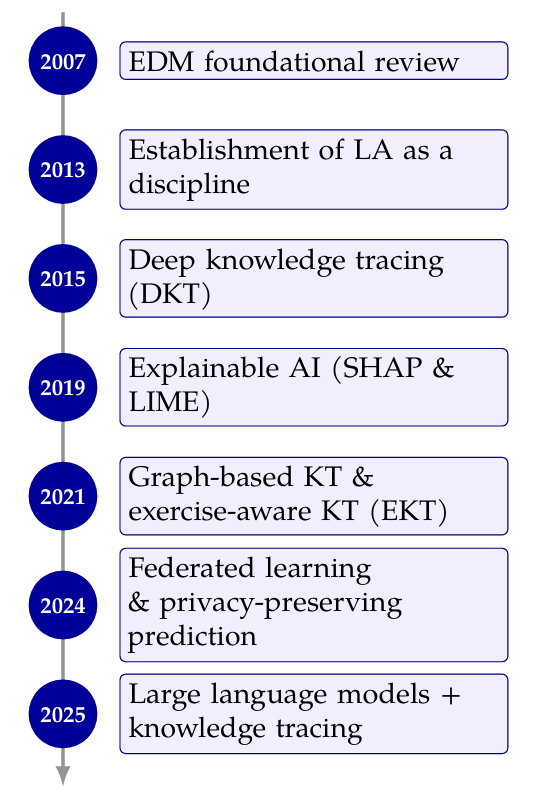
With the rapid advancement of artificial intelligence and smart education, academic performance prediction has emerged as a critical research direction within educational data mining. This paper provides a systematic review of recent progress in this field, focusing on technological evolution, application scenarios, model adaptation, emerging trends, and persistent challenges. The development of prediction technologies has progressed through three stages: statistical methods, machine learning, and deep learning. These approaches have been widely applied to grade prediction, academic risk and dropout prediction, knowledge tracing, and personalized learning recommendation. Different models vary significantly in their data scale requirements, interpretability, and suitability for specific tasks. Current research is shifting toward interpretability, multimodal data fusion, privacy preservation, and lightweight deployment. Despite these advances, challenges remain, including data imbalance, cold-start problems, and limited model interpretability. To better support precision teaching and personalized education, future research should prioritize interpretability, actionability, and deployability.
Graphical Abstract
Keywords
Data Availability Statement
Funding
Conflicts of Interest
AI Use Statement
Ethical Approval and Consent to Participate
References
- Baker, R. S., & Inventado, P. S. (2016). Educational data mining and learning analytics: Potentials and possibilities for online education. \emph{Emergence and innovation in digital learning: Foundations and applications (pp. 83-98). Athabasca University Press.
[CrossRef] [Google Scholar] - Abu Saa, A., Al-Emran, M., & Shaalan, K. (2019). Factors affecting students' performance in higher education: A systematic review of predictive data mining techniques. \emph{Technology, Knowledge and Learning, 24(4), 567-598.
[CrossRef] [Google Scholar] - Wang, W., Guo, L., He, L., & Wu, Y. J. (2019). Effects of social-interactive engagement on the dropout ratio in online learning: Insights from MOOC. \emph{Behaviour & Information Technology, 38(6), 621-636.
[CrossRef] [Google Scholar] - Sarker, S., Paul, M. K., Thasin, S. T. H., & Hasan, M. A. M. (2024). Analyzing students' academic performance using educational data mining. \emph{Computers and Education: Artificial Intelligence, 7, 100263.
[CrossRef] [Google Scholar] - Romero, C., & Ventura, S. (2020). Educational data mining and learning analytics: An updated survey. Wiley interdisciplinary reviews: Data mining and knowledge discovery, 10(3), e1355.
[CrossRef] [Google Scholar] - Galiatsatos, D., & Galiatsatou, P. (2026). Leveraging feature selection and ensemble learning to predict secondary school achievement: A comparative study of three grade granularities. \emph{Information, 17(6), 517.
[CrossRef] [Google Scholar] - Baker, R. S., & Siemens, G. (2022). Learning analytics and educational data mining. In R. K. Sawyer (Ed.), \emph{The Cambridge handbook of the learning sciences (3rd ed., pp. 259-278). Cambridge University Press.
[CrossRef] [Google Scholar] - Ameri, S., Fard, M. J., Chinnam, R. B., & Reddy, C. K. (2016, October). Survival analysis based framework for early prediction of student dropouts. In Proceedings of the 25th ACM international on conference on information and knowledge management (pp. 903-912).
[CrossRef] [Google Scholar] - Weidlich, J., Gašević, D., & Drachsler, H. (2022). Causal inference and bias in learning analytics: A primer on pitfalls using directed acyclic graphs. Journal of Learning Analytics, 9(3), 183-199.
[CrossRef] [Google Scholar] - Rudin, C. (2019). Stop explaining black box machine learning models for high stakes decisions and use interpretable models instead. \emph{Nature Machine Intelligence, 1(5), 206-215.
[CrossRef] [Google Scholar] - Lundberg, S. M., & Lee, S. I. (2017). A unified approach to interpreting model predictions. Advances in neural information processing systems, 30.
[Google Scholar] - Ribeiro, M. T., Singh, S., & Guestrin, C. (2016, August). `` Why should i trust you?'' Explaining the predictions of any classifier. In Proceedings of the 22nd ACM SIGKDD international conference on knowledge discovery and data mining (pp. 1135-1144).
[CrossRef] [Google Scholar] - Ren, Y., & Yu, X. (2024). Long-term student performance prediction using learning ability self-adaptive algorithm. Complex & Intelligent Systems, 10(5), 6379-6408.
[CrossRef] [Google Scholar] - Esin, R. V., & Kustitskaya, T. A. (2026). Two-level monitoring system for preventing academic failure, based on predictive models and SHAP analysis. \emph{Education Sciences, 16(6), 842.
[CrossRef] [Google Scholar] - Lau, W. J., & Abdul Rahman, H. (2026). Predicting academic performance through machine learning: integrating demographic, psychological, and behavioral predictors using explainable AI. Asia Pacific Education Review, 1-18.
[CrossRef] [Google Scholar] - Thammasiri, D., Delen, D., Meesad, P., & Kasap, N. (2014). A critical assessment of imbalanced class distribution problem: The case of predicting freshmen student attrition. Expert Systems with Applications, 41(2), 321-330.
[CrossRef] [Google Scholar] - Yang, M., Li, Z., & Liu, S. (2026). A machine learning based framework for predictive school management using student and faculty analytics. \emph{Scientific Reports, 16, 16224.
[CrossRef] [Google Scholar] - Lakshmi, S., & Maheswaran, C. P. (2024). Effective deep learning based grade prediction system using gated recurrent unit (GRU) with feature optimization using analysis of variance (ANOVA). Automatika, 65(2), 425-440.
[CrossRef] [Google Scholar] - Li, X., Zhu, X., Zhu, X., Ji, Y., & Tang, X. (2020, May). Student academic performance prediction using deep multi-source behavior sequential network. In Pacific-Asia Conference on Knowledge Discovery and Data Mining (pp. 567-579). Cham: Springer International Publishing.
[CrossRef] [Google Scholar] - Zhang, X., Zhang, Y., Chen, A. L., Yu, M., & Zhang, L. (2025). Optimizing multi label student performance prediction with GNN-TINet: A contextual multidimensional deep learning framework. PloS one, 20(1), e0314823.
[CrossRef] [Google Scholar] - Li, M., Wang, X., Wang, Y., Chen, Y., & Chen, Y. (2022). Study-GNN: a novel pipeline for student performance prediction based on multi-topology graph neural networks. Sustainability, 14(13), 7965.
[CrossRef] [Google Scholar] - Nakagawa, H., Iwasawa, Y., & Matsuo, Y. (2019, October). Graph-based knowledge tracing: modeling student proficiency using graph neural network. In IEEE/WIC/aCM international conference on web intelligence (pp. 156-163).
[CrossRef] [Google Scholar] - El Aouifi, H., El Hajji, M., Es-Saady, Y., & Douzi, H. (2021). Predicting learner's performance through video sequences viewing behavior analysis using educational data-mining. Education and Information Technologies, 26(5), 5799-5814.
[CrossRef] [Google Scholar] - Yang, L., Sun, X., Li, H., Xu, R., & Wei, X. (2025). Difficulty aware programming knowledge tracing via large language models. Scientific Reports, 15(1), 11475.
[CrossRef] [Google Scholar] - Bouallegue, S., Omri, A., & Al-Naemi, S. (2026). Machine learning approaches for early student performance prediction in programming education. Information, 17(1), 60.
[CrossRef] [Google Scholar] - Somova, M. V., Vainshtein, Y. V., Noskov, M. V., & Vonog, V. V. (2026). Scenarios of Pedagogical Support to Promote Subject Learning Success Among University Students Based on Academic Risk Analysis. Education Sciences, 16(6), 882.
[CrossRef] [Google Scholar] - Pan, F., Zhang, H., Li, X., Zhang, M., & Ji, Y. (2024). Achieving optimal trade-off for student dropout prediction with multi-objective reinforcement learning. PeerJ Computer Science, 10, e2034.
[CrossRef] [Google Scholar] - Kuzilek, J., Hlosta, M., & Zdrahal, Z. (2017). Open university learning analytics dataset. Scientific data, 4(1), 170171.
[CrossRef] [Google Scholar] - Waheed, H., Hassan, S. U., Aljohani, N. R., Hardman, J., Alelyani, S., & Nawaz, R. (2020). Predicting academic performance of students from VLE big data using deep learning models. Computers in Human behavior, 104, 106189.
[CrossRef] [Google Scholar] - Al-azazi, F. A., & Ghurab, M. (2023). ANN-LSTM: A deep learning model for early student performance prediction in MOOC. \emph{Heliyon, 9(4), e15382.
[CrossRef] [Google Scholar] - Farooq, U., Naseem, S., Mahmood, T., Li, J., Rehman, A., Saba, T., & Mustafa, L. (2024). Transforming educational insights: strategic integration of federated learning for enhanced prediction of student learning outcomes. The Journal of Supercomputing, 80(11), 16334-16367.
[CrossRef] [Google Scholar] - Zhang, Y., Li, Y., Wang, Y., Wei, S., Xu, Y., & Shang, X. (2024). Federated learning-outcome prediction with multi-layer privacy protection. Frontiers of Computer Science, 18(6), 186604.
[CrossRef] [Google Scholar] - Chen, S., & Qi, X. (2025). Entropy-adaptive differential privacy federated learning for student performance prediction and privacy protection: A case study in Python programming. \emph{Frontiers in Artificial Intelligence, 8, 1653437.
[CrossRef] [Google Scholar] - Fachola, C., Tornaría, A., Bermolen, P., Capdehourat, G., Etcheverry, L., & Fariello, M. I. (2023). Federated learning for data analytics in education. Data, 8(2), 43.
[CrossRef] [Google Scholar] - Corbett, A. T., & Anderson, J. R. (1994). Knowledge tracing: Modeling the acquisition of procedural knowledge. User modeling and user-adapted interaction, 4(4), 253-278.
[CrossRef] [Google Scholar] - Piech, C., Bassen, J., Huang, J., Ganguli, S., Sahami, M., Guibas, L. J., & Sohl-Dickstein, J. (2015). Deep knowledge tracing. In \emph{Advances in Neural Information Processing Systems 28 (pp. 505-513).
[Google Scholar] - Liu, Q., Huang, Z., Yin, Y., Chen, E., Xiong, H., Su, Y., & Hu, G. (2021). EKT: Exercise-aware knowledge tracing for student performance prediction. \emph{IEEE Transactions on Knowledge and Data Engineering, 33(1), 100-115.
[CrossRef] [Google Scholar] - Nabizadeh, A. H., Leal, J. P., Rafsanjani, H. N., & Shah, R. R. (2020). Learning path personalization and recommendation methods: A survey of the state-of-the-art. \emph{Expert Systems with Applications, 159, 113596.
[CrossRef] [Google Scholar] - Romero, C., & Ventura, S. (2007). Educational data mining: A survey from 1995 to 2005. \emph{Expert Systems with Applications, 33(1), 135-146.
[CrossRef] [Google Scholar] - Siemens, G. (2013). Learning analytics: The emergence of a discipline. American behavioral scientist, 57(10), 1380-1400.
[CrossRef] [Google Scholar] - Glandorf, D., Lee, H. R., Orona, G. A., Pumptow, M., Yu, R., & Fischer, C. (2024, March). Temporal and between-group variability in college dropout prediction. In Proceedings of the 14th Learning Analytics and Knowledge Conference (pp. 486-497).
[CrossRef] [Google Scholar]
Cite This Article
TY  - JOUR
AU  - Zhu, Xiaowen
PY  - 2026
DA  - 2026/09/28
TI  - A Review of Recent Advances in Academic Performance Prediction within Educational Data Mining
JO  - ICCK Transactions on Educational Data Mining
T2  - ICCK Transactions on Educational Data Mining
JF  - ICCK Transactions on Educational Data Mining
VL  - 2
IS  - 2
SP  - 56
EP  - 62
DO  - 10.62762/TEDM.2026.918140
UR  - https://www.icck.org/article/abs/TEDM.2026.918140
KW  - educational data mining
KW  - academic performance prediction
KW  - machine learning
KW  - deep learning
KW  - model adaptation
AB  - With the rapid advancement of artificial intelligence and smart education, academic performance prediction has emerged as a critical research direction within educational data mining. This paper provides a systematic review of recent progress in this field, focusing on technological evolution, application scenarios, model adaptation, emerging trends, and persistent challenges. The development of prediction technologies has progressed through three stages: statistical methods, machine learning, and deep learning. These approaches have been widely applied to grade prediction, academic risk and dropout prediction, knowledge tracing, and personalized learning recommendation. Different models vary significantly in their data scale requirements, interpretability, and suitability for specific tasks. Current research is shifting toward interpretability, multimodal data fusion, privacy preservation, and lightweight deployment. Despite these advances, challenges remain, including data imbalance, cold-start problems, and limited model interpretability. To better support precision teaching and personalized education, future research should prioritize interpretability, actionability, and deployability.
SN  - 3070-5843
PB  - Institute of Central Computation and Knowledge
LA  - English
ER  -
@article{Zhu2026A,
  author = {Xiaowen Zhu},
  title = {A Review of Recent Advances in Academic Performance Prediction within Educational Data Mining},
  journal = {ICCK Transactions on Educational Data Mining},
  year = {2026},
  volume = {2},
  number = {2},
  pages = {56-62},
  doi = {10.62762/TEDM.2026.918140},
  url = {https://www.icck.org/article/abs/TEDM.2026.918140},
  abstract = {With the rapid advancement of artificial intelligence and smart education, academic performance prediction has emerged as a critical research direction within educational data mining. This paper provides a systematic review of recent progress in this field, focusing on technological evolution, application scenarios, model adaptation, emerging trends, and persistent challenges. The development of prediction technologies has progressed through three stages: statistical methods, machine learning, and deep learning. These approaches have been widely applied to grade prediction, academic risk and dropout prediction, knowledge tracing, and personalized learning recommendation. Different models vary significantly in their data scale requirements, interpretability, and suitability for specific tasks. Current research is shifting toward interpretability, multimodal data fusion, privacy preservation, and lightweight deployment. Despite these advances, challenges remain, including data imbalance, cold-start problems, and limited model interpretability. To better support precision teaching and personalized education, future research should prioritize interpretability, actionability, and deployability.},
  keywords = {educational data mining, academic performance prediction, machine learning, deep learning, model adaptation},
  issn = {3070-5843},
  publisher = {Institute of Central Computation and Knowledge}
}
Article Metrics
Publisher's Note
ICCK stays neutral with regard to jurisdictional claims in published maps and institutional affiliations.
Rights and Permissions


Portico
