

Analysis of Sourdough's Microbial Community and Flavor Components in Traditional Chinese Steamed Bread



Article Information
Abstract
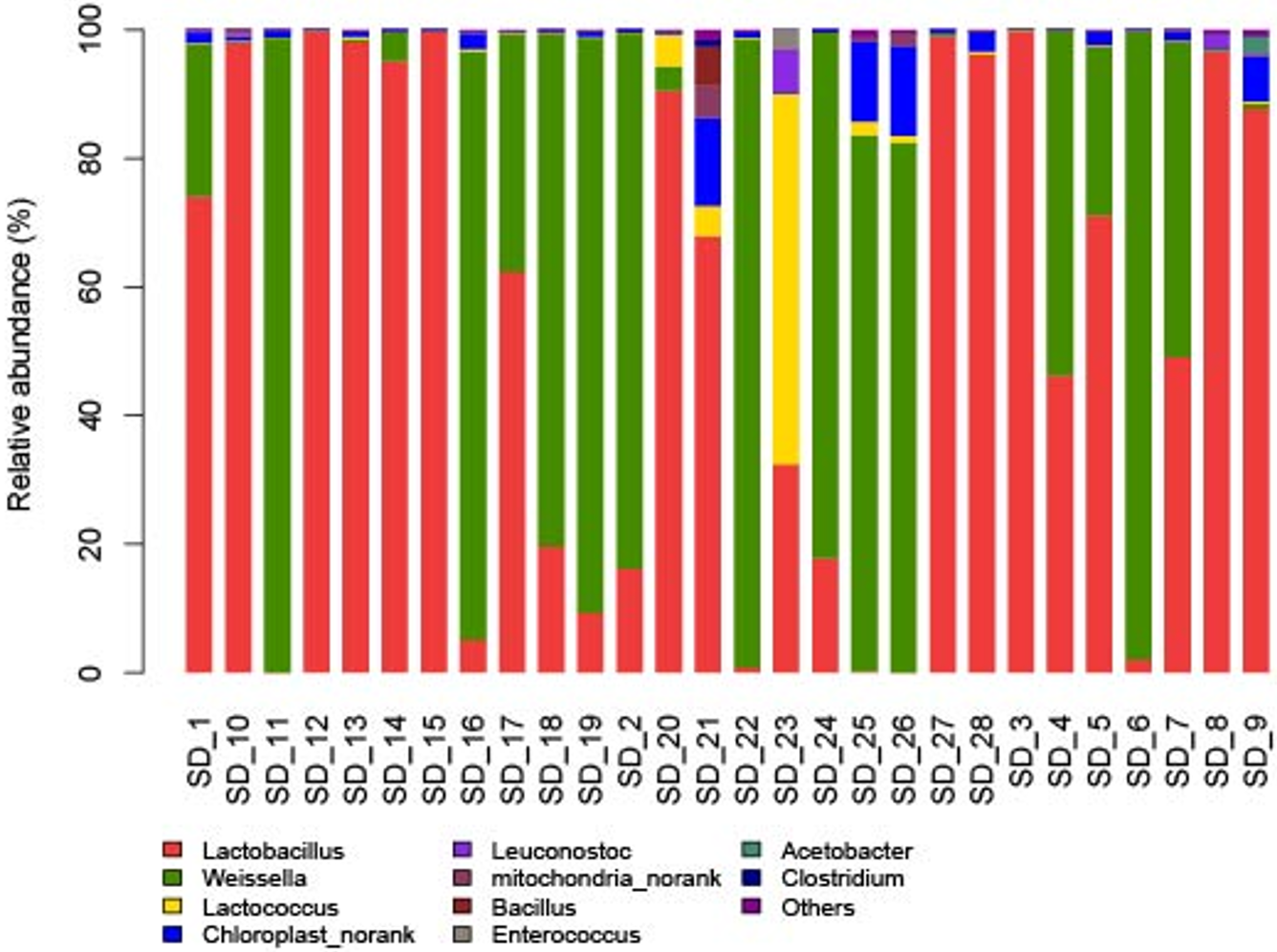
This study aims to figure out the structure of the microbial community in traditional sourdough and the different flavor components of Chinese steamed bread(CSB) made with it. The sourdough samples were selected from Shanxi, Henan and Shandong provinces. The microbial community composition of the sourdoughs was analyzed by a culture-dependent method and high-throughput sequencing, and the flavor compounds of the steamed breads were determined by the solid-phase micro extraction (SPME) method coupled with gas chromatography/mass spectroscopy (GC/MS). The results showed that: in the 28 samples collected, the pH ranged from 3.50 to 4.91, and the total titratable acid (TTA) values ranged from 2.50 to 7.80 mL of NaOH (1 M), while the total number of lactic acid bacteria (LAB) colonies ranged from 10^4 to 10^7 CFU/mL. Lactobacillus, Lactococcus, and Weissella were the dominant genera, as determined by pyrosequencing. A total of 180 LAB strains were isolated and identified using the 16S rRNA gene; the results indicate that Lactobacillus plantarum, Lactobacillus fermentum, and Weissella confusa were isolated with a relatively high frequency. By GC/MS, a total of 24 volatile compounds were detected, including hydrocarbons, aromatic compounds, alcohols, esters, aldehydes, acids, etc. Benzeneethanol and benzaldehyde were abundant in all five samples detected, while benzene-propoxyethyl was not detected in the control group.The flavor compounds contained in sourdough fermented CSBs, both in terms of quantity and concentration, are higher than those in yeast-fermented CSBs. This study provides a useful base for further exploring the deep connections between microbial communities and food flavors.
Graphical Abstract
Keywords
Data Availability Statement
Funding
Conflicts of Interest
Ethical Approval and Consent to Participate
References
- Yan, B., Sadiq, F. A., Cai, Y., Fan, D., Chen, W., Zhang, H., & Zhao, J. (2019). Microbial diversity in traditional type I sourdough and jiaozi and its influence on volatiles in Chinese steamed bread. LWT, 101, 764-773.
[CrossRef] [Google Scholar] - Zhang, G., & He, G. (2013). Predominant bacteria diversity in Chinese traditional sourdough. Journal of food science, 78(8), M1218-M1223.
[CrossRef] [Google Scholar] - Zhang, J., Liu, W., Sun, Z., Bao, Q., Wang, F., Yu, J., ... & Zhang, H. (2011). Diversity of lactic acid bacteria and yeasts in traditional sourdoughs collected from western region in Inner Mongolia of China. Food Control, 22(5), 767-774.
[CrossRef] [Google Scholar] - Zomorrodi, A. R., & Maranas, C. D. (2012). OptCom: a multi-level optimization framework for the metabolic modeling and analysis of microbial communities. PLoS computational biology, 8(2), e1002363.
[CrossRef] [Google Scholar] - Gao, S., Hong, J., Liu, C., Zheng, X., Li, L., & Tian, X. (2022). Comparative study of different fermentation and cooking methods on dough rheology and the quality of Chinese steamed/baked bread. Journal of Food Processing and Preservation, 46(2), e16221.
[CrossRef] [Google Scholar] - Foschino, R., Gallina, S., Andrighetto, C., Rossetti, L., & Galli, A. (2004). Comparison of cultural methods for the identification and molecular investigation of yeasts from sourdoughs for Italian sweet baked products. FEMS Yeast Research, 4(6), 609-618.
[CrossRef] [Google Scholar] - Garofalo, C., Silvestri, G., Aquilanti, L., & Clementi, F. (2008). PCR‐DGGE analysis of lactic acid bacteria and yeast dynamics during the production processes of three varieties of Panettone. Journal of Applied Microbiology, 105(1), 243-254.
[CrossRef] [Google Scholar] - Minervini, F., Di Cagno, R., Lattanzi, A., De Angelis, M., Antonielli, L., Cardinali, G., ... & Gobbetti, M. (2012). Lactic acid bacterium and yeast microbiotas of 19 sourdoughs used for traditional/typical Italian breads: interactions between ingredients and microbial species diversity. Applied and environmental microbiology, 78(4), 1251-1264.
[CrossRef] [Google Scholar] - Palomba, S., Blaiotta, G., Ventorino, V., Saccone, A., & Pepe, O. (2011). Microbial characterization of sourdough for sweet baked products in the Campania region (southern Italy) by a polyphasic approach. Annals of microbiology, 61(2), 307-314.
[CrossRef] [Google Scholar] - Venturi, M., Guerrini, S., & Vincenzini, M. (2012). Stable and non-competitive association of Saccharomyces cerevisiae, Candida milleri and Lactobacillus sanfranciscensis during manufacture of two traditional sourdough baked goods. Food microbiology, 31(1), 107-115.
[CrossRef] [Google Scholar] - Gobbetti, M. (1998). The sourdough microflora: interactions of lactic acid bacteria and yeasts. Trends in Food Science & Technology, 9(7), 267-274.
[CrossRef] [Google Scholar] - Fu, W., Wang, S., & Xue, W. (2024). Mechanism of carbohydrate and protein conversion during sourdough fermentation: An analysis based on representative Chinese sourdough microbiota. International Journal of Food Microbiology, 410, 110487.
[CrossRef] [Google Scholar] - Galle, S., & Arendt, E. K. (2014). Exopolysaccharides from sourdough lactic acid bacteria. Critical reviews in food science and nutrition, 54(7), 891-901.
[CrossRef] [Google Scholar] - Luangsakul, N., Keeratipibul, S., Jindamorakot, S., & Tanasupawat, S. (2009). Lactic acid bacteria and yeasts isolated from the starter doughs for Chinese steamed buns in Thailand. LWT-Food Science and Technology, 42(8), 1404-1412.
[CrossRef] [Google Scholar] - Suo, B., Nie, W., Wang, Y., Ma, J., Xing, X., Huang, Z., ... & Ai, Z. (2020). Microbial diversity of fermented dough and volatile compounds in steamed bread prepared with traditional Chinese starters. Lwt, 126, 109350.
[CrossRef] [Google Scholar] - Yuan, L., Fan, L., Zhao, H., Mgomi, F. C., Ni, H., & He, G. (2022). RNA-seq reveals the phage-resistant mechanisms displayed by Lactiplantibacillus plantarum ZJU-1 isolated from Chinese traditional sourdough. International Dairy Journal, 127, 105286.
[CrossRef] [Google Scholar] - Chen, C., Liu, C., Mu, K., & Xue, W. (2024). Lactobacillus paracasei AH2 isolated from traditionally homemade CSBs' sourdough showed the potential to reduce the immune reactivity of wheat protein by in vitro evaluation; it could suppress anaphylaxis symptoms, gluten-specific immunoglobulin E, histamine and interleukin-4, and increased the relative abundance of Lactobacillus and short-chain fatty acids producers (Faecalibaculum, Alloprevotella and Bacteroides genera). Journal of the Science of Food and Agriculture, 104(2), 664-674.
[CrossRef] [Google Scholar] - Fu, Y., Sun, M., Feng, T., Liu, Q., Yao, L., Yu, C., & Song, S. (2023). Impact of leavening agents on flavor profiles and microbial communities in steamed bread: A comparative analysis of traditional Chinese sourdough and commercial yeast. Journal of Agricultural and Food Chemistry, 71(48), 18973-18985.
[CrossRef] [Google Scholar] - Wang, Y. H., Yang, Y. Y., Xu, F., Zhang, Q. D., Wang, X. K., & Xu, H. (2023). Lexicon development and quantitative descriptive analysis of Chinese steamed bread. Journal of Cereal Science, 111, 103654.
[CrossRef] [Google Scholar] - Iacumin, L., Cecchini, F., Manzano, M., Osualdini, M., Boscolo, D., Orlic, S., & Comi, G. (2009). Description of the microflora of sourdoughs by culture-dependent and culture-independent methods. Food Microbiology, 26(2), 128-135.
[CrossRef] [Google Scholar] - Coda, R., Di Cagno, R., Rizzello, C. G., Nionelli, L., Edema, M. O., & Gobbetti, M. (2011). Utilization of African grains for sourdough bread making. Journal of Food Science, 76(6), M329-M335.
[CrossRef] [Google Scholar] - Gobbetti, M., & Corsetti, A. (1997). Lactobacillus sanfranciscoa key sourdough lactic acid bacterium: a review. Food Microbiology, 14(2), 175-187.
[CrossRef] [Google Scholar] - He, Z. H., Liu, A. H., Javier Peña, R., & Rajaram, S. (2003). Suitability of Chinese wheat cultivars for production of northern style Chinese steamed bread. Euphytica, 131(2), 155-163.
[CrossRef] [Google Scholar] - Lhomme, E., Lattanzi, A., Dousset, X., Minervini, F., De Angelis, M., Lacaze, G., ... & Gobbetti, M. (2015). Lactic acid bacterium and yeast microbiotas of sixteen French traditional sourdoughs. International Journal of Food Microbiology, 215, 161-170.
[CrossRef] [Google Scholar] - Minervini, F., Lattanzi, A., De Angelis, M., Di Cagno, R., & Gobbetti, M. (2012). Influence of artisan bakery-or laboratory-propagated sourdoughs on the diversity of lactic acid bacterium and yeast microbiotas. Applied and Environmental Microbiology, 78(15), 5328-5340.
[CrossRef] [Google Scholar] - Amato, K. R., Yeoman, C. J., Kent, A., Righini, N., Carbonero, F., Estrada, A., ... & Leigh, S. R. (2013). Habitat degradation impacts black howler monkey (Alouatta pigra) gastrointestinal microbiomes. The ISME journal, 7(7), 1344-1353.
[CrossRef] [Google Scholar] - Lattanzi, A., Minervini, F., Di Cagno, R., Diviccaro, A., Antonielli, L., Cardinali, G., ... & Gobbetti, M. (2013). The lactic acid bacteria and yeast microbiota of eighteen sourdoughs used for the manufacture of traditional Italian sweet leavened baked goods. International Journal of Food Microbiology, 163(2-3), 71-79.
[CrossRef] [Google Scholar] - De Vuyst, L., Van Kerrebroeck, S., Harth, H., Huys, G., Daniel, H. M., & Weckx, S. (2014). Microbial ecology of sourdough fermentations: diverse or uniform?. Food microbiology, 37, 11-29.
[CrossRef] [Google Scholar] - Ricciardi, A., Parente, E., Piraino, P., Paraggio, M., & Romano, P. (2005). Phenotypic characterization of lactic acid bacteria from sourdoughs for Altamura bread produced in Apulia (Southern Italy). International Journal of Food Microbiology, 98(1), 63-72.
[CrossRef] [Google Scholar] - Wu, C., Liu, R., Huang, W., Rayas-Duarte, P., Wang, F., & Yao, Y. (2012). Effect of sourdough fermentation on the quality of Chinese Northern-style steamed breads. Journal of Cereal Science, 56(2), 127-133.
[CrossRef] [Google Scholar] - Vas, G., & Vekey, K. (2004). Solid‐phase microextraction: a powerful sample preparation tool prior to mass spectrometric analysis. Journal of mass spectrometry, 39(3), 233-254.
[CrossRef] [Google Scholar] - Kim, Y., Huang, W., Zhu, H., & Rayas-Duarte, P. (2009). Spontaneous sourdough processing of Chinese Northern-style steamed breads and their volatile compounds. Food Chemistry, 114(2), 685-692.
[CrossRef] [Google Scholar] - Kam, W. Y., Aida, W. W., Sahilah, A. M., & Maskat, M. Y. (2011). Volatile compounds and lactic acid bacteria in spontaneous fermented sourdough. Sains Malaysiana, 40(2), 135-138.
[Google Scholar] - Plessas, S., Bekatorou, A., Gallanagh, J., Nigam, P., Koutinas, A. A., & Psarianos, C. (2008). Evolution of aroma volatiles during storage of sourdough breads made by mixed cultures of Kluyveromyces marxianus and Lactobacillus delbrueckii ssp. bulgaricus or Lactobacillus helveticus. Food Chemistry, 107(2), 883-889.
[CrossRef] [Google Scholar] - Kulp, K., & Lorenz, K. (Eds.). (2003). Handbook of dough fermentations (Vol. 127). Crc Press.
[Google Scholar] - Alfonzo, A., Ventimiglia, G., Corona, O., Di Gerlando, R., Gaglio, R., Francesca, N., ... & Settanni, L. (2013). Diversity and technological potential of lactic acid bacteria of wheat flours. Food Microbiology, 36(2), 343-354.
[CrossRef] [Google Scholar] - Hammes, W. P., Brandt, M. J., Francis, K. L., Rosenheim, J., Seitter, M. F., & Vogelmann, S. A. (2005). Microbial ecology of cereal fermentations. Trends in Food Science & Technology, 16(1-3), 4-11.
[CrossRef] [Google Scholar] - Katina, K., Arendt, E., Liukkonen, K. H., Autio, K., Flander, L., & Poutanen, K. (2005). Potential of sourdough for healthier cereal products. Trends in Food Science & Technology, 16(1-3), 104-112.
[CrossRef] [Google Scholar] - Katina, K., Poutanen, K., & Gobbetti, M. (2023). Nutritional aspects of cereal fermentation with lactic acid bacteria and yeast. In Handbook on sourdough biotechnology (pp. 303-324). Cham: Springer International Publishing.
[CrossRef] [Google Scholar] - Rolim, M. E., Fortes, M. I., Von Frankenberg, A., & Duarte, C. K. (2024). Consumption of sourdough bread and changes in the glycemic control and satiety: A systematic review. Critical Reviews in Food Science and Nutrition, 64(3), 801-816.
[CrossRef] [Google Scholar] - Albagli, G., do Monte Schwartz, I., Amaral, P. F., Ferreira, T. F., & Finotelli, P. V. (2021). How dried sourdough starter can enable and spread the use of sourdough bread. LWT, 149, 111888.
[CrossRef] [Google Scholar]
Cited By (1)
-
Junqing Zhang, Yugui Zhao, Junyu Zhang, Zhengxin Bai, Keshun You. Research on anomaly detection and operational status evaluation methods for smart electricity meters based on hybrid deep learning.
PLOS One, 2026 , 21 (6).
[CrossRef]
Cite This Article
TY  - JOUR
AU  - Xue, Ziyu
AU  - Han, Wei
AU  - Zhuang, Xuhui
AU  - Miao, Haijiang
AU  - Chen, Hongjuan
AU  - Luo, Xiaohong
AU  - Li, Xiaomin
PY  - 2025
DA  - 2025/06/30
TI  - Analysis of Sourdough's Microbial Community and Flavor Components in Traditional Chinese Steamed Bread
JO  - Agricultural Science and Food Processing
T2  - Agricultural Science and Food Processing
JF  - Agricultural Science and Food Processing
VL  - 2
IS  - 2
SP  - 106
EP  - 115
DO  - 10.62762/ASFP.2025.520767
UR  - https://www.icck.org/article/abs/ASFP.2025.520767
KW  - sourdough
KW  - Chinese steamed bread
KW  - microbiota
KW  - lactic acid bacteria
KW  - flavor component
AB  - This study aims to figure out the structure of the microbial community in traditional sourdough and the different flavor components of Chinese steamed bread(CSB) made with it. The sourdough samples were selected from Shanxi, Henan and Shandong provinces. The microbial community composition of the sourdoughs was analyzed by a culture-dependent method and high-throughput sequencing, and the flavor compounds of the steamed breads were determined by the solid-phase micro extraction (SPME) method coupled with gas chromatography/mass spectroscopy (GC/MS). The results showed that: in the 28 samples collected, the pH ranged from 3.50 to 4.91, and the total titratable acid (TTA) values ranged from 2.50 to 7.80 mL of NaOH (1 M), while the total number of lactic acid bacteria (LAB) colonies ranged from 10^4 to 10^7 CFU/mL. Lactobacillus, Lactococcus, and Weissella were the dominant genera, as determined by pyrosequencing. A total of 180 LAB strains were isolated and identified using the 16S rRNA gene; the results indicate that Lactobacillus plantarum, Lactobacillus fermentum, and Weissella confusa were isolated with a relatively high frequency. By GC/MS, a total of 24 volatile compounds were detected, including hydrocarbons, aromatic compounds, alcohols, esters, aldehydes, acids, etc. Benzeneethanol and benzaldehyde were abundant in all five samples detected, while benzene-propoxyethyl was not detected in the control group.The flavor compounds contained in sourdough fermented CSBs, both in terms of quantity and concentration, are higher than those in yeast-fermented CSBs. This study provides a useful base for further exploring the deep connections between microbial communities and food flavors.
SN  - 3066-1579
PB  - Institute of Central Computation and Knowledge
LA  - English
ER  -
@article{Xue2025Analysis,
  author = {Ziyu Xue and Wei Han and Xuhui Zhuang and Haijiang Miao and Hongjuan Chen and Xiaohong Luo and Xiaomin Li},
  title = {Analysis of Sourdough's Microbial Community and Flavor Components in Traditional Chinese Steamed Bread},
  journal = {Agricultural Science and Food Processing},
  year = {2025},
  volume = {2},
  number = {2},
  pages = {106-115},
  doi = {10.62762/ASFP.2025.520767},
  url = {https://www.icck.org/article/abs/ASFP.2025.520767},
  abstract = {This study aims to figure out the structure of the microbial community in traditional sourdough and the different flavor components of Chinese steamed bread(CSB) made with it. The sourdough samples were selected from Shanxi, Henan and Shandong provinces. The microbial community composition of the sourdoughs was analyzed by a culture-dependent method and high-throughput sequencing, and the flavor compounds of the steamed breads were determined by the solid-phase micro extraction (SPME) method coupled with gas chromatography/mass spectroscopy (GC/MS). The results showed that: in the 28 samples collected, the pH ranged from 3.50 to 4.91, and the total titratable acid (TTA) values ranged from 2.50 to 7.80 mL of NaOH (1 M), while the total number of lactic acid bacteria (LAB) colonies ranged from 10^4 to 10^7 CFU/mL. Lactobacillus, Lactococcus, and Weissella were the dominant genera, as determined by pyrosequencing. A total of 180 LAB strains were isolated and identified using the 16S rRNA gene; the results indicate that Lactobacillus plantarum, Lactobacillus fermentum, and Weissella confusa were isolated with a relatively high frequency. By GC/MS, a total of 24 volatile compounds were detected, including hydrocarbons, aromatic compounds, alcohols, esters, aldehydes, acids, etc. Benzeneethanol and benzaldehyde were abundant in all five samples detected, while benzene-propoxyethyl was not detected in the control group.The flavor compounds contained in sourdough fermented CSBs, both in terms of quantity and concentration, are higher than those in yeast-fermented CSBs. This study provides a useful base for further exploring the deep connections between microbial communities and food flavors.},
  keywords = {sourdough, Chinese steamed bread, microbiota, lactic acid bacteria, flavor component},
  issn = {3066-1579},
  publisher = {Institute of Central Computation and Knowledge}
}
Publisher's Note
ICCK stays neutral with regard to jurisdictional claims in published maps and institutional affiliations.
Rights and Permissions
 Copyright © 2025 by the Author(s). Published by Institute of Central Computation and Knowledge. This article is an open access article distributed under the terms and conditions of the Creative Commons Attribution (CC BY) license (https://creativecommons.org/licenses/by/4.0/), which permits use, sharing, adaptation, distribution and reproduction in any medium or format, as long as you give appropriate credit to the original author(s) and the source, provide a link to the Creative Commons licence, and indicate if changes were made.


Portico
