


Preliminary Application of Unmanned Plant Protection Machinery for Control of Cauliflower Diseases and Insect Pests in a Greenhouse



Article Information
Abstract
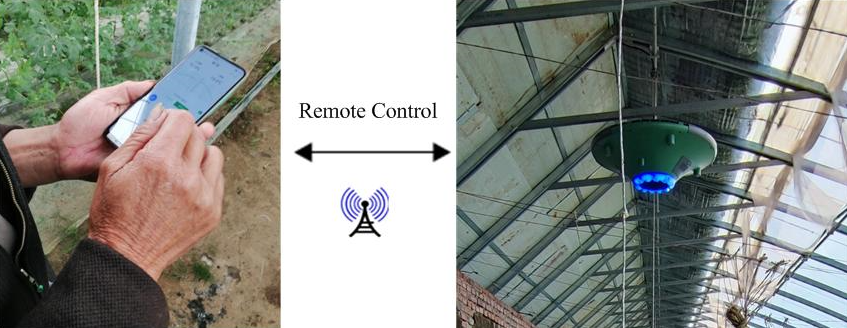
Regular control of diseases and pests is crucial for maximizing cauliflower yield and quality. Spray application of chemical pesticides causes environmental pollution, pesticide residue accumulation, and is labor-intensive. To address these challenges, we developed an unmanned plant protection device integrating ozone sterilization, light traps, and Internet of Things (IoT) technologies. Installed in a greenhouse, the device included an ozone generator, high-speed fan, and insect traps. It was remotely controlled via a mobile app for real-time adjustments to ozone release, fan speed, trap lamp operation, environmental data collection, and system monitoring. Greenhouse experiments tested the device against cauliflower aphids, Pieris rapae, and black rot. Infestation/infection rates of aphids, Pieris rapae, and black rot in the greenhouse with the device were 23.18%, 19.72%, and 45.83%, respectively—22.52%, 7.21%, and 6.95% lower than the rates in the conventional greenhouse with pesticide sprays. No adverse effects on cauliflower growth were noted, and pesticide use was significantly reduced, lowering both agrochemical and labor costs. The results demonstrate that the unmanned device effectively controls pests and diseases and is safe for use. This offers a bio-friendly solution for pest control in cauliflower production.
Graphical Abstract
Keywords
Data Availability Statement
Funding
Conflicts of Interest
Ethical Approval and Consent to Participate
References
- Dias, J. S., & Ortiz, R. (2021). New strategies and approaches for improving vegetable cultivars. In The Basics of Human Civilization (pp. 349-381). CRC Press.
[CrossRef] [Google Scholar] - Sara, U., Rajbongshi, A., Shakil, R., Akter, B., & Uddin, M. S. (2022). VegNet: An organized dataset of cauliflower disease for a sustainable agro-based automation system. Data in Brief, 43, 108422.
[CrossRef] [Google Scholar] - Mayanglambam, S., Singh, K. D., & Rajashekar, Y. (2021). Current biological approaches for management of crucifer pests. Scientific Reports, 11(1), 11831.
[CrossRef] [Google Scholar] - Khatun, P., Islam, A., Sachi, S., Islam, M. Z., & Islam, P. (2023). Pesticides in vegetable production in Bangladesh: A systemic review of contamination levels and associated health risks in the last decade. Toxicology Reports, 11, 199-211.
[CrossRef] [Google Scholar] - Abbas, M., Saleem, M., Hussain, D., Ramzan, M., Jawad Saleem, M., Abbas, S., ... & Parveen, Z. (2022). Review on integrated disease and pest management of field crops. International Journal of Tropical Insect Science, 42(5), 3235-3243.
[CrossRef] [Google Scholar] - Chikte, T., Kopta, T., Psota, V., Arizmendi, J., & Chwil, M. (2024). A comprehensive review of low-and zero-residue pesticide methods in vegetable production. Agronomy, 14(11), 2745.
[CrossRef] [Google Scholar] - Cheng, Z., Zhu, M., & Cai, J. (2025). Reducing fertilizer and pesticide application through mandatory agri-environmental regulation: Insights from “Two Zero” policy in China. Environmental Impact Assessment Review, 110, 107716.
[CrossRef] [Google Scholar] - Huang, K., & Shu, L. (2021). Grand challenges in sustainable and intelligent phytoprotection. Frontiers in Plant Science, 12, 755510.
[CrossRef] [Google Scholar] - Zhang, J., Xie, S., Li, X., & Xia, X. (2024). Adoption of green production technologies by farmers through traditional and digital agro-technology promotion–An example of physical versus biological control technologies. Journal of Environmental Management, 370, 122813.
[CrossRef] [Google Scholar] - Mrnka, L., Frantík, T., Schmidt, C. S., Švecová, E. B., & Vosátka, M. (2023). Intercropping of Tagetes patula with cauliflower and carrot increases yield of cauliflower and tentatively reduces vegetable pests. International Journal of Pest Management, 69(1), 35–45.
[CrossRef] [Google Scholar] - Pandit, M. A., Kumar, J., Gulati, S., Bhandari, N., Mehta, P., Katyal, R., Rawat, C. D., Mishra, V., & Kaur, J. (2022). Major Biological Control Strategies for Plant Pathogens. Pathogens, 11(2), 273.
[CrossRef] [Google Scholar] - Maurya, R. P., Koranga, R., Samal, I., Chaudhary, D., Paschapur, A. U., Sreedhar, M., & Manimala, R. N. (2022). Biological control: A global perspective. International Journal of Tropical Insect Science, 42(4), 3203–3220.
[CrossRef] [Google Scholar] - Collinge, D. B., Jensen, D. F., Rabiey, M., Sarrocco, S., Shaw, M. W., & Shaw, R. H. (2022). Biological control of plant diseases–What has been achieved and what is the direction?. Plant Pathology, 71(5), 1024-1047.
[CrossRef] [Google Scholar] - Ahmad, F., Fouad, H., Liang, S. Y., Hu, Y., & Mo, J. C. (2021). Termites and Chinese agricultural system: applications and advances in integrated termite management and chemical control. Insect science, 28(1), 2-20.
[CrossRef] [Google Scholar] - Jobe, N. B., Chourasia, A., Smith, B. H., Molins, E., Rose, A., Pavlic, T. P., & Paaijmans, K. P. (2024). Using electric fields to control insects: current applications and future directions. Journal of Insect Science, 24(1), 8.
[CrossRef] [Google Scholar] - Al Mamun, M. R., Keya, A. C., Alim, M. S., Hossen, M. A., Mondal, M. F., & Soeb, M. J. A. (2023). Potentiality assessment of solar based LED light trap as pest management tool in tea (Camellia sinensis L.). Smart Agricultural Technology, 5, 100304.
[CrossRef] [Google Scholar] - Wang, Y., Qiao, X., & Wang, Z. (2022). Application of ozone treatment in agriculture and food industry. A review. INMATEH - Agricultural Engineering, 68(3), 861–872.
[CrossRef] [Google Scholar] - Yao, H., Shu, L., Yang, F., Jin, Y., & Yang, Y. (2023). The phototactic rhythm of pests for the Solar Insecticidal Lamp: A review. Frontiers in Plant Science, 13, 1018711.
[CrossRef] [Google Scholar] - Gao, Y., Yin, F., Hong, C., Chen, C., Deng, H., Liu, Y., Li, Z., & Yao, Q. (2025). Intelligent field monitoring system for cruciferous vegetable pests using yellow sticky trap images and an improved Cascade R-CNN. Journal of Integrative Agriculture, 24(1), 220–234.
[CrossRef] [Google Scholar] - Faliagka, S., & Katsoulas, N. (2022). Silica coated insect proof screens for effective insect control in greenhouses. Biosystems Engineering, 215, 21–31.
[CrossRef] [Google Scholar] - Li, X., Liu, Y., Zhang, C., Che, H., He, Q., Wang, L., & Yao, B. (2024). Effect of ozone sterilization on controlling leaf mildew and gray mold tomato disease in a glasshouse and its influence on other growth parameters. Journal of the Science of Food and Agriculture, 104(7), 4097–4108.
[CrossRef] [Google Scholar] - Jiang, L., Liu, B., Zhang, S., Zhang, R., Wu, C., & Qiao, K. (2024). Increasing spray volume and ozone spray of tetraconazole improve control against strawberry powdery mildew. Crop Protection, 179, 106602.
[CrossRef] [Google Scholar] - Wang, H. (2022). Smart phytoprotection and suggestions for its development. Journal of China Agricultural University, 27(10), 1–21.
[Google Scholar] - Zheng, X. (2024). Editorial: AI-empowered services for interconnected smart plant protection systems. Frontiers in Plant Science, 15, 1359627.
[CrossRef] [Google Scholar] - Zhong, Y., Teng, Z., & Tong, M. (2024). LiteMixer: Cauliflower disease diagnosis based on a novel lightweight neural network. The Computer Journal, 67(6), 2346–2356.
[CrossRef] [Google Scholar] - Kanna, G. P., Kumar, S. J., Kumar, Y., Changela, A., Woźniak, M., Shafi, J., & Ijaz, M. F. (2023). Advanced deep learning techniques for early disease prediction in cauliflower plants. Scientific Reports, 13(1), 18475.
[CrossRef] [Google Scholar] - Uddin, M. S., Mazumder, M. K. A., Prity, A. J., Mridha, M. F., Alfarhood, S., Safran, M., & Che, D. (2024). Cauli-Det: Enhancing cauliflower disease detection with modified YOLOv8. Frontiers in Plant Science, 15, 1373590.
[CrossRef] [Google Scholar] - Wang, S., Xu, T., & Li, X. (2022). Development status and perspectives of crop protection machinery and techniques for vegetables. Horticulturae, 8(2), 166.
[CrossRef] [Google Scholar] - Zheng, L. I. U., Chengqian, J. I. N., Yugang, F. E. N. G., & Tengxiang, Y. A. N. G. (2024). Research status and trends of intelligent technology in plant protection machinery. Journal of Intelligent Agricultural Mechanization, 5(1), 40-50.
[CrossRef] [Google Scholar] - He, X., Yang, F., & Qiu, B. (2024). Agricultural environment and intelligent plant protection equipment. Agronomy, 14(5), 937.
[CrossRef] [Google Scholar] - Sun, X., Zhang, Y., Tang, C. L., Zhao, H. H., & Ai, C. S. (2016). Development of the field of wheat plant protection precision spraying robot control system. Applied mechanics and materials, 851, 427-432.
[CrossRef] [Google Scholar] - Li, X., Li, Y., Wang, L., Zhang, C., Tao, L., & Zhang, Y. (2024). Design and experiment of closed-loop control system for ozone sterilization in facility agriculture. Journal of Chinese Agricultural Mechanization, 45(9), 62–68.
[Google Scholar] - Barthwal, R., Negi, A., Kathuria, D., & Singh, N. (2025). Ozonation: Post-harvest processing of different fruits and vegetables enhancing and preserving the quality. Food Chemistry, 463, 141489.
[CrossRef] [Google Scholar] - Simplício, I. B. O., Sousa, S. C., Thomaz, T. S., Lima, F. S., Bezerra, J. S., Carvalho, M. C. O., Ferreira, M. S., & Miranda, M. K. V. (2023). Ozone use in surface disinfection: an integrative review. Acta Paulista De Enfermagem, 36, eAPE00542.
[CrossRef] [Google Scholar] - Cruz, L. K., Schroer, I. A., Hansen, E., Bender, B. N., da Silva, P. R. S., Brochier, B., da Silva, J., & da Silva, S. B. (2025). Ozone application for inactivation of Escherichia coli in air-conditioned environments for food production. Ozone Science & Engineering, 1–10.
[CrossRef] [Google Scholar] - Wang, Y., Chang, Y., Zhang, S., Jiang, X., Yang, B., & Wang, G. (2022). Comparison of phototactic behavior between two migratory pests, Helicoverpa armigera and Spodoptera frugiperda. Insects, 13(10), 917.
[CrossRef] [Google Scholar] - Han, D., Chen, X., Zhou, F., Wu, X., Zhao, M., & Chen, X. (2021). Control effects of blue and yellow light on Bemisia tabaci on greenhouse cucumbers. Chinese Journal of Eco-Agriculture, 29(5), 802–808. https://dx.doi.org/10.13930/j.cnki.cjea.200727
[Google Scholar] - Athanasiadou, M., Seger, R., & Meyhöfer, R. (2025). Potential of blue light-emitting diodes (LEDs) to disturb whiteflies on the crop: a new push-pull strategy? Journal of Pest Science, 98(3), 1117–1133.
[CrossRef] [Google Scholar] - Grupe, B., & Meyhöfer, R. (2024). Whitefly Detected: LED Traps Enhance Monitoring of Trialeurodes vaporariorum in Greenhouse-Grown Tomato. Horticulturae, 10(9).
[CrossRef] [Google Scholar] - Mansoor, S., Iqbal, S., Popescu, S. M., Kim, S. L., Chung, Y. S., & Baek, J. H. (2025). Integration of smart sensors and IOT in precision agriculture: trends, challenges and future prospectives. Frontiers in Plant Science, 16, 1587869.
[CrossRef] [Google Scholar]
Cited By (1)
-
Yaojun Zhang, Guiling Wu, Jianbo Shen, Chong Xu. Precise tea leaf disease detection using UAV low-altitude remote sensing and optimized YOLO11 model.
PLOS One, 2026 , 21 (2).
[CrossRef]
Cite This Article
TY  - JOUR
AU  - Wang, Zhibin
AU  - Fan, Zhenzhen
AU  - Chen, Xifeng
AU  - Qiao, Xiaojun
AU  - Shen, Jianbo
PY  - 2025
DA  - 2025/08/28
TI  - Preliminary Application of Unmanned Plant Protection Machinery for Control of Cauliflower Diseases and Insect Pests in a Greenhouse
JO  - Digital Intelligence in Agriculture
T2  - Digital Intelligence in Agriculture
JF  - Digital Intelligence in Agriculture
VL  - 1
IS  - 1
SP  - 24
EP  - 34
DO  - 10.62762/DIA.2025.202928
UR  - https://www.icck.org/article/abs/DIA.2025.202928
KW  - plant protection machinery
KW  - unmanned
KW  - pesticide reduction
KW  - smart phytoprotection
KW  - disease
KW  - insect pest
KW  - agriculture facility
AB  - Regular control of diseases and pests is crucial for maximizing cauliflower yield and quality. Spray application of chemical pesticides causes environmental pollution, pesticide residue accumulation, and is labor-intensive. To address these challenges, we developed an unmanned plant protection device integrating ozone sterilization, light traps, and Internet of Things (IoT) technologies. Installed in a greenhouse, the device included an ozone generator, high-speed fan, and insect traps. It was remotely controlled via a mobile app for real-time adjustments to ozone release, fan speed, trap lamp operation, environmental data collection, and system monitoring. Greenhouse experiments tested the device against cauliflower aphids, Pieris rapae, and black rot. Infestation/infection rates of aphids, Pieris rapae, and black rot in the greenhouse with the device were 23.18%, 19.72%, and 45.83%, respectively—22.52%, 7.21%, and 6.95% lower than the rates in the conventional greenhouse with pesticide sprays. No adverse effects on cauliflower growth were noted, and pesticide use was significantly reduced, lowering both agrochemical and labor costs. The results demonstrate that the unmanned device effectively controls pests and diseases and is safe for use. This offers a bio-friendly solution for pest control in cauliflower production.
SN  - 3069-3187
PB  - Institute of Central Computation and Knowledge
LA  - English
ER  -
@article{Wang2025Preliminar,
  author = {Zhibin Wang and Zhenzhen Fan and Xifeng Chen and Xiaojun Qiao and Jianbo Shen},
  title = {Preliminary Application of Unmanned Plant Protection Machinery for Control of Cauliflower Diseases and Insect Pests in a Greenhouse},
  journal = {Digital Intelligence in Agriculture},
  year = {2025},
  volume = {1},
  number = {1},
  pages = {24-34},
  doi = {10.62762/DIA.2025.202928},
  url = {https://www.icck.org/article/abs/DIA.2025.202928},
  abstract = {Regular control of diseases and pests is crucial for maximizing cauliflower yield and quality. Spray application of chemical pesticides causes environmental pollution, pesticide residue accumulation, and is labor-intensive. To address these challenges, we developed an unmanned plant protection device integrating ozone sterilization, light traps, and Internet of Things (IoT) technologies. Installed in a greenhouse, the device included an ozone generator, high-speed fan, and insect traps. It was remotely controlled via a mobile app for real-time adjustments to ozone release, fan speed, trap lamp operation, environmental data collection, and system monitoring. Greenhouse experiments tested the device against cauliflower aphids, Pieris rapae, and black rot. Infestation/infection rates of aphids, Pieris rapae, and black rot in the greenhouse with the device were 23.18\%, 19.72\%, and 45.83\%, respectively—22.52\%, 7.21\%, and 6.95\% lower than the rates in the conventional greenhouse with pesticide sprays. No adverse effects on cauliflower growth were noted, and pesticide use was significantly reduced, lowering both agrochemical and labor costs. The results demonstrate that the unmanned device effectively controls pests and diseases and is safe for use. This offers a bio-friendly solution for pest control in cauliflower production.},
  keywords = {plant protection machinery, unmanned, pesticide reduction, smart phytoprotection, disease, insect pest, agriculture facility},
  issn = {3069-3187},
  publisher = {Institute of Central Computation and Knowledge}
}
Publisher's Note
ICCK stays neutral with regard to jurisdictional claims in published maps and institutional affiliations.
Rights and Permissions
 Copyright © 2025 by the Author(s). Published by Institute of Central Computation and Knowledge. This article is an open access article distributed under the terms and conditions of the Creative Commons Attribution (CC BY) license (https://creativecommons.org/licenses/by/4.0/), which permits use, sharing, adaptation, distribution and reproduction in any medium or format, as long as you give appropriate credit to the original author(s) and the source, provide a link to the Creative Commons licence, and indicate if changes were made.

