


The Tsing-Agri Farm Paradigm: Integrating Controlled Environment Agriculture with Industrial Systems for a Low-Carbon Future

Article Information
Abstract
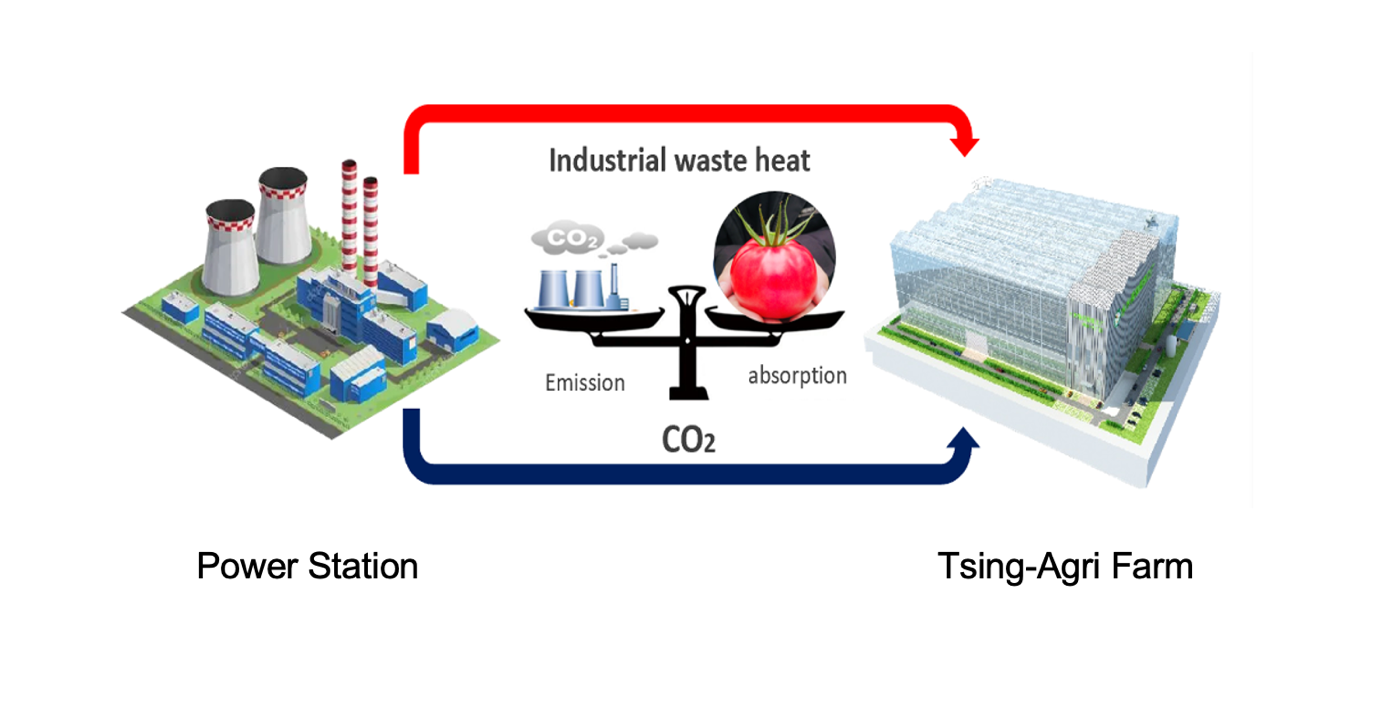
Agriculture is both a major contributor to and a victim of climate change, accounting for approximately 22–25% of global greenhouse gas (GHG) emissions and facing heightened risks from extreme weather events. International climate frameworks, including the Paris Agreement, emphasize the urgent need for transformative changes in food systems to achieve net-zero emissions by mid-century. In this context, China has pledged to peak carbon emissions by 2030 and reach carbon neutrality by 2060, with agriculture playing a central role. This paper presents the Tsing-Agri Farm, an advanced controlled environment agriculture (CEA) system developed by Beijing TsingSky Technology Co., Ltd., affiliated with Tsinghua University. Each facility, covering 60,000 m^2, is engineered to operate under extreme climate conditions and meet the annual tomato consumption of 100,000 people. Distinctively, the system integrates with adjacent industrial infrastructure to recover waste heat and CO2, thereby reducing operational costs while enhancing carbon sequestration. The carbon mitigation effect of every 100 acres of such farms is comparable to that of 16,000 acres of photovoltaic installations, highlighting its significant climate benefits. By examining the technical design, carbon reduction potential, and operational resilience of the Tsing-Agri Farm, this study contributes to the discourse on climate-smart agriculture and demonstrates a scalable model for sustainable, low-carbon food production under future climate uncertainties.
Graphical Abstract
Keywords
Data Availability Statement
Funding
Conflicts of Interest
Ethical Approval and Consent to Participate
References
- Omotoso, A. B., & Omotayo, A. O. (2024). The interplay between agriculture, greenhouse gases, and climate change in Sub-Saharan Africa. Regional Environmental Change, 24(1), 1.
[CrossRef] [Google Scholar] - Costa Jr, C., Wollenberg, E., Benitez, M., Newman, R., Gardner, N., & Bellone, F. (2022). Roadmap for achieving net-zero emissions in global food systems by 2050. Scientific reports, 12(1), 15064.
[CrossRef] [Google Scholar] - Mehta, P. (2024). The impact of climate change on the environment, water resources, and agriculture: a comprehensive review. Climate, Environment and Agricultural Development: A Sustainable Approach Towards Society, 189-201.
[CrossRef] [Google Scholar] - Allen, M., Antwi-Agyei, P., Aragon-Durand, F., Babiker, M., Bertoldi, P., Bind, M., ... & Zickfeld, K. (2019). Technical Summary: Global warming of 1.5 C. An IPCC Special Report on the impacts of global warming of 1.5 C above pre-industrial levels and related global greenhouse gas emission pathways, in the context of strengthening the global response to the threat of climate change, sustainable development, and efforts to eradicate poverty.
[Google Scholar] - Schaeffer, M., Hutfilter, U. F., Brecha, R., Fyson, C., & Hare, B. (2019). Insights from the IPCC Special Report on 1.5 C for preparation of long-term strategies. Berlin, Germany. Retrieved from https://climateanalytics. org/media/climateanalytics\_ipcc-lt-leds\_report\_april\_2019. pdf
[Google Scholar] - Boix-Fayos, C., & De Vente, J. (2023). Challenges and potential pathways towards sustainable agriculture within the European Green Deal. Agricultural Systems, 207, 103634.
[CrossRef] [Google Scholar] - King, J. K. K., Granjou, C., Fournil, J., & Cecillon, L. (2018). Soil sciences and the French 4 per 1000 Initiative—The promises of underground carbon. Energy research & social science, 45, 144-152.
[CrossRef] [Google Scholar] - Halder, S., Banerjee, S., Youssef, Y. M., Chandel, A., Alarifi, N., Bhandari, G., & Abd-Elmaboud, M. E. (2025). Ground–Surface Water Assessment for Agricultural Land Prioritization in the Upper Kansai Basin, India: An Integrated SWAT-VIKOR Framework Approach. Water, 17(6), 880.
[CrossRef] [Google Scholar] - Zhang, S., & Chen, W. (2022). China’s energy transition pathway in a carbon neutral vision. Engineering, 14, 64-76.
[CrossRef] [Google Scholar] - He, G., Zhao, Y., Wang, L., Jiang, S., & Zhu, Y. (2019). China's food security challenge: Effects of food habit changes on requirements for arable land and water. Journal of Cleaner Production, 229, 739-750.
[CrossRef] [Google Scholar] - Haj-Amor, Z., Kim, D. G., & Bouri, S. (2023). Sustainable Agriculture: Adaptation Strategies to Address Climate Change by 2050. CRC Press.
[CrossRef] [Google Scholar] - Fontana, E., Nicola, S., & Tibaldi, G. (2008, September). Tomato production systems and their application to the tropics. In International Symposium on Tomato in the Tropics 821 (pp. 27-34).
[CrossRef] [Google Scholar] - Devlet, A. (2021). Modern agriculture and challenges. Frontiers in Life Sciences and Related Technologies, 2(1), 21-29.
[CrossRef] [Google Scholar] - Su, R., Chen, B., Wang, S., & Duan, C. (2024). Energy technical resilience assessment based on complex network analysis–A case study of China. Applied Energy, 364, 123231.
[CrossRef] [Google Scholar] - Geng, Q., Zhao, Y., Sun, S., He, X., Wang, D., Wu, D., & Tian, Z. (2023). Spatio-temporal changes and its driving forces of irrigation water requirements for cotton in Xinjiang, China. Agricultural Water Management, 280, 108218.
[CrossRef] [Google Scholar]
Cited By (2)
-
Wei Duan, Yuehong Pan, Jianbo Shen, Shuaishuai Jia, Dongsheng Chen, Minfang Wang. Green credit, perceived value, and the green development of grain family farms: evidence from Hunan Province, China.
Frontiers in Sustainable Food Systems, 2026 , 10 .
[CrossRef] -
Yuansheng Wang, Huarui Wu, Cheng Chen, Gongming Wang. A Review and Design of Semantic-Level Feature Spatial Representation and Resource Spatiotemporal Mapping for Socialized Service Resources in Rural Characteristic Industries.
Sustainability, 2025 , 17 (19).
[CrossRef]
Cite This Article
TY  - JOUR
AU  - Wang, Yiyi
AU  - Wang, Xiaoqing
PY  - 2025
DA  - 2025/08/27
TI  - The Tsing-Agri Farm Paradigm: Integrating Controlled Environment Agriculture with Industrial Systems for a Low-Carbon Future
JO  - Digital Intelligence in Agriculture
T2  - Digital Intelligence in Agriculture
JF  - Digital Intelligence in Agriculture
VL  - 1
IS  - 1
SP  - 6
EP  - 13
DO  - 10.62762/DIA.2025.899209
UR  - https://www.icck.org/article/abs/DIA.2025.899209
KW  - extreme weather
KW  - food security
KW  - industrial-agricultural integration
KW  - controlled-environment agriculture
KW  - agricultural carbon sequestration
AB  - Agriculture is both a major contributor to and a victim of climate change, accounting for approximately 22–25% of global greenhouse gas (GHG) emissions and facing heightened risks from extreme weather events. International climate frameworks, including the Paris Agreement, emphasize the urgent need for transformative changes in food systems to achieve net-zero emissions by mid-century. In this context, China has pledged to peak carbon emissions by 2030 and reach carbon neutrality by 2060, with agriculture playing a central role. This paper presents the Tsing-Agri Farm, an advanced controlled environment agriculture (CEA) system developed by Beijing TsingSky Technology Co., Ltd., affiliated with Tsinghua University. Each facility, covering 60,000 m^2, is engineered to operate under extreme climate conditions and meet the annual tomato consumption of 100,000 people. Distinctively, the system integrates with adjacent industrial infrastructure to recover waste heat and CO2, thereby reducing operational costs while enhancing carbon sequestration. The carbon mitigation effect of every 100 acres of such farms is comparable to that of 16,000 acres of photovoltaic installations, highlighting its significant climate benefits. By examining the technical design, carbon reduction potential, and operational resilience of the Tsing-Agri Farm, this study contributes to the discourse on climate-smart agriculture and demonstrates a scalable model for sustainable, low-carbon food production under future climate uncertainties.
SN  - 3069-3187
PB  - Institute of Central Computation and Knowledge
LA  - English
ER  -
@article{Wang2025The,
  author = {Yiyi Wang and Xiaoqing Wang},
  title = {The Tsing-Agri Farm Paradigm: Integrating Controlled Environment Agriculture with Industrial Systems for a Low-Carbon Future},
  journal = {Digital Intelligence in Agriculture},
  year = {2025},
  volume = {1},
  number = {1},
  pages = {6-13},
  doi = {10.62762/DIA.2025.899209},
  url = {https://www.icck.org/article/abs/DIA.2025.899209},
  abstract = {Agriculture is both a major contributor to and a victim of climate change, accounting for approximately 22–25\% of global greenhouse gas (GHG) emissions and facing heightened risks from extreme weather events. International climate frameworks, including the Paris Agreement, emphasize the urgent need for transformative changes in food systems to achieve net-zero emissions by mid-century. In this context, China has pledged to peak carbon emissions by 2030 and reach carbon neutrality by 2060, with agriculture playing a central role. This paper presents the Tsing-Agri Farm, an advanced controlled environment agriculture (CEA) system developed by Beijing TsingSky Technology Co., Ltd., affiliated with Tsinghua University. Each facility, covering 60,000 m^2, is engineered to operate under extreme climate conditions and meet the annual tomato consumption of 100,000 people. Distinctively, the system integrates with adjacent industrial infrastructure to recover waste heat and CO2, thereby reducing operational costs while enhancing carbon sequestration. The carbon mitigation effect of every 100 acres of such farms is comparable to that of 16,000 acres of photovoltaic installations, highlighting its significant climate benefits. By examining the technical design, carbon reduction potential, and operational resilience of the Tsing-Agri Farm, this study contributes to the discourse on climate-smart agriculture and demonstrates a scalable model for sustainable, low-carbon food production under future climate uncertainties.},
  keywords = {extreme weather, food security, industrial-agricultural integration, controlled-environment agriculture, agricultural carbon sequestration},
  issn = {3069-3187},
  publisher = {Institute of Central Computation and Knowledge}
}
Publisher's Note
ICCK stays neutral with regard to jurisdictional claims in published maps and institutional affiliations.
Rights and Permissions
 Copyright © 2025 by the Author(s). Published by Institute of Central Computation and Knowledge. This article is an open access article distributed under the terms and conditions of the Creative Commons Attribution (CC BY) license (https://creativecommons.org/licenses/by/4.0/), which permits use, sharing, adaptation, distribution and reproduction in any medium or format, as long as you give appropriate credit to the original author(s) and the source, provide a link to the Creative Commons licence, and indicate if changes were made.

