


Research on the Application of Agricultural Big Data in Plant Growth Prediction


Article Information
Abstract
The intelligent transformation of agriculture places plant growth prediction as a critical component for ensuring food security, optimizing resource allocation, and enhancing sustainable productivity. Traditional methods reliant on empirical or simplified mechanistic models struggle with the nonlinearity, high dimensionality, and spatiotemporal heterogeneity inherent in agro-ecological systems. This study investigates the paradigm shift enabled by agricultural big data integrating multi-source, real-time streams from IoT sensors, satellites, UAVs, and farm management systems. We propose a ``Multi-source Data Assimilation and Hybrid Intelligence'' (MDA-HI) framework that synergistically couples process-based crop models with ensemble machine learning algorithms---including Transformer-based architectures and Physics-Informed Neural Networks---within a holistic pipeline encompassing multi-modal data fusion, hybrid modeling, and scalable deployment. Empirical validation across major crops (rice, wheat, maize, tomato) in diverse eco-regions of China (2023--2025) demonstrates significant improvements: the MDA-HI model achieved average RMSE reductions of 42.7% for yield prediction and 38.1% for key phenological stage prediction relative to best-in-class standalone models. A large-scale case study on rice-wheat rotation systems showed that data-driven prescriptions reduced nitrogen fertilizer use by 22.5% and irrigation water by 18.3% while increasing yield by 5.1%. The study further establishes a five-dimensional evaluation system covering accuracy, robustness, interpretability, scalability, and economic benefit. Remaining challenges include edge computing for real-time inference, federated learning for privacy-preserving collaboration, and explainability of complex ``black-box'' models. This research concludes that agricultural big data constitutes a foundational catalyst for predictive, precise, and proactive cognitive agriculture, with profound implications for global food system resilience.
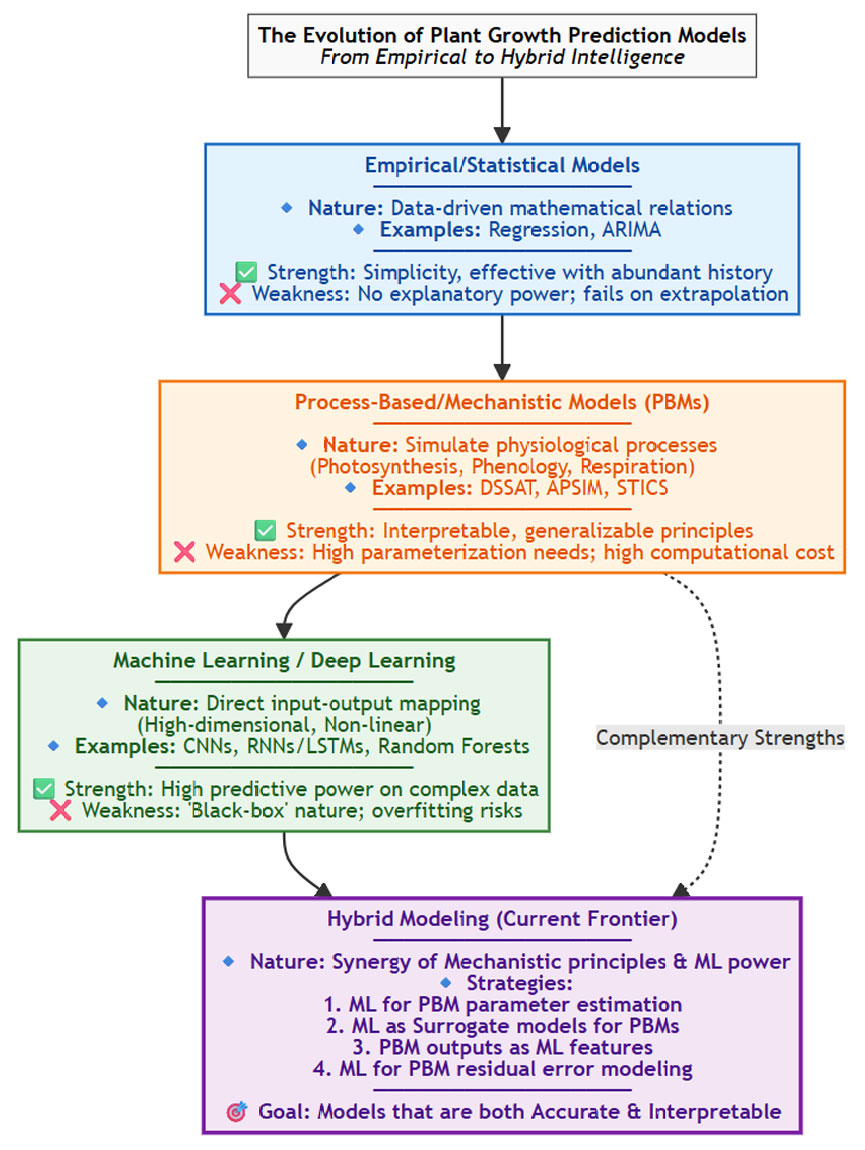
Graphical Abstract
Keywords
Data Availability Statement
Funding
Conflicts of Interest
AI Use Statement
Ethical Approval and Consent to Participate
References
- FAO. (2022). The future of food and agriculture – Drivers and triggers for transformation. Rome: Food and Agriculture Organization of the United Nations. https://openknowledge.fao.org/handle/20.500.14283/cc0959en
[Google Scholar] - Wolfert, S., Ge, L., Verdouw, C., & Bogaardt, M. J. (2017). Big data in smart farming–a review. Agricultural systems, 153, 69-80.
[CrossRef] [Google Scholar] - Liakos, K. G., Busato, P., Moshou, D., Pearson, S., & Bochtis, D. (2018). Machine learning in agriculture: A review. Sensors, 18(8), 2674.
[CrossRef] [Google Scholar] - Jones, J. W., Antle, J. M., Basso, B., Boote, K. J., Conant, R. T., Foster, I., ... & Wheeler, T. R. (2017). Brief history of agricultural systems modeling. Agricultural systems, 155, 240-254.
[CrossRef] [Google Scholar] - Seidel, S. J., Palosuo, T., Thorburn, P., & Wallach, D. (2018). Towards improved calibration of crop models–Where are we now and where should we go?. European Journal of Agronomy, 94, 25-35.
[CrossRef] [Google Scholar] - Tzounis, A., Katsoulas, N., Bartzanas, T., & Kittas, C. (2017). Internet of Things in agriculture, recent advances and future challenges. Biosystems engineering, 164, 31-48.
[CrossRef] [Google Scholar] - Moghimi, A., Yang, C., & Anderson, J. A. (2020). Aerial hyperspectral imagery and deep neural networks for high-throughput yield phenotyping in wheat. Computers and Electronics in Agriculture, 172, 105299.
[CrossRef] [Google Scholar] - Van Klompenburg, T., Kassahun, A., & Catal, C. (2020). Crop yield prediction using machine learning: A systematic literature review. Computers and electronics in agriculture, 177, 105709.
[CrossRef] [Google Scholar] - Reichstein, M., Camps-Valls, G., Stevens, B., Jung, M., Denzler, J., Carvalhais, N., & Prabhat, F. (2019). Deep learning and process understanding for data-driven Earth system science. Nature, 566(7743), 195-204.
[CrossRef] [Google Scholar] - Barbedo, J. G. A. (2022). Data fusion in agriculture: resolving ambiguities and closing data gaps. Sensors, 22(6), 2285.
[CrossRef] [Google Scholar] - Palanivel, K., & Surianarayanan, C. (2019). An approach for prediction of crop yield using machine learning and big data techniques. International Journal of Computer Engineering and Technology, 10(3), 110-118. https://iaeme.com/Home/article_id/IJCET_10_03_013
[Google Scholar] - Roscher, R., Bohn, B., Duarte, M. F., & Garcke, J. (2020). Explainable machine learning for scientific insights and discoveries. IEEE Access, 8, 42200-42216.
[CrossRef] [Google Scholar] - Elijah, O., Rahman, T. A., Orikumhi, I., Leow, C. Y., & Hindia, M. N. (2018). An overview of Internet of Things (IoT) and data analytics in agriculture: Benefits and challenges. IEEE Internet of things Journal, 5(5), 3758-3773.
[CrossRef] [Google Scholar] - Kairouz, P., & McMahan, H. B. (2021). Advances and open problems in federated learning. Foundations and trends in machine learning, 14(1-2), 1-210.
[CrossRef] [Google Scholar] - Crane-Droesch, A. (2018). Machine learning methods for crop yield prediction and climate change impact assessment in agriculture. Environmental Research Letters, 13(11), 114003.
[CrossRef] [Google Scholar] - You, J., Li, X., Low, M., Lobell, D., & Ermon, S. (2017, February). Deep gaussian process for crop yield prediction based on remote sensing data. In Proceedings of the AAAI conference on artificial intelligence (Vol. 31, No. 1).
[CrossRef] [Google Scholar] - Karpatne, A., Atluri, G., Faghmous, J. H., Steinbach, M., Banerjee, A., Ganguly, A., ... & Kumar, V. (2017). Theory-guided data science: A new paradigm for scientific discovery from data. IEEE Transactions on knowledge and data engineering, 29(10), 2318-2331.
[CrossRef] [Google Scholar] - Vogel, E., Donat, M. G., Alexander, L. V., Meinshausen, M., Ray, D. K., Karoly, D., ... & Frieler, K. (2019). The effects of climate extremes on global agricultural yields. Environmental Research Letters, 14(5), 054010.
[CrossRef] [Google Scholar] - Dosovitskiy, A., Beyer, L., Kolesnikov, A., Weissenborn, D., Zhai, X., Unterthiner, T., ... & Houlsby, N. (2020). An image is worth 16x16 words: Transformers for image recognition at scale. arXiv preprint arXiv:2010.11929. https://arxiv.org/pdf/2010.11929/100
[Google Scholar] - Lundberg, S. M., & Lee, S. I. (2017). A unified approach to interpreting model predictions. Advances in neural information processing systems, 30. https://proceedings.neurips.cc/paper/2017/hash/8a20a8621978632d76c43dfd28b67767-Abstract.html
[Google Scholar] - Rudin, C. (2019). Stop explaining black box machine learning models for high stakes decisions and use interpretable models instead. Nature machine intelligence, 1(5), 206-215.
[CrossRef] [Google Scholar] - Verdouw, C., Tekinerdogan, B., Beulens, A., & Wolfert, S. (2021). Digital twins in smart farming. Agricultural Systems, 189, 103046.
[CrossRef] [Google Scholar]
Cite This Article
TY  - JOUR
AU  - Wei, Yongqiang
AU  - Li, Yiyang
AU  - Xu, Zhaoxing
AU  - Wang, Bin
AU  - Zhang, Gesen
PY  - 2026
DA  - 2026/05/06
TI  - Research on the Application of Agricultural Big Data in Plant Growth Prediction
JO  - Digital Intelligence in Agriculture
T2  - Digital Intelligence in Agriculture
JF  - Digital Intelligence in Agriculture
VL  - 2
IS  - 2
SP  - 54
EP  - 67
DO  - 10.62762/DIA.2025.779448
UR  - https://www.icck.org/article/abs/DIA.2025.779448
KW  - agricultural big data
KW  - plant growth prediction
KW  - precision agriculture
KW  - hybrid AI model
KW  - data assimilation
KW  - sustainable intensification
KW  - digital twin
AB  - The intelligent transformation of agriculture places plant growth prediction as a critical component for ensuring food security, optimizing resource allocation, and enhancing sustainable productivity. Traditional methods reliant on empirical or simplified mechanistic models struggle with the nonlinearity, high dimensionality, and spatiotemporal heterogeneity inherent in agro-ecological systems. This study investigates the paradigm shift enabled by agricultural big data integrating multi-source, real-time streams from IoT sensors, satellites, UAVs, and farm management systems. We propose a ``Multi-source Data Assimilation and Hybrid Intelligence'' (MDA-HI) framework that synergistically couples process-based crop models with ensemble machine learning algorithms---including Transformer-based architectures and Physics-Informed Neural Networks---within a holistic pipeline encompassing multi-modal data fusion, hybrid modeling, and scalable deployment. Empirical validation across major crops (rice, wheat, maize, tomato) in diverse eco-regions of China (2023--2025) demonstrates significant improvements: the MDA-HI model achieved average RMSE reductions of 42.7% for yield prediction and 38.1% for key phenological stage prediction relative to best-in-class standalone models. A large-scale case study on rice-wheat rotation systems showed that data-driven prescriptions reduced nitrogen fertilizer use by 22.5% and irrigation water by 18.3% while increasing yield by 5.1%. The study further establishes a five-dimensional evaluation system covering accuracy, robustness, interpretability, scalability, and economic benefit. Remaining challenges include edge computing for real-time inference, federated learning for privacy-preserving collaboration, and explainability of complex ``black-box'' models. This research concludes that agricultural big data constitutes a foundational catalyst for predictive, precise, and proactive cognitive agriculture, with profound implications for global food system resilience.
SN  - 3069-3187
PB  - Institute of Central Computation and Knowledge
LA  - English
ER  -
@article{Wei2026Research,
  author = {Yongqiang Wei and Yiyang Li and Zhaoxing Xu and Bin Wang and Gesen Zhang},
  title = {Research on the Application of Agricultural Big Data in Plant Growth Prediction},
  journal = {Digital Intelligence in Agriculture},
  year = {2026},
  volume = {2},
  number = {2},
  pages = {54-67},
  doi = {10.62762/DIA.2025.779448},
  url = {https://www.icck.org/article/abs/DIA.2025.779448},
  abstract = {The intelligent transformation of agriculture places plant growth prediction as a critical component for ensuring food security, optimizing resource allocation, and enhancing sustainable productivity. Traditional methods reliant on empirical or simplified mechanistic models struggle with the nonlinearity, high dimensionality, and spatiotemporal heterogeneity inherent in agro-ecological systems. This study investigates the paradigm shift enabled by agricultural big data integrating multi-source, real-time streams from IoT sensors, satellites, UAVs, and farm management systems. We propose a ``Multi-source Data Assimilation and Hybrid Intelligence'' (MDA-HI) framework that synergistically couples process-based crop models with ensemble machine learning algorithms---including Transformer-based architectures and Physics-Informed Neural Networks---within a holistic pipeline encompassing multi-modal data fusion, hybrid modeling, and scalable deployment. Empirical validation across major crops (rice, wheat, maize, tomato) in diverse eco-regions of China (2023--2025) demonstrates significant improvements: the MDA-HI model achieved average RMSE reductions of 42.7\% for yield prediction and 38.1\% for key phenological stage prediction relative to best-in-class standalone models. A large-scale case study on rice-wheat rotation systems showed that data-driven prescriptions reduced nitrogen fertilizer use by 22.5\% and irrigation water by 18.3\% while increasing yield by 5.1\%. The study further establishes a five-dimensional evaluation system covering accuracy, robustness, interpretability, scalability, and economic benefit. Remaining challenges include edge computing for real-time inference, federated learning for privacy-preserving collaboration, and explainability of complex ``black-box'' models. This research concludes that agricultural big data constitutes a foundational catalyst for predictive, precise, and proactive cognitive agriculture, with profound implications for global food system resilience.},
  keywords = {agricultural big data, plant growth prediction, precision agriculture, hybrid AI model, data assimilation, sustainable intensification, digital twin},
  issn = {3069-3187},
  publisher = {Institute of Central Computation and Knowledge}
}
Article Metrics
Publisher's Note
ICCK stays neutral with regard to jurisdictional claims in published maps and institutional affiliations.
Rights and Permissions
 Copyright © 2026 by the Author(s). Published by Institute of Central Computation and Knowledge. This article is an open access article distributed under the terms and conditions of the Creative Commons Attribution (CC BY) license (https://creativecommons.org/licenses/by/4.0/), which permits use, sharing, adaptation, distribution and reproduction in any medium or format, as long as you give appropriate credit to the original author(s) and the source, provide a link to the Creative Commons licence, and indicate if changes were made.

