


Research on Precision Paddy Field Irrigation Control Technology Based on Multi-Source Sensing Hybrid Model


Article Information
Abstract
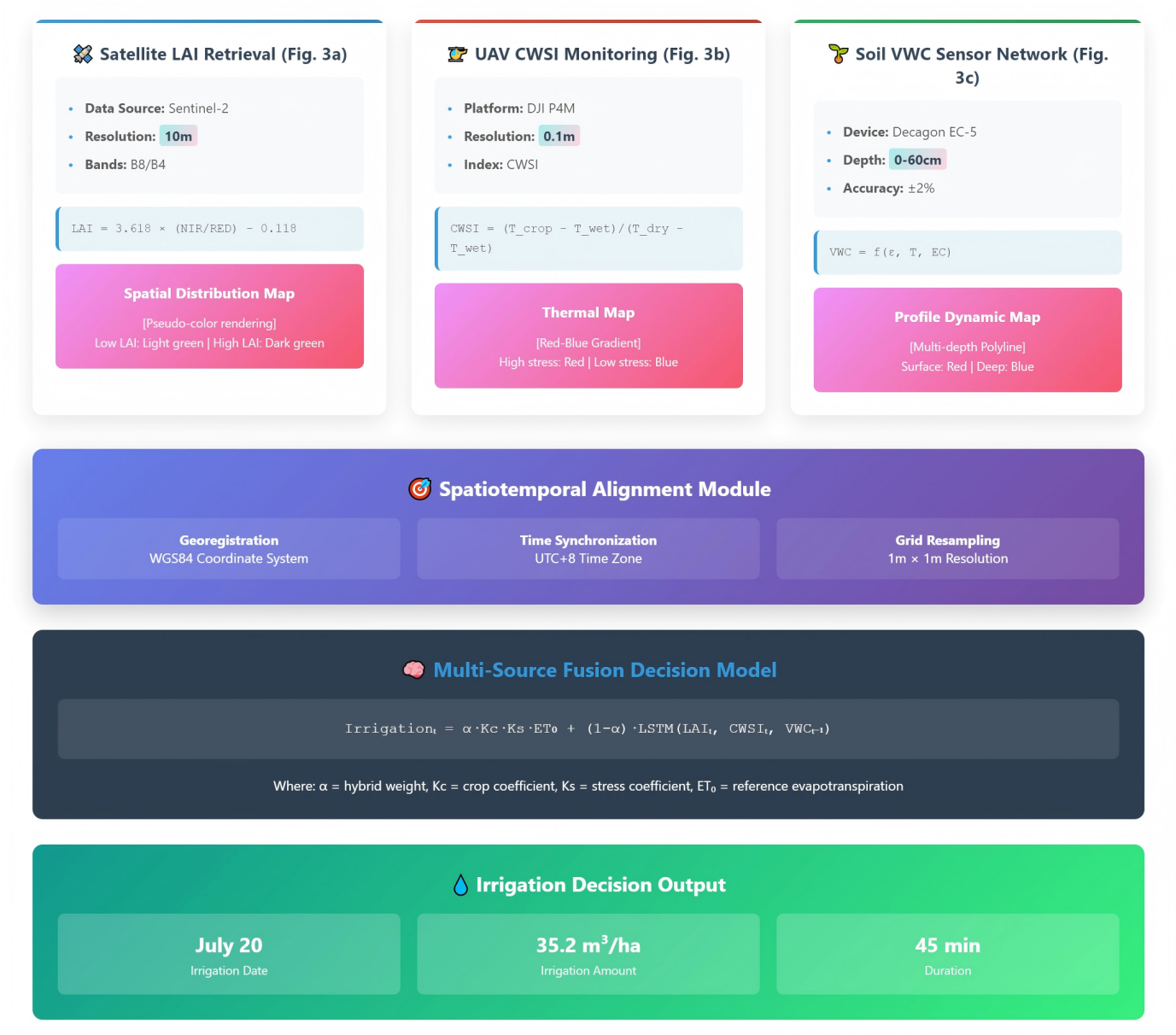
Rice cultivation accounts for 65% of agricultural water consumption in China but suffers from low irrigation water use efficiency (WUE ≈ 0.80kg/m^3) and severe nitrogen and phosphorus loss, contributing up to 30% of agricultural non-point source pollution. To address these core issues, this study developed a multi-source collaborative sensing-based Intelligent Precision Paddy Irrigation Control System (IPICS). The system integrates satellite and UAV remote sensing with IoT technologies to construct a ``sky-space-ground'' three-dimensional monitoring system, couples the FAO-56 Penman-Monteith model with LSTM deep learning algorithms to establish a dynamic irrigation decision model, and integrates a self-developed solar-powered intelligent sluice gate (AG-SOLAR-M7) for precise canal water control. A two-year field validation (2023-2024) was conducted at Youyi Farm (131.8121°E, 46.7825°N), comparing the Intelligent Precision Irrigation Control System (IPICS) with conventional flooding(each 40 ha, 3 replicates). Results demonstrated that: (1) IPICS reduced irrigation by 25.3% (625±32 mm vs. 837±41 mm, p<0.01); (2) maintained stable yield (7.0±0.4 t/ha vs. 7.1±0.5 t/ha); (3) increased WUE by 31.8% (1.12±0.08 kg/m^3 vs. 0.85±0.06 kg/m^3); (4) decreased nitrogen leaching by 57.4% (18.2±3.1 kg/ha vs. 42.7±5.9 kg/ha). The ``sensing-decision-execution'' closed-loop control of IPICS significantly enhanced water and fertilizer utilization efficiency, offering a replicable technical model and practical application for digital farmland development.
Graphical Abstract
Keywords
Data Availability Statement
Funding
Conflicts of Interest
Ethical Approval and Consent to Participate
References
- Vishwakarma, S. K., Bhattarai, B., Kothari, K., & Pandey, A. (2025). Mapping crop water productivity of rice across diverse irrigation and fertilizer rates using field experiment and UAV-based multispectral data. Remote Sensing Applications: Society and Environment, 37, 101456.
[CrossRef] [Google Scholar] - Kushwaha, N. L., Rajput, J., Sena, D. R., Elbeltagi, A., Singh, D. K., & Mani, I. (2022). Evaluation of data-driven hybrid machine learning algorithms for modelling daily reference evapotranspiration. Atmosphere-Ocean, 60(5), 519-540.
[CrossRef] [Google Scholar] - Hu, J., Chen, Y., Cai, Z., Wei, H., Zhang, X., Zhou, W., ... & Xu, B. (2023). Mapping diverse paddy rice cropping patterns in South China using harmonized Landsat and Sentinel-2 data. Remote Sensing, 15(4), 1034.
[CrossRef] [Google Scholar] - Li, Y., Cong, Z., & Yang, D. (2023). Remotely sensed soil moisture assimilation in the distributed hydrological model based on the error subspace transform Kalman filter. Remote Sensing, 15(7), 1852.
[CrossRef] [Google Scholar] - Chandel, N. S., Rajwade, Y. A., Dubey, K., Chandel, A. K., Subeesh, A., & Tiwari, M. K. (2022). Water stress identification of winter wheat crop with state-of-the-art AI techniques and high-resolution thermal-RGB imagery. Plants, 11(23), 3344.
[CrossRef] [Google Scholar] - Niranjane, V., Patil, S., Dharpure, T., Bhosle, M., & Pawar, R. (2023, December). Canal Water Data Monitoring System and Controlling System. In International Conference on Innovations in Bio-Inspired Computing and Applications (pp. 384-392). Cham: Springer Nature Switzerland.
[CrossRef] [Google Scholar] - Alumfareh, M. F., Humayun, M., Ahmad, Z., & Khan, A. (2024). An intelligent LoRaWAN-based IoT device for monitoring and control solutions in smart farming through anomaly detection integrated with unsupervised machine learning. IEEE Access, 12, 119072-119086.
[CrossRef] [Google Scholar] - Kumar, A., Sarangi, A., Singh, D. K., Mani, I., & Dash, S. (2025). Development of a digital open channel flow measuring device for surface irrigation. Water Supply, 25(4), 667-683.
[CrossRef] [Google Scholar] - Ministry of Water Resources, China. (2020). GB/T 38585-2020 Technical specification for automatic irrigation gates. Retrieved from https://openstd.samr.gov.cn/bzgk/gb/newGbInfo?hcno=A97B606386AA66BD8CF85E33E858D167
[Google Scholar] - Liu, Y., Li, D., Du, B., Shu, L., & Han, G. (2022). Rethinking sustainable sensing in agricultural Internet of Things: From power supply perspective. IEEE Wireless Communications, 29(4), 102-109.
[CrossRef] [Google Scholar] - Food and Agriculture Organization (FAO). (2023). The state of the world's land and water resources 2023. Rome. Retrieved from https://openknowledge.fao.org/items/ff3cfcc4-e895-4df0-a925-c8ce240004ab
[Google Scholar] - China’s 2022 water resources bulletin released. (2022, June 29). YICODE. Retrieved from https://www.yicode.org.cn/en/chinas-2022-water-resources-bulletin-released/
[Google Scholar] - Babel, M. S., Rahman, M., Budhathoki, A., & Chapagain, K. (2023). Optimization of economic return from water using water-energy-food nexus approach: A case of Karnafuli Basin, Bangladesh. Energy Nexus, 10, 100186.
[CrossRef] [Google Scholar] - Qin, X., & Han, X. (2023). Climate-Smart Agriculture in China: Current Status and Future Perspectives. Innovation for Environmentally-friendly Food Production and Food Safety in China, 205-231.
[CrossRef] [Google Scholar] - Qiu, H., Yang, S., Jiang, Z., Xu, Y., & Jiao, X. (2022). Effect of irrigation and fertilizer management on rice yield and nitrogen loss: A meta-analysis. Plants, 11(13), 1690.
[CrossRef] [Google Scholar] - Jiang, H., Xing, X., Meng, X., Chen, J., Yu, K., Xu, X., ... & Wu, Z. (2023). Research progress in water‐saving cultivation of rice in China. Crop Science, 63(5), 2623-2635.
[CrossRef] [Google Scholar] - Liu, S., Liu, J., Tan, X., Chen, X., & Chen, J. (2024). A hybrid Spatiotemporal Fusion Method for high spatial resolution imagery: Fusion of Gaofen-1 and Sentinel-2 over Agricultural landscapes. Journal of Remote Sensing, 4, 0159.
[CrossRef] [Google Scholar] - Yang, X., Pu, Y., Weng, S., Hou, M., & Wang, Z. (2022). Review of agricultural water-saving policies and measures in recent years–a case study of Jiangsu province, China. Water Supply, 22(4), 3951-3967.
[CrossRef] [Google Scholar] - Zhang, H., Zhang, Y. D., Huang, Y., & Wang, B. (2023). Study on water consumption and growth characteristics of rice under different irrigation modes.
[CrossRef] [Google Scholar] - National Development and Reform Commission. (2021). 14th Five-Year Plan for Modern Irrigation Construction.
[Google Scholar] - Ministry of Water Resources, China. (2021). SL/T 810-2021 Technical specification for intelligent irrigation systems.
[Google Scholar] - United Nations (UN). (2023). Sustainable Development Goal 6.4. Water Use Efficiency Reporting Guidelines.
[Google Scholar]
Cited By (2)
-
Yaojun Zhang, Guiling Wu, Jianbo Shen, Chong Xu. Precise tea leaf disease detection using UAV low-altitude remote sensing and optimized YOLO11 model.
PLOS One, 2026 , 21 (2).
[CrossRef] -
Aya Benkhada, Said Zahmoun, Fatima Zahrae Kbibech, Elhoussaine Ouabida. .
2025 International Congress on Smart Agriculture and Sustainable Systems (SmartAgri&SuSY), 2025 .
[CrossRef]
Cite This Article
TY  - JOUR
AU  - Zhang, Hongliang
AU  - Xu, Hongxi
AU  - Zhu, Meimei
AU  - Zeng, Min
AU  - Zhao, Xiaojing
AU  - Wu, Hongfeng
PY  - 2025
DA  - 2025/08/27
TI  - Research on Precision Paddy Field Irrigation Control Technology Based on Multi-Source Sensing Hybrid Model
JO  - Digital Intelligence in Agriculture
T2  - Digital Intelligence in Agriculture
JF  - Digital Intelligence in Agriculture
VL  - 1
IS  - 1
SP  - 14
EP  - 23
DO  - 10.62762/DIA.2025.680966
UR  - https://www.icck.org/article/abs/DIA.2025.680966
KW  - precision irrigation
KW  - hybrid model
KW  - multi-source data fusion
KW  - collaborative control
AB  - Rice cultivation accounts for 65% of agricultural water consumption in China but suffers from low irrigation water use efficiency (WUE ≈ 0.80kg/m^3) and severe nitrogen and phosphorus loss, contributing up to 30% of agricultural non-point source pollution. To address these core issues, this study developed a multi-source collaborative sensing-based Intelligent Precision Paddy Irrigation Control System (IPICS). The system integrates satellite and UAV remote sensing with IoT technologies to construct a ``sky-space-ground'' three-dimensional monitoring system, couples the FAO-56 Penman-Monteith model with LSTM deep learning algorithms to establish a dynamic irrigation decision model, and integrates a self-developed solar-powered intelligent sluice gate (AG-SOLAR-M7) for precise canal water control. A two-year field validation (2023-2024) was conducted at Youyi Farm (131.8121°E, 46.7825°N), comparing the Intelligent Precision Irrigation Control System (IPICS) with conventional flooding(each 40 ha, 3 replicates). Results demonstrated that: (1) IPICS reduced irrigation by 25.3% (625±32 mm vs. 837±41 mm, p
SN  - 3069-3187
PB  - Institute of Central Computation and Knowledge
LA  - English
ER  -
@article{Zhang2025Research,
  author = {Hongliang Zhang and Hongxi Xu and Meimei Zhu and Min Zeng and Xiaojing Zhao and Hongfeng Wu},
  title = {Research on Precision Paddy Field Irrigation Control Technology Based on Multi-Source Sensing Hybrid Model},
  journal = {Digital Intelligence in Agriculture},
  year = {2025},
  volume = {1},
  number = {1},
  pages = {14-23},
  doi = {10.62762/DIA.2025.680966},
  url = {https://www.icck.org/article/abs/DIA.2025.680966},
  abstract = {Rice cultivation accounts for 65\% of agricultural water consumption in China but suffers from low irrigation water use efficiency (WUE ≈ 0.80kg/m^3) and severe nitrogen and phosphorus loss, contributing up to 30\% of agricultural non-point source pollution. To address these core issues, this study developed a multi-source collaborative sensing-based Intelligent Precision Paddy Irrigation Control System (IPICS). The system integrates satellite and UAV remote sensing with IoT technologies to construct a ``sky-space-ground'' three-dimensional monitoring system, couples the FAO-56 Penman-Monteith model with LSTM deep learning algorithms to establish a dynamic irrigation decision model, and integrates a self-developed solar-powered intelligent sluice gate (AG-SOLAR-M7) for precise canal water control. A two-year field validation (2023-2024) was conducted at Youyi Farm (131.8121°E, 46.7825°N), comparing the Intelligent Precision Irrigation Control System (IPICS) with conventional flooding(each 40 ha, 3 replicates). Results demonstrated that: (1) IPICS reduced irrigation by 25.3\% (625±32 mm vs. 837±41 mm, p},
  keywords = {precision irrigation, hybrid model, multi-source data fusion, collaborative control},
  issn = {3069-3187},
  publisher = {Institute of Central Computation and Knowledge}
}
Publisher's Note
ICCK stays neutral with regard to jurisdictional claims in published maps and institutional affiliations.
Rights and Permissions
 Copyright © 2025 by the Author(s). Published by Institute of Central Computation and Knowledge. This article is an open access article distributed under the terms and conditions of the Creative Commons Attribution (CC BY) license (https://creativecommons.org/licenses/by/4.0/), which permits use, sharing, adaptation, distribution and reproduction in any medium or format, as long as you give appropriate credit to the original author(s) and the source, provide a link to the Creative Commons licence, and indicate if changes were made.

