


Digital-Intelligence Assessment of Production–Living–Ecological Spaces for Agricultural Modernization: A Case Study of Ulanqab City


Article Information
Abstract
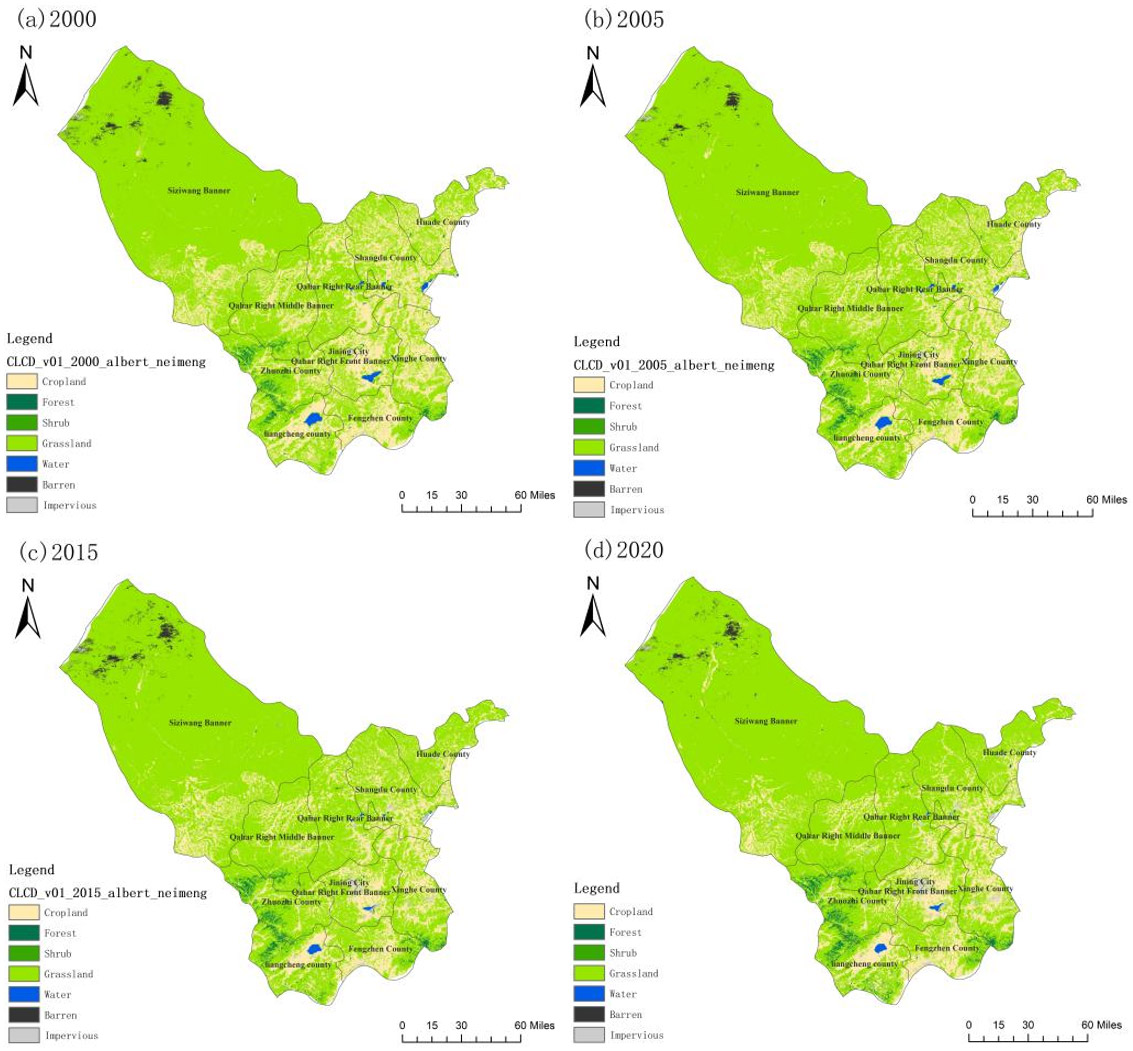
Against the backdrop of the synergistic advancement of rural revitalization and agricultural modernization, optimizing the Production-Living-Ecological (PLE) spatial pattern and introducing digital-intelligent technologies have become key pathways for enhancing sustainable rural development capabilities. This study takes Ulanqab City in Inner Mongolia, a typical agro-pastoral ecotone, as a case study. Based on multi-source remote sensing image data from 2000 to 2020, it comprehensively utilizes a coupling coordination model and spatial information technology to evaluate the evolution characteristics of its PLE spaces and the coordination mechanisms of agricultural functions, supplemented by NDVI and soil moisture data to link ecological and agricultural functions. The results indicate that the city's PLE spaces exhibit a pattern of "North-South differentiation, overall coordination," temporally evolving through three stages: "maladjustment-breaking-in-differentiation." The southern region promotes PLE synergy and urban-rural integration leveraging clean energy and smart logistics; the central region maintains functional balance through the Grain for Green program and characteristic eco-agriculture; the northern region is constrained by traditional animal husbandry and ecological degradation. Addressing regional disparities, differentiated pathways are proposed: developing "smart agriculture + digital supply chains" in the south, constructing an "ecological–intensive" intelligent animal husbandry model in the north, and establishing a remote sensing and Internet of Things (IoT) based value realization mechanism for eco-agriculture in the central region. Recommendations include enhancing agricultural digitalization levels and PLE functional coordination through spatial regulation, green technology empowerment, and ecological compensation policies, providing theoretical and data support for achieving sustainable agricultural development and modernized rural revitalization.
Graphical Abstract
Keywords
Data Availability Statement
Funding
Conflicts of Interest
Ethical Approval and Consent to Participate
References
- Hong, H. K., Xie, D., Guo, L., Hu, R., & Liao, H. (2017). Differentiation of spatial function in a mountainous rural area from a multi-functional perspective. Acta Ecol. Sin, 37, 2415-2427.
[CrossRef] [Google Scholar] - Liao, G., He, P., Gao, X., Deng, L., Zhang, H., Feng, N., ... & Deng, O. (2019). The production–living–ecological land classification system and its characteristics in the hilly area of Sichuan province, southwest China based on identification of the main functions. Sustainability, 11(6), 1600.
[CrossRef] [Google Scholar] - Hong, H. K. (2016). Research on the Rural Space Optimization of Chongqing City from a Coordination of “Sansheng” Function (Ph.D. Thesis, Southwest University, Chongqing, China, June 2016).
[Google Scholar] - Wang, W., Zhao, Y., Ma, C., & Dong, S. (2025). Identification and Analysis of Production–Living–Ecological Space Based on Multi-Source Geospatial Data: A Case Study of Xuzhou City. Sustainability, 17(3), 886.
[CrossRef] [Google Scholar] - Lian, H., Zhang, Y., Xiong, X., & Han, W. (2025). Functional Assessment of Rural Counties Under the Production–Living–Ecological Framework: Evidence from Guangdong, China. Land, 14(5), 995.
[CrossRef] [Google Scholar] - Guo, C. X., & Miao, Y. F. (2023). The Mechanism and Pathways of Digital Economy Promoting the Rural Industries Rivitalization. Journal of Beijing University of Technology (Social Science Edition), 23(1), 98-108.
[CrossRef] [Google Scholar] - Luo, G., Yang, Y., & Wang, L. (2023). Driving rural industry revitalization in the digital economy era: Exploring strategies and pathways in China. Plos one, 18(9), e0292241.
[CrossRef] [Google Scholar] - Wang, C., Yang, Y., & Zhang, Y. (2011). Economic development, rural livelihoods, and ecological restoration: Evidence from China. Ambio, 40(1), 78-87.
[CrossRef] [Google Scholar] - Ge, S., & Ma, Y. (2025). Quantifying the spatio-temporal dynamics and coupling coordination of PLE spaces in Heilongjiang's Grain Belt: a grid-based geospatial analysis. Frontiers in Ecology and Evolution, 13, 1635979.
[CrossRef] [Google Scholar] - Liu, M. Z., Zhang, H. J., Wang, Y. F., & Pei, H. W. (2021). Characteristics of habitat quality in the agro-pastoral ecotone of northern China based on land uses. Soil and Water Conservation Research, 28, 156-162.
[Google Scholar] - Yue, H., Jing, C., & Peng, W. (2021). Spatiotemporal evolution pattern and driving factors of ecological vulnerability in agro-pastoral region in northern China: a case of Yanchi County in Ningxia. Arid Land Geography, 44(4), 1175-1185.
[Google Scholar] - Cattivelli, V. (2021). Methods for the identification of urban, rural and peri-urban areas in Europe: An overview. Journal of Urban Regeneration & Renewal, 14(3), 240-246.
[CrossRef] [Google Scholar] - Wang, X., Liu, Y., Shao, Y., & Li, S. (2024). Evolution pattern and mechanism of rural areal functions in Xi'an metropolitan area, China. Habitat International, 148, 103088.
[CrossRef] [Google Scholar] - Nagireddy, S. K. (2025). Sensor-Driven Autonomy in Agriculture: A Multi-Modal Approach to Precision Farming. Journal of Computer Science and Technology Studies, 7(7), 979-986.
[CrossRef] [Google Scholar] - Zhao, W., Liang, Z., & Li, B. (2022). Realizing a rural sustainable development through a digital village construction: experiences from China. Sustainability, 14(21), 14199.
[CrossRef] [Google Scholar] - Wang, L., Zhang, G., Wang, Z., Liu, J., Shang, J., & Liang, L. (2019). Bibliometric analysis of remote sensing research trend in crop growth monitoring: A case study in China. Remote Sensing, 11(7), 809.
[CrossRef] [Google Scholar] - Mohiuddin, M., Hosseini, E., Tajpour, M., & Bahman-Zangi, B. (2024). Internet of Thing (IOT) Based Sensor Technologies and Smart Irrigation System: An Analysis of Critical Success Factors in Emerging Markets. The Journal of Developing Areas, 58(4), 167-188.
[CrossRef] [Google Scholar] - Xiang, F., & Wang, D. (2020, April). Research on operation mode of “internet plus” agricultural products intelligent supply chain. In 2020 International Conference on Urban Engineering and Management Science (ICUEMS) (pp. 208-211). IEEE.
[CrossRef] [Google Scholar] - Liu, Y., Liu, J., & Zhou, Y. (2017). Spatio-temporal patterns of rural poverty in China and targeted poverty alleviation strategies. Journal of rural studies, 52, 66-75.
[CrossRef] [Google Scholar] - Lin, G., Jiang, D., Fu, J., & Zhao, Y. (2022). A review on the overall optimization of production–living–ecological space: Theoretical basis and conceptual framework. Land, 11(3), 345.
[CrossRef] [Google Scholar] - Lyu, X., Li, X., Dang, D., Dou, H., Wang, K., & Lou, A. (2022). Unmanned aerial vehicle (UAV) remote sensing in grassland ecosystem monitoring: A systematic review. Remote Sensing, 14(5), 1096.
[CrossRef] [Google Scholar] - Xin, W. A. N. G., & Shan, H. A. I. (2024). Sustainable development scale of a typical agro-pastoral ecotone based on emergy analysis: A case study of Ulanqab City, Inner Mongolia. Arid Zone Research, 41(4), 706-715.
[CrossRef] [Google Scholar] - Borrero, J. D., & Mariscal, J. (2022). A case study of a digital data platform for the agricultural sector: A valuable decision support system for small farmers. Agriculture, 12(6), 767.
[CrossRef] [Google Scholar] - Mei, Y., Miao, J., & Lu, Y. (2022). Digital villages construction accelerates high-quality economic development in rural China through promoting digital entrepreneurship. Sustainability, 14(21), 14224.
[CrossRef] [Google Scholar] - Renting, H., Oostindie, H., Laurent, C., Brunori, G., Barjolle, D., Jervell, A., ... & Heinonen, M. (2008). Multifunctionality of agricultural activities, changing rural identities and new institutional arrangements. International Journal of Agricultural Resources, Governance and Ecology, 7(4-5), 361-385.
[CrossRef] [Google Scholar] - Chen, Y., & Wang, J. (2025). Spatiotemporal distribution of rural multifunctionality and its influencing factors: a case study of the Liaoning Coastal Economic Belt, China. Frontiers in Environmental Science, 13, 1517900.
[CrossRef] [Google Scholar] - Wang, J., Xin, L., & Wang, Y. (2020). How farmers’ non-agricultural employment affects rural land circulation in China?. Journal of Geographical Sciences, 30(3), 378-400.
[CrossRef] [Google Scholar] - Gao, Y., Tian, L., Cao, Y., Zhou, L., Li, Z., & Hou, D. (2019). Supplying social infrastructure land for satisfying public needs or leasing residential land? A study of local government choices in China. Land Use Policy, 87, 104088.
[CrossRef] [Google Scholar] - Wang, J., Wei, X., & Guo, Q. (2018). A three-dimensional evaluation model for regional carrying capacity of ecological environment to social economic development: Model development and a case study in China. Ecological indicators, 89, 348-355.
[CrossRef] [Google Scholar] - Fu, J., Bu, Z., Jiang, D., Lin, G., & Li, X. (2022). Sustainable land use diagnosis based on the perspective of production–living–ecological spaces in China. Land Use Policy, 122, 106386.
[CrossRef] [Google Scholar] - Zhang, Y., Long, H., Chen, S., Ma, L., & Gan, M. (2023). The development of multifunctional agriculture in farming regions of China: Convergence or divergence?. Land Use Policy, 127, 106576.
[CrossRef] [Google Scholar] - Zhu, Y., Zhang, Y., & Piao, H. (2022). Does agricultural mechanization improve agricultural environment efficiency? Evidence from China’s planting industry. Environmental Science and Pollution Research, 29(35), 53673-53690.
[CrossRef] [Google Scholar] - Kryszak, Ł., Świerczyńska, K., & Staniszewski, J. (2023). Measuring total factor productivity in agriculture: a bibliometric review. International Journal of Emerging Markets, 18(1), 148-172.
[CrossRef] [Google Scholar] - Ang, J. B. (2019). Agricultural legacy and individualistic culture. Journal of Economic Growth, 24(4), 397-425.
[CrossRef] [Google Scholar] - Pellegrina, H. S. (2016). The Determinants and Policy Implications of Agricultural Specialization in Brazil. Brown University, 1-56.
[Google Scholar] - Qiao, F. (2023). The impact of mechanization on crop production in China. Applied Economics, 55(15), 1728-1741.
[CrossRef] [Google Scholar] - Zheng, L., Jin, S., & Su, L. (2025). Of nothing comes nothing: the impact of agricultural comparative return on cropland abandonment. Journal of Rural Studies, 119, 103759.
[CrossRef] [Google Scholar] - Zhou, X., Tong, C., Nian, S., & Yan, J. (2024). Realization Mechanism of Farmers’ Rights and Interests Protection in the Paid Withdrawal of Rural Homesteads in China—Empirical Analysis Based on Judicial Verdicts. Land, 13(8), 1180.
[CrossRef] [Google Scholar] - Amatya, D. M., Irmak, S., Gowda, P., Sun, G., Nettles, J. E., Douglas-Mankin, K. R. (2016). Ecosystem evapotranspiration: challenges in measurements, estimates, and modeling. Transactions of the ASABE, 59(2), 555–560.
[Google Scholar] - Cao, Y., Huang, X., Liu, X., & Cao, B. (2023). Spatio-temporal evolution characteristics, development patterns, and ecological effects of “production-living-ecological space” at the city level in China. Sustainability, 15(2), 1672.
[CrossRef] [Google Scholar] - Wang, L., Lv, T., & Tan, Y. (2025). Understanding the characteristics and coupling evolution trends of the non agricultural transformation of “population-land-industry”: a case study in Nanchang City. Environment, Development and Sustainability, 1-30.
[CrossRef] [Google Scholar] - Li, Q., Ma, Z., Li, J., Li, W., Li, Y., & Yang, J. (2024). Overview of the Research Status of Intelligent Water Conservancy Technology System. Applied Sciences, 14(17), 7809.
[CrossRef] [Google Scholar] - Gong, Z., Yuan, Y., Qie, L., Huang, S., Xie, X., Zhong, R., & Pu, L. (2023). Spatiotemporal differentiation and coupling coordination relationship of the production–living–ecological function at county scale: a case study of jiangsu province. Land, 12(11), 2027.
[CrossRef] [Google Scholar] - Yi, D., Jun, L., Haodic, G., Xing, Z., Lie, Y., Maidin, S. S., ... & Wider, W. (2024). Transforming Agriculture: An Insight into Decision Support Systems in Precision Farming. Journal of Applied Data Sciences, 5(4), 1614-1624.
[CrossRef] [Google Scholar] - Cheng, C., Chen, Z., Guo, Z., & Li, N. (2023). Research and Development of Simulation Training Platform for Multi-agent Collaborative Decision-making. Journal of System Simulation, 35(12), 2669-2679.
[CrossRef] [Google Scholar] - Tiandi Tu Service Center. (n.d.). Tiandi Tu Service Center. Retrieved from https://cloudcenter.tianditu.gov.cn/administrativeDivision
[Google Scholar] - Li, X., Yu, L., Du, Z., & Liu, X. (2024). Tracking spatiotemporal dynamics of crop-specific areas through machine learning and statistics disaggregating. Earth System Science Data Discussions, 2024, 1-30. 2024
[CrossRef] [Google Scholar] - Harvard Dataverse. (n.d.). Dataset title for DOI: 10.7910/DVN/GIYGJU. Harvard Dataverse.
[CrossRef] [Google Scholar] - MOD13A2.006 Terra vegetation indices 16-Day global 1km. (n.d.). Google for Developers. Retrieved December~8,~2025, from https://developers.google.com/earth-engine/datasets/catalog/MODIS_006_MOD13A2
[Google Scholar] - Sun, H., Qian, X., & Zhao, Z. (2023). Monthly gap-filled CCI soil moisture over region of China (Combined product). Science Data Bank.
[Google Scholar] - Yang, J., & Huang, X. (2021). The 30m annual land cover dataset and its dynamics in China from 1990 to 2019. Earth System Science Data, 13(8), 3907–3925.
[CrossRef] [Google Scholar] - Fu, J., Gao, Q., Jiang, D., Li, X., & Lin, G. (2023). Spatial–temporal distribution of global production–living–ecological space during the period 2000–2020. Scientific Data, 10(1), 589.
[CrossRef] [Google Scholar]
Cite This Article
TY  - JOUR
AU  - Cui, Yuxiu
AU  - Chang, Yueming
AU  - Hong, Ying
AU  - Yan, Yuling
PY  - 2025
DA  - 2025/12/08
TI  - Digital-Intelligence Assessment of Production–Living–Ecological Spaces for Agricultural Modernization: A Case Study of Ulanqab City
JO  - Digital Intelligence in Agriculture
T2  - Digital Intelligence in Agriculture
JF  - Digital Intelligence in Agriculture
VL  - 1
IS  - 2
SP  - 61
EP  - 78
DO  - 10.62762/DIA.2025.135622
UR  - https://www.icck.org/article/abs/DIA.2025.135622
KW  - production-living-ecological (PLE) spaces
KW  - digital intelligence
KW  - agricultural modernization
KW  - coupling coordination model
KW  - Ulanqab City
AB  - Against the backdrop of the synergistic advancement of rural revitalization and agricultural modernization, optimizing the Production-Living-Ecological (PLE) spatial pattern and introducing digital-intelligent technologies have become key pathways for enhancing sustainable rural development capabilities. This study takes Ulanqab City in Inner Mongolia, a typical agro-pastoral ecotone, as a case study. Based on multi-source remote sensing image data from 2000 to 2020, it comprehensively utilizes a coupling coordination model and spatial information technology to evaluate the evolution characteristics of its PLE spaces and the coordination mechanisms of agricultural functions, supplemented by NDVI and soil moisture data to link ecological and agricultural functions. The results indicate that the city's PLE spaces exhibit a pattern of "North-South differentiation, overall coordination," temporally evolving through three stages: "maladjustment-breaking-in-differentiation." The southern region promotes PLE synergy and urban-rural integration leveraging clean energy and smart logistics; the central region maintains functional balance through the Grain for Green program and characteristic eco-agriculture; the northern region is constrained by traditional animal husbandry and ecological degradation. Addressing regional disparities, differentiated pathways are proposed: developing "smart agriculture + digital supply chains" in the south, constructing an "ecological–intensive" intelligent animal husbandry model in the north, and establishing a remote sensing and Internet of Things (IoT) based value realization mechanism for eco-agriculture in the central region. Recommendations include enhancing agricultural digitalization levels and PLE functional coordination through spatial regulation, green technology empowerment, and ecological compensation policies, providing theoretical and data support for achieving sustainable agricultural development and modernized rural revitalization.
SN  - 3069-3187
PB  - Institute of Central Computation and Knowledge
LA  - English
ER  -
@article{Cui2025DigitalInt,
  author = {Yuxiu Cui and Yueming Chang and Ying Hong and Yuling Yan},
  title = {Digital-Intelligence Assessment of Production–Living–Ecological Spaces for Agricultural Modernization: A Case Study of Ulanqab City},
  journal = {Digital Intelligence in Agriculture},
  year = {2025},
  volume = {1},
  number = {2},
  pages = {61-78},
  doi = {10.62762/DIA.2025.135622},
  url = {https://www.icck.org/article/abs/DIA.2025.135622},
  abstract = {Against the backdrop of the synergistic advancement of rural revitalization and agricultural modernization, optimizing the Production-Living-Ecological (PLE) spatial pattern and introducing digital-intelligent technologies have become key pathways for enhancing sustainable rural development capabilities. This study takes Ulanqab City in Inner Mongolia, a typical agro-pastoral ecotone, as a case study. Based on multi-source remote sensing image data from 2000 to 2020, it comprehensively utilizes a coupling coordination model and spatial information technology to evaluate the evolution characteristics of its PLE spaces and the coordination mechanisms of agricultural functions, supplemented by NDVI and soil moisture data to link ecological and agricultural functions. The results indicate that the city's PLE spaces exhibit a pattern of "North-South differentiation, overall coordination," temporally evolving through three stages: "maladjustment-breaking-in-differentiation." The southern region promotes PLE synergy and urban-rural integration leveraging clean energy and smart logistics; the central region maintains functional balance through the Grain for Green program and characteristic eco-agriculture; the northern region is constrained by traditional animal husbandry and ecological degradation. Addressing regional disparities, differentiated pathways are proposed: developing "smart agriculture + digital supply chains" in the south, constructing an "ecological–intensive" intelligent animal husbandry model in the north, and establishing a remote sensing and Internet of Things (IoT) based value realization mechanism for eco-agriculture in the central region. Recommendations include enhancing agricultural digitalization levels and PLE functional coordination through spatial regulation, green technology empowerment, and ecological compensation policies, providing theoretical and data support for achieving sustainable agricultural development and modernized rural revitalization.},
  keywords = {production-living-ecological (PLE) spaces, digital intelligence, agricultural modernization, coupling coordination model, Ulanqab City},
  issn = {3069-3187},
  publisher = {Institute of Central Computation and Knowledge}
}
Article Metrics
Publisher's Note
ICCK stays neutral with regard to jurisdictional claims in published maps and institutional affiliations.
Rights and Permissions
 Copyright © 2025 by the Author(s). Published by Institute of Central Computation and Knowledge. This article is an open access article distributed under the terms and conditions of the Creative Commons Attribution (CC BY) license (https://creativecommons.org/licenses/by/4.0/), which permits use, sharing, adaptation, distribution and reproduction in any medium or format, as long as you give appropriate credit to the original author(s) and the source, provide a link to the Creative Commons licence, and indicate if changes were made.

