

Dynamic Behavior of Cu–Water and Al2O3–Water Nanofluids in a Thermally Radiative MHD Flow Over a Porous Channel




Article Information
Abstract
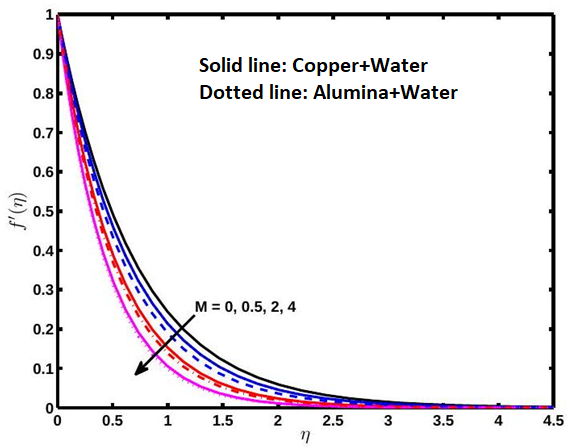
This study describes convective temperature and mass transport in a magnetohydrodynamic nanofluid moving via an absorbing channel stretched across an extensive region while being influenced by a securing region. The analytical framework incorporates a multitude of factors including heat generation, thermal radiation effects, viscous dissipation, and chemical reaction implications. The influences of porosity, warm production, thermal emission, attractive fields, sticky indulgence, and substance reactions on the flow dynamics are absolutely expounded across a spectrum of governing parameters. Furthermore, it is posited that regulation can be applied to the nanoparticle volume segment at the boundary interface. Two specific varieties of nanofluids, specifically Copper-Water (Cu-H2O) with Aluminium Oxide-Water (Al2O3-H2O), are engaged in the scrutiny. The sensible challenge is mathematically articulated as approaches of nonlinear differential equations, which are subsequently resolved arithmetically employing the fourth-order Runge-Kutta procedure in sequence with the shooting approach. A proportional assessment of our findings with formerly published occasions in the scholarly prose reveals a significant degree of concordance.
Graphical Abstract
Keywords
Data Availability Statement
Funding
Conflicts of Interest
Ethical Approval and Consent to Participate
References
- Crane, L. J. (1970). Flow past a stretching plate. Zeitschrift für angewandte Mathematik und Physik ZAMP, 21(4), 645-647.
[CrossRef] [Google Scholar] - Khan, W. A., & Pop, I. (2010). Boundary-layer flow of a nanofluid past a stretching sheet. International journal of heat and mass transfer, 53(11-12), 2477-2483.
[CrossRef] [Google Scholar] - Abd El-Aziz, M. (2008). Thermal-diffusion and diffusion-thermo effects on combined heat and mass transfer by hydromagnetic three-dimensional free convection over a permeable stretching surface with radiation. Physics Letters A, 372(3), 263-272.
[CrossRef] [Google Scholar] - Hady, F. M., Ibrahim, F. S., Abdel-Gaied, S. M., & Eid, M. R. (2012). Radiation effect on viscous flow of a nanofluid and heat transfer over a nonlinearly stretching sheet. Nanoscale Research Letters, 7(1), 229.
[CrossRef] [Google Scholar] - Bachok, N., Ishak, A., & Pop, I. (2012). Unsteady boundary-layer flow and heat transfer of a nanofluid over a permeable stretching/shrinking sheet. International Journal of Heat and Mass Transfer, 55(7-8), 2102-2109.
[CrossRef] [Google Scholar] - Rohni, A. M., Ahmad, S., & Pop, I. (2012). Flow and heat transfer over an unsteady shrinking sheet with suction in nanofluids. International Journal of Heat and Mass Transfer, 55(7-8), 1888-1895.
[CrossRef] [Google Scholar] - Buongiorno, J. (2006). Convective transport in nanofluids.
[CrossRef] [Google Scholar] - Sandhya, A., Ramana Reddy, G. V., & Deekshitulu, V. S. R. G. (2020). Heat and mass transfer effects on MHD flow past an inclined porous plate in the presence of chemical reaction. International Journal of Applied Mechanics and Engineering, 25(3).
[CrossRef] [Google Scholar] - Murthy, P. V. S. N., & Singh, P. (1997). Effect of viscous dissipation on a non-Darcy natural convection regime. International journal of heat and mass transfer, 40(6), 1251-1260.
[CrossRef] [Google Scholar] - Motsa, S. S. (2014). A new spectral relaxation method for similarity variable nonlinear boundary layer flow systems. Chemical Engineering Communications, 201(2), 241-256.
[CrossRef] [Google Scholar] - Gladys, T., & Reddy, G. R. (2022). Contributions of variable viscosity and thermal conductivity on the dynamics of non-Newtonian nanofluids flow past an accelerating vertical plate. Partial Diff. Eq. Appl. Math, 5, 100264.
[CrossRef] [Google Scholar] - Vijaya, K., & Reddy, G. V. R. (2019). Magnetohydrodynamic Casson fluid flow over a vertical porous plate in the presence of radiation, Soret and chemical reaction effects. Journal of Nanofluids, 8(6), 1240-1248.
[CrossRef] [Google Scholar] - Oztop, H. F., & Abu-Nada, E. (2008). Numerical study of natural convection in partially heated rectangular enclosures filled with nanofluids. International journal of heat and fluid flow, 29(5), 1326-1336.
[CrossRef] [Google Scholar] - Brinkman, H. C. (1952). The viscosity of concentrated suspensions and solutions. Journal of chemical physics, 20(4), 571-571.
[CrossRef] [Google Scholar] - Maxwell-Garnett, J. C. (1904). XII. Colours in metal glasses and in metallic films. Philosophical Transactions of the Royal Society of London. Series A, Containing Papers of a Mathematical or Physical Character, 203(359-371), 385-420.
[CrossRef] [Google Scholar] - Abu-Nada, E. (2008). Application of nanofluids for heat transfer enhancement of separated flows encountered in a backward facing step. International Journal of Heat and Fluid Flow, 29(1), 242-249.
[CrossRef] [Google Scholar] - Hamad, M. A. A. (2011). Analytical solution of natural convection flow of a nanofluid over a linearly stretching sheet in the presence of magnetic field. International communications in heat and mass transfer, 38(4), 487-492.
[CrossRef] [Google Scholar] - Kameswaran, P. K., Narayana, M., Sibanda, P., & Murthy, P. V. S. N. (2012). Hydromagnetic nanofluid flow due to a stretching or shrinking sheet with viscous dissipation and chemical reaction effects. International Journal of Heat and Mass Transfer, 55(25-26), 7587-7595.
[CrossRef] [Google Scholar] - Grubka, L. J., & Bobba, K. M. (1985). Heat transfer characteristics of a continuous stretching surface with variable temperature. Journal of Heat Transfer, 107(1), 248-250.
[CrossRef] [Google Scholar] - Pattnaik, P. K., Shamshuddin, M. D., Mishra, S. R., & Panda, S. (2025). Exploring Darcy dissipation modulation of nanofluid with titanium dioxide (TiO2) and copper (Cu) for enhanced thermal performance in a vertical sheet. Case Studies in Thermal Engineering, 68, 105904.
[CrossRef] [Google Scholar] - Dhange, M., Devi, C. U., Jamshed, W., Eid, M. R., Ramesh, K., Shamshuddin, M. D., ... & Batool, K. (2024). Studying the effect of various types of chemical reactions on hydrodynamic properties of dispersion and peristaltic flow of couple-stress fluid: Comprehensive examination. Journal of Molecular Liquids, 409, 125542.
[CrossRef] [Google Scholar] - Shamshuddin, M. D., Panda, S., Salawu, S. O., Mishra, S. R., & Patil, V. S. (2025). Analysis of Casson ternary nanofluid integration under various thermal physical impacts with Cattaneo-Christov model: Exploring magnified heat transfer in stretchy surface. International Journal of Hydrogen Energy, 101, 450-460.
[CrossRef] [Google Scholar] - Panda, S., Shamshuddin, M. D., Mishra, S. R., Khan, U., Ishak, A., Salawu, S. O., & Pattnaik, P. K. (2024). Computation of Fe3O4-CoFe2O4 hybrid nanofluid flow in stretchable (Shrinkable) wedge with Variant magnetized force and heat generation. Engineering Science and Technology, an International Journal, 58, 101839.
[CrossRef] [Google Scholar] - Biswas, N., Mandal, D. K., Manna, N. K., & Benim, A. C. (2023). Enhanced energy and mass transport dynamics in a thermo-magneto-bioconvective porous system containing oxytactic bacteria and nanoparticles: cleaner energy application. Energy, 263, 125775.
[CrossRef] [Google Scholar] - Ganji, D. D., Mahboobtosi, M., & Chari, F. N. (2025). Three-dimensional flow analysis of penta and ternary-hybrid nanofluids over an elongating sheet with thermal radiation and gyrotactic microorganisms. Scientific Reports, 15(1), 24396.
[CrossRef] [Google Scholar] - Rasool, G., Shah, N. A., El-Zahar, E. R., & Wakif, A. (2025). Numerical investigation of EMHD nanofluid flows over a convectively heated riga pattern positioned horizontally in a Darcy-Forchheimer porous medium: Application of passive control strategy and generalized transfer laws. Waves in Random and Complex Media, 35(3), 6039-6058.
[CrossRef] [Google Scholar] - Hussain, S., Jamal, M., Maatki, C., Ghachem, K., & Kolsi, L. (2021). MHD mixed convection of Al$_2$O$_3$–Cu–water hybrid nanofluid in a wavy channel with incorporated fixed cylinder. Journal of Thermal Analysis and Calorimetry, 144(6), 2219-2233.
[CrossRef] [Google Scholar] - Vinoth Kumar, B., & Poornima, T. (2025). Analysis of Jeffrey fluid over a vertical porous plate in Keller box method. Multiscale and Multidisciplinary Modeling, Experiments and Design, 8(8), 1-18.
[CrossRef] [Google Scholar] - Dibaji, A. S., Rashidi, A., Baniyaghoob, S., & Shahrabadi, A. (2022). Synthesizing CNT-TiO2 nanocomposite and experimental pore-scale displacement of crude oil during nanofluid flooding. Petroleum Exploration and Development, 49(6), 1430-1439.
[CrossRef] [Google Scholar] - Obalalu, A. M., Shah, S. H. A. M., Darvesh, A., Khan, U., Ishak, A., Adegbite, P., ... & Galal, A. M. (2024). Insight into the Hamilton and Crosser model for ternary hybrid nanofluid flow over a Riga wedge with heterogeneous catalytic reaction. The European Physical Journal Special Topics, 1-22.
[CrossRef] [Google Scholar] - Osman, S., Amidu, M. A., Afgan, I., & Addad, Y. (2024). Experimental study of boiling heat transfer of inclined down-ward facing heated curved wall under low flow and pressure conditions. Applied Thermal Engineering, 236, 121706.
[CrossRef] [Google Scholar] - Zhai, X., Ding, S., Cheng, Y., Jin, Y., & Cheng, Y. (2010). CFD simulation with detailed chemistry of steam reforming of methane for hydrogen production in an integrated micro-reactor. International Journal of Hydrogen Energy, 35(11), 5383-5392.
[CrossRef] [Google Scholar] - Varun Kumar, R. S., Sowmya, G., Jayaprakash, M. C., Prasannakumara, B. C., Khan, M. I., Guedri, K., ... & Galal, A. M. (2022). Assessment of thermal distribution through an inclined radiative-convective porous fin of concave profile using generalized residual power series method (GRPSM). Scientific Reports, 12(1), 13275.
[CrossRef] [Google Scholar] - Veclani, D., Tolazzi, M., & Melchior, A. (2020). Molecular interpretation of pharmaceuticals’ adsorption on carbon nanomaterials: theory meets experiments. Processes, 8(6), 642.
[CrossRef] [Google Scholar] - Ijaz Khan, M., Qayyum, S., Nigar, M., Chu, Y. M., & Kadry, S. (2023). Dynamics of Arrhenius activation energy in flow of Carreau fluid subject to Brownian motion diffusion. Numerical Methods for Partial Differential Equations, 39(6), 4468-4488.
[CrossRef] [Google Scholar] - Harby, K., Ali, E. S., & Almohammadi, K. M. (2021). A novel combined reverse osmosis and hybrid absorption desalination-cooling system to increase overall water recovery and energy efficiency. Journal of Cleaner Production, 287, 125014.
[CrossRef] [Google Scholar] - Raju, C. S. K., Sandeep, N., & Malvandi, A. (2016). Free convective heat and mass transfer of MHD non-Newtonian nanofluids over a cone in the presence of non-uniform heat source/sink. Journal of Molecular Liquids, 221, 108-115.
[CrossRef] [Google Scholar] - Virk, K., Sharma, K., Kapil, S., Kumar, V., Sharma, V., Pandey, S., & Kumar, V. (2022). Synthesis of gum acacia-silver nanoparticles based hydrogel composites and their comparative anti-bacterial activity. Journal of Polymer Research, 29(4), 118.
[CrossRef] [Google Scholar] - Zahoor Raja, M. A., Shoaib, M., El-Zahar, E. R., Hussain, S., Li, Y. M., Khan, M. I., ... & Malik, M. Y. (2025). Heat transport in entropy-optimized flow of viscoelastic fluid due to Riga plate: analysis of artificial neural network. Waves in Random and Complex Media, 35(1), 1077-1096.
[CrossRef] [Google Scholar] - Upendra Lambe, U. L., Minakshi, P., Basanti Brar, B. B., Madhusudan Guray, M. G., Ikbal, I., Koushlesh Ranjan, K. R., ... & Manimegalai, J. (2016). Nanodiagnostics: a new frontier for veterinary and medical sciences.
[Google Scholar] - Puneeth, V., Khan, M. I., Narayan, S. S., El-Zahar, E. R., & Guedri, K. (2025). The impact of the movement of the gyrotactic microorganisms on the heat and mass transfer characteristics of Casson nanofluid. Waves in Random and Complex Media, 35(2), 3852-3875.
[CrossRef] [Google Scholar]
Cited By (11)
-
K.Ganesh Kumar, Ali B.M. Ali, M.S. Sarvajith, V.S. Sampath Kumar, Dana Mohammad Khidhir, Dilsora Abduvalieva, M. Ijaz Khan. Bio-magnetic fluid dynamics: Analyzing thermophoretic particle deposition in biomedical applications via RKF-45 technique.
Next Materials, 2026 , 11 .
[CrossRef] -
Ghulam Rasool, Ali B. M. Ali, Thirupathi Thumma, Noorullah Noori, Sandiri Rajendar, Abduvali Sottarov, Zokir Mamadiyarov, Lamia Abu El Maati. Optimizing thermal dynamics of magnetohydrodynamic copper-titania hybrid nanofluids for energy and industrial applications in porous structures.
Journal of Thermal Analysis and Calorimetry, 2026 .
[CrossRef] -
K. Sudarmozhi, Ali B.M. Ali, R. Raghavendran, Khayrilla Kurbonov, Gaganjot Kaur, Mirjalol Ismoilov, M.Ijaz Khan. Exploring Maxwell fluid behavior: A systematic review of methods, geometries, and applications.
South African Journal of Chemical Engineering, 2026 , 57 .
[CrossRef] -
Zakir Hussain, Adeel Shah, Mushtaq K. Abdalrahem, Mehboob Ali, Waqar Azeem Khan, Mirjalol Ismoilov, Rakhmonjon Akhmadjonov, Taseer Muhammad. Instability of MHD Poiseuille flow of nanoparticles Fe2O3 in water cylinder flow.
Results in Surfaces and Interfaces, 2026 , 23 .
[CrossRef] -
Pradeep G. Janthe, Jagadish V. Tawade, Eatedal Alabdulkreem, Abduvali Sottarov, Ilkhom Khaydarov, M.Ijaz Khan. Thermocapillary-driven thin film flow with Joule heating and slip in a magnetized porous medium.
South African Journal of Chemical Engineering, 2026 , 57 .
[CrossRef] -
Thirupathi Thumma, Ali B.M. Ali, Rajendar Sandiri, Ghulam Rasool, Mirjalol Ismoilov, Noorullah Noori, Farkhod Rakhmonov. Coupled particle-fluid dynamics of hybrid ferrite nanofluids in porous media under MHD and radiative effects.
Hybrid Advances, 2026 , 13 .
[CrossRef] -
Idrees Khan, Zhi Ling, Tiri Chinyoka, Muhammad Sohaib, Ahmed Ahmed Ibrahim. Entropy Generation in Unsteady Flow of a Ternary Nanofluid With Chemical Reaction, Thermal Radiation, Magnetic Field, and Darcy Effects in a Porous Microchannel Subject to Convective Cooling and Uniform Suction/Injection.
ZAMM - Journal of Applied Mathematics and Mechanics / Zeitschrift für Angewandte Mathematik und Mechanik, 2026 , 106 (7).
[CrossRef] -
Meysam Atashafrooz, Elham Sadat Behineh. Entropy generation characteristics of radiative magnetic hybrid nanofluid flow through a recessed channel.
Hybrid Advances, 2026 , 13 .
[CrossRef] -
S. Ravikumar, Ali B.M. Ali, Raghunath Kodi, Ghulam Rasool, Umid Turdialiyev, Dilsora Abduvalieva, M.Ijaz Khan, Nidhal Ben Khedher. Computational modeling of peristaltic blood flow in a tapered channel with radiative heat flux and reaction mechanisms.
South African Journal of Chemical Engineering, 2026 , 55 .
[CrossRef] -
T. Salahuddin, Aqib Ali, Muhammad Awais, Mair Khan, Nissren Tamam, Nidhal Ben Khedher. Double layer stratifications of Carreau Yasuda fluid flow in cylindrical system along with activation energy.
Dynamics of Atmospheres and Oceans, 2025 , 112 .
[CrossRef] -
M. Salman Kausar, Ali B.M. Ali, Talha Anwar, M. Nasir, S. Saleem, M. Waqas, Tadesse Walelign. Thermal energy optimization in Darcy-Forchheimer slip flow featuring viscoplastic (Casson) model subjected to diffusion of chemically reactive species.
Case Studies in Thermal Engineering, 2025 , 76 .
[CrossRef]
Cite This Article
TY  - JOUR
AU  - Anupama, Anumolu
AU  - Kalyani, U. Venkata
AU  - Reddy, G. Venkata Ramana
AU  - Ganteda, Charankumar
AU  - Govindan, Vediyappan
AU  - Rasool, Ghulam
AU  - Khan, Muhammad Ijaz
PY  - 2025
DA  - 2025/08/20
TI  - Dynamic Behavior of Cu–Water and  Al2O3–Water Nanofluids in a Thermally Radiative MHD Flow Over a Porous Channel
JO  - International Journal of Thermo-Fluid Systems and Sustainable Energy
T2  - International Journal of Thermo-Fluid Systems and Sustainable Energy
JF  - International Journal of Thermo-Fluid Systems and Sustainable Energy
VL  - 1
IS  - 1
SP  - 3
EP  - 15
DO  - 10.62762/IJTSSE.2025.532667
UR  - https://www.icck.org/article/abs/IJTSSE.2025.532667
KW  - MHD
KW  - porous media
KW  - thermal radiation
KW  - skin-friction
KW  - eckert number
AB  - This study describes convective temperature and mass transport in a magnetohydrodynamic nanofluid moving via an absorbing channel stretched across an extensive region while being influenced by a securing region. The analytical framework incorporates a multitude of factors including heat generation, thermal radiation effects, viscous dissipation, and chemical reaction implications. The influences of porosity, warm production, thermal emission, attractive fields, sticky indulgence, and substance reactions on the flow dynamics are absolutely expounded across a spectrum of governing parameters. Furthermore, it is posited that regulation can be applied to the nanoparticle volume segment at the boundary interface. Two specific varieties of nanofluids, specifically Copper-Water (Cu-H2O) with Aluminium Oxide-Water (Al2O3-H2O), are engaged in the scrutiny. The sensible challenge is mathematically articulated as approaches of nonlinear differential equations, which are subsequently resolved arithmetically employing the fourth-order Runge-Kutta procedure in sequence with the shooting approach. A proportional assessment of our findings with formerly published occasions in the scholarly prose reveals a significant degree of concordance.
SN  - 3069-1877
PB  - Institute of Central Computation and Knowledge
LA  - English
ER  -
@article{Anupama2025Dynamic,
  author = {Anumolu Anupama and U. Venkata Kalyani and G. Venkata Ramana Reddy and Charankumar Ganteda and Vediyappan Govindan and Ghulam Rasool and Muhammad Ijaz Khan},
  title = {Dynamic Behavior of Cu–Water and Al2O3–Water Nanofluids in a Thermally Radiative MHD Flow Over a Porous Channel},
  journal = {International Journal of Thermo-Fluid Systems and Sustainable Energy},
  year = {2025},
  volume = {1},
  number = {1},
  pages = {3-15},
  doi = {10.62762/IJTSSE.2025.532667},
  url = {https://www.icck.org/article/abs/IJTSSE.2025.532667},
  abstract = {This study describes convective temperature and mass transport in a magnetohydrodynamic nanofluid moving via an absorbing channel stretched across an extensive region while being influenced by a securing region. The analytical framework incorporates a multitude of factors including heat generation, thermal radiation effects, viscous dissipation, and chemical reaction implications. The influences of porosity, warm production, thermal emission, attractive fields, sticky indulgence, and substance reactions on the flow dynamics are absolutely expounded across a spectrum of governing parameters. Furthermore, it is posited that regulation can be applied to the nanoparticle volume segment at the boundary interface. Two specific varieties of nanofluids, specifically Copper-Water (Cu-H2O) with Aluminium Oxide-Water (Al2O3-H2O), are engaged in the scrutiny. The sensible challenge is mathematically articulated as approaches of nonlinear differential equations, which are subsequently resolved arithmetically employing the fourth-order Runge-Kutta procedure in sequence with the shooting approach. A proportional assessment of our findings with formerly published occasions in the scholarly prose reveals a significant degree of concordance.},
  keywords = {MHD, porous media, thermal radiation, skin-friction, eckert number},
  issn = {3069-1877},
  publisher = {Institute of Central Computation and Knowledge}
}
Publisher's Note
ICCK stays neutral with regard to jurisdictional claims in published maps and institutional affiliations.
Rights and Permissions
 Copyright © 2025 by the Author(s). Published by Institute of Central Computation and Knowledge. This article is an open access article distributed under the terms and conditions of the Creative Commons Attribution (CC BY) license (https://creativecommons.org/licenses/by/4.0/), which permits use, sharing, adaptation, distribution and reproduction in any medium or format, as long as you give appropriate credit to the original author(s) and the source, provide a link to the Creative Commons licence, and indicate if changes were made.


Portico
