

Heat and Momentum Transfer in MHD Boundary Layer Flow with Radiation and Heat Source/Sink Effects


Article Information
Abstract
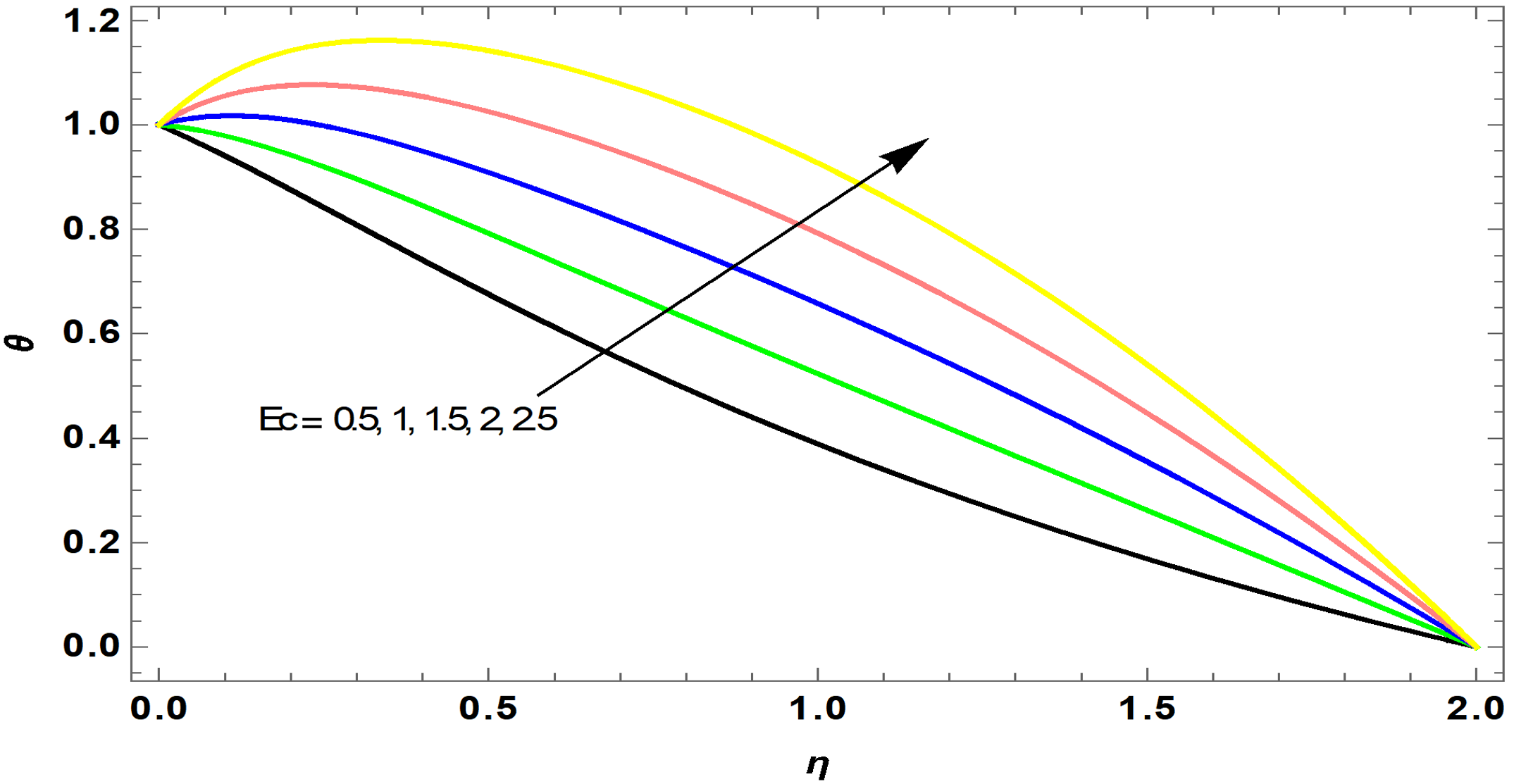
The porosity parameter serves as a pivotal factor in determining the resistance exerted by a porous medium on fluid motion, especially in magnetohydrodynamic (MHD) flows. This study presents a novel numerical investigation of the coupled influence of porosity, viscous dissipation, and Joule heating on both momentum and thermal boundary layers over a porous surface. The results demonstrate that increasing porosity enhances medium permeability, thereby reducing hydrodynamic drag and intensifying the velocity gradient near the stagnation region. Conversely, lower porosity impedes fluid penetration, resulting in diminished velocity and a compressed boundary layer structure. While the direct impact of porosity on thermal transport is minimal, its interaction with dissipative effects leads to subtle modifications in temperature distribution. The graphical and quantitative findings underscore the importance of fine-tuning the porosity parameter to regulate flow resistance and thermal behaviour in advanced MHD systems. The methodology employed based on robust numerical simulations offers a comprehensive framework for analysing porous flow dynamics in engineering and energy applications, highlighting the novelty of integrating complex interdependencies between porosity and thermophysical mechanisms.
Graphical Abstract
Keywords
Data Availability Statement
Funding
Conflicts of Interest
Ethical Approval and Consent to Participate
References
- Crane, L. J. (1970). Flow past a stretching plate. Zeitschrift für Angewandte Mathematik und Physik (ZAMP), 21(4), 645–647.
[CrossRef] [Google Scholar] - Carragher, P., & Crane, L. (1982). Heat transfer on a continuous stretching sheet. Zeitschrift für Angewandte Mathematik und Mechanik, 62(10), 564–565.
[CrossRef] [Google Scholar] - Zhu, A., Ali, H., Ishaq, M., Junaid, M. S., Raza, J., & Amjad, M. (2022). Numerical study of heat and mass transfer for Williamson nanofluid over stretching/shrinking sheet along with Brownian and thermophoresis effects. Energies, 15(16), 5926.
[CrossRef] [Google Scholar] - Siddheshwar, P. G., & Mahabaleswar, U. S. (2005). Effects of radiation and heat source on MHD flow of a viscoelastic liquid and heat transfer over a stretching sheet. International Journal of Non-Linear Mechanics, 40(6), 807–820.
[CrossRef] [Google Scholar] - Hayat, T., Qayyum, S., Alsaedi, A., & Shafiq, A. (2016). Inclined magnetic field and heat source/sink aspects in flow of nanofluid with nonlinear thermal radiation. International Journal of Heat and Mass Transfer, 103, 99–107.
[CrossRef] [Google Scholar] - Makinde, O. D., Mabood, F., & Ibrahim, M. S. (2018). Chemically reacting on MHD boundary-layer flow of nanofluids over a non-linear stretching sheet with heat source/sink and thermal radiation. Thermal Science, 22(1B), 495–506.
[CrossRef] [Google Scholar] - Abel, M. S., & Nandeppanavar, M. M. (2009). Heat transfer in MHD viscoelastic boundary layer flow over a stretching sheet with non-uniform heat source/sink. Communications in Nonlinear Science and Numerical Simulation, 14(5), 2120–2131.
[CrossRef] [Google Scholar] - Damala, C. K., Bhumarapu, V., & Makinde, O. D. (2021). Radiative MHD Walter’s liquid-B flow past a semi-infinite vertical plate in the presence of viscous dissipation with a heat source. Engineering Transactions, 69(4), 373–401.
[CrossRef] [Google Scholar] - Salahuddin, T., Malik, M. Y., Hussain, A., Bilal, S., & Awais, M. (2015). Effects of transverse magnetic field with variable thermal conductivity on tangent hyperbolic fluid with exponentially varying viscosity. AIP Advances, 5(12), 127103.
[CrossRef] [Google Scholar] - Khader, M. M. (2019). The numerical solution for BVP of the liquid film flow over an unsteady stretching sheet with thermal radiation and magnetic field using the finite element method. International Journal of Modern Physics C, 30(11), 1950080.
[CrossRef] [Google Scholar] - Farooq, U., Tahir, M., Waqas, H., Muhammad, T., Alshehri, A., & Imran, M. (2022). Investigation of 3D flow of magnetized hybrid nanofluid with heat source/sink over a stretching sheet. Scientific Reports, 12, 12254.
[CrossRef] [Google Scholar] - Vijayaragavan, R., & Karthikeyan, S. (2017). Joule heating and thermal radiation effects on chemically reacting Casson fluid past a vertical plate with variable magnetic field. Research Journal of Engineering and Technology, 8(4), 393–404.
[CrossRef] [Google Scholar] - Seth, G. S., Sharma, R., Kumbhakar, B., & Tripathi, R. (2017). MHD stagnation point flow over exponentially stretching sheet with exponentially moving free-stream, viscous dissipation, thermal radiation and non-uniform heat source/sink. Diffusion foundations, 11, 182-190.
[CrossRef] [Google Scholar] - Thiagarajan, M., & Kumar, M. D. (2019). Heat source/sink and chemical reaction effects on MHD and heat transfer flow of radiative nanofluid over a porous exponentially stretching sheet with viscous dissipation and ohmic heating. Int. J. Basic Sci. Appl. Comput, 2, 5-12.
[Google Scholar] - Shateyi, S., & Marewo, G. T. (2014). On a new numerical analysis of the Hall effect on MHD flow and heat transfer over an unsteady stretching permeable surface in the presence of thermal radiation and heat source/sink. Boundary Value Problems, 2014(1), 170.
[CrossRef] [Google Scholar] - Krishnaiah, M., Rajendar, P., Laxmi, T. V., & Reddy, M. C. K. (2017). Influence of non-uniform heat source/sink on stagnation point flow of a MHD Casson nanofluid flow over an exponentially stretching surface. Global Journal of Pure and Applied Mathematics, 13(10), 7009–7033.
[Google Scholar] - Mishra, S. R., Baag, S., Dash, G. C., & Acharya, M. R. (2020). Numerical approach to MHD flow of power-law fluid on a stretching sheet with non-uniform heat source. Nonlinear Engineering, 9(1), 81–93.
[CrossRef] [Google Scholar] - Kumar, S. G., Varma, S. V. K., Prasad, P. D., Raju, C. S. K., Makinde, O. D., & Sharma, R. (2018). MHD reacting and radiating 3-D flow of Maxwell fluid past a stretching sheet with heat source/sink and Soret effects in a porous medium. Defect and Diffusion Forum, 387, 145–156.
[CrossRef] [Google Scholar] - Guled, C. N., Tawade, J. V., Nandeppanavar, M. M., & Saraf, A. R. (2022). MHD slip flow and heat transfer of UCM fluid with the effect of suction/injection due to stretching sheet: OHAM solution. Heat Transfer, 51(5), 3201–3218.
[CrossRef] [Google Scholar] - Benal, S. S., Tawade, J. V., Biradar, M. M., & Allasi, H. L. (2022). Effects of the magnetohydrodynamic flow within the boundary layer of a jeffery fluid in a porous medium over a shrinking/stretching sheet. Mathematical Problems in Engineering, 2022(1), 7326504.
[CrossRef] [Google Scholar] - Mahabaleshwar, U. S., Vinay Kumar, P. N., & Sheremet, M. (2016). Magnetohydrodynamics flow of a nanofluid driven by a stretching/shrinking sheet with suction. SpringerPlus, 5(1), 1901.
[CrossRef] [Google Scholar] - Anwar, T., Kumam, P., Khan, I., & Thounthong, P. (2022). Thermal analysis of MHD convective slip transport of fractional Oldroyd-B fluid over a plate. Mechanics of Time-Dependent Materials, 26(2), 431-462.
[CrossRef] [Google Scholar] - Siva, T., Dubey, D., & Jangili, S. (2024). Rotational flow dynamics of electroosmotic transport of couple stress fluid in a microfluidic channel under electromagnetohydrodynamic and slip-dependent zeta potential effects. Physics of Fluids, 36(9).
[CrossRef] [Google Scholar] - Zhang, W., Zhu, Q., Zhan, H., Huang, G., & Wang, Q. (2020). A critical review of non-Darcian flow and future challenges. Earth and Space Science Open Archive ESSOAr.
[CrossRef] [Google Scholar] - Huang, H., & Ayoub, J. (2008). Applicability of the Forchheimer equation for non-Darcy flow in porous media. Spe Journal, 13(01), 112-122.
[CrossRef] [Google Scholar] - Pal, D., & Mondal, H. (2011). The influence of thermal radiation on hydromagnetic Darcy-Forchheimer mixed convection flow past a stretching sheet embedded in a porous medium. Meccanica, 46(4), 739-753.
[CrossRef] [Google Scholar] - Babaelahi, M., & Sadri, S. (2024). Magneto-Hydro-Dynamic Generator with Joule Heating and Viscous Dissipation: An Analytic Investigation of Mixed Convection Flow. Arabian Journal for Science and Engineering, 49(8), 11445-11455.
[CrossRef] [Google Scholar]
Cited By (2)
-
Abha Singh, Khan Hina, Umar Nazir, M.A. Ahmed, Seham M. Al-Mekhlafi, Hakim AL Garalleh, Ahmed M. Galal. Combine optimizations of rheologically complex fluids using a multiscale hybrid nanofluid across a vertical stretching/ shrinking disk: Response surface method.
International Journal of Thermofluids, 2026 , 33 .
[CrossRef] -
Shahid Rafiq, Ali B. M. Ali, Salma Aslam, F. F. Al-Harbi, Hameed Ullah, Dilsora Abduvalieva, Nadia Batool. Modeling and Simulation of Radiated Upper Convected Maxwell Fluid Flow in a Parallel Plate Channel.
Journal of Vibration Engineering & Technologies, 2025 , 13 (8).
[CrossRef]
Cite This Article
TY  - JOUR
AU  - Govindan, Vediyappan
PY  - 2025
DA  - 2025/08/24
TI  - Heat and Momentum Transfer in MHD Boundary Layer Flow with Radiation and Heat Source/Sink Effects
JO  - International Journal of Thermo-Fluid Systems and Sustainable Energy
T2  - International Journal of Thermo-Fluid Systems and Sustainable Energy
JF  - International Journal of Thermo-Fluid Systems and Sustainable Energy
VL  - 1
IS  - 1
SP  - 39
EP  - 45
DO  - 10.62762/IJTSSE.2025.817838
UR  - https://www.icck.org/article/abs/IJTSSE.2025.817838
KW  - porosity parameter
KW  - magnetohydrodynamic (MHD) flows
KW  - viscous dissipation
KW  - joule heating
KW  - numerical simulations
AB  - The porosity parameter serves as a pivotal factor in determining the resistance exerted by a porous medium on fluid motion, especially in magnetohydrodynamic (MHD) flows. This study presents a novel numerical investigation of the coupled influence of porosity, viscous dissipation, and Joule heating on both momentum and thermal boundary layers over a porous surface. The results demonstrate that increasing porosity enhances medium permeability, thereby reducing hydrodynamic drag and intensifying the velocity gradient near the stagnation region. Conversely, lower porosity impedes fluid penetration, resulting in diminished velocity and a compressed boundary layer structure. While the direct impact of porosity on thermal transport is minimal, its interaction with dissipative effects leads to subtle modifications in temperature distribution. The graphical and quantitative findings underscore the importance of fine-tuning the porosity parameter to regulate flow resistance and thermal behaviour in advanced MHD systems. The methodology employed based on robust numerical simulations offers a comprehensive framework for analysing porous flow dynamics in engineering and energy applications, highlighting the novelty of integrating complex interdependencies between porosity and thermophysical mechanisms.
SN  - 3069-1877
PB  - Institute of Central Computation and Knowledge
LA  - English
ER  -
@article{Govindan2025Heat,
  author = {Vediyappan Govindan},
  title = {Heat and Momentum Transfer in MHD Boundary Layer Flow with Radiation and Heat Source/Sink Effects},
  journal = {International Journal of Thermo-Fluid Systems and Sustainable Energy},
  year = {2025},
  volume = {1},
  number = {1},
  pages = {39-45},
  doi = {10.62762/IJTSSE.2025.817838},
  url = {https://www.icck.org/article/abs/IJTSSE.2025.817838},
  abstract = {The porosity parameter serves as a pivotal factor in determining the resistance exerted by a porous medium on fluid motion, especially in magnetohydrodynamic (MHD) flows. This study presents a novel numerical investigation of the coupled influence of porosity, viscous dissipation, and Joule heating on both momentum and thermal boundary layers over a porous surface. The results demonstrate that increasing porosity enhances medium permeability, thereby reducing hydrodynamic drag and intensifying the velocity gradient near the stagnation region. Conversely, lower porosity impedes fluid penetration, resulting in diminished velocity and a compressed boundary layer structure. While the direct impact of porosity on thermal transport is minimal, its interaction with dissipative effects leads to subtle modifications in temperature distribution. The graphical and quantitative findings underscore the importance of fine-tuning the porosity parameter to regulate flow resistance and thermal behaviour in advanced MHD systems. The methodology employed based on robust numerical simulations offers a comprehensive framework for analysing porous flow dynamics in engineering and energy applications, highlighting the novelty of integrating complex interdependencies between porosity and thermophysical mechanisms.},
  keywords = {porosity parameter, magnetohydrodynamic (MHD) flows, viscous dissipation, joule heating, numerical simulations},
  issn = {3069-1877},
  publisher = {Institute of Central Computation and Knowledge}
}
Publisher's Note
ICCK stays neutral with regard to jurisdictional claims in published maps and institutional affiliations.
Rights and Permissions
 Copyright © 2025 by the Author(s). Published by Institute of Central Computation and Knowledge. This article is an open access article distributed under the terms and conditions of the Creative Commons Attribution (CC BY) license (https://creativecommons.org/licenses/by/4.0/), which permits use, sharing, adaptation, distribution and reproduction in any medium or format, as long as you give appropriate credit to the original author(s) and the source, provide a link to the Creative Commons licence, and indicate if changes were made.


Portico
