

Heat Transportation During Slip Flow of Non-Newtonian Rheology with Thermal Stratification past a Stretched Surface



Article Information
Abstract
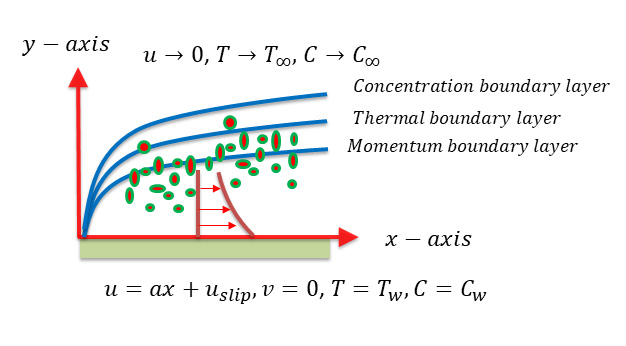
This study investigates heat transportation in slip flow of a non-Newtonian fluid with thermal stratification over a stretched surface, a configuration that closely represents many industrial and engineering processes. The inclusion of slip effects and non-Newtonian rheology provides a more realistic description of flows encountered in polymer extrusion, coating technologies, micro- and nano-scale devices, and biomedical systems. Thermal stratification is incorporated to model non-uniform temperature environments commonly observed in heat exchangers, cooling of electronic components, and energy systems. The governing partial differential equations for momentum, energy, and nanoparticle concentration are transformed into a system of nonlinear ordinary differential equations using appropriate similarity transformations. The resulting boundary value problem is solved numerically to analyze the impact of key parameters such as the slip coefficient, thermal stratification parameter, Sutterby fluid parameter, and Brownian motion on velocity, temperature, and concentration profiles. Results indicate that thermal stratification significantly reduces the temperature distribution within the boundary layer, while velocity slip at the surface diminishes the skin friction coefficient. The non-Newtonian characteristics of the Sutterby fluid substantially influence the heat transfer rate, with shear-thinning fluids demonstrating enhanced thermal performance compared to shear-thickening fluids. This analysis provides valuable insights for thermal engineering applications involving non-Newtonian nanofluids in stratified environments.
Graphical Abstract
Keywords
Data Availability Statement
Funding
Conflicts of Interest
AI Use Statement
Ethical Approval and Consent to Participate
References
- Choi, S. U. (1995, November). Enhancing thermal conductivity of fluids with nanoparticles. In ASME international mechanical engineering congress and exposition (Vol. 17421, pp. 99-105). American Society of Mechanical Engineers.
[CrossRef] [Google Scholar] - Xuan, Y., & Li, Q. (2000). Heat transfer enhancement of nanofluids. International Journal of Heat and Fluid Flow, 21(1), 58–64.
[CrossRef] [Google Scholar] - Buongiorno, J. (2006). Convective transport in nanofluids. Journal of Heat Transfer, 128(3), 240–250.
[CrossRef] [Google Scholar] - Kuznetsov, A. V., & Nield, D. A. (2010). Natural convective boundary-layer flow of a nanofluid past a vertical plate. International Journal of Thermal Sciences, 49(2), 243-247.
[CrossRef] [Google Scholar] - Makinde, O. D., & Aziz, A. (2011). Boundary layer flow of a nanofluid past a stretching sheet with a convective boundary condition. International Journal of Thermal Sciences, 50(7), 1326-1332.
[CrossRef] [Google Scholar] - Mustafa, M., Hayat, T., Pop, I., Asghar, S., & Obaidat, S. (2011). Stagnation-point flow of a nanofluid towards a stretching sheet. International Journal of Heat and Mass Transfer, 54(25-26), 5588-5594.
[CrossRef] [Google Scholar] - Ibrahim, W., Shankar, B., & Nandeppanavar, M. M. (2013). MHD stagnation point flow and heat transfer due to nanofluid towards a stretching sheet. International journal of heat and mass transfer, 56(1-2), 1-9.
[CrossRef] [Google Scholar] - Hamad, M. A. A., & Ferdows, M. (2012). Similarity solution of boundary layer stagnation-point flow towards a heated porous stretching sheet saturated with a nanofluid with heat absorption/generation and suction/blowing: a Lie group analysis. Communications in Nonlinear Science and Numerical Simulation, 17(1), 132-140.
[CrossRef] [Google Scholar] - Hayat, T., Imtiaz, M., & Alsaedi, A. (2016). Magnetohydrodynamic flow of nanofluid over permeable stretching sheet with convective boundary conditions. Thermal science, 20(6), 1835-1845.
[CrossRef] [Google Scholar] - Pop, I., Roşca, N. C., & Roşca, A. V. (2018). MHD stagnation-point flow and heat transfer of a nanofluid over a stretching/shrinking sheet with melting, convective heat transfer and second-order slip. International Journal of Numerical Methods for Heat & Fluid Flow, 28(9), 2089–2110.
[CrossRef] [Google Scholar] - Aly, E. H., & Pop, I. (2020). MHD flow and heat transfer near stagnation point over a stretching/shrinking surface with partial slip and viscous dissipation: Hybrid nanofluid versus nanofluid. Powder Technology, 367, 192–205.
[CrossRef] [Google Scholar] - Waqas, H., Farooq, U., Liu, D., Abid, M., Imran, M., & Muhammad, T. (2022). Heat transfer analysis of hybrid nanofluid flow with thermal radiation through a stretching sheet: A comparative study. International Communications in Heat and Mass Transfer, 138, 106303.
[CrossRef] [Google Scholar] - Iqbal, J., & Abbasi, F. M. (2025). Convective heat transfer analysis for magnetohydrodynamics Reiner–Philippoff nanofluid flow over a curved stretching surface: non-similar solution. Multidiscipline Modeling in Materials and Structures, 21(2), 405-424.
[CrossRef] [Google Scholar] - Hashim, Bouzgarrou, S., Rehman, S., & Sabi, E. (2023). Thermodynamic analysis of Powell-Eyring-blood hybrid nanofluid through vertical stretching sheet with interface slip and melting heat. Results in Engineering, 20, 101644.
[CrossRef] [Google Scholar] - Turkyilmazoglu, M. (2024). Two models on the unsteady heat and fluid flow induced by stretching or shrinking sheets and novel time-dependent solutions. Journal of Heat and Mass Transfer, 146(10), 101802.
[CrossRef] [Google Scholar] - Hassani, M., Tabar, M. M., Nemati, H., Domairry, G., & Noori, F. (2011). An analytical solution for boundary layer flow of a nanofluid past a stretching sheet. International Journal of Thermal Sciences, 50(11), 2256-2263.
[CrossRef] [Google Scholar] - Khan, W. A., & Pop, I. (2010). Boundary-layer flow of a nanofluid past a stretching sheet. International journal of heat and mass transfer, 53(11-12), 2477-2483.
[CrossRef] [Google Scholar] - Bhattacharyya, K., Mukhopadhyay, S., & Layek, G. C. (2011). MHD boundary layer slip flow and heat transfer over a flat plate. Chinese Physics Letters, 28(2), 024701.
[CrossRef] [Google Scholar] - Waseem, F., Sohail, M., & Singh, A. (2024). Entropy analysis of three-dimensional stretched magnetized hybrid nanofluid with thermal radiation and heat generation. BioNanoScience, 14(2), 547-565.
[CrossRef] [Google Scholar] - Waseem, F., Sohail, M., Ilyas, N., Awwad, E. M., Sharaf, M., Khan, M. J., & Tulu, A. (2024). Entropy analysis of MHD hybrid nanoparticles with OHAM considering viscous dissipation and thermal radiation. Scientific Reports, 14(1), 1096.
[CrossRef] [Google Scholar] - Rashidi, M. M., Ganesh, N. V., Hakeem, A. A., & Ganga, B. (2014). Buoyancy effect on MHD flow of nanofluid over a stretching sheet in the presence of thermal radiation. Journal of Molecular liquids, 198, 234-238.
[CrossRef] [Google Scholar] - Ibrahim, W., & Shankar, B. (2013). MHD boundary layer flow and heat transfer of a nanofluid past a permeable stretching sheet with velocity, thermal and solutal slip boundary conditions. Computers & Fluids, 75, 1-10.
[CrossRef] [Google Scholar] - Andersson, H. I. (2002). Slip flow past a stretching surface. Acta Mechanica, 158(1), 121-125.
[CrossRef] [Google Scholar] - Wang, C. Y. (2002). Flow due to a stretching boundary with partial slip—an exact solution of the Navier–Stokes equations. Chemical Engineering Science, 57(17), 3745-3747.
[CrossRef] [Google Scholar] - Wang, C. Y. (2006). Stagnation slip flow and heat transfer on a moving plate. Chemical Engineering Science, 61(23), 7668-7672.
[CrossRef] [Google Scholar] - Wu, L. (2008). A slip model for rarefied gas flows at arbitrary Knudsen number. Applied Physics Letters, 93(25), 053103.
[CrossRef] [Google Scholar] - Fang, T., Zhang, J., & Yao, S. (2009). Slip MHD viscous flow over a stretching sheet–an exact solution. Communications in Nonlinear Science and Numerical Simulation, 14(11), 3731-3737.
[CrossRef] [Google Scholar] - Hayat, T., Qasim, M., & Mesloub, S. (2011). MHD flow and heat transfer over permeable stretching sheet with slip conditions. International Journal for Numerical Methods in Fluids, 66(8), 963-975.
[CrossRef] [Google Scholar] - Aziz, A. (2010). Hydrodynamic and thermal slip flow boundary layer over a flat plate with constant heat flux boundary condition. Communications in Nonlinear Science and Numerical Simulation, 15(3), 573–580.
[CrossRef] [Google Scholar] - Fang, T., Yao, S., Zhang, J., & Aziz, A. (2010). Viscous flow over a shrinking sheet with a second order slip flow model. Communications in Nonlinear Science and Numerical Simulation, 15(7), 1831-1842.
[CrossRef] [Google Scholar] - Nandeppanavar, M. M., Vajravelu, K., Abel, M. S., & Siddalingappa, M. N. (2012). Second order slip flow and heat transfer over a stretching sheet with non-linear Navier boundary condition. International Journal of Thermal Sciences, 58, 143-150.
[CrossRef] [Google Scholar] - Turkyilmazoglu, M. (2012). Exact analytical solutions for heat and mass transfer of MHD slip flow in nanofluids. Chemical Engineering Science, 84, 182-187.
[CrossRef] [Google Scholar] - Alsaedi, A., Awais, M., & Hayat, T. (2012). Effects of heat generation/absorption on stagnation point flow of nanofluid over a surface with convective boundary conditions. Communications in Nonlinear Science and Numerical Simulation, 17(11), 4210-4223.
[CrossRef] [Google Scholar] - Sutterby, J. L. (1965). Laminar converging flow of dilute polymer solutions in conical sections. II. Transactions of the Society of Rheology, 9(2), 227-241.
[CrossRef] [Google Scholar] - Mir, N. A., Farooq, M., Rizwan, M., Ahmad, F., Ahmad, S., & Ahmad, B. (2020). Analysis of thermally stratified flow of Sutterby nanofluid with zero mass flux condition. Journal of Materials Research and Technology, 9(2), 1631-1639.
[CrossRef] [Google Scholar]
Cited By (4)
-
Beeram Vasu, N. Pothanna, Bitla Hari Prasad, Adigoppula Raju. A computational investigation on thermo-viscous steady flow between extremely stretched parallel flat plates with suction/injection.
International Journal of Thermofluids, 2026 , 35 .
[CrossRef] -
ZAREEN ZAFAR, MUBBASHAR NAZEER, ZULFIQAR ALI, KHAYRILLA KURBONOV, DALIA H. ELKAMCHOUCHI, HALA A. HEJAZI. THERMAL AND FLOW CHARACTERISTICS OF TWO-PHASE ELLIS FLUID IN A SYMMETRIC WAVY CHANNEL: APPLICATIONS TO BIOMEDICAL SYSTEMS.
Journal of Mechanics in Medicine and Biology, 2026 .
[CrossRef] -
Imran Abbasi, Waqar Azeem Khan, Muhammad Naeem, Brijesh Kumar Chaurasia, Pardeep Singh Bains, Harjot Singh Gill, Gafur Abdulakimov, Mehboob Ali. Analysis of melting heat-mass characteristics of Sutterby nanofluid flow based on design of intelligent-based neuro-structures.
Results in Surfaces and Interfaces, 2026 , 24 .
[CrossRef] -
Muhammad Waqas Ashraf, Zhoushun Zheng, Dalia H. Elkamchouchi, S. Saadaoui, Muyassar Norberdiyeva, Hala A. Hejazi. Influence of surface corrugation and magnetic field on nanofluid heat transfer and flow structure in confined geometries.
Journal of Thermal Analysis and Calorimetry, 2026 .
[CrossRef]
Cite This Article
TY  - JOUR
AU  - Hashim
AU  - Mehmood, Kashif
AU  - Afzal, Bilal Sher
PY  - 2026
DA  - 2026/03/28
TI  - Heat Transportation During Slip Flow of Non-Newtonian Rheology with Thermal Stratification past a Stretched Surface
JO  - International Journal of Thermo-Fluid Systems and Sustainable Energy
T2  - International Journal of Thermo-Fluid Systems and Sustainable Energy
JF  - International Journal of Thermo-Fluid Systems and Sustainable Energy
VL  - 2
IS  - 1
SP  - 18
EP  - 29
DO  - 10.62762/IJTSSE.2025.505390
UR  - https://www.icck.org/article/abs/IJTSSE.2025.505390
KW  - non-Newtonian Sutterby model
KW  - nanofluids
KW  - thermal stratification
KW  - buongiorno’s model
KW  - heat transport
AB  - This study investigates heat transportation in slip flow of a non-Newtonian fluid with thermal stratification over a stretched surface, a configuration that closely represents many industrial and engineering processes. The inclusion of slip effects and non-Newtonian rheology provides a more realistic description of flows encountered in polymer extrusion, coating technologies, micro- and nano-scale devices, and biomedical systems. Thermal stratification is incorporated to model non-uniform temperature environments commonly observed in heat exchangers, cooling of electronic components, and energy systems. The governing partial differential equations for momentum, energy, and nanoparticle concentration are transformed into a system of nonlinear ordinary differential equations using appropriate similarity transformations. The resulting boundary value problem is solved numerically to analyze the impact of key parameters such as the slip coefficient, thermal stratification parameter, Sutterby fluid parameter, and Brownian motion on velocity, temperature, and concentration profiles. Results indicate that thermal stratification significantly reduces the temperature distribution within the boundary layer, while velocity slip at the surface diminishes the skin friction coefficient. The non-Newtonian characteristics of the Sutterby fluid substantially influence the heat transfer rate, with shear-thinning fluids demonstrating enhanced thermal performance compared to shear-thickening fluids. This analysis provides valuable insights for thermal engineering applications involving non-Newtonian nanofluids in stratified environments.
SN  - 3069-1877
PB  - Institute of Central Computation and Knowledge
LA  - English
ER  -
@article{Hashim2026Heat,
  author = {Hashim and Kashif Mehmood and Bilal Sher Afzal},
  title = {Heat Transportation During Slip Flow of Non-Newtonian Rheology with Thermal Stratification past a Stretched Surface},
  journal = {International Journal of Thermo-Fluid Systems and Sustainable Energy},
  year = {2026},
  volume = {2},
  number = {1},
  pages = {18-29},
  doi = {10.62762/IJTSSE.2025.505390},
  url = {https://www.icck.org/article/abs/IJTSSE.2025.505390},
  abstract = {This study investigates heat transportation in slip flow of a non-Newtonian fluid with thermal stratification over a stretched surface, a configuration that closely represents many industrial and engineering processes. The inclusion of slip effects and non-Newtonian rheology provides a more realistic description of flows encountered in polymer extrusion, coating technologies, micro- and nano-scale devices, and biomedical systems. Thermal stratification is incorporated to model non-uniform temperature environments commonly observed in heat exchangers, cooling of electronic components, and energy systems. The governing partial differential equations for momentum, energy, and nanoparticle concentration are transformed into a system of nonlinear ordinary differential equations using appropriate similarity transformations. The resulting boundary value problem is solved numerically to analyze the impact of key parameters such as the slip coefficient, thermal stratification parameter, Sutterby fluid parameter, and Brownian motion on velocity, temperature, and concentration profiles. Results indicate that thermal stratification significantly reduces the temperature distribution within the boundary layer, while velocity slip at the surface diminishes the skin friction coefficient. The non-Newtonian characteristics of the Sutterby fluid substantially influence the heat transfer rate, with shear-thinning fluids demonstrating enhanced thermal performance compared to shear-thickening fluids. This analysis provides valuable insights for thermal engineering applications involving non-Newtonian nanofluids in stratified environments.},
  keywords = {non-Newtonian Sutterby model, nanofluids, thermal stratification, buongiorno’s model, heat transport},
  issn = {3069-1877},
  publisher = {Institute of Central Computation and Knowledge}
}
Publisher's Note
ICCK stays neutral with regard to jurisdictional claims in published maps and institutional affiliations.
Rights and Permissions
 Copyright © 2026 by the Author(s). Published by Institute of Central Computation and Knowledge. This article is an open access article distributed under the terms and conditions of the Creative Commons Attribution (CC BY) license (https://creativecommons.org/licenses/by/4.0/), which permits use, sharing, adaptation, distribution and reproduction in any medium or format, as long as you give appropriate credit to the original author(s) and the source, provide a link to the Creative Commons licence, and indicate if changes were made.


Portico
