

Modeling and Simulation of Oil Film Influence on Hydraulic Piston Pump Vibrations


Article Information
Abstract
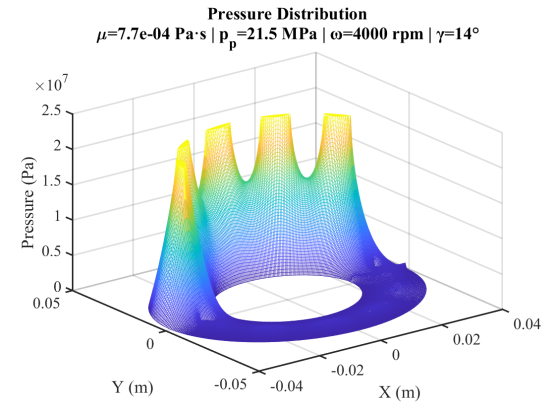
This paper presents a coupled numerical-analytical framework for investigating the influence of the oil film dynamics on the vibration characteristics of the hydraulic piston pump. A finite difference solver is developed to compute the hydrodynamic pressure distribution in the distribution plate under realistic operating conditions, from which equivalent stiffness and damping coefficients are extracted using analytical squeeze-film relations and integrated into a single-degree-of-freedom vibration model. For the baseline case (\( \mu = 7.7 \times 10^{-4} \, \text{Pa·s}, \, \omega = 4000 \, \text{rpm}, \, p_p = 21.5 \, \text{MPa}, \, \gamma = 14^\circ \)), the simulation yields a mean pressure of \( 4.72 \, \text{MPa} \) and a stable mean oil film thickness of \( 5.70 \times 10^{-4} \, \text{m} \), resulting in a calibrated stiffness of \( 1.97 \times 10^7 \, \text{N·m}^{-1} \) and a damping coefficient of \( 3.21 \times 10^{-4} \, \text{N·s·m}^{-1} \). Two coefficient extraction methods are compared; although they reveal consistent trends across operating conditions, they differ by several orders of magnitude, highlighting the sensitivity of dynamic coefficient estimation to modeling assumptions. The vibration analysis yields a natural frequency of approximately \( 6.56 \, \text{kHz} \) and a near-zero damping ratio across all operating conditions investigated. These results demonstrate that while the oil film provides substantial elastic support, its intrinsic damping capacity is insufficient for passive vibration suppression, underscoring the necessity of additional structural or fluid-borne damping mechanisms in the design of low-vibration hydraulic pumps.
Graphical Abstract
Keywords
Data Availability Statement
Funding
Conflicts of Interest
AI Use Statement
Ethical Approval and Consent to Participate
References
- Ivantysyn, J., & Ivantysynova, M. (2001). Hydrostatic Pumps and Motors: Principles, Design, Performance, Modelling, Analysis, Control and Testing. Fluid Power Net Publications.
[Google Scholar] - Manring, N. (2013). Fluid power pumps and motors: analysis, design, and control (pp. 107-116). New York, NY, USA: McGraw-Hill Education. https://www.mheducation.com/highered/mhp/product/fluid-power-pumps-motors-analysis-design-control.html
[Google Scholar] - Milind, T. R., & Mitra, M. (2016). A study on the dynamics and vibration behavior of an axial piston pump using combined MBD/FE approach. Procedia engineering, 144, 452-460.
[CrossRef] [Google Scholar] - Wang, W. (2017). Vibration model and characteristic analysis of hydraulic piston pump. Chemical Engineering Transactions, 59, 61-66.
[CrossRef] [Google Scholar] - Ye, S., Zhang, J., Wang, X., Tang, H., & Zhang, Y. (2021). A theoretical dynamic model to study the vibration response characteristics of an axial piston pump. Mechanical Systems and Signal Processing, 150, 107237.
[CrossRef] [Google Scholar] - Ye, S., Zhang, J., Xu, B., Zhu, S., Xiang, J., & Tang, H. (2019). Theoretical investigation of the contributions of the excitation forces to the vibration of an axial piston pump. Mechanical Systems and Signal Processing, 129, 201-217.
[CrossRef] [Google Scholar] - Ying, P., Tang, H., Chen, L., Ren, Y., & Kumar, A. (2023). Dynamic modeling and vibration characteristics of multibody system in axial piston pump. Alexandria Engineering Journal, 62, 523-540.
[CrossRef] [Google Scholar] - Hamrock, B. J., Schmid, S. R., & Jacobson, B. O. (2004). Fundamentals of fluid film lubrication. CRC press.
[CrossRef] [Google Scholar] - Zhou, C., & Xiao, Z. (2018). Stiffness and damping models for the oil film in line contact elastohydrodynamic lubrication and applications in the gear drive. Applied Mathematical Modelling, 61, 634-649.
[CrossRef] [Google Scholar] - Zhang, Y., Liu, H., Zhu, C., Liu, M., & Song, C. (2016). Oil film stiffness and damping in an elastohydrodynamic lubrication line contact-vibration. Journal of Mechanical Science and Technology, 30(7), 3031-3039.
[CrossRef] [Google Scholar] - Wang, Z., Hu, S., Ji, H., Wang, Z., & Liu, X. (2018). Analysis of lubricating characteristics of valve plate pair of a piston pump. Tribology International, 126, 49-64.
[CrossRef] [Google Scholar] - Pelosi, M., & Ivantysynova, M. (2012). Heat Transfer and Thermal Elastic Deformation Analysis on the Piston/Cylinder Interface of Axial Piston Machines. Journal of Tribology, 134(4).
[CrossRef] [Google Scholar] - Yongling, F. U., Jiming, M. A., Jian, F. U., Qun, C. H. A. O., & Yan, W. A. N. G. (2021). Review of cylinder block/valve plate interface in axial piston pumps: Theoretical models, experimental investigations, and optimal design. Chinese Journal of Aeronautics, 34(1), 111-134.
[CrossRef] [Google Scholar] - Shengrong, G. U. O., Jinhua, C. H. E. N., Yueliang, L. U., Yan, W. A. N. G., & Hongkang, D. O. N. G. (2020). Hydraulic piston pump in civil aircraft: Current status, future directions and critical technologies. Chinese Journal of Aeronautics, 33(1), 16-30.
[CrossRef] [Google Scholar] - Peixin, G. A. O., Tao, Y. U., Jiao, W. A. N. G., \& Jingyu, Z. H. A. I. (2021). Vibration analysis and control technologies of hydraulic pipeline system in aircraft: A review. \textit{Chinese Journal of Aeronautics, 34}(4), 83-114.
[CrossRef] [Google Scholar] - Milind, T. R., & Mitra, M. (2016). A study on the flexible multibody dynamic modeling of an axial piston pump considering housing flexibility. Procedia Engineering, 144, 1234-1241.
[CrossRef] [Google Scholar] - Ye, S., Sun, Y., Zhang, J., Chen, J., Xu, B., Zhao, S., & Liu, H. (2025). A new coupled dynamic model to study the vibration and lubrication characteristics of slipper/swash-plate interface in an axial piston pump. Proceedings of the Institution of Mechanical Engineers, Part J: Journal of Engineering Tribology, 239(8), 1026-1049.
[CrossRef] [Google Scholar] - Wu, H., Wang, T., Zhang, X., & Wang, D. (2026). Mechanical hydraulic coupling modeling and dynamic behavior analysis of piston pump. Journal of the Brazilian Society of Mechanical Sciences and Engineering, 48(5), 340.
[CrossRef] [Google Scholar] - Xiao, Z., Li, Z., Shi, X., & Zhou, C. (2018). Oil film damping analysis in non-Newtonian transient thermal elastohydrodynamic lubrication for gear transmission. Journal of Applied Mechanics, 85(3), 035001.
[CrossRef] [Google Scholar] - Tsuha, N. A. H., & Cavalca, K. L. (2020). Stiffness and damping of elastohydrodynamic line contact applied to cylindrical roller bearing dynamic model. Journal of Sound and Vibration, 481, 115444.
[CrossRef] [Google Scholar]
Cite This Article
TY  - JOUR
AU  - Berger, Avae
AU  - Ma, Jiming
AU  - Zhang, Yunrui
AU  - Tian, Xiangxiang
PY  - 2026
DA  - 2026/06/04
TI  - Modeling and Simulation of Oil Film Influence on Hydraulic Piston Pump Vibrations
JO  - International Journal of Thermo-Fluid Systems and Sustainable Energy
T2  - International Journal of Thermo-Fluid Systems and Sustainable Energy
JF  - International Journal of Thermo-Fluid Systems and Sustainable Energy
VL  - 2
IS  - 2
SP  - 51
EP  - 62
DO  - 10.62762/IJTSSE.2026.808760
UR  - https://www.icck.org/article/abs/IJTSSE.2026.808760
KW  - oil film
KW  - piston pump
KW  - dynamic coefficients
KW  - vibrations
AB  - This paper presents a coupled numerical-analytical framework for investigating the influence of the oil film dynamics on the vibration characteristics of the hydraulic piston pump. A finite difference solver is developed to compute the hydrodynamic pressure distribution in the distribution plate under realistic operating conditions, from which equivalent stiffness and damping coefficients are extracted using analytical squeeze-film relations and integrated into a single-degree-of-freedom vibration model. For the baseline case (\( \mu = 7.7 \times 10^{-4} \, \text{Pa·s}, \, \omega = 4000 \, \text{rpm}, \, p_p = 21.5 \, \text{MPa}, \, \gamma = 14^\circ \)), the simulation yields a mean pressure of \( 4.72 \, \text{MPa} \) and a stable mean oil film thickness of \( 5.70 \times 10^{-4} \, \text{m} \), resulting in a calibrated stiffness of \( 1.97 \times 10^7 \, \text{N·m}^{-1} \) and a damping coefficient of \( 3.21 \times 10^{-4} \, \text{N·s·m}^{-1} \). Two coefficient extraction methods are compared; although they reveal consistent trends across operating conditions, they differ by several orders of magnitude, highlighting the sensitivity of dynamic coefficient estimation to modeling assumptions. The vibration analysis yields a natural frequency of approximately \( 6.56 \, \text{kHz} \) and a near-zero damping ratio across all operating conditions investigated. These results demonstrate that while the oil film provides substantial elastic support, its intrinsic damping capacity is insufficient for passive vibration suppression, underscoring the necessity of additional structural or fluid-borne damping mechanisms in the design of low-vibration hydraulic pumps.
SN  - 3069-1877
PB  - Institute of Central Computation and Knowledge
LA  - English
ER  -
@article{Berger2026Modeling,
  author = {Avae Berger and Jiming Ma and Yunrui Zhang and Xiangxiang Tian},
  title = {Modeling and Simulation of Oil Film Influence on Hydraulic Piston Pump Vibrations},
  journal = {International Journal of Thermo-Fluid Systems and Sustainable Energy},
  year = {2026},
  volume = {2},
  number = {2},
  pages = {51-62},
  doi = {10.62762/IJTSSE.2026.808760},
  url = {https://www.icck.org/article/abs/IJTSSE.2026.808760},
  abstract = {This paper presents a coupled numerical-analytical framework for investigating the influence of the oil film dynamics on the vibration characteristics of the hydraulic piston pump. A finite difference solver is developed to compute the hydrodynamic pressure distribution in the distribution plate under realistic operating conditions, from which equivalent stiffness and damping coefficients are extracted using analytical squeeze-film relations and integrated into a single-degree-of-freedom vibration model. For the baseline case (\( \mu = 7.7 \times 10^{-4} \, \text{Pa·s}, \, \omega = 4000 \, \text{rpm}, \, p\_p = 21.5 \, \text{MPa}, \, \gamma = 14^\circ \)), the simulation yields a mean pressure of \( 4.72 \, \text{MPa} \) and a stable mean oil film thickness of \( 5.70 \times 10^{-4} \, \text{m} \), resulting in a calibrated stiffness of \( 1.97 \times 10^7 \, \text{N·m}^{-1} \) and a damping coefficient of \( 3.21 \times 10^{-4} \, \text{N·s·m}^{-1} \). Two coefficient extraction methods are compared; although they reveal consistent trends across operating conditions, they differ by several orders of magnitude, highlighting the sensitivity of dynamic coefficient estimation to modeling assumptions. The vibration analysis yields a natural frequency of approximately \( 6.56 \, \text{kHz} \) and a near-zero damping ratio across all operating conditions investigated. These results demonstrate that while the oil film provides substantial elastic support, its intrinsic damping capacity is insufficient for passive vibration suppression, underscoring the necessity of additional structural or fluid-borne damping mechanisms in the design of low-vibration hydraulic pumps.},
  keywords = {oil film, piston pump, dynamic coefficients, vibrations},
  issn = {3069-1877},
  publisher = {Institute of Central Computation and Knowledge}
}
Article Metrics
Publisher's Note
ICCK stays neutral with regard to jurisdictional claims in published maps and institutional affiliations.
Rights and Permissions
 Copyright © 2026 by the Author(s). Published by Institute of Central Computation and Knowledge. This article is an open access article distributed under the terms and conditions of the Creative Commons Attribution (CC BY) license (https://creativecommons.org/licenses/by/4.0/), which permits use, sharing, adaptation, distribution and reproduction in any medium or format, as long as you give appropriate credit to the original author(s) and the source, provide a link to the Creative Commons licence, and indicate if changes were made.


Portico
