


Mechanisms and Optimization Design of Flow-Induced Vibration Energy Harvesting: A Review



Article Information
Abstract
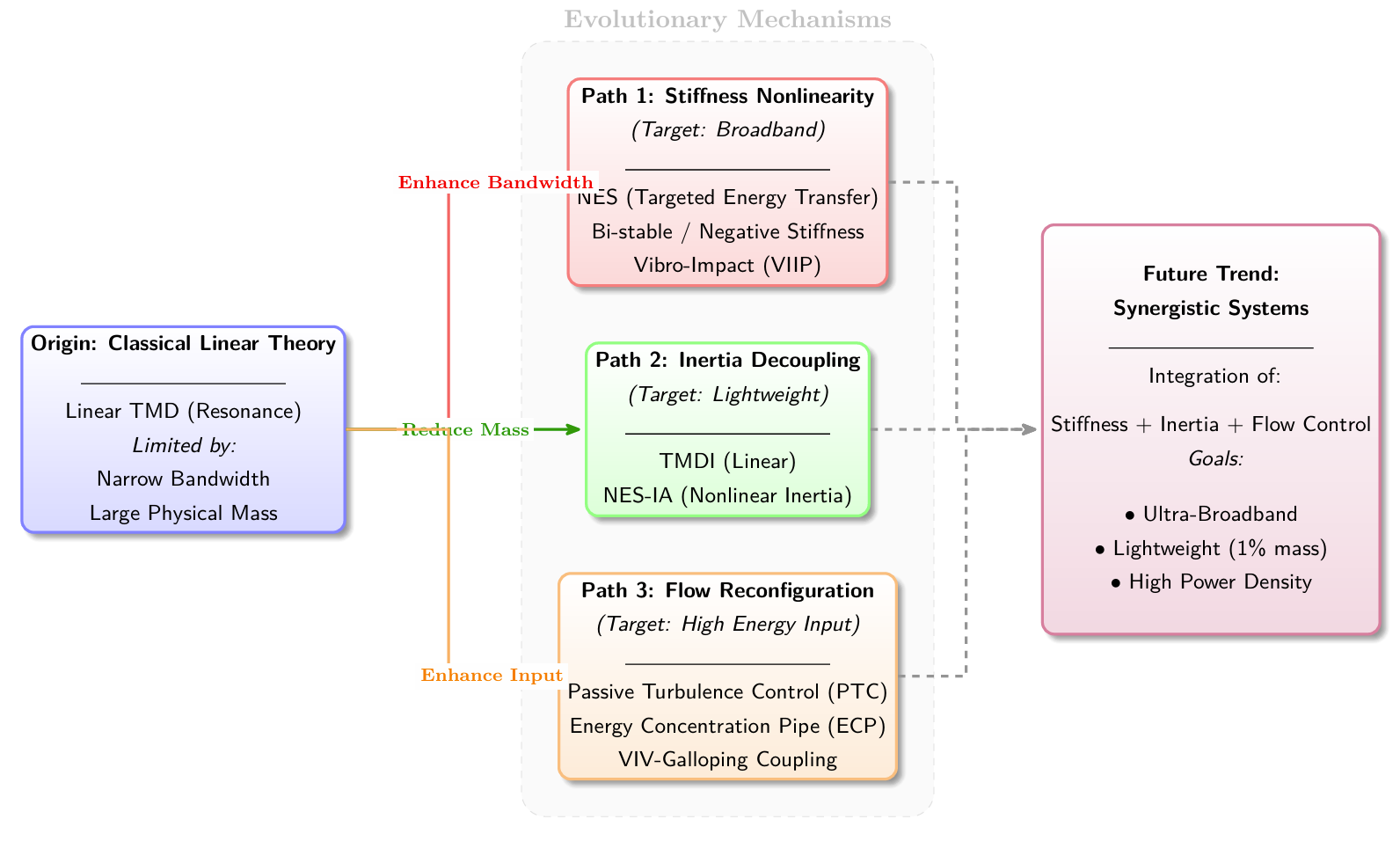
With the widespread deployment of the Internet of Things (IoT) and distributed sensing networks in marine and industrial environments, energy harvesting based on Flow-Induced Vibration (FIV) has garnered significant attention due to its high energy density and environmental adaptability. This paper provides a comprehensive review of the evolution of FIV energy harvesting systems, with a particular focus on absorber-based configurations. First, the classification of existing systems is systematically outlined, and the theoretical foundations of the classic linear Tuned Mass Damper (TMD) are revisited. The review critically analyzes the inherent limitations of linear theories, specifically frequency detuning and high mass dependency, when applied to complex, variable-frequency flow fields. Subsequently, the paper synthesizes the paradigm shift in system design, highlighting three core evolutionary paths: (1) Stiffness nonlinearity: The transition from linear resonance to Nonlinear Energy Sinks (NES) and bistable mechanisms to achieve broadband energy capture; (2) Mass decoupling: The shift from reliance on physical mass to inertial amplification (Inerter/TMDI) to achieve lightweight designs; and (3) Flow field reconstruction: The progression from passive adaptation to source enhancement via Passive Turbulence Control (PTC) and wake interference. Finally, the paper summarizes current technical challenges and offers perspectives on future research directions, including Fluid Mechanics, Bionics, Computer Science, Materials Science.
Graphical Abstract
Keywords
Data Availability Statement
Funding
Conflicts of Interest
AI Use Statement
Ethical Approval and Consent to Participate
References
- IEA (2025). World Energy Outlook 2025. IEA, Paris. Retrieved from https://www.iea.org/reports/world-energy-outlook-2025
[Google Scholar] - NDRC (National Development and Reform Commission). (2021, October 24). Working guidance for carbon dioxide peaking and carbon neutrality in full and faithful implementation of the new development philosophy. Retrieved from https://en.ndrc.gov.cn/policies/202110/t20211024_1300725.html
[Google Scholar] - CPC Central Committee. (2025, October 28). Recommendations of the CPC Central Committee for formulating the 15th five-year plan for national economic and social development. IDCPC. Retrieved from https://www.idcpc.org.cn/english2023/ttxw\_5749/202510/t20251029\_167976.html
[Google Scholar] - Chengliang, H. (2026). Pursuing Green Development: From the 14th to the 15th Five-Year Plan. China Economist, 21(2), 89-119.
[Google Scholar] - Wang, Y., Qin, J., & Lin, L. (2026, February). Discussion on Energy Economy and Optimization of Energy Structure. In 2025 7th Management Science Informatization and Economic Innovation Development Conference (MSIEID 2025) (pp. 229-241). Atlantis Press.
[CrossRef] [Google Scholar] - Mork, G., Barstow, S., Kabuth, A., & Pontes, M. T. (2010, January). Assessing the global wave energy potential. In International conference on offshore mechanics and arctic engineering (Vol. 49118, pp. 447-454).
[CrossRef] [Google Scholar] - Khan, M. Z. A., Khan, H. A., & Aziz, M. (2022). Harvesting energy from ocean: Technologies and perspectives. Energies, 15(9), 3456.
[CrossRef] [Google Scholar] - Qiu, T., Zhao, Z., Zhang, T., Chen, C., & Chen, C. P. (2019). Underwater Internet of Things in smart ocean: System architecture and open issues. IEEE transactions on industrial informatics, 16(7), 4297-4307.
[CrossRef] [Google Scholar] - Liu, L., Guo, X., Liu, W., & Lee, C. (2021). Recent progress in the energy harvesting technology—from self-powered sensors to self-sustained IoT, and new applications. Nanomaterials, 11(11), 2975.
[CrossRef] [Google Scholar] - Nordfjord, S. J., Thorsteinsson, S. E., & Andersen, K. (2025). Powering underwater robotics sensor networks through ocean energy harvesting and wireless power transfer methods: Systematic review. Journal of Marine Science and Engineering, 13(9), 1728.
[CrossRef] [Google Scholar] - McPhaden, M. J., Connell, K. J., Foltz, G. R., Perez, R. C., & Grissom, K. (2023). Tropical ocean observations for weather and climate. Oceanography, 36(2/3), 32-43.
[Google Scholar] - Shinohara, M., Araki, E., Mochizuki, M., Kanazawa, T., & Suyehiro, K. (2009). Practical application of a sea-water battery in deep-sea basin and its performance. Journal of Power Sources, 187(1), 253-260.
[CrossRef] [Google Scholar] - Naqvi, A., Ali, A., Altabey, W. A., & Kouritem, S. A. (2022). Energy harvesting from fluid flow using piezoelectric materials: a review. Energies, 15(19), 7424.
[CrossRef] [Google Scholar] - Abdelkareem, M. A., Ayoub, M., Khuri, S., Alami, A. H., Sayed, E. T., Deepa, T. D., & Olabi, A. G. (2023). Environmental aspects of batteries. Sustainable Horizons, 8, 100074.
[CrossRef] [Google Scholar] - Han, J. Y., & Jung, S. (2022). Thermal stability and the effect of water on hydrogen fluoride generation in lithium-ion battery electrolytes containing LiPF6. Batteries, 8(7), 61.
[CrossRef] [Google Scholar] - Guillou, N., Lavidas, G., & Chapalain, G. (2020). Wave energy resource assessment for exploitation—a review. Journal of Marine Science and Engineering, 8(9), 705.
[CrossRef] [Google Scholar] - Alford, M. H., Peacock, T., MacKinnon, J. A., Nash, J. D., Buijsman, M. C., Centurioni, L. R., ... & Tang, T. Y. (2015). The formation and fate of internal waves in the South China Sea. Nature, 521(7550), 65-69.
[CrossRef] [Google Scholar] - He, Z., Wu, W., Wang, J., Ding, L., Chang, Q., & Huang, Y. (2024). Investigations into motion responses of suspended submersible in internal solitary wave field. Journal of Marine Science and Engineering, 12(4), 596.
[CrossRef] [Google Scholar] - Yue, H., Zhang, H., Zhu, Q., Ai, Y., Tang, H., & Zhou, L. (2025). Wake dynamics of a wind turbine under real-time varying inflow turbulence: A coherence mode perspective. Energy Conversion and Management, 332, 119729.
[CrossRef] [Google Scholar] - Bernitsas, M. M., Raghavan, K., Ben-Simon, Y., & Garcia, E. M. H. (2008). VIVACE (Vortex Induced Vibration Aquatic Clean Energy): A New Concept in Generation of Clean and Renewable Energy From Fluid Flow. Journal of Offshore Mechanics and Arctic Engineering, 130(4), 041101.
[CrossRef] [Google Scholar] - Frahm, H. (1911). U.S. Patent No. 989,958. Washington, DC: U.S. Patent and Trademark Office.
[Google Scholar] - Den Hartog, J. P. (1985). Mechanical vibrations. Courier Corporation.
[Google Scholar] - Poon, D., Shieh, S. S., Joseph, L. M., & Chang, C. (2004, October). Structural design of Taipei 101, the world’s tallest building. In Proceedings of the ctbuh 2004 seoul conference, seoul, korea (pp. 271-278). sn.
[Google Scholar] - Lee, Y. S., Kerschen, G., McFarland, D. M., Hill, W. J., Nichkawde, C., Strganac, T. W., ... & Vakakis, A. F. (2007). Suppressing aeroelastic instability using broadband passive targeted energy transfers, part 2: experiments. AIAA journal, 45(10), 2391-2400.
[CrossRef] [Google Scholar] - Chao, C., Dai, W., Shi, B., Branson, D., & Yang, J. (2025). Suppression of self-excited vibrations using tuned mass damper or nonlinear energy sink. Nonlinear Dynamics, 113(23), 32007-32035.
[CrossRef] [Google Scholar] - Yang, F., Sedaghati, R., & Esmailzadeh, E. (2022). Vibration suppression of structures using tuned mass damper technology: A state-of-the-art review. Journal of Vibration and Control, 28(7-8), 812-836.
[CrossRef] [Google Scholar] - Mehmood, A., Nayfeh, A. H., & Hajj, M. R. (2014). Effects of a non-linear energy sink (NES) on vortex-induced vibrations of a circular cylinder. Nonlinear dynamics, 77(3), 667-680.
[CrossRef] [Google Scholar] - VAKAKIS, A. (2001). Inducing passive nonlinear energy sinks in vibrating systems. Journal of vibration and acoustics, 123(3), 324-332.
[CrossRef] [Google Scholar] - Daqaq, M. F., Masana, R., Erturk, A., & Dane Quinn, D. (2014). On the role of nonlinearities in vibratory energy harvesting: a critical review and discussion. Applied mechanics reviews, 66(4), 040801.
[CrossRef] [Google Scholar] - Kang, X., Huang, Q., Wu, Z., Tang, J., Jiang, X., & Lei, S. (2024). A Review of the Tuned Mass Damper Inerter (TMDI) in Energy Harvesting and Vibration Control: Designs, Analysis and Applications. Computer Modeling in Engineering & Sciences (CMES), 139(3).
[CrossRef] [Google Scholar] - Warburton, G. B. (1982). Optimum absorber parameters for various combinations of response and excitation parameters. Earthquake engineering & structural dynamics, 10(3), 381-401.
[CrossRef] [Google Scholar] - Zhang, Z., Lu, Z. Q., Ding, H., & Chen, L. Q. (2019). An inertial nonlinear energy sink. Journal of Sound and Vibration, 450, 199-213.
[CrossRef] [Google Scholar] - Guilmineau, E., & Queutey, P. (2004). Numerical simulation of vortex-induced vibration of a circular cylinder with low mass-damping in a turbulent flow. Journal of fluids and structures, 19(4), 449-466.
[CrossRef] [Google Scholar] - Qi, X. K., Zhang, J. C., Wang, J., & Li, B. Q. (2024). Research on vibration suppression of nonlinear energy sink with linear damping and geometrically nonlinear damping. Nonlinear Dynamics, 112(15), 12721-12750.
[CrossRef] [Google Scholar] - Jing, X. J., & Lang, Z. Q. (2009). Frequency domain analysis of a dimensionless cubic nonlinear damping system subject to harmonic input. Nonlinear Dynamics, 58(3), 469-485.
[CrossRef] [Google Scholar] - Al-Shudeifat, M. A. (2017). Nonlinear energy sinks with nontraditional kinds of nonlinear restoring forces. Journal of Vibration and Acoustics, 139(2), 024503.
[CrossRef] [Google Scholar] - Saeed, A. S., AL-Shudeifat, M. A., & Vakakis, A. F. (2019). Rotary-oscillatory nonlinear energy sink of robust performance. International Journal of Non-Linear Mechanics, 117, 103249.
[CrossRef] [Google Scholar] - Saeed, A. S., AL-Shudeifat, M. A., Vakakis, A. F., & Cantwell, W. J. (2020). Rotary-impact nonlinear energy sink for shock mitigation: analytical and numerical investigations. Archive of Applied Mechanics, 90(3), 495-521.
[CrossRef] [Google Scholar] - Gendelman, O. V., & Alloni, A. (2015). Dynamics of forced system with vibro-impact energy sink. Journal of Sound and Vibration, 358, 301-314.
[CrossRef] [Google Scholar] - AL-Shudeifat, M. A., & Nasar, R. A. (2025). On rapid vibration suppression by nonlinear energy sink during first half cycle of oscillation. Communications in Nonlinear Science and Numerical Simulation, 142, 108534.
[CrossRef] [Google Scholar] - Gourdon, E., Alexander, N. A., Taylor, C. A., Lamarque, C. H., & Pernot, S. (2007). Nonlinear energy pumping under transient forcing with strongly nonlinear coupling: Theoretical and experimental results. Journal of sound and vibration, 300(3-5), 522-551.
[CrossRef] [Google Scholar] - Huang, X., & Zhong, T. (2023). Hydrokinetic energy harvesting from flow-induced vibration of a hollow cylinder attached with a bi-stable energy harvester. Energy Conversion and Management, 278, 116718.
[CrossRef] [Google Scholar] - Facchinetti, M. L., De Langre, E., & Biolley, F. (2004). Coupling of structure and wake oscillators in vortex-induced vibrations. Journal of Fluids and structures, 19(2), 123-140.
[CrossRef] [Google Scholar] - Cottone, F., Vocca, H., & Gammaitoni, L. (2009). Nonlinear energy harvesting. Physical review letters, 102(8), 080601.
[CrossRef] [Google Scholar] - Harne, R. L., & Wang, K. W. (2013). A review of the recent research on vibration energy harvesting via bistable systems. Smart materials and structures, 22(2), 023001.
[CrossRef] [Google Scholar] - Yurchenko, D., Lai, Z. H., Thomson, G., Val, D. V., & Bobryk, R. V. (2017). Parametric study of a novel vibro-impact energy harvesting system with dielectric elastomer. Applied energy, 208, 456-470.
[CrossRef] [Google Scholar] - Wu, Y., & Wu, H. (2025). A novel flow-induced motion energy harvesting with coupled mechanism of time-varying stiffness and passive turbulence control. Physics of Fluids, 37(6).
[CrossRef] [Google Scholar] - Mazzolai, B., Laschi, C., Cianchetti, M., Patane, F., Bassi-Luciani, L., Izzo, I., & Dario, P. (2007, August). Biorobotic investigation on the muscle structure of an octopus tentacle. In 2007 29th Annual International Conference of the IEEE Engineering in Medicine and Biology Society (pp. 1471-1474). IEEE.
[CrossRef] [Google Scholar] - Wu, H., Wu, Y., & Jia, S. (2023). The performance investigation of flow-induced motion energy-harvesting by applying time-varying stiffness in the dynamic ocean environment. Ocean Engineering, 286, 115618.
[CrossRef] [Google Scholar] - Smith, M. C. (2002). Synthesis of mechanical networks: the inerter. IEEE Transactions on automatic control, 47(10), 1648-1662.
[CrossRef] [Google Scholar] - Zhang, W., Zhang, W., & Guo, X. (2023). Vertical vibration control using nonlinear energy sink with inertial amplifier. Applied Mathematics and Mechanics, 44(10), 1721-1738.
[CrossRef] [Google Scholar] - Lu, Z. Q., Ding, H., & Chen, L. Q. (2019). Resonance response interaction without internal resonance in vibratory energy harvesting. Mechanical Systems and Signal Processing, 121, 767-776.
[CrossRef] [Google Scholar] - Wang, J., Zhou, S., Zhang, Z., & Yurchenko, D. (2019). High-performance piezoelectric wind energy harvester with Y-shaped attachments. Energy conversion and management, 181, 645-652.
[CrossRef] [Google Scholar] - Wang, J., Geng, L., Ding, L., Zhu, H., & Yurchenko, D. (2020). The state-of-the-art review on energy harvesting from flow-induced vibrations. Applied Energy, 267, 114902.
[CrossRef] [Google Scholar] - Wang, J., Gu, S., Zhang, C., Hu, G., Chen, G., Yang, K., ... & Yurchenko, D. (2020). Hybrid wind energy scavenging by coupling vortex-induced vibrations and galloping. Energy Conversion and Management, 213, 112835.
[CrossRef] [Google Scholar] - Chang, C. C. J., Kumar, R. A., & Bernitsas, M. M. (2011). VIV and galloping of single circular cylinder with surface roughness at 3.0× 10⁴$\leq$ Re$\leq$ 1.2× 10⁵. Ocean Engineering, 38(16), 1713-1732.
[CrossRef] [Google Scholar] - Hu, G., Tse, K. T., Wei, M., Naseer, R., Abdelkefi, A., & Kwok, K. C. (2018). Experimental investigation on the efficiency of circular cylinder-based wind energy harvester with different rod-shaped attachments. Applied energy, 226, 682-689.
[CrossRef] [Google Scholar] - Park, H., Bernitsas, M. M., & Chang, C. C. (2013, June). Map of passive turbulence control to flow-induced motions for a circular cylinder at 30,000< re< 120,000: sensitivity to zone covering. In International Conference on Offshore Mechanics and Arctic Engineering (Vol. 55416, p. V007T08A003). American Society of Mechanical Engineers.
[CrossRef] [Google Scholar] - Ding, L., Mao, X., Yang, L., Yan, B., Wang, J., & Zhang, L. (2021). Effects of installation position of fin-shaped rods on wind-induced vibration and energy harvesting of aeroelastic energy converter. Smart Materials and Structures, 30(2), 025026.
[CrossRef] [Google Scholar] - Sun, H., Yang, Z., Li, J., Ding, H., & Lv, P. (2024). Performance evaluation and optimal design for passive turbulence control-based hydrokinetic energy harvester using EWM-based TOPSIS. Energy, 298, 131377.
[CrossRef] [Google Scholar] - Betz, A. (2014). Introduction to the Theory of Flow Machines. Elsevier.
[Google Scholar] - Tamimi, V., Esfehani, M. J., Zeinoddini, M., Naeeni, S. T. O., Wu, J., & Shahvaghar-Asl, S. (2020). Marine hydrokinetic energy harvesting performance of diamond and square oscillators in tandem arrangements. Energy, 202, 117749.
[CrossRef] [Google Scholar] - Zhu, H., Zhao, Y., & Zhou, T. (2018). CFD analysis of energy harvesting from flow induced vibration of a circular cylinder with an attached free-to-rotate pentagram impeller. Applied energy, 212, 304-321.
[CrossRef] [Google Scholar] - Park, H., Kumar, R. A., & Bernitsas, M. M. (2013). Enhancement of flow-induced motion of rigid circular cylinder on springs by localized surface roughness at 3× 10⁴$\leq$ Re$\leq$ 1.2× 10⁵. Ocean Engineering, 72, 403-415.
[CrossRef] [Google Scholar] - Li, N., Park, H., Sun, H., & Bernitsas, M. M. (2022). Hydrokinetic energy conversion using flow induced oscillations of single-cylinder with large passive turbulence control. Applied Energy, 308, 118380.
[CrossRef] [Google Scholar] - Park, H., Mentzelopoulos, A. P., & Bernitsas, M. M. (2023). Hydrokinetic energy harvesting from slow currents using flow-induced oscillations. Renewable Energy, 214, 242-254.
[CrossRef] [Google Scholar] - Chen, W. L., Gao, D. L., Yuan, W. Y., Li, H., & Hu, H. (2015). Passive jet control of flow around a circular cylinder. Experiments in Fluids, 56(11), 201.
[CrossRef] [Google Scholar] - Wang, J., Han, C., Yurchenko, D., Zhou, Y., Meng, X., & Zhang, W. (2024). Energy concentration pipe based on passive jet control for enhancing flow induced vibration energy harvesting. Energy Conversion and Management, 319, 118948.
[CrossRef] [Google Scholar] - Wang, X. J., Chen, W. L., Gao, D. L., Yang, W. H., & Li, H. (2020). Passive jet approach to control the flow over a circular cylinder. Journal of Aerospace Engineering, 33(3), 04020015.
[CrossRef] [Google Scholar] - Xu, F., Chen, W. L., Duan, Z. D., & Ou, J. P. (2020). Large eddy simulation of passive jet flow control on the wake of flow around a circular cylinder. Computers & Fluids, 196, 104342.
[CrossRef] [Google Scholar] - Huang, Z., Wang, J., Zhang, D., & Wang, X. (2025). Investigation of vibration suppression by nonlinear energy sink (NES) based on structure–wake oscillator coupled model. International Journal of Non-Linear Mechanics, 105219.
[CrossRef] [Google Scholar] - Bearman, P. W., Gartshore, I. S., Maull, D. J., & Parkinson, G. V. (1987). Experiments on flow-induced vibration of a square-section cylinder. Journal of Fluids and Structures, 1(1), 19-34.
[CrossRef] [Google Scholar] - Wang, J., Tang, B., Yang, H., Zhu, G., & Tan, W. (2025). Energy harvesting of flow induced vibration enhanced by bionic non-smooth surfaces. Chinese Journal of Mechanical Engineering, 38(1), 79.
[CrossRef] [Google Scholar] - Sun, W., Wang, Y., Liu, Y., Su, B., Guo, T., Cheng, G., ... & Seok, J. (2024). Navigating the future of flow-induced vibration-based piezoelectric energy harvesting. Renewable and Sustainable Energy Reviews, 201, 114624.
[CrossRef] [Google Scholar] - Williamson, C. H. K., & Govardhan, R. (2004). Vortex-Induced Vibrations. Annual Review of Fluid Mechanics, 36, 413-455.
[CrossRef] [Google Scholar] - Nguyen, V. T., & Nguyen, H. H. (2016). Detached eddy simulations of flow induced vibrations of circular cylinders at high Reynolds numbers. Journal of Fluids and Structures, 63, 103-119.
[CrossRef] [Google Scholar]
Cite This Article
TY  - JOUR
AU  - Liu, Jinshuai
AU  - Huang, Xingrong
AU  - Li, Zhe
PY  - 2026
DA  - 2026/04/18
TI  - Mechanisms and Optimization Design of Flow-Induced Vibration Energy Harvesting: A Review
JO  - Journal of Carbon Neutrality
T2  - Journal of Carbon Neutrality
JF  - Journal of Carbon Neutrality
VL  - 1
IS  - 1
SP  - 10
EP  - 28
DO  - 10.62762/JCN.2026.299279
UR  - https://www.icck.org/article/abs/JCN.2026.299279
KW  - flow-induced vibration (FIV)
KW  - energy harvesting
KW  - nonlinear energy sink (NES)
KW  - inerter
KW  - passive turbulence control (PTC)
AB  - With the widespread deployment of the Internet of Things (IoT) and distributed sensing networks in marine and industrial environments, energy harvesting based on Flow-Induced Vibration (FIV) has garnered significant attention due to its high energy density and environmental adaptability. This paper provides a comprehensive review of the evolution of FIV energy harvesting systems, with a particular focus on absorber-based configurations. First, the classification of existing systems is systematically outlined, and the theoretical foundations of the classic linear Tuned Mass Damper (TMD) are revisited. The review critically analyzes the inherent limitations of linear theories, specifically frequency detuning and high mass dependency, when applied to complex, variable-frequency flow fields. Subsequently, the paper synthesizes the paradigm shift in system design, highlighting three core evolutionary paths: (1) Stiffness nonlinearity: The transition from linear resonance to Nonlinear Energy Sinks (NES) and bistable mechanisms to achieve broadband energy capture; (2) Mass decoupling: The shift from reliance on physical mass to inertial amplification (Inerter/TMDI) to achieve lightweight designs; and (3) Flow field reconstruction: The progression from passive adaptation to source enhancement via Passive Turbulence Control (PTC) and wake interference. Finally, the paper summarizes current technical challenges and offers perspectives on future research directions, including Fluid Mechanics, Bionics, Computer Science, Materials Science.
SN  - 3144-2668
PB  - Institute of Central Computation and Knowledge
LA  - English
ER  -
@article{Liu2026Mechanisms,
  author = {Jinshuai Liu and Xingrong Huang and Zhe Li},
  title = {Mechanisms and Optimization Design of Flow-Induced Vibration Energy Harvesting: A Review},
  journal = {Journal of Carbon Neutrality},
  year = {2026},
  volume = {1},
  number = {1},
  pages = {10-28},
  doi = {10.62762/JCN.2026.299279},
  url = {https://www.icck.org/article/abs/JCN.2026.299279},
  abstract = {With the widespread deployment of the Internet of Things (IoT) and distributed sensing networks in marine and industrial environments, energy harvesting based on Flow-Induced Vibration (FIV) has garnered significant attention due to its high energy density and environmental adaptability. This paper provides a comprehensive review of the evolution of FIV energy harvesting systems, with a particular focus on absorber-based configurations. First, the classification of existing systems is systematically outlined, and the theoretical foundations of the classic linear Tuned Mass Damper (TMD) are revisited. The review critically analyzes the inherent limitations of linear theories, specifically frequency detuning and high mass dependency, when applied to complex, variable-frequency flow fields. Subsequently, the paper synthesizes the paradigm shift in system design, highlighting three core evolutionary paths: (1) Stiffness nonlinearity: The transition from linear resonance to Nonlinear Energy Sinks (NES) and bistable mechanisms to achieve broadband energy capture; (2) Mass decoupling: The shift from reliance on physical mass to inertial amplification (Inerter/TMDI) to achieve lightweight designs; and (3) Flow field reconstruction: The progression from passive adaptation to source enhancement via Passive Turbulence Control (PTC) and wake interference. Finally, the paper summarizes current technical challenges and offers perspectives on future research directions, including Fluid Mechanics, Bionics, Computer Science, Materials Science.},
  keywords = {flow-induced vibration (FIV), energy harvesting, nonlinear energy sink (NES), inerter, passive turbulence control (PTC)},
  issn = {3144-2668},
  publisher = {Institute of Central Computation and Knowledge}
}
Article Metrics
Publisher's Note
ICCK stays neutral with regard to jurisdictional claims in published maps and institutional affiliations.
Rights and Permissions
 Copyright © 2026 by the Author(s). Published by Institute of Central Computation and Knowledge. This article is an open access article distributed under the terms and conditions of the Creative Commons Attribution (CC BY) license (https://creativecommons.org/licenses/by/4.0/), which permits use, sharing, adaptation, distribution and reproduction in any medium or format, as long as you give appropriate credit to the original author(s) and the source, provide a link to the Creative Commons licence, and indicate if changes were made.

