


Editorial for Journal of Carbon Neutrality




Article Information
Abstract
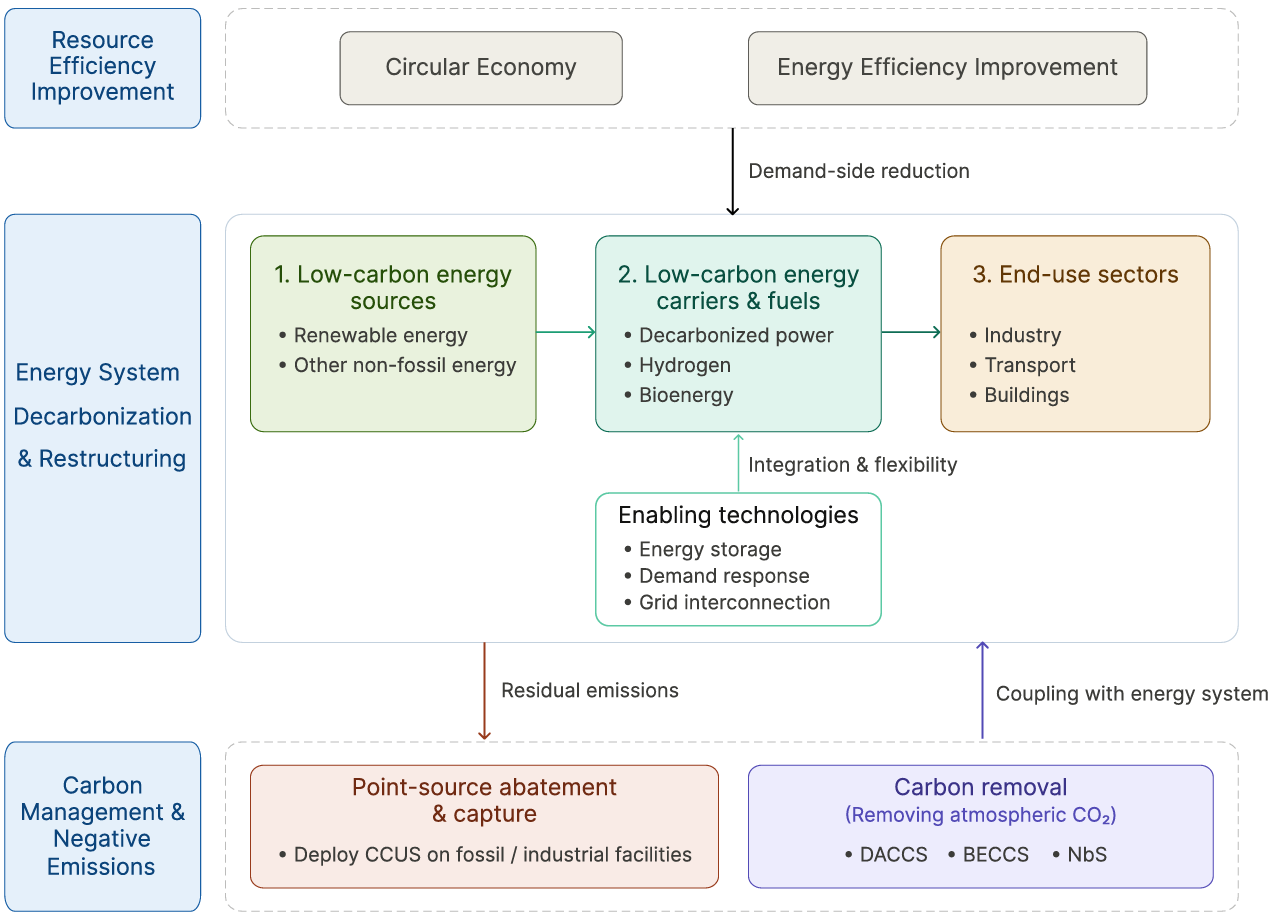
Achieving carbon neutrality demands a fundamental transformation across energy, industry, technology, and policy sectors, supported by interdisciplinary scientific innovation. This paper presents a comprehensive overview of key technological pathways toward carbon neutrality, including energy decarbonization, resource efficiency, and nature-based solutions. It further highlights five emerging scientific frontiers, that is, photovoltaics with energy storage and electric mobility, chemical CO$_2$ valorisation, contrail mitigation, lightweight and low-carbon materials, and AI-driven healthcare decarbonization, to illustrate the breadth of research contributions essential for a net-zero future. Within this context, the authors focus on energy harvesting from fluid-structure interaction (FSI) as a representative cross-cutting technology. Recent advances in flow-induced rotation (FIR) of square cylinders and flexible flag dynamics are reviewed, with emphasis on the identification of multi-stable regimes, analytical modeling, and the development of a strongly coupled fluid-structure-piezoelectric interaction (FSPEI) framework. These findings underscore the potential of FSI-based systems to enable self-powered, low-carbon infrastructure and distributed energy solutions.
Graphical Abstract
Keywords
Data Availability Statement
Funding
Conflicts of Interest
AI Use Statement
Ethical Approval and Consent to Participate
References
- Allen, J. J., & Smits, A. J. (2001). Energy harvesting eel. Journal of fluids and structures, 15(3-4), 629-640.
[CrossRef] [Google Scholar] - Williamson, C. H. K., & Govardhan, R. (2004). Vortex-induced vibrations. Annual Review of Fluid Mechanics, 36(1), 413--455.
[CrossRef] [Google Scholar] - Wang, J., Yurchenko, D., Hu, G., Zhao, L., Tang, L., & Yang, Y. (2021). Perspectives in flow-induced vibration energy harvesting. Applied Physics Letters, 119(10), 100502.
[CrossRef] [Google Scholar] - Bernitsas, M. M., Raghavan, K., Ben-Simon, Y., & Garcia, E. M. H. (2008). VIVACE (Vortex Induced Vibration Aquatic Clean Energy): A new concept in generation of clean and renewable energy from fluid flow. Journal of Offshore Mechanics and Arctic Engineering, 130(4), 041101.
[CrossRef] [Google Scholar] - Zhao, M. (2023). A review of recent studies on the control of vortex-induced vibration of circular cylinders. Ocean Engineering, 285, 115389.
[CrossRef] [Google Scholar] - Ryu, S., & Iaccarino, G. (2017). Vortex-induced rotations of a rigid square cylinder at low Reynolds numbers. Journal of Fluid Mechanics, 813, 482--507.
[CrossRef] [Google Scholar] - Kim, D., Cossé, J., Huertas Cerdeira, C., & Gharib, M. (2013). Flapping dynamics of an inverted flag. Journal of Fluid Mechanics, 736, R1.
[CrossRef] [Google Scholar] - Ryu, J., Park, S. G., Kim, B., & Sung, H. J. (2015). Flapping dynamics of an inverted flag in a uniform flow. Journal of Fluids and Structures, 57, 159--169.
[CrossRef] [Google Scholar] - Orrego, S., Shoele, K., Ruas, A., Doran, K., Caggiano, B., Mittal, R., & Kang, S. H. (2017). Harvesting ambient wind energy with an inverted piezoelectric flag. Applied Energy, 194, 212--222.
[CrossRef] [Google Scholar] - Jia, K., Fang, L., & Huang, W. X. (2019). Coupled states of dual side-by-side inverted flags in a uniform flow. Journal of Fluids and Structures, 91, 102768.
[CrossRef] [Google Scholar] - Wang, J., Geng, L., Ding, L., Zhu, H., & Yurchenko, D. (2020). The state-of-the-art review on energy harvesting from flow-induced vibrations. Applied Energy, 267, 114902.
[CrossRef] [Google Scholar] - Michelin, S., & Doaré, O. (2013). Energy harvesting efficiency of piezoelectric flags in axial flows. Journal of Fluid Mechanics, 714, 489--504.
[CrossRef] [Google Scholar] - Naik, A. D., Salcan-Reyes, G., Silva-Leon, J., Cioncolini, A., Revell, A., & Nabawy, M. R. A. (2026). Energy harvesting using piezoelectric inverted flags. Renewable & Sustainable Energy Reviews, 225, 116153.
[CrossRef] [Google Scholar] - Zaki, T. G., Sen, M., & Gad-El-Hak, M. (1994). Numerical and experimental investigation of flow past a freely rotatable square cylinder. Journal of Fluids and Structures, 8(7), 555--582.
[CrossRef] [Google Scholar] - Mou, R. Y., Huang, X. R., Huang, W. X., & Fang, L. (2024). Vortex-induced rotation of a square cylinder under the influence of Reynolds number and density ratio. Journal of Fluid Mechanics, 986, A15.
[CrossRef] [Google Scholar] - Luo, C. S., Mou, R. Y., Huang, X. R., Huang, W. X., & Fang, L. (2023). A free-streamline boundary-layer model for small-amplitude oscillation regime of square cylinder under vortex-induced rotation. Physics of Fluids, 35(9), 093602.
[CrossRef] [Google Scholar] - Rostami, A. B., & Armandei, M. (2017). Renewable energy harvesting by vortex-induced motions: Review and benchmarking of technologies. Renewable & Sustainable Energy Reviews, 70, 193--214.
[CrossRef] [Google Scholar] - Wang, H., Yan, Y., Chen, C., Ji, C., & Zhai, Q. (2019). Numerical investigation on vortex-induced rotations of a triangular cylinder using an immersed boundary method. China Ocean Engineering, 33, 723--733.
[CrossRef] [Google Scholar] - Wang, H., Huang, X., Li, Z., & Fang, L. (2025). Design of a Portable Integrated Fluid–Structure Interaction-Based Piezoelectric Flag Energy-Harvesting System. Fluids, 10(5), 121.
[CrossRef] [Google Scholar] - Yu, Y., Liu, Y., & Amandolese, X. (2019). A Review on Fluid-Induced Flag Vibrations. Applied Mechanics Reviews, 71(1), 010801.
[CrossRef] [Google Scholar] - Li, Z., Huang, X. R., & Fang, L. (2023). Numerical modeling of fluid–structure–piezoelectric interaction for energy harvesting. Computer Methods in Applied Mechanics and Engineering, 414, 116164.
[CrossRef] [Google Scholar]
Cite This Article
TY  - JOUR
AU  - Fang, Le
AU  - Wang, Haochen
PY  - 2026
DA  - 2026/04/06
TI  - Editorial for Journal of Carbon Neutrality
JO  - Journal of Carbon Neutrality
T2  - Journal of Carbon Neutrality
JF  - Journal of Carbon Neutrality
VL  - 1
IS  - 1
SP  - 1
EP  - 9
DO  - 10.62762/JCN.2026.161462
UR  - https://www.icck.org/article/abs/JCN.2026.161462
KW  - carbon neutrality
KW  - fluid-structure interaction
KW  - energy harvesting
KW  - flow-induced rotation
KW  - flag flapping
KW  - Interdisciplinary carbon reduction technologies
AB  - Achieving carbon neutrality demands a fundamental transformation across energy, industry, technology, and policy sectors, supported by interdisciplinary scientific innovation. This paper presents a comprehensive overview of key technological pathways toward carbon neutrality, including energy decarbonization, resource efficiency, and nature-based solutions. It further highlights five emerging scientific frontiers, that is, photovoltaics with energy storage and electric mobility, chemical CO$_2$ valorisation, contrail mitigation, lightweight and low-carbon materials, and AI-driven healthcare decarbonization, to illustrate the breadth of research contributions essential for a net-zero future. Within this context, the authors focus on energy harvesting from fluid-structure interaction (FSI) as a representative cross-cutting technology. Recent advances in flow-induced rotation (FIR) of square cylinders and flexible flag dynamics are reviewed, with emphasis on the identification of multi-stable regimes, analytical modeling, and the development of a strongly coupled fluid-structure-piezoelectric interaction (FSPEI) framework. These findings underscore the potential of FSI-based systems to enable self-powered, low-carbon infrastructure and distributed energy solutions.
SN  - 3144-2668
PB  - Institute of Central Computation and Knowledge
LA  - English
ER  -
@article{Fang2026Editorial,
  author = {Le Fang and Haochen Wang},
  title = {Editorial for Journal of Carbon Neutrality},
  journal = {Journal of Carbon Neutrality},
  year = {2026},
  volume = {1},
  number = {1},
  pages = {1-9},
  doi = {10.62762/JCN.2026.161462},
  url = {https://www.icck.org/article/abs/JCN.2026.161462},
  abstract = {Achieving carbon neutrality demands a fundamental transformation across energy, industry, technology, and policy sectors, supported by interdisciplinary scientific innovation. This paper presents a comprehensive overview of key technological pathways toward carbon neutrality, including energy decarbonization, resource efficiency, and nature-based solutions. It further highlights five emerging scientific frontiers, that is, photovoltaics with energy storage and electric mobility, chemical CO\$\_2\$ valorisation, contrail mitigation, lightweight and low-carbon materials, and AI-driven healthcare decarbonization, to illustrate the breadth of research contributions essential for a net-zero future. Within this context, the authors focus on energy harvesting from fluid-structure interaction (FSI) as a representative cross-cutting technology. Recent advances in flow-induced rotation (FIR) of square cylinders and flexible flag dynamics are reviewed, with emphasis on the identification of multi-stable regimes, analytical modeling, and the development of a strongly coupled fluid-structure-piezoelectric interaction (FSPEI) framework. These findings underscore the potential of FSI-based systems to enable self-powered, low-carbon infrastructure and distributed energy solutions.},
  keywords = {carbon neutrality, fluid-structure interaction, energy harvesting, flow-induced rotation, flag flapping, Interdisciplinary carbon reduction technologies},
  issn = {3144-2668},
  publisher = {Institute of Central Computation and Knowledge}
}
Article Metrics
Publisher's Note
ICCK stays neutral with regard to jurisdictional claims in published maps and institutional affiliations.
Rights and Permissions
 Copyright © 2026 by the Author(s). Published by Institute of Central Computation and Knowledge. This article is an open access article distributed under the terms and conditions of the Creative Commons Attribution (CC BY) license (https://creativecommons.org/licenses/by/4.0/), which permits use, sharing, adaptation, distribution and reproduction in any medium or format, as long as you give appropriate credit to the original author(s) and the source, provide a link to the Creative Commons licence, and indicate if changes were made.

