


A Bayesian-Optimization-Based Method for Exploring the Energy Optimization Potential of Data Centers


Article Information
Abstract
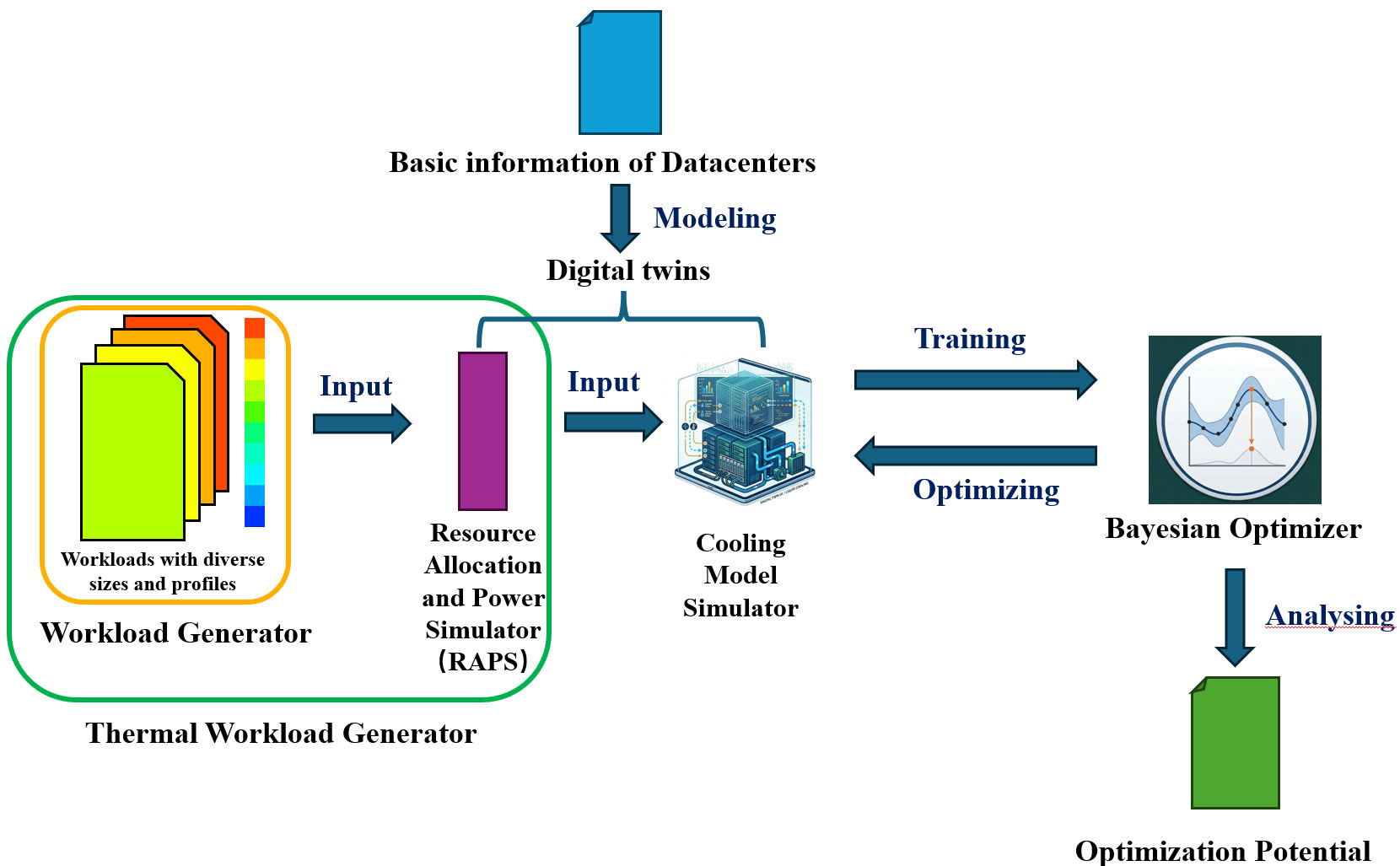
With the expansion of artificial intelligence, data center energy consumption has surged, making its optimization critical for achieving carbon neutrality. Traditional fixed-rule controls rely too heavily on manual experience to explore the highest efficiency, while standard AI black-box models often lack interpretability and present evaluation challenges. This study introduces a Bayesian optimization-based methodology to explore the energy optimization potential of data center cooling systems. We enhanced the Resource Allocation and Power Simulator (RAPS) to generate dynamic workloads reflecting the authentic statistical characteristics of supercomputers for rigorous stress testing. This generator integrates with a model of the Frontier supercomputer cooling systems via a Functional Mock-up Unit (FMU) interface, enabling co-simulation. A context-informed Gaussian Process Bayesian optimization algorithm was designed to optimize upper-level setpoints piecewise, targeting Power Usage Effectiveness (PUE) under temperature penalty constraints, to uncover the data center's energy optimization potential across distinct control variables and dynamic workloads. Experimental results under a 24-h random workload demonstrate that optimizing the cooling tower temperature correction parameter (adj) reduced average PUE from 1.1164 to 1.1104-a 0.54\% decrease consistent in magnitude with comparable studies-validating the method's efficacy. Extended testing reveals that the primary differential-pressure setpoint provides the largest and most consistent optimization benefits, whereas the pump stage-up threshold shows weak and workload-dependent effects, and the stage-down threshold provides modest but consistently positive improvements. This research establishes a high-fidelity, interpretable gray-box testing framework for control strategy pre-evaluation and key variable screening in large-scale data centers.
Graphical Abstract
Keywords
Data Availability Statement
Funding
Conflicts of Interest
AI Use Statement
Ethical Approval and Consent to Participate
References
- Armbrust, M., Fox, A., Griffith, R., Joseph, A. D., Katz, R., Konwinski, A., ... & Zaharia, M. (2010). A view of cloud computing. Communications of the ACM, 53(4), 50-58.
[CrossRef] [Google Scholar] - International Energy Agency. (2025). Energy and AI. IEA. Retrieved from https://www.iea.org/reports/energy-and-ai
[Google Scholar] - Masanet, E., Shehabi, A., Lei, N., Smith, S., & Koomey, J. (2020). Recalibrating global data center energy-use estimates. Science, 367(6481), 984-986.
[CrossRef] [Google Scholar] - Zhou, D., Du, L., Xu, R., Song, J., Chen, N., Zheng, S., & Fan, Y. (2025). Accelerating liquid cooling adoption in data centers: Necessity, challenges and solutions. Technology Review for Carbon Neutrality, 1, 9550014.
[CrossRef] [Google Scholar] - Shahi, P., Deshmukh, A. P., Hurnekar, H. Y., Saini, S., Bansode, P., Kasukurthy, R., & Agonafer, D. (2022). Design, development, and characterization of a flow control device for dynamic cooling of liquid-cooled servers. Journal of Electronic Packaging, 144(4), 041008.
[CrossRef] [Google Scholar] - Chen, H., Han, Y., Tang, G., & Zhang, X. (2020). A dynamic control system for server processor direct liquid cooling. IEEE Transactions on Components, Packaging and Manufacturing Technology, 10(5), 786-794.
[CrossRef] [Google Scholar] - Lucchese, R., Varagnolo, D., & Johansson, A. (2020). Controlled direct liquid cooling of data servers. IEEE Transactions on Control Systems Technology, 29(6), 2325-2338.
[CrossRef] [Google Scholar] - ASHRAE Technical Committee 9.9. (2015). Thermal Guidelines for Data Processing Environments (4th ed.). Atlanta, GA: ASHRAE. Retrieved from https://www.ashrae.org/technical-resources/bookstore/datacom-series#thermalguidelines
[Google Scholar] - Fulpagare, Y., & Bhargav, A. (2015). Advances in data center thermal management. Renewable and Sustainable Energy Reviews, 43, 981-996.
[CrossRef] [Google Scholar] - Kahil, H., Sharma, S., Välisuo, P., & Elmusrati, M. (2025). Reinforcement learning for data center energy efficiency optimization: A systematic literature review and research roadmap. Applied Energy, 389, 125734.
[CrossRef] [Google Scholar] - Zhang, H., Shao, S., Xu, H., Zou, H., & Tian, C. (2021). A survey on data center cooling systems: Technology, power consumption modeling and control strategy optimization. Journal of Systems Architecture, 119, 102253.
[CrossRef] [Google Scholar] - Lazic, N., Lu, T., Boutilier, C., Ryu, M., Wong, E., Roy, B., & Imwalle, G. (2018). Data center cooling using model-predictive control. Advances in Neural Information Processing Systems, 31.
[Google Scholar] - Li, Y., Wen, Y., Tao, D., & Guan, K. (2020). Transforming cooling optimization for green data center via deep reinforcement learning. IEEE Transactions on Cybernetics, 50(5), 2002-2013.
[CrossRef] [Google Scholar] - Lin, X., Guo, Q., Yuan, D., & Gao, M. (2023). Bayesian optimization framework for HVAC system control. Buildings, 13(2), 314.
[CrossRef] [Google Scholar] - Gao, J. (2014). Machine learning applications for data center optimization. Google Research. Retrieved from https://research.google/pubs/pub42542/
[Google Scholar] - Naug, A., Guillen-Perez, A., Kumar, V., Greenwood, S., Brewer, W., Ghorbanpour, S., ... & Sarkar, S. (2026). Lc-opt: Benchmarking reinforcement learning and agentic ai for end-to-end liquid cooling optimization in data centers. Advances in Neural Information Processing Systems, 38.
[Google Scholar] - Li, Y., O'Neill, Z., Zhang, L., Chen, J., Im, P., & DeGraw, J. (2021). Grey-box modeling and application for building energy simulations-A critical review. Renewable and Sustainable Energy Reviews, 146, 111174.
[CrossRef] [Google Scholar] - Brewer, W., Maiterth, M., Kumar, V., Wojda, R., Bouknight, S., Hines, J., ... & Wang, F. (2024, November). A digital twin framework for liquid-cooled supercomputers as demonstrated at exascale. In SC24: International Conference for High Performance Computing, Networking, Storage and Analysis (pp. 1-18). IEEE.
[CrossRef] [Google Scholar] - Wang, L., Rodriguez, M. A., & Lipovetzky, N. (2025, October). HPCsim: A High-Level Simulation and Workload Data Schema Framework for HPC Workload Management Research. In 2025 IEEE International Conference on Systems, Man, and Cybernetics (SMC) (pp. 5314-5320). IEEE.
[CrossRef] [Google Scholar] - Maiterth, M., Brewer, W. H., Kuruvella, J. S., Dey, A., Islam, T. Z., Kabir, R., ... & Wang, F. (2025, November). HPC digital twins for evaluating scheduling policies, incentive structures and their impact on power and cooling. In Proceedings of the SC'25 Workshops of the International Conference for High Performance Computing, Networking, Storage and Analysis (pp. 1959-1969).
[CrossRef] [Google Scholar] - Cirou. (2024). Adastra jobs MI250 15days [Dataset]. CINES.
[CrossRef] [Google Scholar] - Athavale, J., Bash, C., Brewer, W., Maiterth, M., Milojicic, D., Petty, H., & Sarkar, S. (2024). Digital twins for data centers. Computer, 57(10), 151-158.
[CrossRef] [Google Scholar] - Modelica Association. (2023). Modelica standard library version 4.0.0. Retrieved from https://github.com/modelica/ModelicaStandardLibrary
[Google Scholar] - Casella, F., & Leva, A. (2003, November). Modelica open library for power plant simulation: design and experimental validation. In Proceeding of the 2003 Modelica conference, Linkoping, Sweden. https://modelica.org/events/Conference2003/papers/h08_Leva_original.pdf
[Google Scholar] - Greenwood, M. S., Fugate, D. L., & Cetiner, M. S. (2017). A templated approach for multi-physics modeling of hybrid energy systems in Modelica. Oak Ridge National Laboratory (ORNL), ORNL/TM-2017/399. Retrieved from https://www.osti.gov/biblio/1427611
[Google Scholar] - Kumar, V., Greenwood, S., Brewer, W., Grant, D., Parkison, N., & Williams, W. (2024). Thermo-fluid modeling framework for supercomputer digital twins: Part 1, demonstration at exascale. Proceedings of the American Modelica Conference 2024, Storrs, CT, USA, October 14-16, 2024. Oak Ridge National Laboratory (ORNL). Retrieved from https://www.osti.gov/biblio/2480044]
[Google Scholar] - Wetter, M., Zuo, W., Nouidui, T. S., & Pang, X. (2014). Modelica buildings library. Journal of Building Performance Simulation, 7(4), 253-270.
[CrossRef] [Google Scholar] - Greenwood, M. S., Cetiner, M. S., Fugate, D. L., Hale, R. E., Harrison, T. J., & Qualls, A. L. (2017). TRANSFORM - TRANsient Simulation Framework of Reconfigurable Models [Computer software]. U.S. Department of Energy, Oak Ridge National Laboratory. Retrieved from https://www.osti.gov/biblio/1395459
[Google Scholar] - Blochwitz, T., Otter, M., Åkesson, J., Arnold, M., Clauss, C., Elmqvist, H., ... & Viel, A. (2012). Functional mockup interface 2.0: The standard for tool independent exchange of simulation models. In 9th international modelica conference (pp. 173-184). The Modelica Association.
[CrossRef] [Google Scholar] - Rasmussen, C. E. (2003). Gaussian processes in machine learning. In Summer school on machine learning (pp. 63-71). Berlin, Heidelberg: Springer Berlin Heidelberg.
[CrossRef] [Google Scholar] - Krause, A., & Ong, C. S. (2011). Contextual Gaussian process bandit optimization. Advances in Neural Information Processing Systems, 24.
[Google Scholar] - Srinivas, N., Krause, A., Kakade, S. M., & Seeger, M. (2009). Gaussian process optimization in the bandit setting: No regret and experimental design. arXiv preprint arXiv:0912.3995.
[CrossRef] [Google Scholar] - Frazier, P. I. (2018). A tutorial on Bayesian optimization. arXiv preprint arXiv:1807.02811.
[CrossRef] [Google Scholar] - Yang, C., Wang, X., Lu, Y., Liu, H., Le, Q. V., Zhou, D., & Chen, X. (2024). Large language models as optimizers. Proceedings of the 12th International Conference on Learning Representations (ICLR 2024).
[Google Scholar]
Cite This Article
TY  - JOUR
AU  - Gu, Simian
AU  - Wang, Yuxuan
AU  - Zhu, Shunyao
AU  - Yu, Lei
AU  - Magoulès, Frédéric
PY  - 2026
DA  - 2026/09/03
TI  - A Bayesian-Optimization-Based Method for Exploring the Energy Optimization Potential of Data Centers
JO  - Journal of Carbon Neutrality
T2  - Journal of Carbon Neutrality
JF  - Journal of Carbon Neutrality
VL  - 1
IS  - 2
SP  - 97
EP  - 126
DO  - 10.62762/JCN.2026.592975
UR  - https://www.icck.org/article/abs/JCN.2026.592975
KW  - Bayesian optimization
KW  - data center cooling
KW  - energy optimization
KW  - digital twin
KW  - control strategy
AB  - With the expansion of artificial intelligence, data center energy consumption has surged, making its optimization critical for achieving carbon neutrality. Traditional fixed-rule controls rely too heavily on manual experience to explore the highest efficiency, while standard AI black-box models often lack interpretability and present evaluation challenges. This study introduces a Bayesian optimization-based methodology to explore the energy optimization potential of data center cooling systems. We enhanced the Resource Allocation and Power Simulator (RAPS) to generate dynamic workloads reflecting the authentic statistical characteristics of supercomputers for rigorous stress testing. This generator integrates with a model of the Frontier supercomputer cooling systems via a Functional Mock-up Unit (FMU) interface, enabling co-simulation. A context-informed Gaussian Process Bayesian optimization algorithm was designed to optimize upper-level setpoints piecewise, targeting Power Usage Effectiveness (PUE) under temperature penalty constraints, to uncover the data center's energy optimization potential across distinct control variables and dynamic workloads. Experimental results under a 24-h random workload demonstrate that optimizing the cooling tower temperature correction parameter (adj) reduced average PUE from 1.1164 to 1.1104-a 0.54\% decrease consistent in magnitude with comparable studies-validating the method's efficacy. Extended testing reveals that the primary differential-pressure setpoint provides the largest and most consistent optimization benefits, whereas the pump stage-up threshold shows weak and workload-dependent effects, and the stage-down threshold provides modest but consistently positive improvements. This research establishes a high-fidelity, interpretable gray-box testing framework for control strategy pre-evaluation and key variable screening in large-scale data centers.
SN  - 3144-2668
PB  - Institute of Central Computation and Knowledge
LA  - English
ER  -
@article{Gu2026A,
  author = {Simian Gu and Yuxuan Wang and Shunyao Zhu and Lei Yu and Frédéric Magoulès},
  title = {A Bayesian-Optimization-Based Method for Exploring the Energy Optimization Potential of Data Centers},
  journal = {Journal of Carbon Neutrality},
  year = {2026},
  volume = {1},
  number = {2},
  pages = {97-126},
  doi = {10.62762/JCN.2026.592975},
  url = {https://www.icck.org/article/abs/JCN.2026.592975},
  abstract = {With the expansion of artificial intelligence, data center energy consumption has surged, making its optimization critical for achieving carbon neutrality. Traditional fixed-rule controls rely too heavily on manual experience to explore the highest efficiency, while standard AI black-box models often lack interpretability and present evaluation challenges. This study introduces a Bayesian optimization-based methodology to explore the energy optimization potential of data center cooling systems. We enhanced the Resource Allocation and Power Simulator (RAPS) to generate dynamic workloads reflecting the authentic statistical characteristics of supercomputers for rigorous stress testing. This generator integrates with a model of the Frontier supercomputer cooling systems via a Functional Mock-up Unit (FMU) interface, enabling co-simulation. A context-informed Gaussian Process Bayesian optimization algorithm was designed to optimize upper-level setpoints piecewise, targeting Power Usage Effectiveness (PUE) under temperature penalty constraints, to uncover the data center's energy optimization potential across distinct control variables and dynamic workloads. Experimental results under a 24-h random workload demonstrate that optimizing the cooling tower temperature correction parameter (adj) reduced average PUE from 1.1164 to 1.1104-a 0.54\\% decrease consistent in magnitude with comparable studies-validating the method's efficacy. Extended testing reveals that the primary differential-pressure setpoint provides the largest and most consistent optimization benefits, whereas the pump stage-up threshold shows weak and workload-dependent effects, and the stage-down threshold provides modest but consistently positive improvements. This research establishes a high-fidelity, interpretable gray-box testing framework for control strategy pre-evaluation and key variable screening in large-scale data centers.},
  keywords = {Bayesian optimization, data center cooling, energy optimization, digital twin, control strategy},
  issn = {3144-2668},
  publisher = {Institute of Central Computation and Knowledge}
}
Article Metrics
Publisher's Note
ICCK stays neutral with regard to jurisdictional claims in published maps and institutional affiliations.
Rights and Permissions
 Copyright © 2026 by the Author(s). Published by Institute of Central Computation and Knowledge. This article is an open access article distributed under the terms and conditions of the Creative Commons Attribution (CC BY) license (https://creativecommons.org/licenses/by/4.0/), which permits use, sharing, adaptation, distribution and reproduction in any medium or format, as long as you give appropriate credit to the original author(s) and the source, provide a link to the Creative Commons licence, and indicate if changes were made.

