


A Hybrid Unet-MLP Neural Network Enabling Ultra-Fast and High-Accuracy Prediction for Low-Gradient Temperature Field in Lithium-ion Batteries



Article Information
Abstract
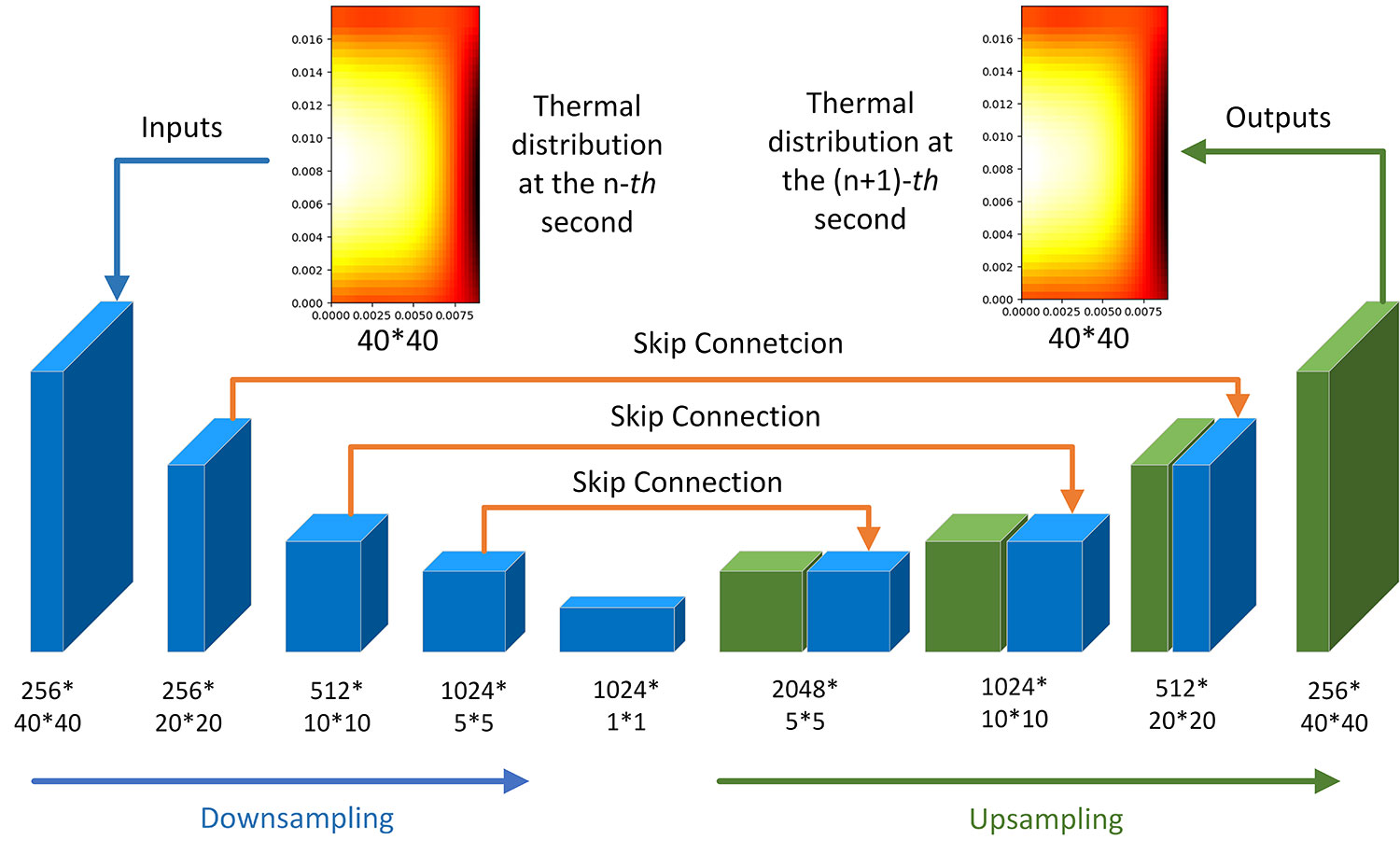
Accurate prediction of the internal temperature field in batteries is of critical importance for ensuring safe operation, extending battery lifespan, and ultimately accelerating the global transition to electric vehicles (EVs). Unsafe thermal conditions not only degrade battery performance but also hinder EV adoption. However, conventional 3D thermal models involve complex computations that struggle to meet the fast computational speed requirements of Battery Management Systems (BMS), and traditional neural network models are not accurate enough for temperature field prediction, especially for low-gradient fields. To achieve precise and rapid prediction of the internal battery temperature field, this paper proposes a hybrid neural network combining Unet and MLP architecture (HNNUM) as a green energy storage technology assurance tool to enable safe, durable battery operation. In this framework, the Unet module captures the relative magnitude relationships of temperatures across different locations in the temperature field, while the MLP module learns the temperature field range information. Finally, an inverse MinMax method integrates these two modules to output the predicted internal battery temperature field. The results demonstrate that the proposed HNNUM can achieve accurate prediction of the internal battery temperature field with only 5.16e-4 K RMSE, and takes only 16.59s to complete the prediction of 3000 temperature fields. The source code is available at https://github.com/kon9chun/hnnum.
Graphical Abstract
Keywords
Data Availability Statement
Funding
Conflicts of Interest
AI Use Statement
Ethical Approval and Consent to Participate
References
- Feng, X., Ouyang, M., Liu, X., Lu, L., Xia, Y., & He, X. (2018). Thermal runaway mechanism of lithium ion battery for electric vehicles: A review. Energy storage materials, 10, 246-267.
[CrossRef] [Google Scholar] - Liu, K., Li, K., Peng, Q., & Zhang, C. (2019). A brief review on key technologies in the battery management system of electric vehicles. Frontiers of mechanical engineering, 14(1), 47-64.
[CrossRef] [Google Scholar] - Lin, X., Perez, H. E., Mohan, S., Siegel, J. B., Stefanopoulou, A. G., Ding, Y., & Castanier, M. P. (2014). A lumped-parameter electro-thermal model for cylindrical batteries. Journal of Power Sources, 257, 1-11.
[CrossRef] [Google Scholar] - Zhu, G., Kong, C., Wang, J. V., Kang, J., Yang, G., & Wang, Q. (2023). A fractional-order model of lithium-ion battery considering polarization in electrolyte and thermal effect. Electrochimica Acta, 438, 141461.
[CrossRef] [Google Scholar] - Li, C., Cui, N., Wang, C., & Zhang, C. (2021). Simplified electrochemical lithium-ion battery model with variable solid-phase diffusion and parameter identification over wide temperature range. Journal of Power Sources, 497, 229900.
[CrossRef] [Google Scholar] - He, Y. B., Wang, B. C., Deng, H. P., & Li, H. X. (2024). Physics-reserved spatiotemporal modeling of battery thermal process: Temperature prediction, parameter identification, and heat generation rate estimation. Journal of Energy Storage, 75, 109604.
[CrossRef] [Google Scholar] - Amietszajew, T., McTurk, E., Fleming, J., & Bhagat, R. (2018). Understanding the limits of rapid charging using instrumented commercial 18650 high-energy Li-ion cells. Electrochimica Acta, 263, 346-352.
[CrossRef] [Google Scholar] - He, C. X., Yue, Q. L., Wu, M. C., Chen, Q., & Zhao, T. S. (2021). A 3D electrochemical-thermal coupled model for electrochemical and thermal analysis of pouch-type lithium-ion batteries. International Journal of Heat and Mass Transfer, 181, 121855.
[CrossRef] [Google Scholar] - Liu, Y., Yang, S., Guo, B., & Deng, C. (2014). Numerical analysis and design of thermal management system for lithium ion battery pack using thermoelectric coolers. Advances in Mechanical Engineering, 6, 852712.
[CrossRef] [Google Scholar] - Deng, H. P., He, Y. B., Wang, B. C., & Li, H. X. (2023). Physics-dominated neural network for spatiotemporal modeling of battery thermal process. IEEE Transactions on Industrial Informatics, 20(1), 452-460.
[CrossRef] [Google Scholar] - Pang, Y., Dong, A., Wang, Y., & Niu, Z. (2024). Deep learning from three-dimensional Lithium-ion battery multiphysics model Part II: Convolutional neural network and long short-term memory integration. Energy and AI, 17, 100398.
[CrossRef] [Google Scholar] - Liu, J., Yadav, S., Salman, M., Chavan, S., & Kim, S. C. (2024). Review of thermal coupled battery models and parameter identification for lithium-ion battery heat generation in EV battery thermal management system. International Journal of Heat and Mass Transfer, 218, 124748.
[CrossRef] [Google Scholar] - Jeong, J., Kwak, E., Kim, J. H., & Oh, K. Y. (2024). Prediction of thermal runaway for a lithium-ion battery through multiphysics-informed DeepONet with virtual data. ETransportation, 21, 100337.
[CrossRef] [Google Scholar] - Shen, K., Ling, Y., Meng, X., Lai, X., Zhu, Z., Sun, T., ... & Feng, X. (2025). A deep learning-based digital twin model for the temperature field of large-scale battery systems. Journal of Energy Storage, 113, 115676.
[CrossRef] [Google Scholar] - Zhu, G., Kong, C., Wang, J. V., Chen, W., Wang, Q., & Kang, J. (2024). A simplified electrochemical model for lithium-ion batteries based on ensemble learning. iScience, 27(5), 109685.
[CrossRef] [Google Scholar] - Chen, Q., Chen, X. S., & Li, Z. (2023). A fast numerical method with non-iterative source term for pseudo-two-dimension lithium-ion battery model. Journal of Power Sources, 577, 233258.
[CrossRef] [Google Scholar] - Ronneberger, O., Fischer, P., & Brox, T. (2015, October). U-net: Convolutional networks for biomedical image segmentation. In International Conference on Medical image computing and computer-assisted intervention (pp. 234-241). Cham: Springer international publishing.
[CrossRef] [Google Scholar] - Goodfellow, I., Bengio, Y., Courville, A., & Bengio, Y. (2016). Deep learning (Vol. 1, No. 2, pp. 1-800). Cambridge: MIT press.
[Google Scholar] - Hornik, K., Stinchcombe, M., & White, H. (1989). Multilayer feedforward networks are universal approximators. Neural networks, 2(5), 359-366.
[CrossRef] [Google Scholar] - Kingma, D. P., & Ba, J. (2014). Adam: A method for stochastic optimization. arXiv preprint arXiv:1412.6980.
[CrossRef] [Google Scholar]
Cite This Article
TY  - JOUR
AU  - Kong, Chun
AU  - Li, Zhe
AU  - Zhao, Lance
PY  - 2026
DA  - 2026/09/02
TI  - A Hybrid Unet-MLP Neural Network Enabling Ultra-Fast and High-Accuracy Prediction for Low-Gradient Temperature Field in Lithium-ion Batteries
JO  - Journal of Carbon Neutrality
T2  - Journal of Carbon Neutrality
JF  - Journal of Carbon Neutrality
VL  - 1
IS  - 2
SP  - 83
EP  - 96
DO  - 10.62762/JCN.2026.807406
UR  - https://www.icck.org/article/abs/JCN.2026.807406
KW  - temperature field prediction
KW  - lithium-ion batteries
KW  - hybrid neural network
KW  - 3D thermal model
AB  - Accurate prediction of the internal temperature field in batteries is of critical importance for ensuring safe operation, extending battery lifespan, and ultimately accelerating the global transition to electric vehicles (EVs). Unsafe thermal conditions not only degrade battery performance but also hinder EV adoption. However, conventional 3D thermal models involve complex computations that struggle to meet the fast computational speed requirements of Battery Management Systems (BMS), and traditional neural network models are not accurate enough for temperature field prediction, especially for low-gradient fields. To achieve precise and rapid prediction of the internal battery temperature field, this paper proposes a hybrid neural network combining Unet and MLP architecture (HNNUM) as a green energy storage technology assurance tool to enable safe, durable battery operation. In this framework, the Unet module captures the relative magnitude relationships of temperatures across different locations in the temperature field, while the MLP module learns the temperature field range information. Finally, an inverse MinMax method integrates these two modules to output the predicted internal battery temperature field. The results demonstrate that the proposed HNNUM can achieve accurate prediction of the internal battery temperature field with only 5.16e-4 K RMSE, and takes only 16.59s to complete the prediction of 3000 temperature fields. The source code is available at https://github.com/kon9chun/hnnum.
SN  - 3144-2668
PB  - Institute of Central Computation and Knowledge
LA  - English
ER  -
@article{Kong2026A,
  author = {Chun Kong and Zhe Li and Lance Zhao},
  title = {A Hybrid Unet-MLP Neural Network Enabling Ultra-Fast and High-Accuracy Prediction for Low-Gradient Temperature Field in Lithium-ion Batteries},
  journal = {Journal of Carbon Neutrality},
  year = {2026},
  volume = {1},
  number = {2},
  pages = {83-96},
  doi = {10.62762/JCN.2026.807406},
  url = {https://www.icck.org/article/abs/JCN.2026.807406},
  abstract = {Accurate prediction of the internal temperature field in batteries is of critical importance for ensuring safe operation, extending battery lifespan, and ultimately accelerating the global transition to electric vehicles (EVs). Unsafe thermal conditions not only degrade battery performance but also hinder EV adoption. However, conventional 3D thermal models involve complex computations that struggle to meet the fast computational speed requirements of Battery Management Systems (BMS), and traditional neural network models are not accurate enough for temperature field prediction, especially for low-gradient fields. To achieve precise and rapid prediction of the internal battery temperature field, this paper proposes a hybrid neural network combining Unet and MLP architecture (HNNUM) as a green energy storage technology assurance tool to enable safe, durable battery operation. In this framework, the Unet module captures the relative magnitude relationships of temperatures across different locations in the temperature field, while the MLP module learns the temperature field range information. Finally, an inverse MinMax method integrates these two modules to output the predicted internal battery temperature field. The results demonstrate that the proposed HNNUM can achieve accurate prediction of the internal battery temperature field with only 5.16e-4 K RMSE, and takes only 16.59s to complete the prediction of 3000 temperature fields. The source code is available at https://github.com/kon9chun/hnnum.},
  keywords = {temperature field prediction, lithium-ion batteries, hybrid neural network, 3D thermal model},
  issn = {3144-2668},
  publisher = {Institute of Central Computation and Knowledge}
}
Article Metrics
Publisher's Note
ICCK stays neutral with regard to jurisdictional claims in published maps and institutional affiliations.
Rights and Permissions
 Copyright © 2026 by the Author(s). Published by Institute of Central Computation and Knowledge. This article is an open access article distributed under the terms and conditions of the Creative Commons Attribution (CC BY) license (https://creativecommons.org/licenses/by/4.0/), which permits use, sharing, adaptation, distribution and reproduction in any medium or format, as long as you give appropriate credit to the original author(s) and the source, provide a link to the Creative Commons licence, and indicate if changes were made.

