


Numerical Study of Premixed Hydrogen/Air Flame-Wall Interaction for Confined Systems


Article Information
Abstract
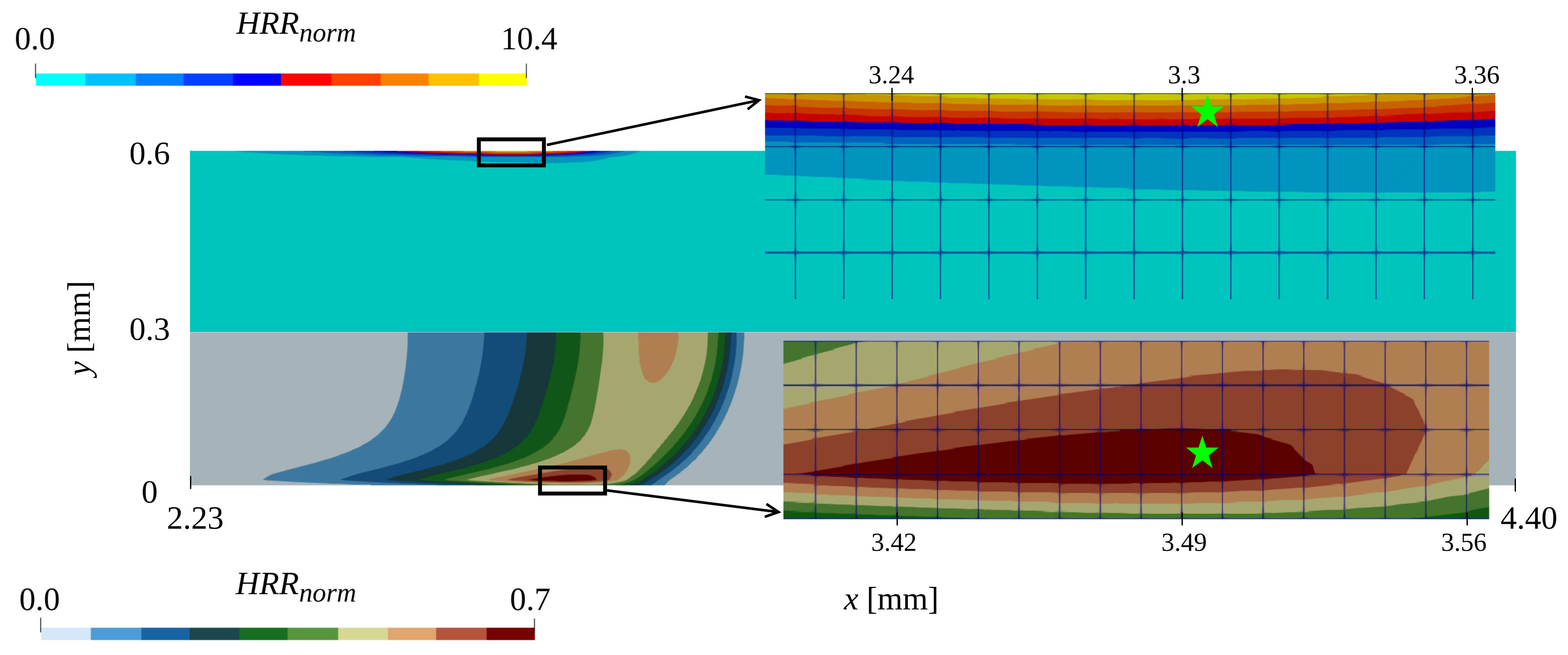
Accurate modeling of flame-wall interaction is essential for predicting premixed hydrogen combustion in confined configurations relevant to hydrogen-based energy systems. Detailed chemical mechanisms often produce unphysical near-wall heat release due to persistent radical-consuming reactions at low temperatures, reducing simulation fidelity and limiting predictive capability. To address this, we apply an H radical recombination model that selectively removes H radicals at the wall through recombination to $\ce{H2}$ while conserving mass. The model is validated using canonical flame-wall interaction scenarios, including head-on quenching of stoichiometric hydrogen/oxygen flames and side-wall quenching of premixed hydrogen/air flames. One- and two-dimensional simulations evaluate flame propagation, quenching, and stability with isothermal walls. Results show that H radicals dominate abnormal near-wall heat release, and selective recombination effectively suppresses this behavior. In side-wall quenching, the model reproduces experimental flame propagation speed accurately. For wider channels, wall heat losses destabilize asymmetric flames and promote symmetric configurations, consistent with experiments. This H radical recombination model provides a physically consistent and computationally efficient strategy for capturing flame-wall interactions and heat losses in premixed hydrogen flames. By improving near-wall prediction fidelity in confined configurations, it supports more reliable simulations of hydrogen combustion systems, advancing the development of safe and efficient carbon-neutral energy technologies.
Graphical Abstract
Keywords
Data Availability Statement
Funding
Conflicts of Interest
AI Use Statement
Ethical Approval and Consent to Participate
References
- Poinsot, T., & Veynante, D. (2005). Theoretical and numerical combustion. RT Edwards, Inc.
[Google Scholar] - Popp, P., & Baum, M. (1997). Analysis of wall heat fluxes, reaction mechanisms, and unburnt hydrocarbons during the head-on quenching of a laminar methane flame. Combustion and Flame, 108(3), 327-348.
[CrossRef] [Google Scholar] - Dabireau, F., Cuenot, B., Vermorel, O., & Poinsot, T. (2003). Interaction of flames of H2+ O2 with inert walls. Combustion and flame, 135(1-2), 123-133.
[CrossRef] [Google Scholar] - Peters, N., & Warnatz, J. (2013). Numerical methods in laminar flame propagation: A GAMM-Workshop. Springer-Verlag.
[Google Scholar] - Liu, J., Yu, R., Ma, B., & Tang, C. (2020). On the second explosion limits of hydrogen, methane, ethane, and propane. ACS omega, 5(30), 19268-19276.
[CrossRef] [Google Scholar] - Li, J., Liang, W., Chen, J., Han, W., & Law, C. K. (2022). Role of surface reactions in hydrogen–oxygen explosion limits. Energy & Fuels, 36(20), 12729-12736.
[CrossRef] [Google Scholar] - De Nardi, L., Douasbin, Q., Vermorel, O., & Poinsot, T. (2024). Infinitely fast heterogeneous catalysis model for premixed hydrogen flame-wall interaction. Combustion and flame, 261, 113328.
[CrossRef] [Google Scholar] - Dejoan, A., Jiménez, C., & Kurdyumov, V. N. (2019). Critical conditions for non-symmetric flame propagation in narrow channels: Influence of the flow rate, the thermal expansion, the Lewis number and heat-losses. Combustion and Flame, 209, 430-440.
[CrossRef] [Google Scholar] - Bioche, K., Vervisch, L., & Ribert, G. (2018). Premixed flame–wall interaction in a narrow channel: impact of wall thermal conductivity and heat losses. Journal of Fluid Mechanics, 856, 5-35.
[CrossRef] [Google Scholar] - Chen, Z., Ballossier, Y., Zhao, S., Denet, B., Almarcha, C., & Boivin, P. (2025). Study on symmetric/asymmetric hydrogen flame shapes in the thickness of a Hele-Shaw burner. Combustion and Flame, 277, 114208.
[CrossRef] [Google Scholar] - Boivin, P., Tayyab, M., & Zhao, S. (2021). Benchmarking a lattice-Boltzmann solver for reactive flows: Is the method worth the effort for combustion?. Physics of Fluids, 33(7).
[CrossRef] [Google Scholar] - Chen, Z., Zhao, S., Denet, B., Almarcha, C., & Boivin, P. (2025). A three-dimensional study on premixed flame propagation in narrow channels considering hydrodynamic and thermodiffusive instabilities. Combustion and Flame, 281, 114392.
[CrossRef] [Google Scholar] - Farag, G., Zhao, S., Coratger, T., Boivin, P., Chiavassa, G., & Sagaut, P. (2020). A pressure-based regularized lattice-Boltzmann method for the simulation of compressible flows. Physics of Fluids, 32(6).
[CrossRef] [Google Scholar] - Boivin, P., Jiménez, C., Sánchez, A. L., & Williams, F. A. (2011). An explicit reduced mechanism for H2–air combustion. Proceedings of the Combustion Institute, 33(1), 517-523.
[CrossRef] [Google Scholar] - Boivin, P., Dauptain, A., Jiménez, C., & Cuenot, B. (2012). Simulation of a supersonic hydrogen–air autoignition-stabilized flame using reduced chemistry. Combustion and Flame, 159(4), 1779-1790.
[CrossRef] [Google Scholar] - CERFACS. (n.d.). Hydrogen mechanism (Cantera chemical mechanisms). Cantera CERFACS. https://www.cerfacs.fr/cantera/mechanisms/hydro.php
[Google Scholar] - Ballossier, Y., Boivin, P., & Almarcha, C. (2024). Three dimensional shapes of hydrogen-air flames within millimetric Hele Shaw cells. International Journal of Hydrogen Energy, 60, 333-341.
[CrossRef] [Google Scholar]
Cite This Article
TY  - JOUR
AU  - Chen, Ziyin
AU  - Mai, Yuxi
PY  - 2026
DA  - 2026/05/12
TI  - Numerical Study of Premixed Hydrogen/Air Flame-Wall Interaction for Confined Systems
JO  - Journal of Carbon Neutrality
T2  - Journal of Carbon Neutrality
JF  - Journal of Carbon Neutrality
VL  - 1
IS  - 1
SP  - 29
EP  - 37
DO  - 10.62762/JCN.2026.937655
UR  - https://www.icck.org/article/abs/JCN.2026.937655
KW  - hydrogen combustion
KW  - flame-wall interaction
KW  - confined flames
KW  - wall heat losses
KW  - numerical modeling
AB  - Accurate modeling of flame-wall interaction is essential for predicting premixed hydrogen combustion in confined configurations relevant to hydrogen-based energy systems. Detailed chemical mechanisms often produce unphysical near-wall heat release due to persistent radical-consuming reactions at low temperatures, reducing simulation fidelity and limiting predictive capability. To address this, we apply an H radical recombination model that selectively removes H radicals at the wall through recombination to $\ce{H2}$ while conserving mass. The model is validated using canonical flame-wall interaction scenarios, including head-on quenching of stoichiometric hydrogen/oxygen flames and side-wall quenching of premixed hydrogen/air flames. One- and two-dimensional simulations evaluate flame propagation, quenching, and stability with isothermal walls. Results show that H radicals dominate abnormal near-wall heat release, and selective recombination effectively suppresses this behavior. In side-wall quenching, the model reproduces experimental flame propagation speed accurately. For wider channels, wall heat losses destabilize asymmetric flames and promote symmetric configurations, consistent with experiments. This H radical recombination model provides a physically consistent and computationally efficient strategy for capturing flame-wall interactions and heat losses in premixed hydrogen flames. By improving near-wall prediction fidelity in confined configurations, it supports more reliable simulations of hydrogen combustion systems, advancing the development of safe and efficient carbon-neutral energy technologies.
SN  - 3144-2668
PB  - Institute of Central Computation and Knowledge
LA  - English
ER  -
@article{Chen2026Numerical,
  author = {Ziyin Chen and Yuxi Mai},
  title = {Numerical Study of Premixed Hydrogen/Air Flame-Wall Interaction for Confined Systems},
  journal = {Journal of Carbon Neutrality},
  year = {2026},
  volume = {1},
  number = {1},
  pages = {29-37},
  doi = {10.62762/JCN.2026.937655},
  url = {https://www.icck.org/article/abs/JCN.2026.937655},
  abstract = {Accurate modeling of flame-wall interaction is essential for predicting premixed hydrogen combustion in confined configurations relevant to hydrogen-based energy systems. Detailed chemical mechanisms often produce unphysical near-wall heat release due to persistent radical-consuming reactions at low temperatures, reducing simulation fidelity and limiting predictive capability. To address this, we apply an H radical recombination model that selectively removes H radicals at the wall through recombination to \$\ce{H2}\$ while conserving mass. The model is validated using canonical flame-wall interaction scenarios, including head-on quenching of stoichiometric hydrogen/oxygen flames and side-wall quenching of premixed hydrogen/air flames. One- and two-dimensional simulations evaluate flame propagation, quenching, and stability with isothermal walls. Results show that H radicals dominate abnormal near-wall heat release, and selective recombination effectively suppresses this behavior. In side-wall quenching, the model reproduces experimental flame propagation speed accurately. For wider channels, wall heat losses destabilize asymmetric flames and promote symmetric configurations, consistent with experiments. This H radical recombination model provides a physically consistent and computationally efficient strategy for capturing flame-wall interactions and heat losses in premixed hydrogen flames. By improving near-wall prediction fidelity in confined configurations, it supports more reliable simulations of hydrogen combustion systems, advancing the development of safe and efficient carbon-neutral energy technologies.},
  keywords = {hydrogen combustion, flame-wall interaction, confined flames, wall heat losses, numerical modeling},
  issn = {3144-2668},
  publisher = {Institute of Central Computation and Knowledge}
}
Article Metrics
Publisher's Note
ICCK stays neutral with regard to jurisdictional claims in published maps and institutional affiliations.
Rights and Permissions
 Copyright © 2026 by the Author(s). Published by Institute of Central Computation and Knowledge. This article is an open access article distributed under the terms and conditions of the Creative Commons Attribution (CC BY) license (https://creativecommons.org/licenses/by/4.0/), which permits use, sharing, adaptation, distribution and reproduction in any medium or format, as long as you give appropriate credit to the original author(s) and the source, provide a link to the Creative Commons licence, and indicate if changes were made.

