

NeuroPrivateVR: A Differential Privacy Framework for Secure Emotion Data in Immersive Virtual Reality





Article Information
Abstract
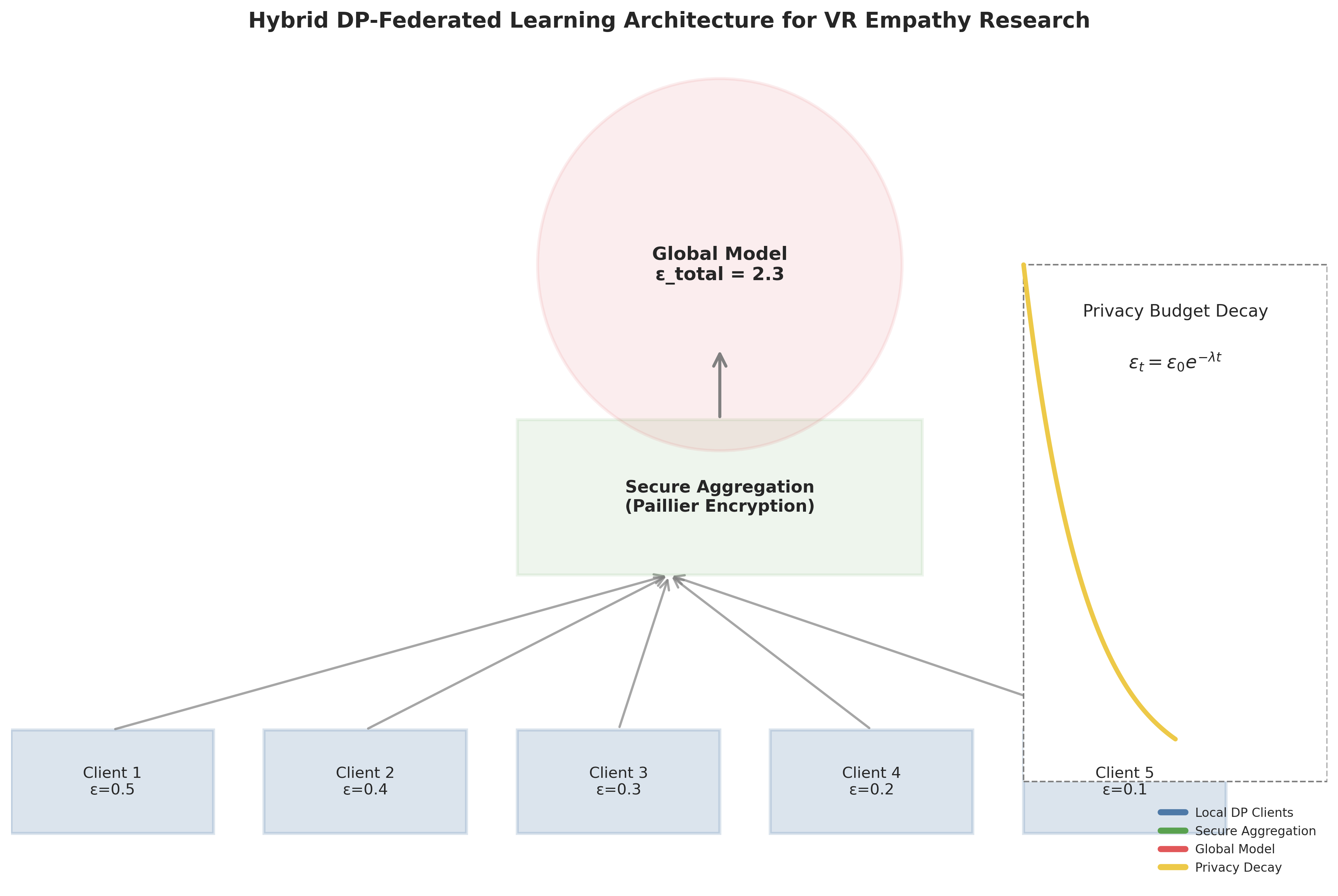
VR empirical data include the sensitive affective and behavioral data (e.g. gaze patterns, physiological signals, facial expressions), placing a person at the risk of re-identification. Tailored privacy-preserving approaches to immersive data have not, however, received much attention in the recent affective-computing investigations. In the present paper, a differentially-privacy (DP) framework is presented as that allows anonymizing VR-based studies of emotion without losing scientific value. The first one is the quantification of re-identification risks through empirical linkage and inference attacks and then the mitigation of the risk through DP mechanisms such as Laplace noise, that sought to reduce the re-identification risks by 80%. At the same time, the strategy returned an 85% retention with respect to utility relating to emotion-classification. The results can allow sharing VR-collected affective data safely to use in research without infringing GDPR/HIPAA provisions and thus offer practical procedures in implementing DP in VR-based empathy research and developing ethical data collection practices in the field. Finally, on the one hand, the framework mediates between immersive technology and information privacy, and on the other hand, it enables the development of emotional AI and psychological research by providing anonymity of the participants. Among its contributions, VR-specific parameter optimizations and a risk-utility assessment metric, there are specific findings towards the higher priority of effectiveness of affective datasets in the VR-based therapy and social-emotional learning.
Graphical Abstract
Keywords
Data Availability Statement
Funding
Conflicts of Interest
Ethical Approval and Consent to Participate
References
- Abadi, M., Chu, A., Goodfellow, I., McMahan, H. B., Mironov, I., Talwar, K., & Zhang, L. (2016). Deep learning with differential privacy. In Proceedings of the ACM SIGSAC Conference on Computer and Communications Security (CCS) (pp. 308–318).
[CrossRef] [Google Scholar] - Bailenson, J. N. (2018). Experience on demand: What virtual reality is, how it works, and what it can do. W. W. Norton & Company.
[Google Scholar] - Bertrand, P., Guegan, J., Robieux, L., McCall, C. A., & Zenasni, F. (2018). Learning empathy through virtual reality: Multiple strategies for training empathy-related abilities using body ownership illusions in embodied virtual reality. Frontiers in Robotics and AI, 5, 26.
[CrossRef] [Google Scholar] - Im, E., Kim, H., Lee, H., Jiang, X., & Kim, J. H. (2024). Exploring the tradeoff between data privacy and utility with a clinical data analysis use case. BMC Medical Informatics and Decision Making, 24(1), 147.
[CrossRef] [Google Scholar] - Dwork, C., McSherry, F., Nissim, K., & Smith, A. (2006, March). Calibrating noise to sensitivity in private data analysis. In Theory of cryptography conference (pp. 265-284). Berlin, Heidelberg: Springer Berlin Heidelberg.
[CrossRef] [Google Scholar] - Dwork, C., & Roth, A. (2014). The algorithmic foundations of differential privacy. Foundations and trends® in theoretical computer science, 9(3–4), 211-407.
[CrossRef] [Google Scholar] - Jerald, J. (2015). The VR book: Human-centered design for virtual reality. Morgan & Claypool.
[Google Scholar] - Lécuyer, A., Lotte, F., Reilly, R. B., Leeb, R., Hirose, M., & Slater, M. (2008). Brain-computer interfaces, virtual reality, and videogames. Computer, 41(10), 66–72.
[CrossRef] [Google Scholar] - Kairouz, P., McMahan, H. B., Avent, B., Bellet, A., Bennis, M., Bhagoji, A. N., & others. (2021). Advances and open problems in federated learning. Foundations and Trends in Machine Learning, 14(1-2), 1–210.
[CrossRef] [Google Scholar] - Jiang, B., Li, J., Wang, H., & Song, H. (2021). Privacy-preserving federated learning for industrial edge computing via hybrid differential privacy and adaptive compression. IEEE Transactions on Industrial Informatics, 19(2), 1136-1144.
[CrossRef] [Google Scholar] - Syed, S., Iqbal, A., Mehmood, W., Syed, Z., Khan, M., & Pau, G. (2023). Split-Second Cryptocurrency Forecast Using Prognostic Deep Learning Algorithms: Data Curation by Deephaven. IEEE Access, 11, 128644–128654.
[CrossRef] [Google Scholar] - Rafique, W., Shah, B., Hakak, S., Khan, M., & Anwar, S. (2023, May). Blockchain based secure interoperable framework for the internet of medical things. In Proceedings of International Conference on Information Technology and Applications: ICITA 2022 (pp. 533-545). Singapore: Springer Nature Singapore.
[CrossRef] [Google Scholar] - Decety, J., & Jackson, P. L. (2004). The functional architecture of human empathy. Behavioral and Cognitive Neuroscience Reviews, 3(2), 71–100.
[CrossRef] [Google Scholar] - Herrera, F., Bailenson, J., Weisz, E., Ogle, E., & Zaki, J. (2018). Building long-term empathy: A large-scale comparison of traditional and virtual reality perspective-taking. PLOS ONE, 13(10), e0204494.
[CrossRef] [Google Scholar]
Cite This Article
TY  - JOUR
AU  - Nasir, Hifsah
AU  - Riaz, Wajahat
AU  - Ullah, Rizwan
AU  - Latif, Shahid
AU  - Khan, Maqbool
PY  - 2025
DA  - 2025/10/15
TI  - NeuroPrivateVR: A Differential Privacy Framework for Secure Emotion Data in Immersive Virtual Reality
JO  - ICCK Transactions on Information Security and Cryptography
T2  - ICCK Transactions on Information Security and Cryptography
JF  - ICCK Transactions on Information Security and Cryptography
VL  - 1
IS  - 1
SP  - 42
EP  - 51
DO  - 10.62762/TISC.2025.954549
UR  - https://www.icck.org/article/abs/TISC.2025.954549
KW  - differential privacy
KW  - virtual reality
KW  - affective computing
KW  - emotion recognition
KW  - de-anonymization attacks
KW  - immersive technology security
KW  - ethical AI
KW  - multi-modal emotion preservation
AB  - VR empirical data include the sensitive affective and behavioral data (e.g. gaze patterns, physiological signals, facial expressions), placing a person at the risk of re-identification. Tailored privacy-preserving approaches to immersive data have not, however, received much attention in the recent affective-computing investigations. In the present paper, a differentially-privacy (DP) framework is presented as that allows anonymizing VR-based studies of emotion without losing scientific value. The first one is the quantification of re-identification risks through empirical linkage and inference attacks and then the mitigation of the risk through DP mechanisms such as Laplace noise, that sought to reduce the re-identification risks by 80%. At the same time, the strategy returned an 85% retention with respect to utility relating to emotion-classification. The results can allow sharing VR-collected affective data safely to use in research without infringing GDPR/HIPAA provisions and thus offer practical procedures in implementing DP in VR-based empathy research and developing ethical data collection practices in the field. Finally, on the one hand, the framework mediates between immersive technology and information privacy, and on the other hand, it enables the development of emotional AI and psychological research by providing anonymity of the participants. Among its contributions, VR-specific parameter optimizations and a risk-utility assessment metric, there are specific findings towards the higher priority of effectiveness of affective datasets in the VR-based therapy and social-emotional learning.
SN  - 3070-2429
PB  - Institute of Central Computation and Knowledge
LA  - English
ER  -
@article{Nasir2025NeuroPriva,
  author = {Hifsah Nasir and Wajahat Riaz and Rizwan Ullah and Shahid Latif and Maqbool Khan},
  title = {NeuroPrivateVR: A Differential Privacy Framework for Secure Emotion Data in Immersive Virtual Reality},
  journal = {ICCK Transactions on Information Security and Cryptography},
  year = {2025},
  volume = {1},
  number = {1},
  pages = {42-51},
  doi = {10.62762/TISC.2025.954549},
  url = {https://www.icck.org/article/abs/TISC.2025.954549},
  abstract = {VR empirical data include the sensitive affective and behavioral data (e.g. gaze patterns, physiological signals, facial expressions), placing a person at the risk of re-identification. Tailored privacy-preserving approaches to immersive data have not, however, received much attention in the recent affective-computing investigations. In the present paper, a differentially-privacy (DP) framework is presented as that allows anonymizing VR-based studies of emotion without losing scientific value. The first one is the quantification of re-identification risks through empirical linkage and inference attacks and then the mitigation of the risk through DP mechanisms such as Laplace noise, that sought to reduce the re-identification risks by 80\%. At the same time, the strategy returned an 85\% retention with respect to utility relating to emotion-classification. The results can allow sharing VR-collected affective data safely to use in research without infringing GDPR/HIPAA provisions and thus offer practical procedures in implementing DP in VR-based empathy research and developing ethical data collection practices in the field. Finally, on the one hand, the framework mediates between immersive technology and information privacy, and on the other hand, it enables the development of emotional AI and psychological research by providing anonymity of the participants. Among its contributions, VR-specific parameter optimizations and a risk-utility assessment metric, there are specific findings towards the higher priority of effectiveness of affective datasets in the VR-based therapy and social-emotional learning.},
  keywords = {differential privacy, virtual reality, affective computing, emotion recognition, de-anonymization attacks, immersive technology security, ethical AI, multi-modal emotion preservation},
  issn = {3070-2429},
  publisher = {Institute of Central Computation and Knowledge}
}
Article Metrics
Publisher's Note
ICCK stays neutral with regard to jurisdictional claims in published maps and institutional affiliations.
Rights and Permissions


Portico
