

Multi-Attack Audio-Visual Spoof Detection for Secure Hearing-Assistive Systems Using Transformer Fusion


Article Information
Abstract
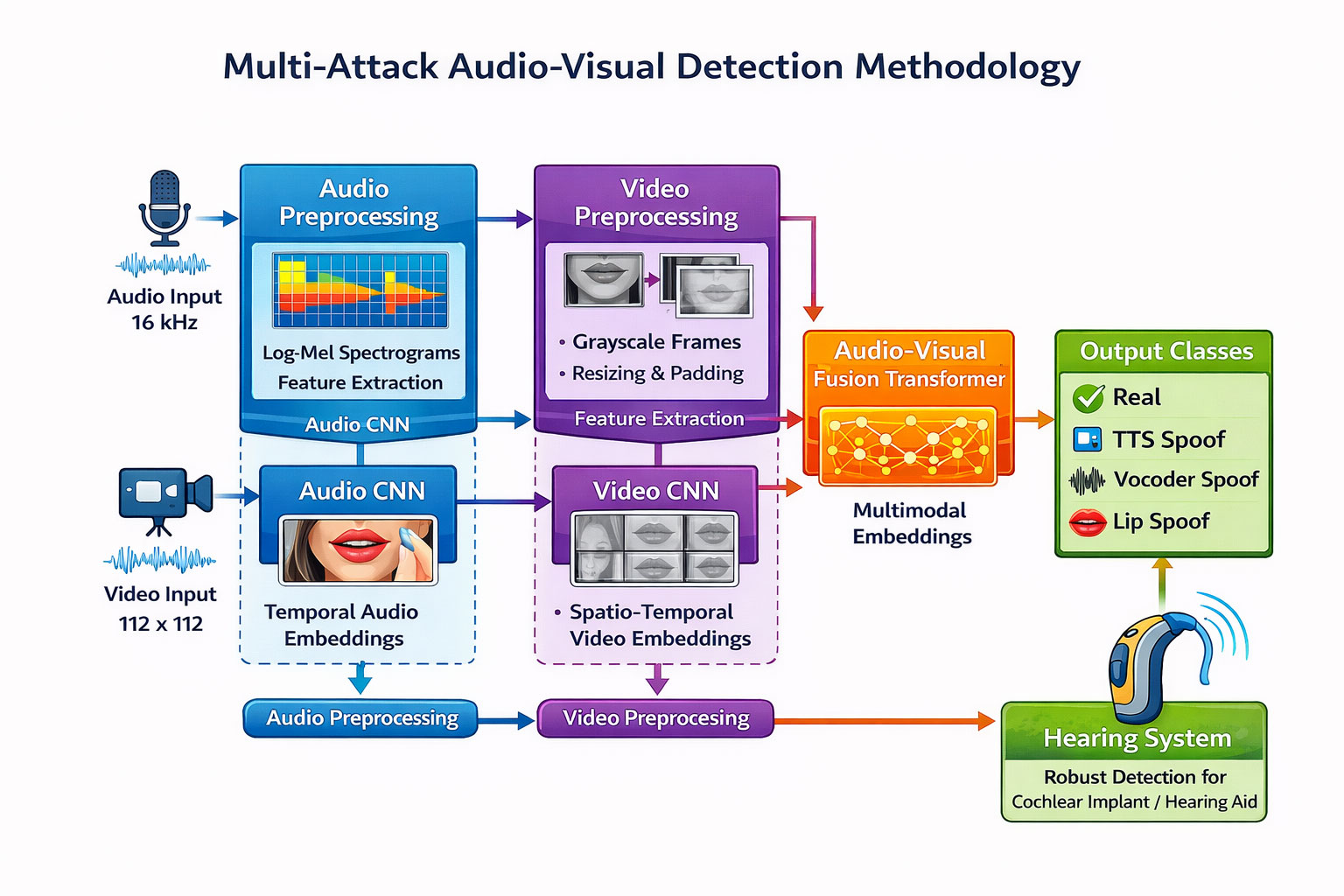
Audio-visual spoofing attacks have emerged as a serious threat to modern hearing-assistive systems due to rapid advances in text-to-speech synthesis, neural vocoders, and lip-sync deepfake generation. Advanced hearing aids and cochlear implants increasingly incorporate AI-based speech enhancement and multimodal perception modules, which makes them vulnerable to manipulated or synthetic inputs. Traditional spoof detection approaches are often limited to binary classification between bonafide and spoofed speech, failing to capture the diversity of emerging multi-modal attack types.In this paper, we propose a multi-attack audio-visual spoof detection framework designed that explicitly models four spoof categories: real speech, text-to-speech (TTS) spoofing, vocoder-based spoofing, and lip-sync manipulation attacks. A multi-attack protocol is introduced to enable fine-grained supervision across both audio and video modalities. The proposed system employs convolutional feature extractors for each stream, followed by multimodal fusion for robust classification. Experimental results demonstrate reliable performance under in-dataset evaluation settings. Confusion matrix analysis further highlights the effectiveness of audio-visual fusion, particularly in detecting visually driven spoofing attacks. Overall, this work provides a strong foundation for next-generation secure hearing-assistive systems operating in real-world acoustic environments.
Graphical Abstract
Keywords
Data Availability Statement
Funding
Conflicts of Interest
AI Use Statement
Ethical Approval and Consent to Participate
References
- Simikić, V. (2024, May). Internet of Medical Things (IoMT): Smart Hearing Aids, Today and Tomorrow. In Serbian International Conference on Applied Artificial Intelligence (pp. 402-411). Cham: Springer Nature Switzerland.
[CrossRef] [Google Scholar] - Hussain, A., Goman, A. M., Gogate, M., Dashtipour, K., Kirton-Wingate, J., Hussain, Z., Sheikh, A., Akeroyd, M. A., & Hussain, A. (2026). Audio-visual speech-in-noise tests for evaluating speech reception thresholds: A scoping review. PLoS One, 21(1), e0338600.
[CrossRef] [Google Scholar] - Ren, Z., Qian, K., Schultz, T., & Schuller, B. W. (2023, December). An overview of the ICASSP special session on AI security and privacy in speech and audio processing. In Proceedings of the 5th ACM International Conference on Multimedia in Asia Workshops (pp. 1-6).
[CrossRef] [Google Scholar] - Lavrentyeva, G., Novoselov, S., Malykh, E., Kozlov, A., Kudashev, O., & Shchemelinin, V. (2017, August). Audio replay attack detection with deep learning frameworks. In Interspeech (pp. 82-86).
[CrossRef] [Google Scholar] - Yamagishi, J., Todisco, M., Sahidullah, M., Delgado, H., Wang, X., Evans, N., ... & Nautsch, A. (2019). Asvspoof 2019: Automatic speaker verification spoofing and countermeasures challenge evaluation plan. ASV Spoof, 13. https://www.asvspoof.org/asvspoof2019/asvspoof2019_evaluation_plan.pdf
[Google Scholar] - Todisco, M., Wang, X., Vestman, V., Sahidullah, M., Delgado, H., Nautsch, A., ... & Lee, K. A. (2019). ASVspoof 2019: Future horizons in spoofed and fake audio detection. arXiv preprint arXiv:1904.05441.
[CrossRef] [Google Scholar] - Chugh, K., Gupta, P., Dhall, A., & Subramanian, R. (2020, October). Not made for each other-audio-visual dissonance-based deepfake detection and localization. In Proceedings of the 28th ACM international conference on multimedia (pp. 439-447).
[CrossRef] [Google Scholar] - Borrelli, C., Bestagini, P., Antonacci, F., Sarti, A., & Tubaro, S. (2021). Synthetic speech detection through short-term and long-term prediction traces. EURASIP Journal on Information Security, 2021(1), 2.
[CrossRef] [Google Scholar] - He, Y., & Wang, S. (2025, October). Towards Highly Generalized Lip-Sync Deepfake Detection via Detailed Audio-Visual Inconsistency Analysis. In Chinese Conference on Pattern Recognition and Computer Vision (PRCV) (pp. 522-535). Singapore: Springer Nature Singapore.
[CrossRef] [Google Scholar] - Chung, J. S., & Zisserman, A. (2016, November). Out of time: automated lip sync in the wild. In Asian conference on computer vision (pp. 251-263). Cham: Springer International Publishing.
[CrossRef] [Google Scholar] - Ge, S., Lin, F., Li, C., Zhang, D., Wang, W., & Zeng, D. (2022). Deepfake video detection via predictive representation learning. ACM Transactions on Multimedia Computing, Communications, and Applications (TOMM), 18(2s), 1-21.
[CrossRef] [Google Scholar] - Afouras, T., Chung, J. S., & Zisserman, A. (2018). The conversation: Deep audio-visual speech enhancement. arXiv preprint arXiv:1804.04121.
[CrossRef] [Google Scholar] - Garg, A., Noyola, J., & Bagadia, S. (2016). Lip reading using CNN and LSTM. Technical report, Stanford University, CS231 n project report. http://vision.stanford.edu/teaching/cs231n/reports/2016/pdfs/217_Report.pdf
[Google Scholar] - Wang, J., Wu, Z., Ouyang, W., Han, X., Chen, J., Jiang, Y. G., & Li, S. N. (2022, June). M2tr: Multi-modal multi-scale transformers for deepfake detection. In Proceedings of the 2022 international conference on multimedia retrieval (pp. 615-623).
[CrossRef] [Google Scholar] - Vaswani, A., Shazeer, N., Parmar, N., Uszkoreit, J., Jones, L., Gomez, A. N., ... & Polosukhin, I. (2017). Attention is all you need. Advances in neural information processing systems, 30. https://proceedings.neurips.cc/paper/2017/hash/3f5ee243547dee91fbd053c1c4a845aa-Abstract.html
[Google Scholar] - Gulati, A., Qin, J., Chiu, C. C., Parmar, N., Zhang, Y., Yu, J., ... & Pang, R. (2020). Conformer: Convolution-augmented transformer for speech recognition. Proceedings of Interspeech 2020, 5036-5040.
[CrossRef] [Google Scholar] - Delgado, H., Evans, N., Kinnunen, T., Lee, K. A., Liu, X., Nautsch, A., ... & Yamagishi, J. (2021). ASVspoof 2021: Automatic speaker verification spoofing and countermeasures challenge evaluation plan. arXiv preprint arXiv:2109.00535.
[CrossRef] [Google Scholar] - Khan, A. A., Laghari, A. A., Inam, S. A., Ullah, S., Shahzad, M., & Syed, D. (2025). A survey on multimedia-enabled deepfake detection: state-of-the-art tools and techniques, emerging trends, current challenges & limitations, and future directions. Discover Computing, 28(1), 48.
[CrossRef] [Google Scholar] - Wang, X., Yamagishi, J., Todisco, M., Delgado, H., Nautsch, A., Evans, N., ... & Ling, Z. H. (2020). ASVspoof 2019: A large-scale public database of synthesized, converted and replayed speech. Computer Speech & Language, 64, 101114.
[CrossRef] [Google Scholar] - Wang, X., Xiao, Y., & Zhu, X. (2017, August). Feature Selection Based on CQCCs for Automatic Speaker Verification Spoofing. In Interspeech (pp. 32-36).
[CrossRef] [Google Scholar] - Park, D.S., Chan, W., Zhang, Y., Chiu, C.-C., Zoph, B., Cubuk, E.D., Le, Q.V. (2019) SpecAugment: A Simple Data Augmentation Method for Automatic Speech Recognition. Proc. Interspeech 2019, 2613-2617.
[CrossRef] [Google Scholar] - Jung, T., Kim, S., & Kim, K. (2020). Deepvision: Deepfakes detection using human eye blinking pattern. IEEE Access, 8, 83144-83154.
[CrossRef] [Google Scholar] - Li, Y., Zhang, M., Ren, M., Qiao, X., Ma, M., Wei, D., & Yang, H. (2024, November). Cross-domain audio deepfake detection: Dataset and analysis. In Proceedings of the 2024 Conference on Empirical Methods in Natural Language Processing (pp. 4977-4983).
[CrossRef] [Google Scholar] - Khan, N., Nguyen, T., & Khalil, I. (2025, December). Adaptive Inter-Modality Attention for Enhanced Cross-Domain Deepfake Detection Transferability. In Proceedings of the 7th ACM International Conference on Multimedia in Asia (pp. 1-7).
[CrossRef] [Google Scholar] - Liu, X., Sahidullah, M., Lee, K. A., & Kinnunen, T. (2024). Generalizing speaker verification for spoof awareness in the embedding space. IEEE/ACM Transactions on Audio, Speech, and Language Processing, 32, 1261-1273.
[CrossRef] [Google Scholar] - Khan, A., Malik, K. M., Ryan, J., & Saravanan, M. (2023). Battling voice spoofing: a review, comparative analysis, and generalizability evaluation of state-of-the-art voice spoofing counter measures. Artificial Intelligence Review.
[CrossRef] [Google Scholar] - Hussain, T., Saleem, N., Dashtipour, K., Ahmed, S., Hou, J. C., Anwar, U., ... & Hussain, A. (2026). Audio-visual speech enhancement in noisy environments using emotion-based contextual cues. The Journal of the Acoustical Society of America, 159(1), 470-483.
[CrossRef] [Google Scholar] - Dashtipour, K. K., Gogate, M., Ahmed, S., Hussain, A., Hussain, T., Hou, J. C., Arslan, T., Tsao, Y., & Hussain, A. (2024). Towards cross-lingual audio-visual speech enhancement. In Proceedings of AVSEC 2024 (pp. 30-32).
[CrossRef] [Google Scholar]
Cite This Article
TY  - JOUR
AU  - Munawwara, Aysha
AU  - Dashtipour, Kia
AU  - Saleem, Nasir
AU  - Gogate, Mandar
AU  - Hussain, Adeel
AU  - Hussain, Amir
PY  - 2026
DA  - 2026/04/28
TI  - Multi-Attack Audio-Visual Spoof Detection for Secure Hearing-Assistive Systems Using Transformer Fusion
JO  - ICCK Transactions on Information Security and Cryptography
T2  - ICCK Transactions on Information Security and Cryptography
JF  - ICCK Transactions on Information Security and Cryptography
VL  - 2
IS  - 2
SP  - 101
EP  - 108
DO  - 10.62762/TISC.2026.221187
UR  - https://www.icck.org/article/abs/TISC.2026.221187
KW  - hearing systems
KW  - audio-visual spoofing
KW  - deepfake detection
KW  - transformer fusion
KW  - multi-attack protocol
AB  - Audio-visual spoofing attacks have emerged as a serious threat to modern hearing-assistive systems due to rapid advances in text-to-speech synthesis, neural vocoders, and lip-sync deepfake generation. Advanced hearing aids and cochlear implants increasingly incorporate AI-based speech enhancement and multimodal perception modules, which makes them vulnerable to manipulated or synthetic inputs. Traditional spoof detection approaches are often limited to binary classification between bonafide and spoofed speech, failing to capture the diversity of emerging multi-modal attack types.In this paper, we propose a multi-attack audio-visual spoof detection framework designed that explicitly models four spoof categories: real speech, text-to-speech (TTS) spoofing, vocoder-based spoofing, and lip-sync manipulation attacks. A multi-attack protocol is introduced to enable fine-grained supervision across both audio and video modalities. The proposed system employs convolutional feature extractors for each stream, followed by multimodal fusion for robust classification. Experimental results demonstrate reliable performance under in-dataset evaluation settings. Confusion matrix analysis further highlights the effectiveness of audio-visual fusion, particularly in detecting visually driven spoofing attacks. Overall, this work provides a strong foundation for next-generation secure hearing-assistive systems operating in real-world acoustic environments.
SN  - 3070-2429
PB  - Institute of Central Computation and Knowledge
LA  - English
ER  -
@article{Munawwara2026MultiAttac,
  author = {Aysha Munawwara and Kia Dashtipour and Nasir Saleem and Mandar Gogate and Adeel Hussain and Amir Hussain},
  title = {Multi-Attack Audio-Visual Spoof Detection for Secure Hearing-Assistive Systems Using Transformer Fusion},
  journal = {ICCK Transactions on Information Security and Cryptography},
  year = {2026},
  volume = {2},
  number = {2},
  pages = {101-108},
  doi = {10.62762/TISC.2026.221187},
  url = {https://www.icck.org/article/abs/TISC.2026.221187},
  abstract = {Audio-visual spoofing attacks have emerged as a serious threat to modern hearing-assistive systems due to rapid advances in text-to-speech synthesis, neural vocoders, and lip-sync deepfake generation. Advanced hearing aids and cochlear implants increasingly incorporate AI-based speech enhancement and multimodal perception modules, which makes them vulnerable to manipulated or synthetic inputs. Traditional spoof detection approaches are often limited to binary classification between bonafide and spoofed speech, failing to capture the diversity of emerging multi-modal attack types.In this paper, we propose a multi-attack audio-visual spoof detection framework designed that explicitly models four spoof categories: real speech, text-to-speech (TTS) spoofing, vocoder-based spoofing, and lip-sync manipulation attacks. A multi-attack protocol is introduced to enable fine-grained supervision across both audio and video modalities. The proposed system employs convolutional feature extractors for each stream, followed by multimodal fusion for robust classification. Experimental results demonstrate reliable performance under in-dataset evaluation settings. Confusion matrix analysis further highlights the effectiveness of audio-visual fusion, particularly in detecting visually driven spoofing attacks. Overall, this work provides a strong foundation for next-generation secure hearing-assistive systems operating in real-world acoustic environments.},
  keywords = {hearing systems, audio-visual spoofing, deepfake detection, transformer fusion, multi-attack protocol},
  issn = {3070-2429},
  publisher = {Institute of Central Computation and Knowledge}
}
Publisher's Note
ICCK stays neutral with regard to jurisdictional claims in published maps and institutional affiliations.
Rights and Permissions


Portico
