

Privacy-Preserving Artificial Intelligence for Diabetes Prediction: A Comparison of Centralised and Federated Learning



Article Information
Abstract
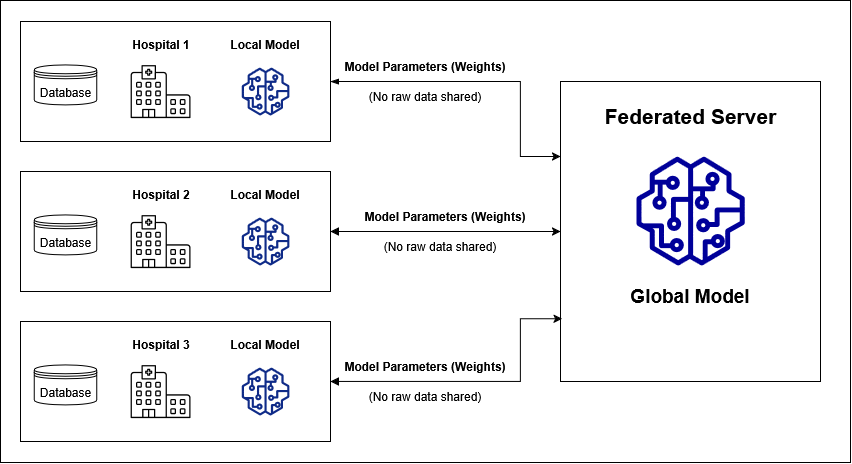
Artificial intelligence (AI) is increasingly used in healthcare to support disease prediction and clinical decision-making. Traditional centralised machine learning approaches often require the aggregation of sensitive patient data into a single repository, which raises substantial privacy, ethical, and regulatory concerns. Federated learning has emerged as a privacy-preserving alternative that enables collaborative model training across distributed data sources without sharing raw patient data. In this study, we investigate whether federated learning can achieve predictive performance comparable to that of centralised machine learning when applied to structured healthcare data. Using the PIMA Indians Diabetes dataset, several centralised machine learning models are evaluated and compared with a federated logistic regression model implemented using the Flower framework. Model performance is assessed using standard classification evaluation metrics. The results show that the federated approach achieves performance comparable to the centralised baselines, with a small reduction in predictive performance. These findings indicate that federated learning is a practical and effective solution for privacy-preserving predictive modelling in healthcare.
Graphical Abstract
Keywords
Data Availability Statement
Funding
Conflicts of Interest
AI Use Statement
Ethical Approval and Consent to Participate
References
- Rajkomar, A., Dean, J., & Kohane, I. (2019). Machine learning in medicine. New England Journal of Medicine, 380(14), 1347-1358.
[CrossRef] [Google Scholar] - Topol, E. J. (2019). High-performance medicine: the convergence of human and artificial intelligence. Nature medicine, 25(1), 44-56.
[CrossRef] [Google Scholar] - World Health Organization. (2016). Global report on diabetes: executive summary. World Health Organization. Available at: https://iris.who.int/handle/10665/204874
[Google Scholar] - Smith, J. W., Everhart, J. E., Dickson, W. C., Knowler, W. C., & Johannes, R. S. (1988, November). Using the ADAP learning algorithm to forecast the onset of diabetes mellitus. In Proceedings of the annual symposium on computer application in medical care (p. 261).
[Google Scholar] - Cloud Security Alliance. (2018). GDPR preparation & challenges survey report. Available at: https://cloudsecurityalliance.org/press-releases/2018/04/17/gdpr-preparation-and-challenges-survey-report
[Google Scholar] - McMahan, B., Moore, E., Ramage, D., Hampson, S., & y Arcas, B. A. (2017, April). Communication-efficient learning of deep networks from decentralized data. In Artificial intelligence and statistics (pp. 1273-1282). Pmlr.
[Google Scholar] - Kavakiotis, I., Tsave, O., Salifoglou, A., Maglaveras, N., Vlahavas, I., & Chouvarda, I. (2017). Machine learning and data mining methods in diabetes research. Computational and structural biotechnology journal, 15, 104-116.
[CrossRef] [Google Scholar] - Kairouz, P., & McMahan, H. B. (2021). Advances and open problems in federated learning. Foundations and trends in machine learning, 14(1-2), 1-210.
[CrossRef] [Google Scholar] - Rieke, N., Hancox, J., Li, W., Milletari, F., Roth, H. R., Albarqouni, S., ... & Cardoso, M. J. (2020). The future of digital health with federated learning. NPJ digital medicine, 3(1), 119.
[CrossRef] [Google Scholar] - Sheller, M. J., Edwards, B., Reina, G. A., Martin, J., Pati, S., Kotrotsou, A., Milchenko, M., Xu, W., Marcus, D., Colen, R. R., & Bakas, S. (2020). Federated learning in medicine: facilitating multi-institutional collaborations without sharing patient data. Scientific Reports, 10(1), 12598.
[CrossRef] [Google Scholar] - Li, T., Sahu, A. K., Talwalkar, A., & Smith, V. (2020). Federated learning: Challenges, methods, and future directions. IEEE signal processing magazine, 37(3), 50-60.
[CrossRef] [Google Scholar] - Truex, S., Baracaldo, N., Anwar, A., Steinke, T., Ludwig, H., Zhang, R., & Zhou, Y. (2019, November). A hybrid approach to privacy-preserving federated learning. In Proceedings of the 12th ACM workshop on artificial intelligence and security (pp. 1-11).
[CrossRef] [Google Scholar] - Shortliffe, E. H., Shortliffe, E. H., Cimino, J. J., & Cimino, J. J. (2014). Biomedical informatics: computer applications in health care and biomedicine. Springer.
[CrossRef] [Google Scholar] - Mittelstadt, B. (2019). Principles alone cannot guarantee ethical AI. Nature machine intelligence, 1(11), 501-507.
[CrossRef] [Google Scholar]
Cite This Article
TY  - JOUR
AU  - Grant, Aimie
AU  - Hussain, Amir
AU  - Gogate, Mandar
AU  - Saleem, Nasir
AU  - Dashtipour, Kia
PY  - 2026
DA  - 2026/04/10
TI  - Privacy-Preserving Artificial Intelligence for Diabetes Prediction: A Comparison of Centralised and Federated Learning
JO  - ICCK Transactions on Information Security and Cryptography
T2  - ICCK Transactions on Information Security and Cryptography
JF  - ICCK Transactions on Information Security and Cryptography
VL  - 2
IS  - 2
SP  - 73
EP  - 81
DO  - 10.62762/TISC.2025.335076
UR  - https://www.icck.org/article/abs/TISC.2025.335076
KW  - federated learning
KW  - privacy-preserving AI
KW  - healthcare
KW  - diabetes prediction
AB  - Artificial intelligence (AI) is increasingly used in healthcare to support disease prediction and clinical decision-making. Traditional centralised machine learning approaches often require the aggregation of sensitive patient data into a single repository, which raises substantial privacy, ethical, and regulatory concerns. Federated learning has emerged as a privacy-preserving alternative that enables collaborative model training across distributed data sources without sharing raw patient data. In this study, we investigate whether federated learning can achieve predictive performance comparable to that of centralised machine learning when applied to structured healthcare data. Using the PIMA Indians Diabetes dataset, several centralised machine learning models are evaluated and compared with a federated logistic regression model implemented using the Flower framework. Model performance is assessed using standard classification evaluation metrics. The results show that the federated approach achieves performance comparable to the centralised baselines, with a small reduction in predictive performance. These findings indicate that federated learning is a practical and effective solution for privacy-preserving predictive modelling in healthcare.
SN  - 3070-2429
PB  - Institute of Central Computation and Knowledge
LA  - English
ER  -
@article{Grant2026PrivacyPre,
  author = {Aimie Grant and Amir Hussain and Mandar Gogate and Nasir Saleem and Kia Dashtipour},
  title = {Privacy-Preserving Artificial Intelligence for Diabetes Prediction: A Comparison of Centralised and Federated Learning},
  journal = {ICCK Transactions on Information Security and Cryptography},
  year = {2026},
  volume = {2},
  number = {2},
  pages = {73-81},
  doi = {10.62762/TISC.2025.335076},
  url = {https://www.icck.org/article/abs/TISC.2025.335076},
  abstract = {Artificial intelligence (AI) is increasingly used in healthcare to support disease prediction and clinical decision-making. Traditional centralised machine learning approaches often require the aggregation of sensitive patient data into a single repository, which raises substantial privacy, ethical, and regulatory concerns. Federated learning has emerged as a privacy-preserving alternative that enables collaborative model training across distributed data sources without sharing raw patient data. In this study, we investigate whether federated learning can achieve predictive performance comparable to that of centralised machine learning when applied to structured healthcare data. Using the PIMA Indians Diabetes dataset, several centralised machine learning models are evaluated and compared with a federated logistic regression model implemented using the Flower framework. Model performance is assessed using standard classification evaluation metrics. The results show that the federated approach achieves performance comparable to the centralised baselines, with a small reduction in predictive performance. These findings indicate that federated learning is a practical and effective solution for privacy-preserving predictive modelling in healthcare.},
  keywords = {federated learning, privacy-preserving AI, healthcare, diabetes prediction},
  issn = {3070-2429},
  publisher = {Institute of Central Computation and Knowledge}
}
Publisher's Note
ICCK stays neutral with regard to jurisdictional claims in published maps and institutional affiliations.
Rights and Permissions


Portico
