

Secure Aware Outlier Detection in Underwater Wireless Sensor Networks Using Deep Learning


Article Information
Abstract
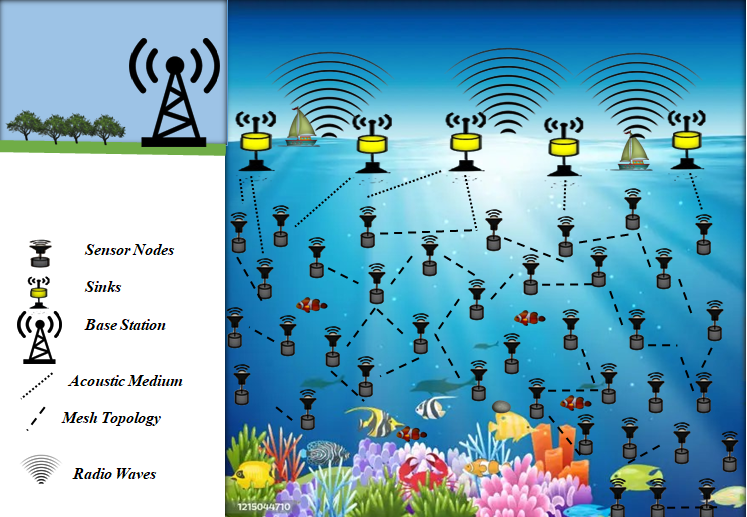
The emerging field of underwater sensor networks (UWSN) has a vital potential shaping the modern and future landscape that assists in measuring water quality, pollution tracking, and identification of underwater habitats. The challenging conditions in the UWSN environments raise data and security concerns in terms of outliers related to the complicated communication system, poor visibility, and limited resources. The data quality and network efficiency may be affected due to these unwanted conditions, giving rise to certain malicious activities in the network. This study aims to enhance the outlier identification process in terms of security and quality perspectives using the Long Short-Term Memory (LSTM) framework. The focus is to identify the temporal patterns and differentiate between various outliers in critical UWSN conditions. Results reveal that the proposed framework achieved high accuracy up to 95% and surpassed the other traditional machine learning models. It is worth mentioning that underwater sensor data have a complicated pattern that can be more appropriately handled using deep learning models, including LSTM, in comparison to traditional machine learning models.
Graphical Abstract
Keywords
Data Availability Statement
Funding
Conflicts of Interest
Ethical Approval and Consent to Participate
References
- Taher, R. J., & Mohsen, K. K. (2024). Underwater wireless sensor networks. BIO Web of Conferences, 97, 00023.
[CrossRef] [Google Scholar] - Masood, F., Khan, M. A., Alshehri, M. S., Ghaban, W., Saeed, F., Albarakati, H. M., & Alkhayyat, A. (2024). AI-based wireless sensor IoT networks for energy-efficient consumer electronics using stochastic optimization. IEEE Transactions on Consumer Electronics, 70(4), 6855-6862.
[CrossRef] [Google Scholar] - Mohamed, R. E., Saleh, A. I., Abdelrazzak, M., & Samra, A. S. (2018). Survey on wireless sensor network applications and energy efficient routing protocols. Wireless Personal Communications, 101(2), 1019-1055.
[CrossRef] [Google Scholar] - Heidemann, J., Stojanovic, M., & Zorzi, M. (2012). Underwater sensor networks: applications, advances and challenges. Philosophical Transactions of the Royal Society A: Mathematical, Physical and Engineering Sciences, 370(1958), 158-175.
[CrossRef] [Google Scholar] - Jouhari, M., Ibrahimi, K., Tembine, H., & Ben-Othman, J. (2019). Underwater wireless sensor networks: A survey on enabling technologies, localization protocols, and internet of underwater things. IEEE Access, 7, 96879-96899.
[CrossRef] [Google Scholar] - Amoli, P. V. (2016). An overview on current researches on underwater sensor networks: Applications, challenges and future trends. International Journal of Electrical and Computer Engineering, 6(3), 955.
[CrossRef] [Google Scholar] - Fattah, S., Gani, A., Ahmedy, I., Idris, M. Y. I., & Targio Hashem, I. A. (2020). A survey on underwater wireless sensor networks: Requirements, taxonomy, recent advances, and open research challenges. Sensors, 20(18), 5393.
[CrossRef] [Google Scholar] - Jiang, S. (2018). On securing underwater acoustic networks: A survey. IEEE Communications Surveys & Tutorials, 21(1), 729-752.
[CrossRef] [Google Scholar] - Chartres, C., & Varma, S. (2010). Out of water: from abundance to scarcity and how to solve the world's water problems. FT Press.
[Google Scholar] - Li, S., Qu, W., Liu, C., Qiu, T., & Zhao, Z. (2019). Survey on high reliability wireless communication for underwater sensor networks. Journal of Network and Computer Applications, 148, 102446.
[CrossRef] [Google Scholar] - Otero, P., Chowdhry, B. S., Zeng, H., & Aamir, M. (2021). underwater communications and sensors technologies. Wireless Personal Communications, 116(2), 955-961.
[CrossRef] [Google Scholar] - Felemban, E., Shaikh, F. K., Qureshi, U. M., Sheikh, A. A., & Qaisar, S. B. (2015). Underwater sensor network applications: A comprehensive survey. International Journal of Distributed Sensor Networks, 11(11), 896832.
[CrossRef] [Google Scholar] - Awan, K. M., Shah, P. A., Iqbal, K., Gillani, S., Ahmad, W., & Nam, Y. (2019). Underwater wireless sensor networks: A review of recent issues and challenges. Wireless Communications and Mobile Computing, 2019(1), 6470359.
[CrossRef] [Google Scholar] - Gola, K. K., & Gupta, B. (2017). Underwater sensor networks routing (UWSN-R): A comprehensive survey. Sensor Letters, 15(11), 877-890.
[CrossRef] [Google Scholar] - Eleftherakis, D., & Vicen-Bueno, R. (2020). Sensors to increase the security of underwater communication cables: A review of underwater monitoring sensors. Sensors, 20(3), 737.
[CrossRef] [Google Scholar] - Das, A. P., Thampi, S. M., & Lloret, J. (2020). Anomaly detection in UASN localization based on time series analysis and fuzzy logic. Mobile Networks and Applications, 25(1), 55-67.
[CrossRef] [Google Scholar] - Rault, T., Bouabdallah, A., & Challal, Y. (2014). Energy efficiency in wireless sensor networks: A top-down survey. Computer networks, 67, 104-122.
[CrossRef] [Google Scholar] - Cao, X., Liu, L., Cheng, Y., & Shen, X. (2017). Towards energy-efficient wireless networking in the big data era: A survey. IEEE Communications Surveys & Tutorials, 20(1), 303-332.
[CrossRef] [Google Scholar] - Meleshko, A. V., Desnitsky, V. A., & Kotenko, I. V. (2020). Machine learning based approach to detection of anomalous data from sensors in cyber-physical water supply systems. IOP conference series: materials science and engineering, 709(3), 033034.
[CrossRef] [Google Scholar] - Liu, N., Chen, D., Huang, H., Huang, X., Yang, Q., & Xiong, N. N. (2022). Anomaly Detection of Underwater Sensor Data Based on Temporal and Spatial Correlation. International Conference on Artificial Intelligence and Security, 239-252.
[CrossRef] [Google Scholar] - Saeed, N., Al-Naffouri, T. Y., & Alouini, M. S. (2018). Outlier detection and optimal anchor placement for 3-D underwater optical wireless sensor network localization. IEEE Transactions on Communications, 67(1), 611-622.
[CrossRef] [Google Scholar] - Samara, M. A., Bennis, I., Abouaissa, A., & Lorenz, P. (2022). A survey of outlier detection techniques in IoT: Review and classification. Journal of Sensor and Actuator Networks, 11(1), 4.
[CrossRef] [Google Scholar] - Yu, Y., Si, X., Hu, C., & Zhang, J. (2019). A review of recurrent neural networks: LSTM cells and network architectures. Neural computation, 31(7), 1235-1270.
[CrossRef] [Google Scholar]
Cited By (1)
-
Chafiq Titouna, Somia Bibi, Faiza Titouna. .
2026 International Wireless Communications and Mobile Computing (IWCMC), 2026 .
[CrossRef]
Cite This Article
TY  - JOUR
AU  - Rani, Sunbal
AU  - Rahim, Saqib Shahid
PY  - 2025
DA  - 2025/08/18
TI  - Secure Aware Outlier Detection in Underwater Wireless Sensor Networks Using Deep Learning
JO  - ICCK Transactions on Information Security and Cryptography
T2  - ICCK Transactions on Information Security and Cryptography
JF  - ICCK Transactions on Information Security and Cryptography
VL  - 1
IS  - 1
SP  - 13
EP  - 25
DO  - 10.62762/TISC.2025.610386
UR  - https://www.icck.org/article/abs/TISC.2025.610386
KW  - underwater sensor networks (UWSN)
KW  - anomaly detection (AD)
KW  - outlier detection (OD)
KW  - deep learning (DL)
KW  - long short-term memory (LSTM)
AB  - The emerging field of underwater sensor networks (UWSN) has a vital potential shaping the modern and future landscape that assists in measuring water quality, pollution tracking, and identification of underwater habitats. The challenging conditions in the UWSN environments raise data and security concerns in terms of outliers related to the complicated communication system, poor visibility, and limited resources. The data quality and network efficiency may be affected due to these unwanted conditions, giving rise to certain malicious activities in the network. This study aims to enhance the outlier identification process in terms of security and quality perspectives using the Long Short-Term Memory (LSTM) framework. The focus is to identify the temporal patterns and differentiate between various outliers in critical UWSN conditions. Results reveal that the proposed framework achieved high accuracy up to 95% and surpassed the other traditional machine learning models. It is worth mentioning that underwater sensor data have a complicated pattern that can be more appropriately handled using deep learning models, including LSTM, in comparison to traditional machine learning models.
SN  - 3070-2429
PB  - Institute of Central Computation and Knowledge
LA  - English
ER  -
@article{Rani2025Secure,
  author = {Sunbal Rani and Saqib Shahid Rahim},
  title = {Secure Aware Outlier Detection in Underwater Wireless Sensor Networks Using Deep Learning},
  journal = {ICCK Transactions on Information Security and Cryptography},
  year = {2025},
  volume = {1},
  number = {1},
  pages = {13-25},
  doi = {10.62762/TISC.2025.610386},
  url = {https://www.icck.org/article/abs/TISC.2025.610386},
  abstract = {The emerging field of underwater sensor networks (UWSN) has a vital potential shaping the modern and future landscape that assists in measuring water quality, pollution tracking, and identification of underwater habitats. The challenging conditions in the UWSN environments raise data and security concerns in terms of outliers related to the complicated communication system, poor visibility, and limited resources. The data quality and network efficiency may be affected due to these unwanted conditions, giving rise to certain malicious activities in the network. This study aims to enhance the outlier identification process in terms of security and quality perspectives using the Long Short-Term Memory (LSTM) framework. The focus is to identify the temporal patterns and differentiate between various outliers in critical UWSN conditions. Results reveal that the proposed framework achieved high accuracy up to 95\% and surpassed the other traditional machine learning models. It is worth mentioning that underwater sensor data have a complicated pattern that can be more appropriately handled using deep learning models, including LSTM, in comparison to traditional machine learning models.},
  keywords = {underwater sensor networks (UWSN), anomaly detection (AD), outlier detection (OD), deep learning (DL), long short-term memory (LSTM)},
  issn = {3070-2429},
  publisher = {Institute of Central Computation and Knowledge}
}
Publisher's Note
ICCK stays neutral with regard to jurisdictional claims in published maps and institutional affiliations.
Rights and Permissions


Portico
