

Editorial
Free to Read
The Age of AI Responsibility: Towards Human-Centric and Ethical Swarm Intelligence


1
Department of Computer Science, University of Guadalajara, CUCEI, Guadalajara, Mexico
* Corresponding Author:
Mario A. Navarro-Velázquez,
[email protected]
Volume 1, Issue 1
2025
Received: 29 July 2025
Accepted: 30 July 2025
Published: 30 August 2025

You have access to this article
·
Limited-Time Free Access
Article Information
Published in
ICCK Transactions on Swarm and Evolutionary Learning
Volume/Issue
Volume 1, Issue 1, 2025
Pages
29-31
Abstract
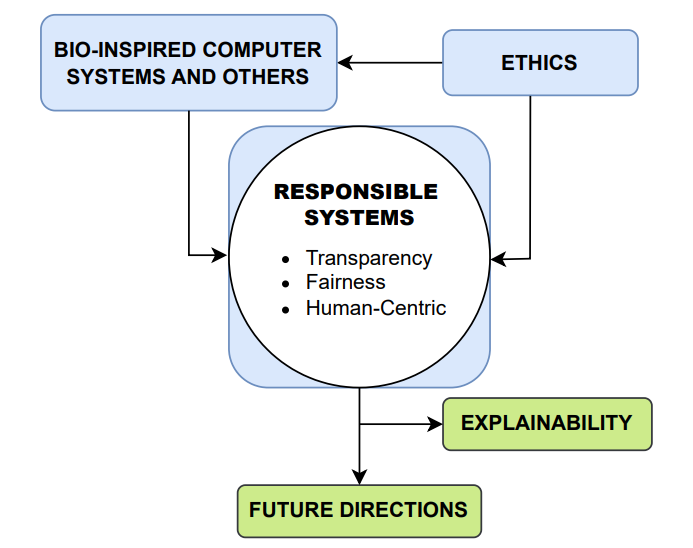
Swarm and evolutionary computation topics has demonstrated remarkable effectiveness in solving complex optimization problems across various scientific and engineering fields. However, as these methods are increasingly used in high-risk applications such as healthcare, finance, and autonomous systems, there is a growing need to address their ethical, interpretability, and social implications. This editorial outlines key guidelines for creating bio-inspired computing systems that are responsible and transparent, highlighting the fundamental role of ethics and explainability in shaping the future of evolutionary and swarm learning.
Graphical Abstract
Keywords
swarm and evolutionary computation
explainable AI
responsible AI
computational ethics
human-centered AI
Data Availability Statement
Not applicable.
Funding
This work was supported without any funding.
Conflicts of Interest
The author declares no conflicts of interest.
Ethical Approval and Consent to Participate
Not applicable.
References
- Kennedy, J., & Eberhart, R. (1995). Particle swarm optimization. In Proceedings of ICNN'95 - International Conference on Neural Networks (Vol. 4, pp. 1942–1948). IEEE.
[CrossRef] [Google Scholar] - Golberg, D. E. (1989). Genetic algorithms in search, optimization, and machine learning. Addion wesley, 1989(102), 36.
[Google Scholar] - Storn, R., & Price, K. (1997). Differential evolution – A simple and efficient heuristic for global optimization over continuous spaces. Journal of Global Optimization, 11(4), 341–359.
[CrossRef] [Google Scholar] - Dorigo, M., Maniezzo, V., & Colorni, A. (1996). Ant system: Optimization by a colony of cooperating agents. IEEE Transactions on Systems, Man, and Cybernetics, Part B (Cybernetics), 26(1), 29–41.
[CrossRef] [Google Scholar] - Arrieta, A. B., Díaz-Rodríguez, N., Del Ser, J., Bennetot, A., Tabik, S., Barbado, A., García, S., Gil-López, S., Molina, D., Benjamins, R., et al. (2020). Explainable artificial intelligence (XAI): Concepts, taxonomies, opportunities and challenges toward responsible AI. Information Fusion, 58, 82–115.
[CrossRef] [Google Scholar] - Mersha, M., Lam, K., Wood, J., Alshami, A. K., & Kalita, J. (2024). Explainable artificial intelligence: A survey of needs, techniques, applications, and future direction. Neurocomputing, 599, 128111.
[CrossRef] [Google Scholar] - Winfield, A. F. T., Swana, M., Ives, J., & Hauert, S. (2025). On the ethical governance of swarm robotic systems in the real world. Philosophical Transactions A, 383(2289), 20240142.
[CrossRef] [Google Scholar]
Cite This Article
APA Style
Navarro-Velázquez, M. A. (2025). The Age of AI Responsibility: Towards Human-Centric and Ethical Swarm Intelligence. ICCK Transactions on Swarm and Evolutionary Learning, 1(1), 29–31. https://doi.org/10.62762/TSEL.2025.807182
Export Citation
RIS Format
Compatible with EndNote, Zotero, Mendeley, and other reference managers
TY  - JOUR
AU  - Navarro-Velázquez, Mario A.
PY  - 2025
DA  - 2025/08/30
TI  - The Age of AI Responsibility: Towards Human-Centric and Ethical Swarm Intelligence
JO  - ICCK Transactions on Swarm and Evolutionary Learning
T2  - ICCK Transactions on Swarm and Evolutionary Learning
JF  - ICCK Transactions on Swarm and Evolutionary Learning
VL  - 1
IS  - 1
SP  - 29
EP  - 31
DO  - 10.62762/TSEL.2025.807182
UR  - https://www.icck.org/article/abs/TSEL.2025.807182
KW  - swarm and evolutionary computation
KW  - explainable AI
KW  - responsible AI
KW  - computational ethics
KW  - human-centered AI
AB  - Swarm and evolutionary computation topics has demonstrated remarkable effectiveness in solving complex optimization problems across various scientific and engineering fields. However, as these methods are increasingly used in high-risk applications such as healthcare, finance, and autonomous systems, there is a growing need to address their ethical, interpretability, and social implications. This editorial outlines key guidelines for creating bio-inspired computing systems that are responsible and transparent, highlighting the fundamental role of ethics and explainability in shaping the future of evolutionary and swarm learning.
SN  - 3069-2962
PB  - Institute of Central Computation and Knowledge
LA  - English
ER  -
BibTeX Format
Compatible with LaTeX, BibTeX, and other reference managers
@article{NavarroVelzquez2025The,
  author = {Mario A. Navarro-Velázquez},
  title = {The Age of AI Responsibility: Towards Human-Centric and Ethical Swarm Intelligence},
  journal = {ICCK Transactions on Swarm and Evolutionary Learning},
  year = {2025},
  volume = {1},
  number = {1},
  pages = {29-31},
  doi = {10.62762/TSEL.2025.807182},
  url = {https://www.icck.org/article/abs/TSEL.2025.807182},
  abstract = {Swarm and evolutionary computation topics has demonstrated remarkable effectiveness in solving complex optimization problems across various scientific and engineering fields. However, as these methods are increasingly used in high-risk applications such as healthcare, finance, and autonomous systems, there is a growing need to address their ethical, interpretability, and social implications. This editorial outlines key guidelines for creating bio-inspired computing systems that are responsible and transparent, highlighting the fundamental role of ethics and explainability in shaping the future of evolutionary and swarm learning.},
  keywords = {swarm and evolutionary computation, explainable AI, responsible AI, computational ethics, human-centered AI},
  issn = {3069-2962},
  publisher = {Institute of Central Computation and Knowledge}
}
Article Metrics
Publisher's Note
ICCK stays neutral with regard to jurisdictional claims in published maps and institutional affiliations.
Rights and Permissions
Institute of Central Computation and Knowledge (ICCK) or its licensor holds exclusive rights to this article under a publishing agreement with the author(s) or other rightsholder(s); author self-archiving of the accepted manuscript version of this article is solely governed by the terms of such publishing agreement and applicable law.


Preserved at
Portico
Portico

Scan to read this article