

A Comparative Analysis of Recent Metaheuristic Algorithms for Image Segmentation Using the Minimum Cross-Entropy for Multilevel Thresholding






Article Information
Abstract
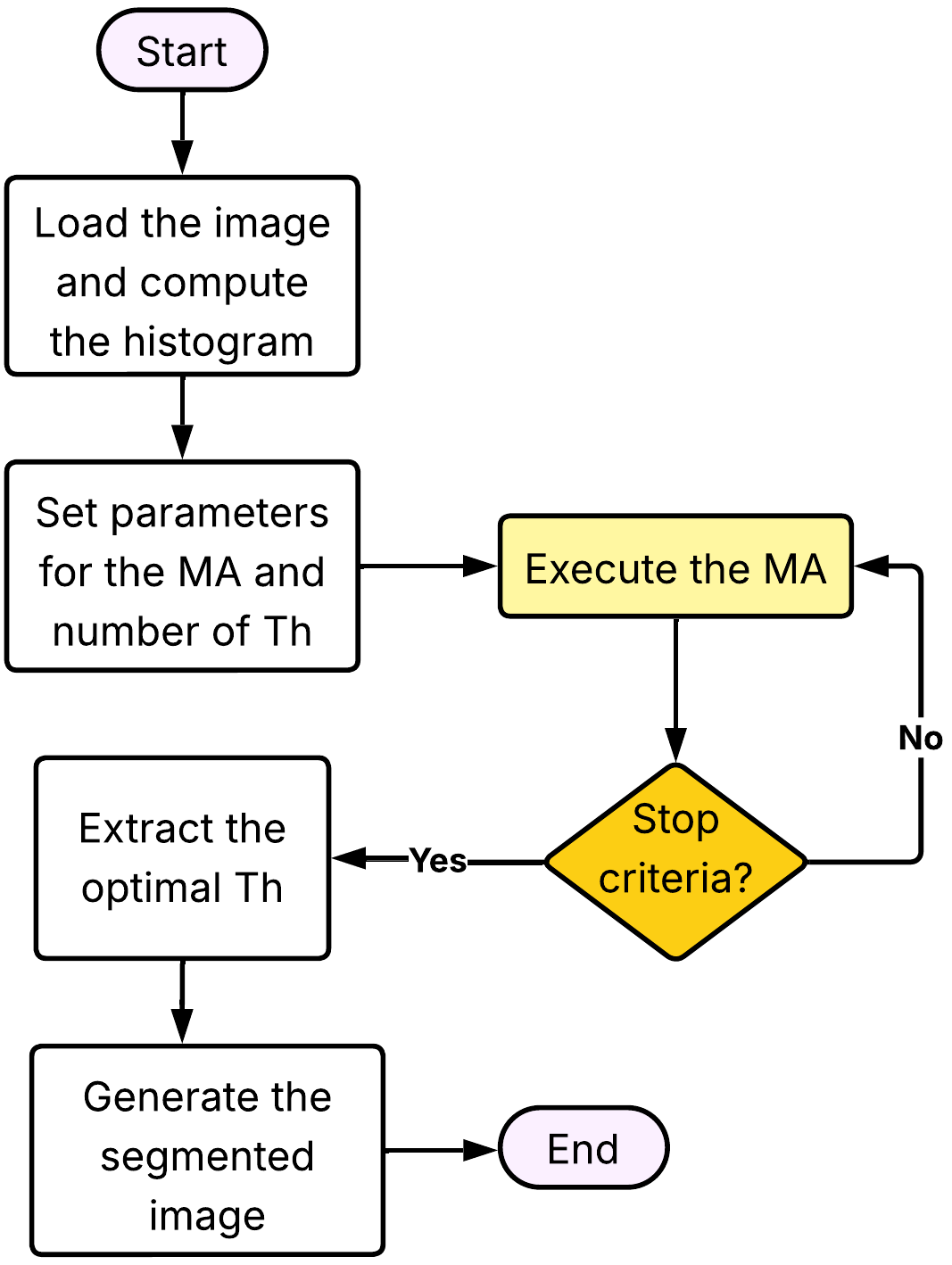
Metaheuristic Algorithms (MAs) are commonly used in the scope of digital image processing, in particular, image segmentation processes. This is evident in Multilevel Thresholding (MTH) methods, where the optimal threshold configuration must be found to produce high-quality segmented images. Minimum Cross-Entropy (MCE) is one of the most prominent techniques for MTH due to its simplicity and efficiency. This article proposes a comparison of recent MAs that have not yet been implemented for image segmentation. Six recently published MAs were implemented and tested on nine complicated images selected from the BSDS300 dataset. Analyzing the results reveals the best algorithm when MCE is used as the objective function. Central tendency indicators, such as Standard Deviation and mean, are also used to analyze the five threshold values. Additionally, three quality indicators used in processing images are analyzed: Peak Signal-to-Noise Ratio (PSNR), Structural Similarity (SSIM), and Feature Similarity (FSIM). The result of this analysis allows for the quality of the segmentation of each algorithm used in the comparison. The metrics with the highest values are indicative of the most effective algorithm in terms of segmentation performance.
Graphical Abstract
Keywords
Data Availability Statement
Funding
Conflicts of Interest
Ethical Approval and Consent to Participate
References
- Oliva, D., Hinojosa, S., Osuna-Enciso, V., Cuevas, E., Pérez-Cisneros, M., & Sanchez-Ante, G. (2019). Image segmentation by minimum cross entropy using evolutionary methods. Soft Computing, 23(2), 431–450.
[CrossRef] [Google Scholar] - Wang, Z., Wang, E., & Zhu, Y. (2020). Image segmentation evaluation: a survey of methods. Artificial Intelligence Review, 53(8), 5637–5674.
[CrossRef] [Google Scholar] - Kumar, M. J., Kumar, D. G. R., & Reddy, R. V. K. (2014). Review on image segmentation techniques. International Journal of Scientific Research Engineering & Technology, 3(6), 993–997.
[Google Scholar] - Kaur, D., & Kaur, Y. (2014). Various image segmentation techniques: a review. International journal of computer science and Mobile Computing, 3(5), 809–814.
[Google Scholar] - Sahoo, P. K., Soltani, S. A. K. C., & Wong, A. K. C. (1988). A survey of thresholding techniques. Computer vision, graphics, and image processing, 41(2), 233–260.
[CrossRef] [Google Scholar] - Bhargavi, K., & Jyothi, S. (2014). A survey on threshold based segmentation technique in image processing. International Journal of Innovative Research and Development, 3(12), 234–239.
[Google Scholar] - Otsu, N. (1979). A threshold selection method from gray-level histograms. IEEE transactions on systems, man, and cybernetics, 9(1), 62–66.
[CrossRef] [Google Scholar] - Jena, B., Naik, M. K., Panda, R., & Abraham, A. (2021). Maximum 3D Tsallis entropy based multilevel thresholding of brain MR image using attacking Manta Ray foraging optimization. Engineering Applications of Artificial Intelligence, 103, 104293.
[CrossRef] [Google Scholar] - Kapur, J. N., Sahoo, P. K., & Wong, A. K. C. (1985). A new method for gray-level picture thresholding using the entropy of the histogram. Computer vision, graphics, and image processing, 29(3), 273–285.
[CrossRef] [Google Scholar] - Agrawal, S., Panda, R., Bhuyan, S., & Panigrahi, B. K. (2013). Tsallis entropy based optimal multilevel thresholding using cuckoo search algorithm. Swarm and Evolutionary Computation, 11, 16–30.
[CrossRef] [Google Scholar] - Sahoo, P., Wilkins, C., & Yeager, J. (1997). Threshold selection using Renyi's entropy. Pattern recognition, 30(1), 71–84.
[CrossRef] [Google Scholar] - Chao, Y., Dai, M., Chen, K., Chen, P., & Zhang, Z. (2016). Fuzzy entropy based multilevel image thresholding using modified gravitational search algorithm. In 2016 IEEE international conference on industrial technology (ICIT) (pp. 752–757).
[CrossRef] [Google Scholar] - Fang, S. C., Peterson, E. L., & Rajasekera, J. R. (1992). Minimum cross-entropy analysis with entropy-type constraints. Journal of computational and applied mathematics, 39(2), 165–178.
[CrossRef] [Google Scholar] - Horng, M. H., & Liou, R. J. (2011). Multilevel minimum cross entropy threshold selection based on the firefly algorithm. Expert Systems with Applications, 38(12), 14805–14811.
[CrossRef] [Google Scholar] - Horng, M. H. (2010). Multilevel minimum cross entropy threshold selection based on the honey bee mating optimization. Expert Systems with Applications, 37(6), 4580–4592.
[CrossRef] [Google Scholar] - Pare, S., Kumar, A., Singh, G. K., & Bajaj, V. (2020). Image segmentation using multilevel thresholding: a research review. Iranian Journal of Science and Technology, Transactions of Electrical Engineering, 44(1), 1–29.
[CrossRef] [Google Scholar] - Karakoyun, M., Baykan, N. A., & Hacibeyoglu, M. (2017). Multi-level thresholding for image segmentation with swarm optimization algorithms. International Research Journal of Electronics & Computer Engineering, 3(3), 1.
[Google Scholar] - Merzban, M. H., & Elbayoumi, M. (2019). Efficient solution of Otsu multilevel image thresholding: A comparative study. Expert Systems with Applications, 116, 299–309.
[CrossRef] [Google Scholar] - Li, C. H., & Lee, C. K. (1993). Minimum cross entropy thresholding. Pattern recognition, 26(4), 617–625.
[CrossRef] [Google Scholar] - Abdel-Basset, M., Mohamed, R., & Abouhawwash, M. (2022). A new fusion of whale optimizer algorithm with Kapur's entropy for multi-threshold image segmentation: Analysis and validations. Artificial intelligence review, 55(8), 6389–6459.
[CrossRef] [Google Scholar] - Ma, P., & Geng, Y. (2024). An improved whale optimization algorithm based on multi-populations and multi-strategies for multilevel threshold image segmentation. In 2024 4th International Conference on Neural Networks, Information and Communication Engineering (NNICE) (pp. 826–831).
[CrossRef] [Google Scholar] - Shi, J., Chen, Y., Cai, Z., Heidari, A. A., Chen, H., & He, Q. (2024). Multi-threshold image segmentation using a boosted whale optimization: case study of breast invasive ductal carcinomas. Cluster Computing, 27(10), 14891–14949.
[CrossRef] [Google Scholar] - Rahkar Farshi, T., & K. Ardabili, A. (2021). A hybrid firefly and particle swarm optimization algorithm applied to multilevel image thresholding. Multimedia Systems, 27(1), 125–142.
[CrossRef] [Google Scholar] - Song, S., Jia, H., & Ma, J. (2019). A chaotic electromagnetic field optimization algorithm based on fuzzy entropy for multilevel thresholding color image segmentation. Entropy, 21(4), 398.
[CrossRef] [Google Scholar] - Thapliyal, S., & Kumar, N. (2024). ASCAEO: accelerated sine cosine algorithm hybridized with equilibrium optimizer with application in image segmentation using multilevel thresholding. Evolving Systems, 15(4), 1297–1358.
[CrossRef] [Google Scholar] - Hammouche, K., Diaf, M., & Siarry, P. (2008). A multilevel automatic thresholding method based on a genetic algorithm for a fast image segmentation. Computer Vision and Image Understanding, 109(2), 163–175.
[CrossRef] [Google Scholar] - Ma, M., & Zhu, Q. (2017). Multilevel thresholding image segmentation based on shuffled frog leaping algorithm. Journal of Computational and Theoretical Nanoscience, 14(8), 3794–3801.
[CrossRef] [Google Scholar] - Ouyang, K., Fu, S., Chen, Y., Cai, Q., Heidari, A. A., & Chen, H. (2024). Escape: an optimization method based on crowd evacuation behaviors. Artificial Intelligence Review, 58(1), 19.
[CrossRef] [Google Scholar] - Zheng, B., Chen, Y., Wang, C., Heidari, A. A., Liu, L., & Chen, H. (2024). The moss growth optimization (MGO): concepts and performance. Journal of Computational Design and Engineering, 11(5), 184–221.
[CrossRef] [Google Scholar] - He, J., Zhao, S., Ding, J., & Wang, Y. (2025). Mirage search optimization: Application to path planning and engineering design problems. Advances in Engineering Software, 203, 103883.
[CrossRef] [Google Scholar] - Abdel-Basset, M., Mohamed, R., Hezam, I. M., Sallam, K. M., & Hameed, I. A. (2024). An improved nutcracker optimization algorithm for discrete and continuous optimization problems: Design, comprehensive analysis, and engineering applications. Heliyon, 10(17).
[CrossRef] [Google Scholar] - Yuan, C., Zhao, D., Heidari, A. A., Liu, L., Chen, Y., & Chen, H. (2024). Polar Lights Optimizer: Algorithm and Applications in Image Segmentation and Feature Selection. Neurocomputing, 607, 128427.
[CrossRef] [Google Scholar] - Heidari, A. (2024). Polar lights optimizer: Algorithm and applications in image segmentation and feature selection [Computer software]. GitHub. https://github.com/aliasgharheidaricom/Polar-Lights-Optimizer-Algorithm-and-Applications-in-Image-Segmentation-and-Feature-Selection
[Google Scholar] - Brink, A. D., & Pendock, N. E. (1996). Minimum cross-entropy threshold selection. Pattern Recognition, 29(1), 179-188.
[CrossRef] [Google Scholar] - Kullback, S. (1997). Information theory and statistics. Courier Corporation.
[Google Scholar] - Horé, A., & Ziou, D. (2010). Image Quality Metrics: PSNR vs. SSIM. In 2010 20th International Conference on Pattern Recognition (pp. 2366-2369).
[CrossRef] [Google Scholar] - Zhang, L., Zhang, L., Mou, X., & Zhang, D. (2011). FSIM: A Feature Similarity Index for Image Quality Assessment. IEEE Transactions on Image Processing, 20(8), 2378-2386.
[CrossRef] [Google Scholar] - Martin, D. R., Fowlkes, C. C., Tal, D., & Malik, J. (2001). A Database of Human Segmented Natural Images and its Application to Evaluating Segmentation Algorithms and Measuring Ecological Statistics. In Proc. 8th Int'l Conf. Computer Vision (Vol. 2, pp. 416–423).
[CrossRef] [Google Scholar] - Duankhan, P., Sunat, K., Chiewchanwattana, S., & Nasa-ngium, P. (2024). The Differentiated Creative Search (DCS): Leveraging differentiated knowledge-acquisition and creative realism to address complex optimization problems. Expert Systems with Applications, 252, 123734.
[CrossRef] [Google Scholar] - Huynh-Thu, Q., & Ghanbari, M. (2008). Scope of validity of PSNR in image/video quality assessment. Electronics letters, 44(13), 800–801.
[CrossRef] [Google Scholar] - Avcibas, I., Sankur, B., & Sayood, K. (2002). Statistical evaluation of image quality measures. Journal of Electronic imaging, 11(2), 206–223.
[CrossRef] [Google Scholar] - Wang, Z., Bovik, A. C., Sheikh, H. R., & Simoncelli, E. P. (2004). Image quality assessment: from error visibility to structural similarity. IEEE transactions on image processing, 13(4), 600–612.
[CrossRef] [Google Scholar] - Sara, U., Akter, M., & Uddin, M. S. (2019). Image quality assessment through FSIM, SSIM, MSE and PSNR—A comparative study. Journal of Computer and Communications, 7(3), 8–18.
[CrossRef] [Google Scholar] - Friedman, M. (1937). The use of ranks to avoid the assumption of normality implicit in the analysis of variance. Journal of the american statistical association, 32(200), 675–701.
[CrossRef] [Google Scholar] - Friedman, M. (1940). A comparison of alternative tests of significance for the problem of m rankings. The Annals of Mathematical Statistics, 11(1), 86–92.
[CrossRef] [Google Scholar] - Scheff, S. W. (2016). Chapter 8 - Nonparametric Statistics. In S. W. Scheff (Ed.), Fundamental Statistical Principles for the Neurobiologist (pp. 157-182). Academic Press.
[CrossRef] [Google Scholar] - Kennedy, J., & Eberhart, R. (1995). Particle swarm optimization. In Proceedings of ICNN'95 - International Conference on Neural Networks (Vol. 4, pp. 1942-1948 vol.4).
[CrossRef] [Google Scholar] - Shi, Y., & Eberhart, R. (1998). A modified particle swarm optimizer. In 1998 IEEE International Conference on Evolutionary Computation Proceedings. IEEE World Congress on Computational Intelligence (Cat. No.98TH8360) (pp. 69-73).
[CrossRef] [Google Scholar] - Shi, Y., & Eberhart, R. C. (1999). Empirical study of particle swarm optimization. In Proceedings of the 1999 Congress on Evolutionary Computation-CEC99 (Cat. No. 99TH8406) (Vol. 3, pp. 1945-1950 Vol. 3).
[CrossRef] [Google Scholar]
Cited By (1)
-
Zhiwei Feng, Benyi Yang, Baosong Deng. SAM-assisted multimodal collaborative enhancement for remote sensing image segmentation.
Information Fusion, 2026 , 135 .
[CrossRef]
Cite This Article
TY  - JOUR
AU  - Alvarez, Omar
AU  - Beltran, Luis A.
AU  - Casas-Ordaz, Angel
AU  - Ramos-Frutos, Jorge
AU  - Navarro-Velázquez, Mario A.
AU  - Ramos-Soto, Oscar
AU  - Oliva, Diego
PY  - 2025
DA  - 2025/11/20
TI  - A Comparative Analysis of Recent Metaheuristic Algorithms for Image Segmentation Using the Minimum Cross-Entropy for Multilevel Thresholding
JO  - ICCK Transactions on Swarm and Evolutionary Learning
T2  - ICCK Transactions on Swarm and Evolutionary Learning
JF  - ICCK Transactions on Swarm and Evolutionary Learning
VL  - 1
IS  - 2
SP  - 50
EP  - 82
DO  - 10.62762/TSEL.2025.417356
UR  - https://www.icck.org/article/abs/TSEL.2025.417356
KW  - image segmentation
KW  - thresholding
KW  - minimum Cross-Entropy
KW  - metaheuristics
AB  - Metaheuristic Algorithms (MAs) are commonly used in the scope of digital image processing, in particular, image segmentation processes. This is evident in Multilevel Thresholding (MTH) methods, where the optimal threshold configuration must be found to produce high-quality segmented images. Minimum Cross-Entropy (MCE) is one of the most prominent techniques for MTH due to its simplicity and efficiency. This article proposes a comparison of recent MAs that have not yet been implemented for image segmentation. Six recently published MAs were implemented and tested on nine complicated images selected from the BSDS300 dataset. Analyzing the results reveals the best algorithm when MCE is used as the objective function. Central tendency indicators, such as Standard Deviation and mean, are also used to analyze the five threshold values. Additionally, three quality indicators used in processing images are analyzed: Peak Signal-to-Noise Ratio (PSNR), Structural Similarity (SSIM), and Feature Similarity (FSIM). The result of this analysis allows for the quality of the segmentation of each algorithm used in the comparison. The metrics with the highest values are indicative of the most effective algorithm in terms of segmentation performance.
SN  - 3069-2962
PB  - Institute of Central Computation and Knowledge
LA  - English
ER  -
@article{Alvarez2025A,
  author = {Omar Alvarez and Luis A. Beltran and Angel Casas-Ordaz and Jorge Ramos-Frutos and Mario A. Navarro-Velázquez and Oscar Ramos-Soto and Diego Oliva},
  title = {A Comparative Analysis of Recent Metaheuristic Algorithms for Image Segmentation Using the Minimum Cross-Entropy for Multilevel Thresholding},
  journal = {ICCK Transactions on Swarm and Evolutionary Learning},
  year = {2025},
  volume = {1},
  number = {2},
  pages = {50-82},
  doi = {10.62762/TSEL.2025.417356},
  url = {https://www.icck.org/article/abs/TSEL.2025.417356},
  abstract = {Metaheuristic Algorithms (MAs) are commonly used in the scope of digital image processing, in particular, image segmentation processes. This is evident in Multilevel Thresholding (MTH) methods, where the optimal threshold configuration must be found to produce high-quality segmented images. Minimum Cross-Entropy (MCE) is one of the most prominent techniques for MTH due to its simplicity and efficiency. This article proposes a comparison of recent MAs that have not yet been implemented for image segmentation. Six recently published MAs were implemented and tested on nine complicated images selected from the BSDS300 dataset. Analyzing the results reveals the best algorithm when MCE is used as the objective function. Central tendency indicators, such as Standard Deviation and mean, are also used to analyze the five threshold values. Additionally, three quality indicators used in processing images are analyzed: Peak Signal-to-Noise Ratio (PSNR), Structural Similarity (SSIM), and Feature Similarity (FSIM). The result of this analysis allows for the quality of the segmentation of each algorithm used in the comparison. The metrics with the highest values are indicative of the most effective algorithm in terms of segmentation performance.},
  keywords = {image segmentation, thresholding, minimum Cross-Entropy, metaheuristics},
  issn = {3069-2962},
  publisher = {Institute of Central Computation and Knowledge}
}
Article Metrics
Publisher's Note
ICCK stays neutral with regard to jurisdictional claims in published maps and institutional affiliations.
Rights and Permissions


Portico
