Volume 2, Issue 1


Volume 2, Issue 1 (March, 2026) – 2 articles
Citations: Crossref logo 0,   0   |   Viewed: 3425, Download: 625

Table of Contents

Open Access | Research Article | 19 March 2026
TinyML Driven Intrusion Detection for 5G Network Slices with Leakage-Free Validation
Next-Generation Computing Systems and Technologies | Volume 2, Issue 1: 10-20, 2026 | DOI: 10.62762/NGCST.2026.664893
Abstract
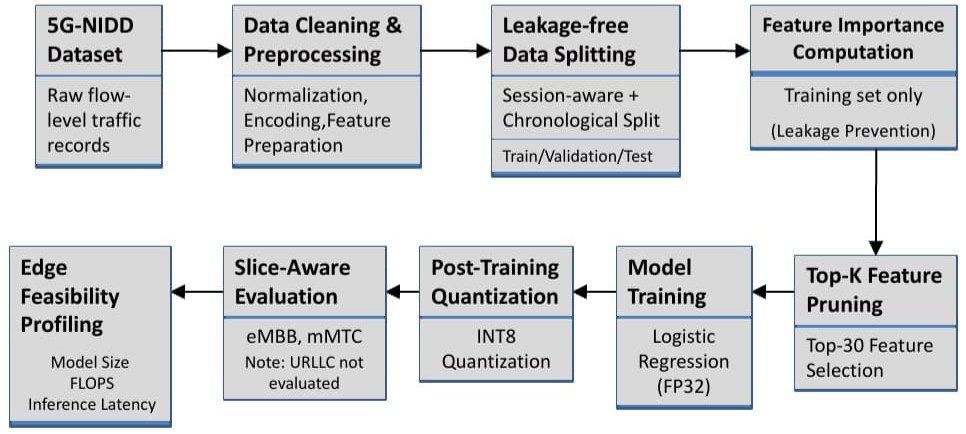
The intrusion detection at the 5G network perimeter demands learning frameworks that are practically feasible and computationally efficient. This research proposes a lightweight, slice-sensitive intrusion detection approach designed for edge deployment, with a strong emphasis on minimizing information leakage while accounting for the resource constraints inherent in edge environments. A rigorous chronological and session-discontinuous experimental protocol ensures that training and test traffic remain temporally separated, faithfully replicating realistic deployment conditions. The proposed framework employs a classical Logistic Regression classifier using flow-based statistical features ext... More >

Graphical Abstract
TinyML Driven Intrusion Detection for 5G Network Slices with Leakage-Free Validation
Open Access | Research Article | 07 March 2026
Predicting University Admission Chances Using Machine Learning
Next-Generation Computing Systems and Technologies | Volume 2, Issue 1: 1-9, 2026 | DOI: 10.62762/NGCST.2026.766610
Abstract
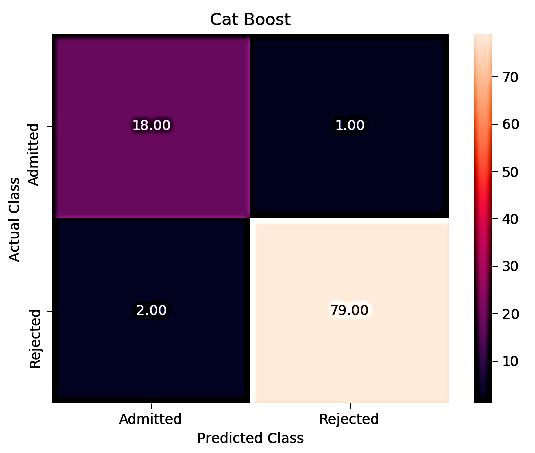
In the current academic landscape, students often face challenges in identifying suitable institutions for higher studies based on their academic and profile attributes. Existing advisory services and online tools are either expensive or lack predictive accuracy. This research proposes a machine learning-based admission prediction system that estimates the probability of university admission using historical applicant data. Linear Regression serves as a baseline model to capture linear relationships, Random Forest models non-linear feature interactions, and CatBoost is selected for its robustness on structured tabular data and native handling of categorical features. Comparative evaluation u... More >

Graphical Abstract
Predicting University Admission Chances Using Machine Learning