
Volume 2, Issue 1, Next-Generation Computing Systems and Technologies
Volume 2, Issue 1, 2026
Submit Manuscript Edit a Special Issue
Article QR Code
Article QR Code
Scan the QR code for reading
Popular articles
Next-Generation Computing Systems and Technologies, Volume 2, Issue 1, 2026: 1-9

Open Access | Research Article | 07 March 2026
Predicting University Admission Chances Using Machine Learning
1 Mahatma Gandhi Institute of Technology, Hyderabad, India
2 Birla Institute of Technology and Science (BITS) - Pilani, Hyderabad, India
* Corresponding Author: Barnali Gupta Banik, [email protected]
ARK: ark:/57805/ngcst.2026.766610
Received: 18 December 2025, Accepted: 23 February 2026, Published: 07 March 2026  
Abstract
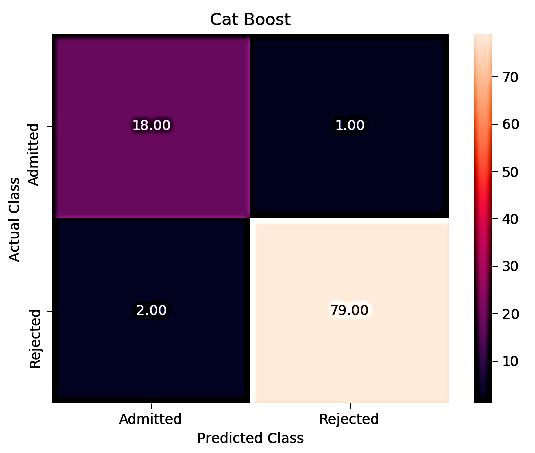
In the current academic landscape, students often face challenges in identifying suitable institutions for higher studies based on their academic and profile attributes. Existing advisory services and online tools are either expensive or lack predictive accuracy. This research proposes a machine learning-based admission prediction system that estimates the probability of university admission using historical applicant data. Linear Regression serves as a baseline model to capture linear relationships, Random Forest models non-linear feature interactions, and CatBoost is selected for its robustness on structured tabular data and native handling of categorical features. Comparative evaluation using MAE, RMSE, and R² shows that CatBoost outperforms the other models, achieving the lowest MAE of 0.042 and the highest R² of 0.81. The model also provides score-versus-admission probability analysis, enabling students to evaluate how improvements in test scores or CGPA affect their admission chances. The proposed approach offers an accurate, interpretable, and cost-free decision-support tool for students, addressing the limitations of existing admission prediction systems.

Graphical Abstract
Predicting University Admission Chances Using Machine Learning

Keywords
prediction
admission
catBoost
historical data analysis
score-based forecasting

Data Availability Statement
Data will be made available on request.

Funding
This work was supported without any funding.

Conflicts of Interest
The authors declare no conflicts of interest.

AI Use Statement
The authors declare that no generative AI was used in the preparation of this manuscript.

Ethical Approval and Consent to Participate
Not applicable.

References
  1. Gupta, M., Alpana, Gupta, P., & Varshney, N. (2025). A comparative study of automated undergraduate engineering admission prediction in an Indian university using machine learning. Journal of Computational Social Science, 8(3), 58.
    [CrossRef]   [Google Scholar]
  2. Sivasangari, A., Shivani, V., Bindhu, Y., Deepa, D., & Vignesh, R. (2021, April). Prediction probability of getting an admission into a university using machine learning. In 2021 5th international conference on computing methodologies and communication (ICCMC) (pp. 1706-1709). IEEE.
    [CrossRef]   [Google Scholar]
  3. Golden, P., Mojesh, K., Devarapalli, L. M., Reddy, P. N. S., Rajesh, S., & Chawla, A. (2021). A comparative study on university admission predictions using machine learning techniques. International Journal of Scientific Research in Computer Science, Engineering and Information Technology, 7(2), 537-548.
    [CrossRef]   [Google Scholar]
  4. Jain, V. M., & Satia, R. (2021). College admission prediction using ensemble machine learning models. International Research Journal of Engineering and Technology (IRJET), 8(12), 403-406.
    [Google Scholar]
  5. AlGhamdi, A., Barsheed, A., AlMshjary, H., & AlGhamdi, H. (2020, March). A machine learning approach for graduate admission prediction. In Proceedings of the 2020 2nd international conference on image, video and signal processing (pp. 155-158).
    [CrossRef]   [Google Scholar]
  6. Raftopoulos, G., Davrazos, G., & Kotsiantis, S. (2024). Fair and transparent student admission prediction using machine learning models. Algorithms, 17(12), 572.
    [CrossRef]   [Google Scholar]
  7. Raman, C. J., Janani, U., Dharani, P., & Balaji, V. (2024, January). Machine learning based university admit eligibility predictor. In AIP Conference Proceedings (Vol. 2802, No. 1, p. 120047). AIP Publishing LLC.
    [CrossRef]   [Google Scholar]
  8. Priyadarshini, A., Martinez-Neda, B., & Gago-Masague, S. (2023, September). Admission prediction in undergraduate applications: an interpretable deep learning approach. In 2023 Fifth International Conference on Transdisciplinary AI (TransAI) (pp. 135-140). IEEE.
    [CrossRef]   [Google Scholar]
  9. Waters, A., & Miikkulainen, R. (2014). Grade: Machine learning support for graduate admissions. Ai Magazine, 35(1), 64-64.
    [CrossRef]   [Google Scholar]
  10. Sridhar, S., Mootha, S., & Kolagati, S. (2020, July). A university admission prediction system using stacked ensemble learning. In 2020 Advanced Computing and Communication Technologies for High Performance Applications (ACCTHPA) (pp. 162-167). IEEE.
    [CrossRef]   [Google Scholar]
  11. Romsaiyud, W. (2025, May). Explainable AI Framework for Multiclass University Recommendations Using SHAP and Counterfactual SHAP. In 2025 10th International Conference on Machine Learning Technologies (ICMLT) (pp. 360-365). IEEE.
    [CrossRef]   [Google Scholar]
  12. Bitto, A. K., Bijoy, M. H. I., Das, A., Ferdousi, J., Begum, A., & Mahmud, I. A Novel CatML Stacking Classifier Based Intelligent System for Predicting Postgraduate Admission Chances: A Study on Bangladesh.
    [CrossRef]   [Google Scholar]
  13. Lundberg, S. M., & Lee, S. I. (2017). Consistent feature attribution for tree ensembles. arXiv preprint arXiv:1706.06060.
    [Google Scholar]
  14. Assegie, T. A., Salau, A. O., Chhabra, G., Kaushik, K., & Braide, S. L. (2024, May). Evaluation of random forest and support vector machine models in educational data mining. In 2024 2nd international conference on advancement in computation & computer technologies (InCACCT) (pp. 131-135). IEEE.
    [CrossRef]   [Google Scholar]
  15. Delena, R. D., Dia, N. J., Sacayan, R. R., Sieras, J. C., Khalid, S. A., Macatotong, A. H. T., & Gulam, S. B. (2025). Predicting student retention: a comparative study of machine learning approach utilizing sociodemographic and academic factors. Systems and Soft Computing, 200352.
    [CrossRef]   [Google Scholar]
  16. Timalsina, P., & Shakya, R. (2025). Predicting Student Academic Success through Explainable Machine Learning Models: A Comparative Study of BRF, XGBoost, and CatBoost. International Journal on Engineering Technology, 3(1), 100-108.
    [CrossRef]   [Google Scholar]
  17. Sahlaoui, H., Nayyar, A., Agoujil, S., & Jaber, M. M. (2021). Predicting and interpreting student performance using ensemble models and shapley additive explanations. IEEE Access, 9, 152688-152703.
    [CrossRef]   [Google Scholar]

Cite This Article
APA Style
Banik, B. G., & Syed, A. B. (2026). Predicting University Admission Chances Using Machine Learning. Next-Generation Computing Systems and Technologies, 2(1), 1–9. https://doi.org/10.62762/NGCST.2026.766610
Export Citation
RIS Format
Compatible with EndNote, Zotero, Mendeley, and other reference managers
RIS format data for reference managers
TY  - JOUR
AU  - Banik, Barnali Gupta
AU  - Syed, Aman Basha
PY  - 2026
DA  - 2026/03/07
TI  - Predicting University Admission Chances Using Machine Learning
JO  - Next-Generation Computing Systems and Technologies
T2  - Next-Generation Computing Systems and Technologies
JF  - Next-Generation Computing Systems and Technologies
VL  - 2
IS  - 1
SP  - 1
EP  - 9
DO  - 10.62762/NGCST.2026.766610
UR  - https://www.icck.org/article/abs/NGCST.2026.766610
KW  - prediction
KW  - admission
KW  - catBoost
KW  - historical data analysis
KW  - score-based forecasting
AB  - In the current academic landscape, students often face challenges in identifying suitable institutions for higher studies based on their academic and profile attributes. Existing advisory services and online tools are either expensive or lack predictive accuracy. This research proposes a machine learning-based admission prediction system that estimates the probability of university admission using historical applicant data. Linear Regression serves as a baseline model to capture linear relationships, Random Forest models non-linear feature interactions, and CatBoost is selected for its robustness on structured tabular data and native handling of categorical features. Comparative evaluation using MAE, RMSE, and R² shows that CatBoost outperforms the other models, achieving the lowest MAE of 0.042 and the highest R² of 0.81. The model also provides score-versus-admission probability analysis, enabling students to evaluate how improvements in test scores or CGPA affect their admission chances. The proposed approach offers an accurate, interpretable, and cost-free decision-support tool for students, addressing the limitations of existing admission prediction systems.
SN  - 3070-3328
PB  - Institute of Central Computation and Knowledge
LA  - English
ER  - 
BibTeX Format
Compatible with LaTeX, BibTeX, and other reference managers
BibTeX format data for LaTeX and reference managers
@article{Banik2026Predicting,
  author = {Barnali Gupta Banik and Aman Basha Syed},
  title = {Predicting University Admission Chances Using Machine Learning},
  journal = {Next-Generation Computing Systems and Technologies},
  year = {2026},
  volume = {2},
  number = {1},
  pages = {1-9},
  doi = {10.62762/NGCST.2026.766610},
  url = {https://www.icck.org/article/abs/NGCST.2026.766610},
  abstract = {In the current academic landscape, students often face challenges in identifying suitable institutions for higher studies based on their academic and profile attributes. Existing advisory services and online tools are either expensive or lack predictive accuracy. This research proposes a machine learning-based admission prediction system that estimates the probability of university admission using historical applicant data. Linear Regression serves as a baseline model to capture linear relationships, Random Forest models non-linear feature interactions, and CatBoost is selected for its robustness on structured tabular data and native handling of categorical features. Comparative evaluation using MAE, RMSE, and R² shows that CatBoost outperforms the other models, achieving the lowest MAE of 0.042 and the highest R² of 0.81. The model also provides score-versus-admission probability analysis, enabling students to evaluate how improvements in test scores or CGPA affect their admission chances. The proposed approach offers an accurate, interpretable, and cost-free decision-support tool for students, addressing the limitations of existing admission prediction systems.},
  keywords = {prediction, admission, catBoost, historical data analysis, score-based forecasting},
  issn = {3070-3328},
  publisher = {Institute of Central Computation and Knowledge}
}

Article Metrics
Citations:

Crossref

0

Scopus

0

Web of Science

0
Article Access Statistics:
Views: 16
PDF Downloads: 5

Publisher's Note
ICCK stays neutral with regard to jurisdictional claims in published maps and institutional affiliations.

Rights and Permissions
CC BY Copyright © 2026 by the Author(s). Published by Institute of Central Computation and Knowledge. This article is an open access article distributed under the terms and conditions of the Creative Commons Attribution (CC BY) license (https://creativecommons.org/licenses/by/4.0/), which permits use, sharing, adaptation, distribution and reproduction in any medium or format, as long as you give appropriate credit to the original author(s) and the source, provide a link to the Creative Commons licence, and indicate if changes were made.
Next-Generation Computing Systems and Technologies

Next-Generation Computing Systems and Technologies

ISSN: 3070-3328 (Online)

Email: [email protected]

Portico

Portico

All published articles are preserved here permanently:
https://www.portico.org/publishers/icck/