 7, 5 | Viewed: 7205, Download: 1878



ICCK Transactions on Electric Power Networks and Systems | Volume 2, Issue 1: 47-57, 2026 | DOI: 10.62762/TEPNS.2026.891956
Abstract
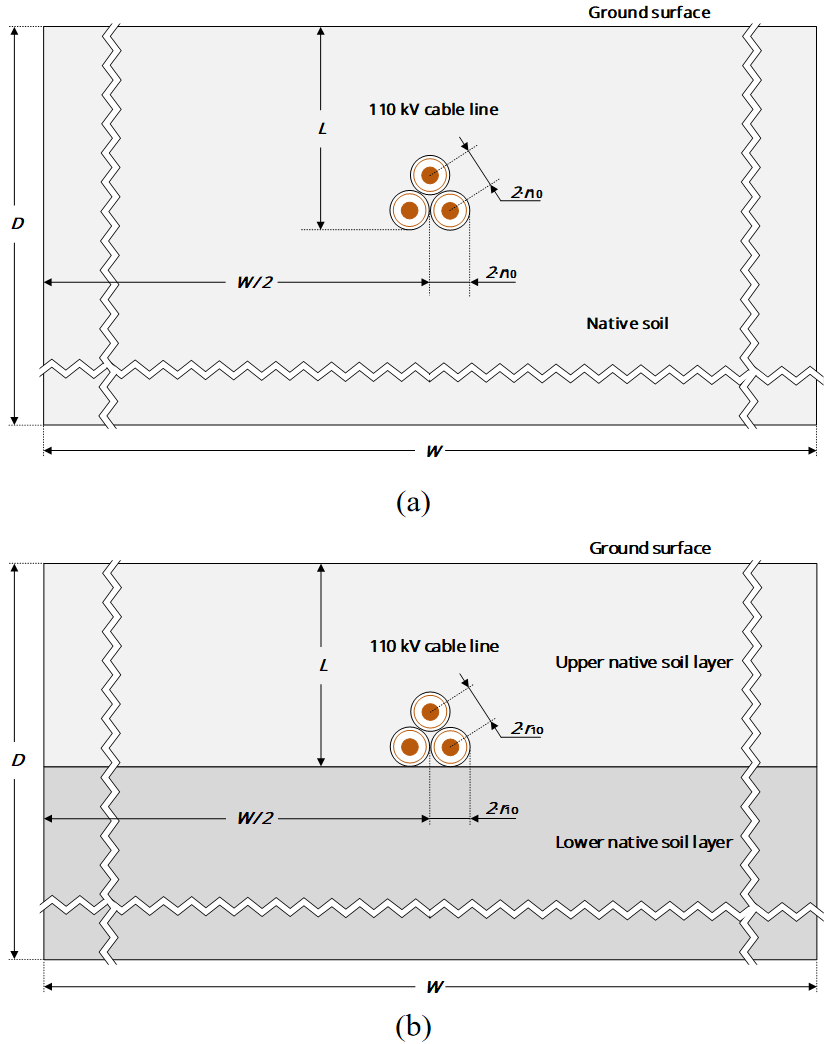
In large-scale 2D finite element steady-state thermal models for underground cable ampacity calculations, where the lateral and lower boundaries are adiabatic, the ground surface may be represented by isothermal Dirichlet, convective Robin, or coupled convection–radiation conditions. In such cases, the soil temperature at depths significantly below the cables tends to be equal or to exceed the temperature of reference soil or air. This paper proposes a novel approach addressing this issue by dividing the native soil into two layers, introducing an effective thermal conductivity for the upper layer, and assuming distinct reference soil temperatures at the cable depth and at the lower bounda... More >
Graphical Abstract