

ICCK Transactions on Electric Power Networks and Systems
ISSN: 3070-2607 (Online)
Email: [email protected]

 Submit Manuscript
Edit a Special Issue
Submit Manuscript
Edit a Special Issue


TY  - JOUR
AU  - Maksimović, Vladimir
AU  - Jakšić, Branimir
PY  - 2026
DA  - 2026/02/27
TI  - Automatic Pollution Detection on High-Voltage Isolators Using a Two-Phase Approach
JO  - ICCK Transactions on Electric Power Networks and Systems
T2  - ICCK Transactions on Electric Power Networks and Systems
JF  - ICCK Transactions on Electric Power Networks and Systems
VL  - 2
IS  - 1
SP  - 7
EP  - 21
DO  - 10.62762/TEPNS.2026.648298
UR  - https://www.icck.org/article/abs/TEPNS.2026.648298
KW  - insulator detection
KW  - insulator pollution
KW  - deep learning
KW  - neural networks
KW  - multi-phase approach
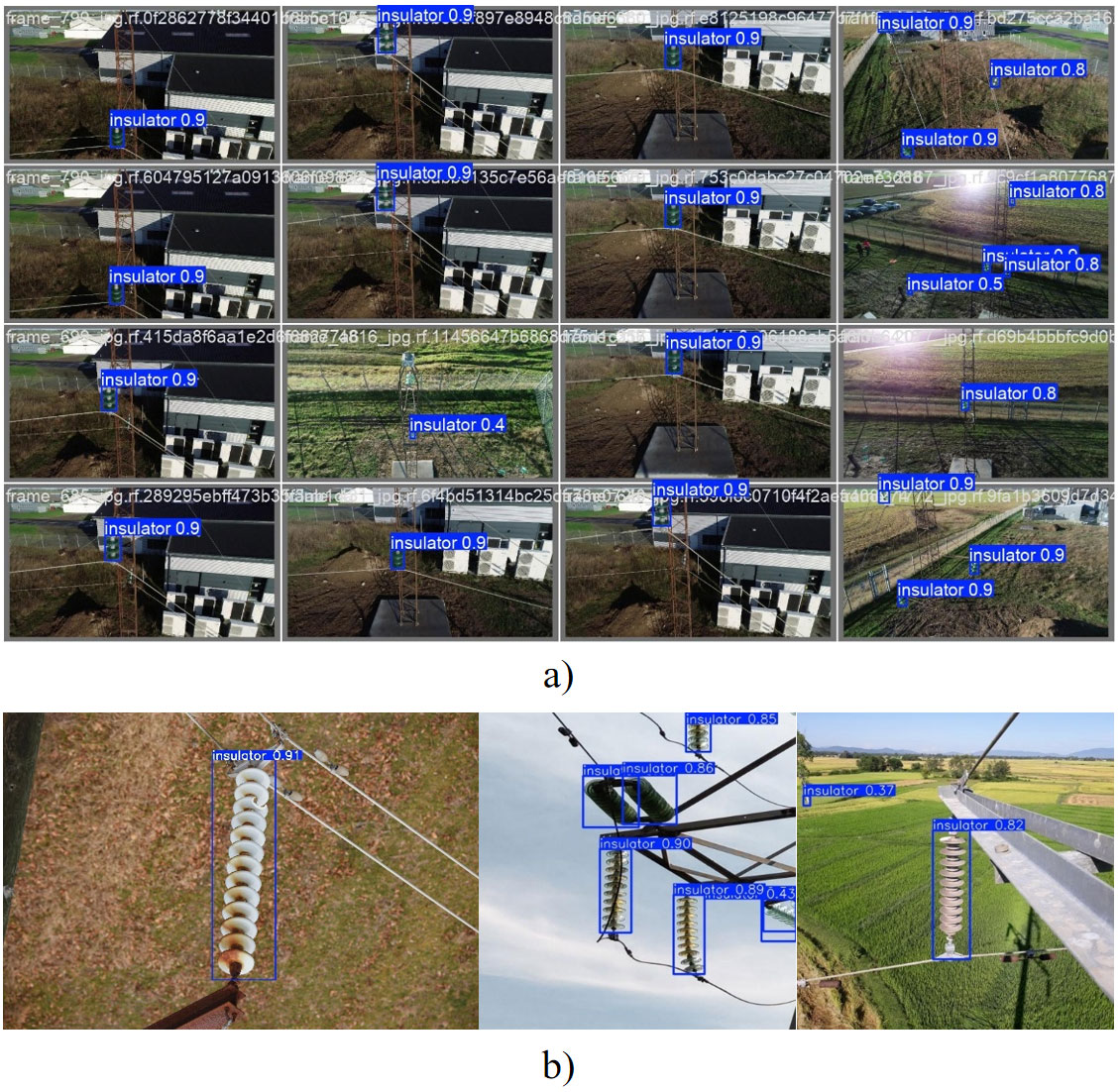
AB  - The accumulation of atmospheric and industrial pollution of high-voltage insulators is one of the frequent problems and a pattern of failures in transmission systems. In this paper, a two-phase approach based on deep learning is proposed for the detection of pollution of high-voltage insulators. The proposed approach automatically detects three types of pollution (salt, soot and excrement) based on UAV images. In addition to detection, the classification of pollution is automatically done into three levels (low, medium and high pollution). In the first phase, the You Only Look Once (YOLO) detector is used for precise detection and isolation of insulators, where an average accuracy of [email protected] of 93.75% is achieved. The model was trained on a Merged Public Insulator Dataset (MPID) database containing over 5000 insulators. The second phase utilizes the Zenodo dataset, which contains over 14,000 synthetic insulator images. In the second phase, the model was trained using the EfficientNet-B0 convolutional network to classify the type and level of pollution. In order to solve the problem of real data, fine-tuning was done for all 10 classes. The results show that the accuracy is 88% on a partial classification of 10 levels of pollution. When using 4 levels of pollution, the model achieves an accuracy of 91%. Additional automation was achieved with priority metrics, which by analyzing 100 images showed 24% of critical cases. The system determines the cleaning priority based on the pollution intensity, ensuring that critical cases are addressed first. A comparative analysis was performed when the model was trained with MobileNetV2, ResNet16 and VGG. The results show that the proposed model with the highest recall minimizes the risk of missed critical insulators. For example, in real-world applications, MobileNetV2 has a larger difference, which means too many false positives, while ResNet18 has a smaller difference, which means more false negatives which is a security risk.
SN  - 3070-2607
PB  - Institute of Central Computation and Knowledge
LA  - English
ER  -
@article{Maksimovi2026Automatic,
  author = {Vladimir Maksimović and Branimir Jakšić},
  title = {Automatic Pollution Detection on High-Voltage Isolators Using a Two-Phase Approach},
  journal = {ICCK Transactions on Electric Power Networks and Systems},
  year = {2026},
  volume = {2},
  number = {1},
  pages = {7-21},
  doi = {10.62762/TEPNS.2026.648298},
  url = {https://www.icck.org/article/abs/TEPNS.2026.648298},
  abstract = {The accumulation of atmospheric and industrial pollution of high-voltage insulators is one of the frequent problems and a pattern of failures in transmission systems. In this paper, a two-phase approach based on deep learning is proposed for the detection of pollution of high-voltage insulators. The proposed approach automatically detects three types of pollution (salt, soot and excrement) based on UAV images. In addition to detection, the classification of pollution is automatically done into three levels (low, medium and high pollution). In the first phase, the You Only Look Once (YOLO) detector is used for precise detection and isolation of insulators, where an average accuracy of [email protected] of 93.75\% is achieved. The model was trained on a Merged Public Insulator Dataset (MPID) database containing over 5000 insulators. The second phase utilizes the Zenodo dataset, which contains over 14,000 synthetic insulator images. In the second phase, the model was trained using the EfficientNet-B0 convolutional network to classify the type and level of pollution. In order to solve the problem of real data, fine-tuning was done for all 10 classes. The results show that the accuracy is 88\% on a partial classification of 10 levels of pollution. When using 4 levels of pollution, the model achieves an accuracy of 91\%. Additional automation was achieved with priority metrics, which by analyzing 100 images showed 24\% of critical cases. The system determines the cleaning priority based on the pollution intensity, ensuring that critical cases are addressed first. A comparative analysis was performed when the model was trained with MobileNetV2, ResNet16 and VGG. The results show that the proposed model with the highest recall minimizes the risk of missed critical insulators. For example, in real-world applications, MobileNetV2 has a larger difference, which means too many false positives, while ResNet18 has a smaller difference, which means more false negatives which is a security risk.},
  keywords = {insulator detection, insulator pollution, deep learning, neural networks, multi-phase approach},
  issn = {3070-2607},
  publisher = {Institute of Central Computation and Knowledge}
}

ICCK Transactions on Electric Power Networks and Systems
ISSN: 3070-2607 (Online)
Email: [email protected]

Portico
All published articles are preserved here permanently:
https://www.portico.org/publishers/icck/