

Two-Step Approach for Improving the Distribution Network Voltage Profile Using the Optimal Integration of the PV-BES System


Article Information
Abstract
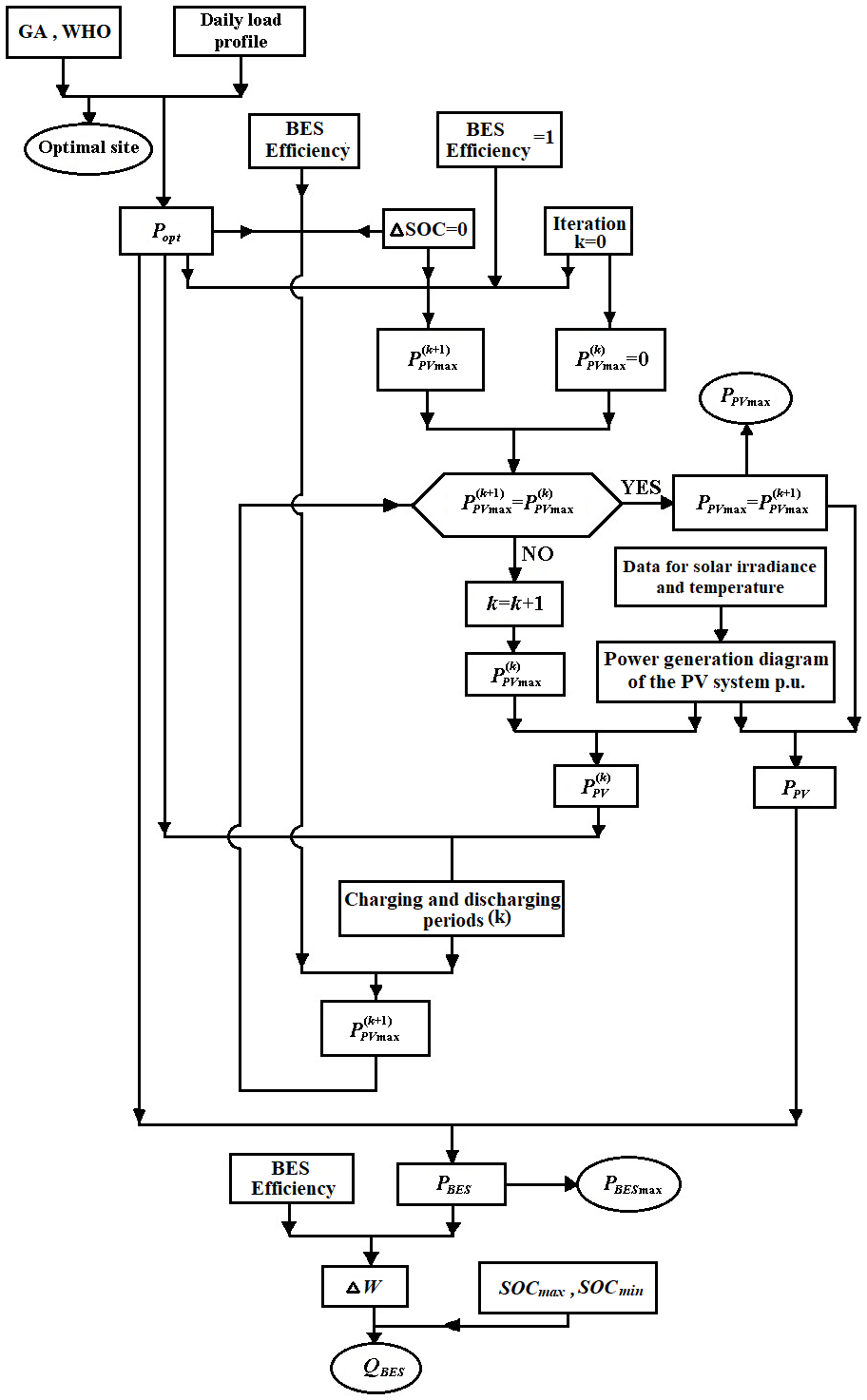
This paper proposes the two-step approach for improving the voltage profile of the distribution network (DN) using the optimal integration of photovoltaic-battery energy storage (PV-BES) system. In the first step of the approach the optimal location of the PV-BES system in the DN and its optimal powers are determined, considering the topology and the load of the DN. This is done to improve the voltage profile of the DN using the meta-heuristic wild horse optimization method (WHO) and genetic algorithm (GA). The second step of the approach determines the optimal sizing of the PV-BES system, by taking into account the optimal powers obtained in the first step, the solar irradiance diagram and the average temperature for each month of the year for the area in which the DN is located. The optimal sizing includes optimal maximum power of the PV system and the optimal maximum power and energy capacity of the BES unit, determined by the proposed iterative method. The results are generated using the topology of the IEEE 18-bus radial DN for three different load diagrams, on a monthly and annual basis.
Graphical Abstract
Keywords
Data Availability Statement
Funding
Conflicts of Interest
AI Use Statement
Ethical Approval and Consent to Participate
References
- Pokhrel, B., Shrestha, A., Phuyal, S., & Jha, S. (2021). Voltage profile improvement of distribution system via integration of distributed resources. Journal of Renewable Energy, Electrical, and Computer Engineering, 1(1), 33-41.
[CrossRef] [Google Scholar] - Mijailović, V. (2011). Distribuirani izvori energije. Beograd: Akademska misao.
[Google Scholar] - Elattar, E., & Elsayed, S. (2020). Optimal location and sizing of distributed generators based on renewable energy sources using modified moth flame optimization technique. IEEE Access, 8, 109625-109638.
[CrossRef] [Google Scholar] - Lamsal, D., Mishra, A., & Gautam, P. (2016, June 1-3). Optimal location and sizing of distributed generation: B-coefficient matrix approach. In 12th IEEE International Conference on Control and Automation (ICCA) (pp. 810-815). Kathmandu, Nepal.
[CrossRef] [Google Scholar] - Das, C., Bass, O., Mahmoud, T., Kothapalli, G., Masoum, M., & Mousavi, N. (2019). An optimal allocation and sizing strategy of distributed energy storage systems to improve performance of distribution networks. Journal of Energy Storage, 26, 100847.
[CrossRef] [Google Scholar] - Chiang, M., Huang, S., Hsiao, T., Zhan, T., & Hou, J. (2022). Optimal sizing and location of photovoltaic generation and energy storage systems in an unbalanced distribution system. Energies, 15(18), 6682.
[CrossRef] [Google Scholar] - Singh, A., Shrestha, A., Phuyal, S., Adhikari, B., & Papadakis, A. (2018). Particle swarm optimization approach for distributed generation allocation planning for voltage profile improvement. In 11th International Conference on Deregulated Engineering Market Issues in South Eastern Europe, Nicosia, Cyprus.
[Google Scholar] - Radosavljević, J. (2021). Voltage regulation in LV distribution networks with PV generation and battery storage. Journal of Electrical Engineering, 72(6), 356-365.
[CrossRef] [Google Scholar] - Bai, W., Zhang, W., Allmendinger, R., Enyekwe, I., & Lee, K. Y. (2024). A comparative study of optimal pv allocation in a distribution network using evolutionary algorithms. Energies, 17(2), 511.
[CrossRef] [Google Scholar] - Mossie, M. A., Yetayew, T. T., Bitew, G. T., Yenealem, M. G., & Beza, T. M. (2025). Adaptive genetic algorithm and enhanced particle swarm optimization for static voltage stability enhancement in radial distribution systems with distributed generation integration. Discover Applied Sciences, 7(12), 1414.
[CrossRef] [Google Scholar] - Zheng, R., Hussien, A., Jia, H., Abualigah, L., Wang, S., & Wu, D. (2022). An improved wild horse optimizer for solving optimization problems. Mathematics, 10(8), 1311.
[CrossRef] [Google Scholar] - Ali, M., Kamel, S., Hassan, M., Tostedo-Veliz, M., & Zawbaa, H. (2022). An improved wild horse optimization algorithm for reliability based optimal DG planning of radial distribution networks. Energy Reports, 8, 582-604.
[CrossRef] [Google Scholar] - Radosavljević, J. (2018). Metaheuristic Optimization in Power Engineering. London: Institution of Engineering and Technology.
[CrossRef] [Google Scholar] - Adetunji, K., Hofsajer, I., Abu-Mahfouz, A., & Cheng, L. (2020). A review of metaheuristic techniques for optimal integration of electrical units in distribution network. IEEE Access, 9, 5046-5068.
[CrossRef] [Google Scholar] - Milovanović, M. J., Radosavljević, J. N., & Perović, B. D. (2025). Taguchi-Based Parameter Tuning of PSO for Optimal Capacitor Placement in Unbalanced Distribution Systems. ICCK Transactions on Electric Power Networks and Systems, 1(1), 6-16.
[CrossRef] [Google Scholar] - Krstic, N. N., Tasic, D. S., Klimenta, D. O., & Milovanovic, M. J. (2024). Improving the Operation of a Distribution Network by Optimal Siting and Sizing of Photovoltaic-Battery Energy Storage Systems. Elektronika ir Elektrotechnika, 30(5), 70-82.
[CrossRef] [Google Scholar] - Khenissi, I., Guesmi, T., Marouani, I., Alshammari, B. M., Alqunun, K., Albadran, S., ... & Neji, R. (2023). Energy management strategy for optimal sizing and siting of PVDG-BES systems under fixed and intermittent load consumption profile. Sustainability, 15(2), 1004.
[CrossRef] [Google Scholar] - Wong, L., Ramachandaramurthy, V., Walker, S., & Ekanayake, J. (2020). Optimal placement and sizing of battery energy storage system considering the duck curve phenomenon. IEEE Access, 8, 197236-197248.
[CrossRef] [Google Scholar] - Wong, L. A., Shareef, H., Mohamed, A., & Ibrahim, A. A. (2017). Optimal placement and sizing of energy storage system in distribution network with photovoltaic based distributed generation using improved firefly algorithms. World Academy of Science, Engineering and Technology, International Journal of Electrical, Computer, Energetic, Electronic and Communication Engineering, 11(7), 864-872.
[Google Scholar] - Tang, X., Deng, K., Wu, Q., & Feng, Y. (2020). Optimal location and capacity of the distributed energy storage system in a distributed network. IEEE Access, 8, 15576-15585.
[CrossRef] [Google Scholar] - Ibrahim, H. O., Moustapha, M. D., Gonda, M., & Issaka, A. M. M. (2026). Multi-objective optimization of the combined sizing and placement of a PV system and an UPQC in an IEEE 69-bus distribution network using genetic algorithm. International Journal of Energy and Power Engineering, 15(1), 37-44.
[CrossRef] [Google Scholar] - Ahmed, H. M., Calucag, L. S., Alqahtani, H., Noaman, N. M., Ismail, Z. M., & Alhawi, O. A. (2024, November). Seasonal analysis of PV performance: optimizing fixed panel angles for maximum efficiency. In 2024 IEEE 9th International Conference on Engineering Technologies and Applied Sciences (ICETAS) (pp. 1-4). IEEE.
[CrossRef] [Google Scholar] - Mansouri, N., Lashab, A., Guerrero, J., & Cherif, A. (2020). Photovoltaic power plants in electrical distribution networks: A review on their impact and solutions. IET Renewable Power Generation, 14(12), 2114-2125.
[CrossRef] [Google Scholar] - Mikulović, J., & Đurišić, Z. (2019). Solarna energetika. Belgrade: Akademska misao.
[Google Scholar] - Bala, A., Moshood Alao, B., Olamide Oyedun, A., Omotayo Alabi, O., & Adamu, M. (2024). Performance evaluation of a solar photovoltaic (PV) module at different solar irradiance. International Journal of Engineering & Applied Sciences (IJEAS), 16(2), 63-75.
[CrossRef] [Google Scholar] - Klimenta, D., Lekic, J., Arsic, S., Tasic, D., Krstic, N., & Radosavljevic, D. (2021). A novel procedure for quick design of off-grid PV water pumping systems for irrigation. Elektronika Ir Elektrotechnika, 27(2), 64-77.
[CrossRef] [Google Scholar] - Kamali, G. A., Moradi, I., & Khalili, A. (2006). Estimating solar radiation on tilted surfaces with various orientations: a study case in Karaj (Iran). Theoretical and applied climatology, 84(4), 235-241.
[CrossRef] [Google Scholar] - Mikulović, J., Đurišić, Ž., & Kostić, R. (2013). Određivanje optimalnih nagibnih uglova fotonaponskih panela. Infoteh, Mart.
[Google Scholar] - Calabrò, E. (2012). The disagreement between anisotropic-isotropic diffuse solar radiation models as a function of solar declination: computing the optimum tilt angle of solar panels in the area of southern-Italy. Smart Grid and Renewable Energy, 3(4), 253-259.
[CrossRef] [Google Scholar] - Milovanović, M. J., Dragičević, M. M., Krečković, N. R., & Perović, B. D. (2025). Short-Term Load Forecasting with Taguchi-Optimized Single-Layer Feedforward Neural Networks: A MATLAB GUI. ICCK Transactions on Electric Power Networks and Systems, 1(2), 70-81.
[CrossRef] [Google Scholar] - Tuka, B. M., & Ali, E. S. (2026). Optimal allocation and sizing of distributed generation for improvement of distribution feeder loss and voltage profile in the distribution network using genetic algorithm. Measurement and Control, 59(2), 217-231.
[CrossRef] [Google Scholar] - Motwakel, A., Alabdulkreem, E., Gaddah, A., Marzouk, R., Salem, N. M., Zamani, A. S., ... & Eldesouki, M. I. (2023). Wild horse optimization with deep learning-driven short-term load forecasting scheme for smart grids. Sustainability, 15(2), 1524.
[CrossRef] [Google Scholar] - Seyednouri, S. N., Ebrahimian, H., & Jalili, A. (2015). Power loss reduction and voltage profile improvement by photovoltaic generation. International Journal of Engineering Trends and Technology (IJETT), 20(4), 192-196.
[CrossRef] [Google Scholar] - Belsky, A., Glukhanich, D., Sutikno, T., & Jopri, M. H. (2023). Estimation of hourly solar irradiation on tilted surfaces. Bulletin of Electrical Engineering and Informatics, 12(6), 3202-3214.
[CrossRef] [Google Scholar] - Azarbakhsh, G., Mahmoudi, A., Kahourzade, S., Yazdani, A., & Mahmud, A. (2025). Optimal sizing of photovoltaic and battery energy storage for residential houses in South Australia by considering vehicle-to-home operation. IET Renewable Power Generation, 19(1), 70053.
[CrossRef] [Google Scholar] - Mumtahina, U., Alahakoon, S., & Wolfs, P. (2025). Optimal allocation and sizing of battery energy storage system in distribution network using mountain gazelle optimization algorithm. Energies, 18, 379-397.
[CrossRef] [Google Scholar]
Cite This Article
TY  - JOUR
AU  - Krstić, Nikola
AU  - Tasić, Dragan
PY  - 2026
DA  - 2026/03/22
TI  - Two-Step Approach for Improving the Distribution Network Voltage Profile Using the Optimal Integration of the PV-BES System
JO  - ICCK Transactions on Electric Power Networks and Systems
T2  - ICCK Transactions on Electric Power Networks and Systems
JF  - ICCK Transactions on Electric Power Networks and Systems
VL  - 2
IS  - 1
SP  - 31
EP  - 46
DO  - 10.62762/TEPNS.2026.581037
UR  - https://www.icck.org/article/abs/TEPNS.2026.581037
KW  - distribution network (DN)
KW  - genetic algorithm (GA)
KW  - photovoltaic-battery energy storage (PV-BES) system
KW  - voltage profile
KW  - wild horse optimization (WHO)
AB  - This paper proposes the two-step approach for improving the voltage profile of the distribution network (DN) using the optimal integration of photovoltaic-battery energy storage (PV-BES) system. In the first step of the approach the optimal location of the PV-BES system in the DN and its optimal powers are determined, considering the topology and the load of the DN. This is done to improve the voltage profile of the DN using the meta-heuristic wild horse optimization method (WHO) and genetic algorithm (GA). The second step of the approach determines the optimal sizing of the PV-BES system, by taking into account the optimal powers obtained in the first step, the solar irradiance diagram and the average temperature for each month of the year for the area in which the DN is located. The optimal sizing includes optimal maximum power of the PV system and the optimal maximum power and energy capacity of the BES unit, determined by the proposed iterative method. The results are generated using the topology of the IEEE 18-bus radial DN for three different load diagrams, on a monthly and annual basis.
SN  - 3070-2607
PB  - Institute of Central Computation and Knowledge
LA  - English
ER  -
@article{Krsti2026TwoStep,
  author = {Nikola Krstić and Dragan Tasić},
  title = {Two-Step Approach for Improving the Distribution Network Voltage Profile Using the Optimal Integration of the PV-BES System},
  journal = {ICCK Transactions on Electric Power Networks and Systems},
  year = {2026},
  volume = {2},
  number = {1},
  pages = {31-46},
  doi = {10.62762/TEPNS.2026.581037},
  url = {https://www.icck.org/article/abs/TEPNS.2026.581037},
  abstract = {This paper proposes the two-step approach for improving the voltage profile of the distribution network (DN) using the optimal integration of photovoltaic-battery energy storage (PV-BES) system. In the first step of the approach the optimal location of the PV-BES system in the DN and its optimal powers are determined, considering the topology and the load of the DN. This is done to improve the voltage profile of the DN using the meta-heuristic wild horse optimization method (WHO) and genetic algorithm (GA). The second step of the approach determines the optimal sizing of the PV-BES system, by taking into account the optimal powers obtained in the first step, the solar irradiance diagram and the average temperature for each month of the year for the area in which the DN is located. The optimal sizing includes optimal maximum power of the PV system and the optimal maximum power and energy capacity of the BES unit, determined by the proposed iterative method. The results are generated using the topology of the IEEE 18-bus radial DN for three different load diagrams, on a monthly and annual basis.},
  keywords = {distribution network (DN), genetic algorithm (GA), photovoltaic-battery energy storage (PV-BES) system, voltage profile, wild horse optimization (WHO)},
  issn = {3070-2607},
  publisher = {Institute of Central Computation and Knowledge}
}
Article Metrics
Publisher's Note
ICCK stays neutral with regard to jurisdictional claims in published maps and institutional affiliations.
Rights and Permissions


Portico
