

Thermal Modeling of the Ground Surface for the Purpose of Calculating the Current-Carrying Capacity of Underground Cable Lines Using the FEM



Article Information
Abstract
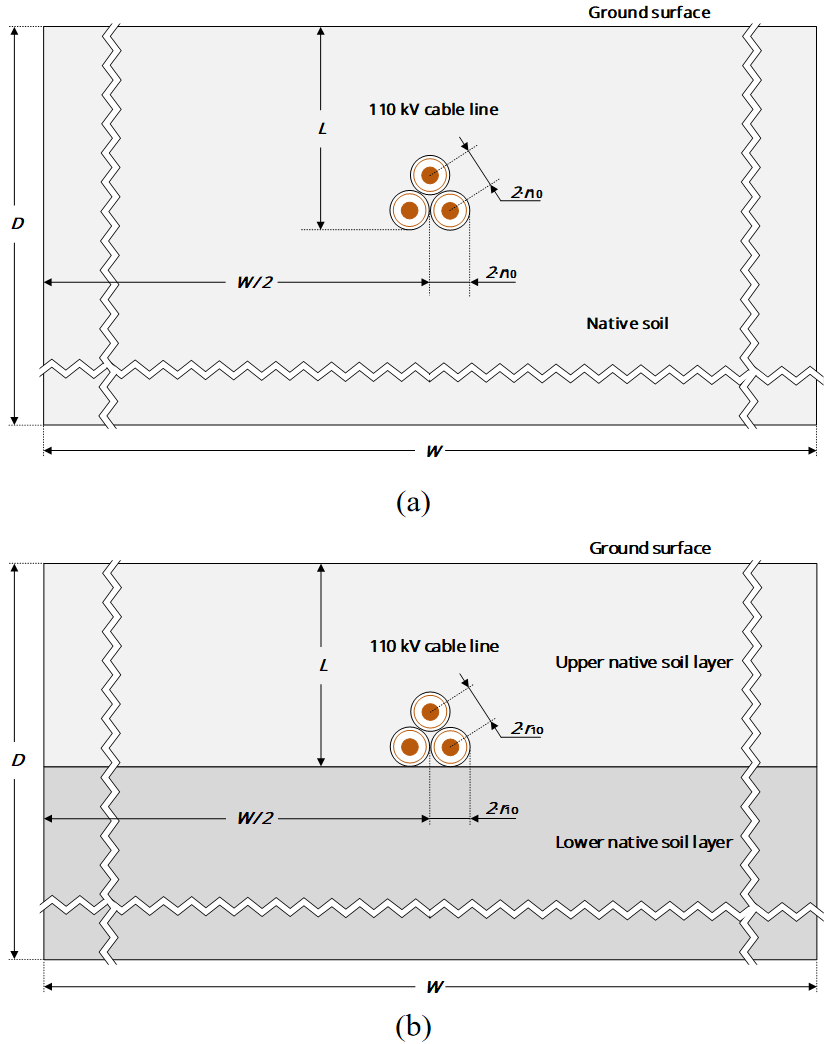
In large-scale 2D finite element steady-state thermal models for underground cable ampacity calculations, where the lateral and lower boundaries are adiabatic, the ground surface may be represented by isothermal Dirichlet, convective Robin, or coupled convection–radiation conditions. In such cases, the soil temperature at depths significantly below the cables tends to be equal or to exceed the temperature of reference soil or air. This paper proposes a novel approach addressing this issue by dividing the native soil into two layers, introducing an effective thermal conductivity for the upper layer, and assuming distinct reference soil temperatures at the cable depth and at the lower boundary. The upper layer spans from the ground surface to the cable installation plane (where reference soil temperature is typically measured), while the lower layer extends to the domain’s bottom. For summer periods, the effective thermal conductivity of the upper layer is calibrated to correspond to measured reference soil temperature under the most unfavorable environmental conditions. A temperature equal to the local average groundwater temperature is assigned to the lower boundary. The study focuses on AXLJ 1×1000/190 mm$^2$ 110 kV cables in trefoil formation, installed in single- and two-layered native soils. Steady-state thermal analyses are performed using COMSOL 4.3. Results show that the cable ampacity can be increased by 8.43%, a value considered safe from both scientific and engineering perspectives.
Graphical Abstract
Keywords
Data Availability Statement
Funding
Conflicts of Interest
AI Use Statement
Ethical Approval and Consent to Participate
References
- International Electrotechnical Commission. (2023). Electric cables – Calculation of the current rating – Part 1-1: Current rating equations (100 \% load factor) and calculation of losses – General (Standard IEC 60287-1-1:2023 CMV). IEC. Retrieved from https://webstore.iec.ch/en/publication/85666
[Google Scholar] - International Electrotechnical Commission. (2023). Electric cables – Calculation of the current rating – Part 2-1: Thermal resistance – Calculation of thermal resistance (Standard IEC 60287-2-1:2023 CMV). IEC. Retrieved from https://webstore.iec.ch/en/publication/85669
[Google Scholar] - International Electrotechnical Commission. (2017). Electric cables – Calculation of the current rating – Part 3-1: Operating conditions – Site reference conditions (Standard IEC 60287-3-1:2017 RLV). IEC. Retrieved from https://webstore.iec.ch/en/publication/60845
[Google Scholar] - Sredojevic, M. R., Naumov, R. M., Popovic, D. P., & Simie, M. D. (1997, June). Long term investigation of thermal behaviour of 110 kV underground transmission lines in the Belgrade area. In 14th International Conference and Exhibition on Electricity Distribution. Part 1. Contributions (IEE Conf. Publ. No. 438) (Vol. 3, pp. 44-1). IET.
[CrossRef] [Google Scholar] - Sredojevic, M. R., Popovic, D. P., & Simic, M. D. (1999, August). Permissible current rating of the investigated 110 kV underground cable line. In PowerTech Budapest 99. Abstract Records.(Cat. No. 99EX376) (p. 218). IEEE.
[CrossRef] [Google Scholar] - COMSOL. (2012). COMSOL Multiphysics user’s guide (Version 4.3) [Computer software]. COMSOL Inc.
[Google Scholar] - International Electrotechnical Commission. (2003). Electric cables – Calculations for current ratings – Finite element method (Technical Report IEC TR 62095:2003). IEC. Retrieved from https://webstore.iec.ch/en/publication/6455
[Google Scholar] - CIGRE Working Group B1.87. (2025). Finite element analysis for cable rating calculations (Technical Brochure TB 963). CIGRE. Retrieved from https://www.e-cigre.org/publications/detail/963-finite-element-analysis-for-cable-rating-calculations.html\#pSummary
[Google Scholar] - Klimenta, D., Šućurović, M., & Tasić, D. (2025). Amendments to some IEC TR 62095 recommendations for underground single-core power cables in trefoil formation. ICCK Transactions on Electric Power Networks and Systems, 1(1), 38–49.
[CrossRef] [Google Scholar] - Šućurović, M., Klimenta, D., & Tasić, D. (2024). Correction of the iec formula for the eddy-current loss factor: The case of single-core cables in trefoil formation with metallic screens bonded and earthed at one end. Facta Universitatis, Series: Electronics and Energetics, 37(2), 391-408.
[CrossRef] [Google Scholar] - Klimenta, D., Perović, B., Klimenta, J., Jevtić, M., Milovanović, M., & Krstić, I. (2018). Controlling the thermal environment of underground cable lines using the pavement surface radiation properties. IET Generation, Transmission & Distribution, 12(12), 2968-2976.
[CrossRef] [Google Scholar] - Rerak, M., & Ocłoń, P. (2017). Thermal analysis of underground power cable system. Journal of Thermal Science, 26(5), 465-471.
[CrossRef] [Google Scholar] - Maximov, S., Venegas, V., Guardado, J. L., Moreno, E. L., & López, R. (2016). Analysis of underground cable ampacity considering non-uniform soil temperature distributions. Electric Power Systems Research, 132, 22–29.
[CrossRef] [Google Scholar] - M’hamed, B., Ali, K. S., Leila, M. S., Sidik, N. A. C., Japar, W. M. A. A., & Mohamad, A. T. (2014). Thermal state effects on potential augmentation of the ampacity of a medium voltage underground cable in power distribution: A case study. Journal of Advanced Research in Numerical Heat Transfer, 18(1), 1–13.
[Google Scholar] - Nahman, J., & Tanaskovic, M. (2013). Calculation of the ampacity of high voltage cables by accounting for radiation and solar heating effects using FEM. International Transactions on Electrical Energy Systems, 23(3), 301-314.
[CrossRef] [Google Scholar] - Nahman, J., & Tanaskovic, M. (2011). Evaluation of the loading capacity of a pair of three-phase high voltage cable systems using the finite-element method. Electric Power Systems Research, 81(7), 1550–1555.
[CrossRef] [Google Scholar] - Kim, Y.-S., Cong, H. N., Dinh, B. H., & Kim, H.-K. (2025). Effect of ambient air and ground temperatures on heat transfer in underground power cable system buried in newly developed cable bedding material. Geothermics, 125, 103151.
[CrossRef] [Google Scholar] - International Electrotechnical Commission. (2023). Conductors of insulated cables (Standard IEC 60228:2023 CMV). IEC. Retrieved from https://webstore.iec.ch/en/publication/90329
[Google Scholar]
Cite This Article
TY  - JOUR
AU  - Klimenta, Dardan
AU  - Šućurović, Marko
AU  - Tasić, Dragan
PY  - 2026
DA  - 2026/03/27
TI  - Thermal Modeling of the Ground Surface for the Purpose of Calculating the Current-Carrying Capacity of Underground Cable Lines Using the FEM
JO  - ICCK Transactions on Electric Power Networks and Systems
T2  - ICCK Transactions on Electric Power Networks and Systems
JF  - ICCK Transactions on Electric Power Networks and Systems
VL  - 2
IS  - 1
SP  - 47
EP  - 57
DO  - 10.62762/TEPNS.2026.891956
UR  - https://www.icck.org/article/abs/TEPNS.2026.891956
KW  - current-carrying capacity
KW  - finite element method (FEM)
KW  - steady-state thermal modeling
KW  - underground cable line
AB  - In large-scale 2D finite element steady-state thermal models for underground cable ampacity calculations, where the lateral and lower boundaries are adiabatic, the ground surface may be represented by isothermal Dirichlet, convective Robin, or coupled convection–radiation conditions. In such cases, the soil temperature at depths significantly below the cables tends to be equal or to exceed the temperature of reference soil or air. This paper proposes a novel approach addressing this issue by dividing the native soil into two layers, introducing an effective thermal conductivity for the upper layer, and assuming distinct reference soil temperatures at the cable depth and at the lower boundary. The upper layer spans from the ground surface to the cable installation plane (where reference soil temperature is typically measured), while the lower layer extends to the domain’s bottom. For summer periods, the effective thermal conductivity of the upper layer is calibrated to correspond to measured reference soil temperature under the most unfavorable environmental conditions. A temperature equal to the local average groundwater temperature is assigned to the lower boundary. The study focuses on AXLJ 1×1000/190 mm$^2$ 110 kV cables in trefoil formation, installed in single- and two-layered native soils. Steady-state thermal analyses are performed using COMSOL 4.3. Results show that the cable ampacity can be increased by 8.43%, a value considered safe from both scientific and engineering perspectives.
SN  - 3070-2607
PB  - Institute of Central Computation and Knowledge
LA  - English
ER  -
@article{Klimenta2026Thermal,
  author = {Dardan Klimenta and Marko Šućurović and Dragan Tasić},
  title = {Thermal Modeling of the Ground Surface for the Purpose of Calculating the Current-Carrying Capacity of Underground Cable Lines Using the FEM},
  journal = {ICCK Transactions on Electric Power Networks and Systems},
  year = {2026},
  volume = {2},
  number = {1},
  pages = {47-57},
  doi = {10.62762/TEPNS.2026.891956},
  url = {https://www.icck.org/article/abs/TEPNS.2026.891956},
  abstract = {In large-scale 2D finite element steady-state thermal models for underground cable ampacity calculations, where the lateral and lower boundaries are adiabatic, the ground surface may be represented by isothermal Dirichlet, convective Robin, or coupled convection–radiation conditions. In such cases, the soil temperature at depths significantly below the cables tends to be equal or to exceed the temperature of reference soil or air. This paper proposes a novel approach addressing this issue by dividing the native soil into two layers, introducing an effective thermal conductivity for the upper layer, and assuming distinct reference soil temperatures at the cable depth and at the lower boundary. The upper layer spans from the ground surface to the cable installation plane (where reference soil temperature is typically measured), while the lower layer extends to the domain’s bottom. For summer periods, the effective thermal conductivity of the upper layer is calibrated to correspond to measured reference soil temperature under the most unfavorable environmental conditions. A temperature equal to the local average groundwater temperature is assigned to the lower boundary. The study focuses on AXLJ 1×1000/190 mm\$^2\$ 110 kV cables in trefoil formation, installed in single- and two-layered native soils. Steady-state thermal analyses are performed using COMSOL 4.3. Results show that the cable ampacity can be increased by 8.43\%, a value considered safe from both scientific and engineering perspectives.},
  keywords = {current-carrying capacity, finite element method (FEM), steady-state thermal modeling, underground cable line},
  issn = {3070-2607},
  publisher = {Institute of Central Computation and Knowledge}
}
Article Metrics
Publisher's Note
ICCK stays neutral with regard to jurisdictional claims in published maps and institutional affiliations.
Rights and Permissions


Portico
