

Advanced Architectures in Preventive Health Informatics: A Hybrid Clinical Decision Support System for Early Endocrine and Metabolic Risk Screening



Article Information
Abstract
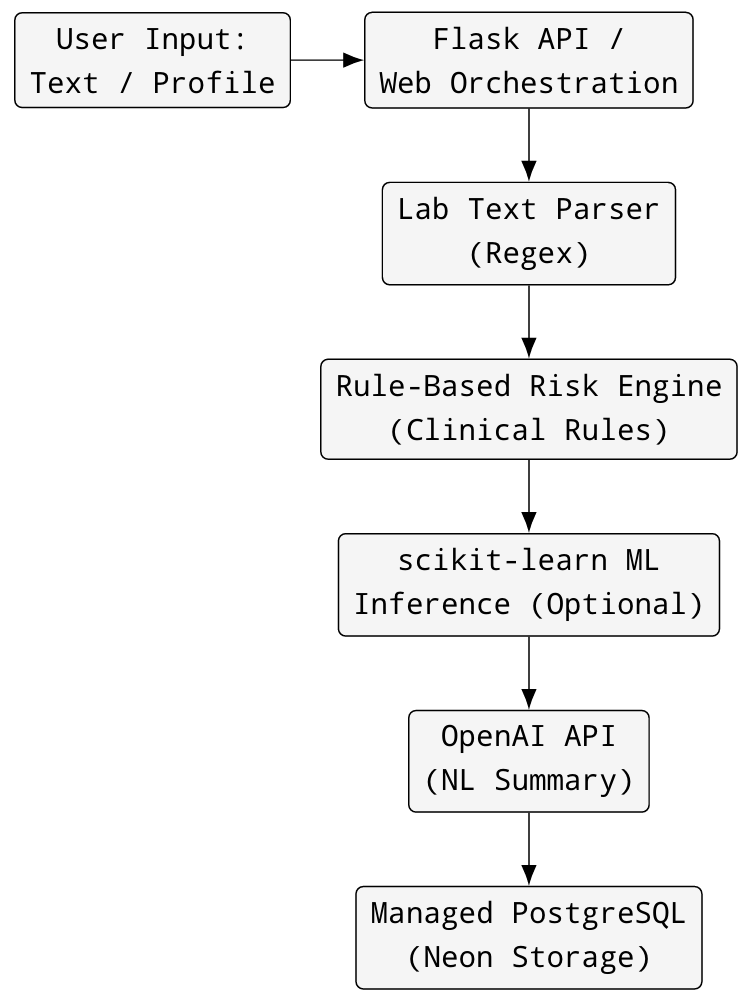
Contemporary medicine is shifting from reactive, symptom-based treatment toward proactive, preventive intervention, yet endocrine and metabolic disorders frequently progress through subtle, subclinical phases that are overlooked during routine primary-care encounters, delaying diagnosis and increasing the longitudinal cost of care. This paper presents EndocrineAI, a full-stack, high-integrity clinical decision support system (CDSS) for early-stage endocrine and metabolic risk screening. The platform adopts a hybrid architecture that synthesizes deterministic, rule-based clinical logic with probabilistic Machine Learning (ML) inference and Generative AI summarization. An eight-stage processing pipeline validates patient profiles, extracts eight clinical markers from unstructured laboratory text via regular-expression parsing, computes rule-based risk levels against established reference ranges, optionally refines borderline cases through a scikit-learn fallback chain, and generates natural-language assessments. The system stratifies risk across five physiological categories---thyroid dysfunction, insulin resistance / type 2 diabetes risk, PCOS risk, adrenal stress, and metabolic syndrome---and emits a standardized JSON risk schema for Electronic Health Record (EHR) interoperability, while a ``safe fallback'' design guarantees a baseline rule-based assessment whenever ML or generative components fail, preventing black-box failure modes. The paper further describes the clinical-governance framework that separates decision support from formal diagnosis, and the deployment parameters---managed PostgreSQL persistence, role-based access control, and secret management---required for longitudinal tracking in cloud environments. EndocrineAI demonstrates that a decoupled deterministic/probabilistic pipeline can convert unstructured clinical data into structured, actionable intelligence, offering a scalable blueprint for preventive CDSS that mitigate clinician burnout while empowering proactive metabolic care.
Graphical Abstract
Keywords
Data Availability Statement
Funding
Conflicts of Interest
AI Use Statement
Ethical Approval and Consent to Participate
References
- Hood, L., & Flores, M. (2012). A personal view on systems medicine and the emergence of proactive P4 medicine: predictive, preventive, personalized and participatory. New biotechnology, 29(6), 613-624.
[CrossRef] [Google Scholar] - Sutton, R. T., Pincock, D., Baumgart, D. C., Sadowski, D. C., Fedorak, R. N., & Kroeker, K. I. (2020). An overview of clinical decision support systems: benefits, risks, and strategies for success. NPJ digital medicine, 3(1), 17.
[CrossRef] [Google Scholar] - Kavakiotis, I., Tsave, O., Salifoglou, A., Maglaveras, N., Vlahavas, I., & Chouvarda, I. (2017). Machine learning and data mining methods in diabetes research.
[CrossRef] [Google Scholar] - Weng, S. F., Reps, J., Kai, J., Garibaldi, J. M., & Qureshi, N. (2017). Can machine-learning improve cardiovascular risk prediction using routine clinical data?. PloS one, 12(4), e0174944.
[CrossRef] [Google Scholar] - Obermeyer, Z., & Emanuel, E. J. (2016). Predicting the future—big data, machine learning, and clinical medicine. The New England journal of medicine, 375(13), 1216.
[CrossRef] [Google Scholar] - Rajkomar, A., Dean, J., & Kohane, I. (2019). Machine learning in medicine. New England Journal of Medicine, 380(14), 1347-1358.
[CrossRef] [Google Scholar] - Wang, Y., Wang, L., Rastegar-Mojarad, M., Moon, S., Shen, F., Afzal, N., ... & Liu, H. (2018). Clinical information extraction applications: a literature review. Journal of biomedical informatics, 77, 34-49.
[CrossRef] [Google Scholar] - Melmed, S., Auchus, R. J., Goldfine, A. B., Koenig, R. J., & Rosen, C. J. (2022). Williams Textbook of Endocrinology (14th ed.). Philadelphia, PA: Elsevier.
[CrossRef] [Google Scholar]
Cite This Article
TY  - JOUR
AU  - Sharma, Rahul
PY  - 2026
DA  - 2026/09/03
TI  - Advanced Architectures in Preventive Health Informatics: A Hybrid Clinical Decision Support System for Early Endocrine and Metabolic Risk Screening
JO  - Biomedical Informatics and Smart Healthcare
T2  - Biomedical Informatics and Smart Healthcare
JF  - Biomedical Informatics and Smart Healthcare
VL  - 2
IS  - 3
SP  - 129
EP  - 135
DO  - 10.62762/BISH.2026.397062
UR  - https://www.icck.org/article/abs/BISH.2026.397062
KW  - EndocrineAI
KW  - clinical decision support system
KW  - metabolic disorders
KW  - machine learning
KW  - preventive health informatics
KW  - actionable intelligence
AB  - Contemporary medicine is shifting from reactive, symptom-based treatment toward proactive, preventive intervention, yet endocrine and metabolic disorders frequently progress through subtle, subclinical phases that are overlooked during routine primary-care encounters, delaying diagnosis and increasing the longitudinal cost of care. This paper presents EndocrineAI, a full-stack, high-integrity clinical decision support system (CDSS) for early-stage endocrine and metabolic risk screening. The platform adopts a hybrid architecture that synthesizes deterministic, rule-based clinical logic with probabilistic Machine Learning (ML) inference and Generative AI summarization. An eight-stage processing pipeline validates patient profiles, extracts eight clinical markers from unstructured laboratory text via regular-expression parsing, computes rule-based risk levels against established reference ranges, optionally refines borderline cases through a scikit-learn fallback chain, and generates natural-language assessments. The system stratifies risk across five physiological categories---thyroid dysfunction, insulin resistance / type 2 diabetes risk, PCOS risk, adrenal stress, and metabolic syndrome---and emits a standardized JSON risk schema for Electronic Health Record (EHR) interoperability, while a ``safe fallback'' design guarantees a baseline rule-based assessment whenever ML or generative components fail, preventing black-box failure modes. The paper further describes the clinical-governance framework that separates decision support from formal diagnosis, and the deployment parameters---managed PostgreSQL persistence, role-based access control, and secret management---required for longitudinal tracking in cloud environments. EndocrineAI demonstrates that a decoupled deterministic/probabilistic pipeline can convert unstructured clinical data into structured, actionable intelligence, offering a scalable blueprint for preventive CDSS that mitigate clinician burnout while empowering proactive metabolic care.
SN  - 3068-5524
PB  - Institute of Central Computation and Knowledge
LA  - English
ER  -
@article{Sharma2026Advanced,
  author = {Rahul Sharma},
  title = {Advanced Architectures in Preventive Health Informatics: A Hybrid Clinical Decision Support System for Early Endocrine and Metabolic Risk Screening},
  journal = {Biomedical Informatics and Smart Healthcare},
  year = {2026},
  volume = {2},
  number = {3},
  pages = {129-135},
  doi = {10.62762/BISH.2026.397062},
  url = {https://www.icck.org/article/abs/BISH.2026.397062},
  abstract = {Contemporary medicine is shifting from reactive, symptom-based treatment toward proactive, preventive intervention, yet endocrine and metabolic disorders frequently progress through subtle, subclinical phases that are overlooked during routine primary-care encounters, delaying diagnosis and increasing the longitudinal cost of care. This paper presents EndocrineAI, a full-stack, high-integrity clinical decision support system (CDSS) for early-stage endocrine and metabolic risk screening. The platform adopts a hybrid architecture that synthesizes deterministic, rule-based clinical logic with probabilistic Machine Learning (ML) inference and Generative AI summarization. An eight-stage processing pipeline validates patient profiles, extracts eight clinical markers from unstructured laboratory text via regular-expression parsing, computes rule-based risk levels against established reference ranges, optionally refines borderline cases through a scikit-learn fallback chain, and generates natural-language assessments. The system stratifies risk across five physiological categories---thyroid dysfunction, insulin resistance / type 2 diabetes risk, PCOS risk, adrenal stress, and metabolic syndrome---and emits a standardized JSON risk schema for Electronic Health Record (EHR) interoperability, while a ``safe fallback'' design guarantees a baseline rule-based assessment whenever ML or generative components fail, preventing black-box failure modes. The paper further describes the clinical-governance framework that separates decision support from formal diagnosis, and the deployment parameters---managed PostgreSQL persistence, role-based access control, and secret management---required for longitudinal tracking in cloud environments. EndocrineAI demonstrates that a decoupled deterministic/probabilistic pipeline can convert unstructured clinical data into structured, actionable intelligence, offering a scalable blueprint for preventive CDSS that mitigate clinician burnout while empowering proactive metabolic care.},
  keywords = {EndocrineAI, clinical decision support system, metabolic disorders, machine learning, preventive health informatics, actionable intelligence},
  issn = {3068-5524},
  publisher = {Institute of Central Computation and Knowledge}
}
Article Metrics
Publisher's Note
ICCK stays neutral with regard to jurisdictional claims in published maps and institutional affiliations.
Rights and Permissions
 Copyright © 2026 by the Author(s). Published by Institute of Central Computation and Knowledge. This article is an open access article distributed under the terms and conditions of the Creative Commons Attribution (CC BY) license (https://creativecommons.org/licenses/by/4.0/), which permits use, sharing, adaptation, distribution and reproduction in any medium or format, as long as you give appropriate credit to the original author(s) and the source, provide a link to the Creative Commons licence, and indicate if changes were made.


Portico
