Soret and Dufour Effects in Computational Analysis of Assisting and Opposing Stagnation Point Flow of Viscoelastic Fluid
Article Information
Abstract
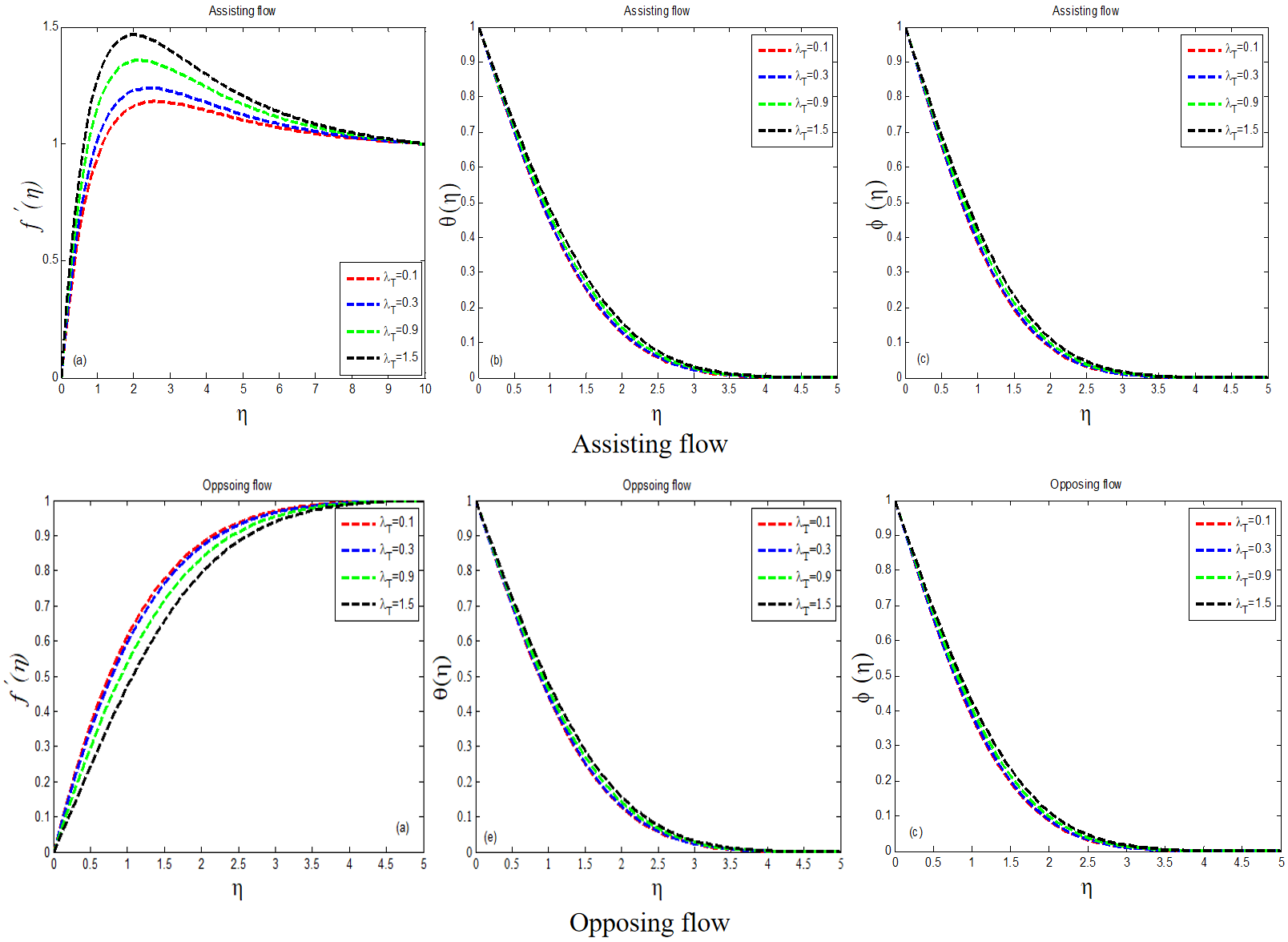
The investigation of stagnation point flow in viscoelastic fluid through a vertical sheet with Soret and Dufour effects is the focus of this study. Stream functions and similarity variables simplify the governing partial differential equations into ordinary differential equations. The model is then integrated using the MATLAB built-in solver bvp4c. In graphs and tables, the solutions for temperature profile, velocity distribution, and mass concentration, as well as their gradients at the surface, are depicted under the influence of emergent parameters that occurred in the flow equations. Physical reasoning is used to discuss the physical attitudes of physical unknown quantities of interest under the influence of various parameters. The results show that raising the viscoelastic parameter K leads to an increase in temperature and concentration profiles, but to a decrease in velocity for assisting flow. Opposing flow has a similar occurrence, with minor differences. The graphical results show that as the Dufour number Du is increased for assisting flow, fluid velocity and temperature increase with no discernible change in concentration profile. The temperature and concentration profiles intensify with increasing Du behavior in the situation of opposing flow velocity. It's worth noting that when the Soret number Sr is increased, the velocity curves increase, but the opposite is true for temperature and concentration profiles. Physical quantities' attitudes toward the above-mentioned parameters are in line with physical phenomena.
Graphical Abstract
Keywords
Data Availability Statement
Funding
Conflicts of Interest
Ethical Approval and Consent to Participate
References
- Abbasi, F. M., Shehzad, S. A., Hayat, T., & Ahmad, B. (2016). Doubly stratified mixed convection flow of Maxwell nanofluid with heat generation/absorption. Journal of Magnetism and Magnetic Materials, 404, 159-165.
[CrossRef] [Google Scholar] - Abu-Nada, E., & Chamkha, A. J. (2010). Mixed convection flow in a lid-driven inclined square enclosure filled with a nanofluid. European Journal of Mechanics-B/Fluids, 29(6), 472-482.
[CrossRef] [Google Scholar] - Ahmad, S., & Pop, I. (2010). Mixed convection boundary layer flow from a vertical flat plate embedded in a porous medium filled with nanofluids. International Communications in Heat and Mass Transfer, 37(8), 987-991.
[CrossRef] [Google Scholar] - Ahmed, J., Khan, M., & Ahmad, L. (2019). Stagnation point flow of Maxwell nanofluid over a permeable rotating disk with heat source/sink. Journal of Molecular Liquids, 287, 110853.
[CrossRef] [Google Scholar] - Arafa, A. A. M., Rida, S. Z., & Mohamed, H. (2011). Homotopy analysis method for solving biological population model. Communications in Theoretical Physics, 56(5), 797.
[CrossRef] [Google Scholar] - Bachok, N., Ishak, A., & Pop, I. (2010). Melting heat transfer in boundary layer stagnation-point flow towards a stretching/shrinking sheet. Physics letters A, 374(40), 4075-4079.
[CrossRef] [Google Scholar] - Balci, N., Thomases, B., Renardy, M., & Doering, C. R. (2011). Symmetric factorization of the conformation tensor in viscoelastic fluid models. Journal of Non-Newtonian Fluid Mechanics, 166(11), 546-553.
[CrossRef] [Google Scholar] - Bhatti, M. M., Abbas, M. A., & Rashidi, M. M. (2018). A robust numerical method for solving stagnation point flow over a permeable shrinking sheet under the influence of MHD. Applied Mathematics and Computation, 316, 381-389.
[CrossRef] [Google Scholar] - Daniel, Y. S., & Daniel, S. K. (2015). Effects of buoyancy and thermal radiation on MHD flow over a stretching porous sheet using homotopy analysis method. Alexandria Engineering Journal, 54(3), 705-712.
[CrossRef] [Google Scholar] - Dehghan, M., Manafian, J., & Saadatmandi, A. (2010). Solving nonlinear fractional partial differential equations using the homotopy analysis method. Numerical Methods for Partial Differential Equations: An International Journal, 26(2), 448-479.
[CrossRef] [Google Scholar] - Hayat, T., Abbas, Z., & Pop, I. (2008). Mixed convection in the stagnation point flow adjacent to a vertical surface in a viscoelastic fluid. International Journal of Heat and Mass Transfer, 51(11-12), 3200-3206.
[CrossRef] [Google Scholar] - Hayat, T., & Alsaedi, A. (2011). On thermal radiation and Joule heating effects in MHD flow of an Oldroyd-B fluid with thermophoresis. Arabian Journal for Science and Engineering, 36, 1113-1124.
[CrossRef] [Google Scholar] - Hayat, T., Khan, M. I., Farooq, M., Alsaedi, A., & Yasmeen, T. (2017). Impact of Marangoni convection in the flow of carbon–water nanofluid with thermal radiation. International Journal of Heat and Mass Transfer, 106, 810-815.
[CrossRef] [Google Scholar] - He, S., Sun, K., & Wang, H. (2019). Dynamics and synchronization of conformable fractional-order hyperchaotic systems using the Homotopy analysis method. Communications in Nonlinear Science and Numerical Simulation, 73, 146-164.
[CrossRef] [Google Scholar] - Ishak, A., Lok, Y. Y., & Pop, I. (2010). Stagnation-point flow over a shrinking sheet in a micropolar fluid. Chemical Engineering Communications, 197(11), 1417-1427.
[CrossRef] [Google Scholar] - Izadi, S., Armaghani, T., Ghasemiasl, R., Chamkha, A. J., & Molana, M. (2019). A comprehensive review on mixed convection of nanofluids in various shapes of enclosures. Powder Technology, 343, 880-907.
[CrossRef] [Google Scholar] - Khan, M. I., Waqas, M., Hayat, T., Alsaedi, A., & Khan, M. I. (2017). Significance of nonlinear radiation in mixed convection flow of magneto Walter-B nanoliquid. International Journal of Hydrogen Energy, 42(42), 26408-26416.
[CrossRef] [Google Scholar] - Khan, M. S., Karim, I., Ali, L. E., & Islam, A. (2012). Unsteady MHD free convection boundary-layer flow of a nanofluid along a stretching sheet with thermal radiation and viscous dissipation effects. International nano letters, 2, 1-9.
[CrossRef] [Google Scholar] - Khan, W. A., Makinde, O. D., & Khan, Z. H. (2016). Non-aligned MHD stagnation point flow of variable viscosity nanofluids past a stretching sheet with radiative heat. International Journal of Heat and Mass Transfer, 96, 525-534.
[CrossRef] [Google Scholar] - Mabood, F., Khan, W. A., & Ismail, A. M. (2015). MHD stagnation point flow and heat transfer impinging on stretching sheet with chemical reaction and transpiration. Chemical Engineering Journal, 273, 430-437.
[CrossRef] [Google Scholar] - Majeed, A., Zeeshan, A., Alamri, S. Z., & Ellahi, R. (2018). Heat transfer analysis in ferromagnetic viscoelastic fluid flow over a stretching sheet with suction. Neural Computing and Applications, 30(6), 1947-1955.
[CrossRef] [Google Scholar] - Malaspinas, O., Fiétier, N., & Deville, M. (2010). Lattice Boltzmann method for the simulation of viscoelastic fluid flows. Journal of Non-Newtonian Fluid Mechanics, 165(23-24), 1637-1653.
[CrossRef] [Google Scholar] - Motsa, S. S., Sibanda, P., & Shateyi, S. (2010). A new spectral-homotopy analysis method for solving a nonlinear second order BVP. Communications in Nonlinear Science and Numerical Simulation, 15(9), 2293-2302.
[CrossRef] [Google Scholar] - Prasad, K. V., Pal, D., Umesh, V., & Rao, N. P. (2010). The effect of variable viscosity on MHD viscoelastic fluid flow and heat transfer over a stretching sheet. Communications in Nonlinear Science and Numerical Simulation, 15(2), 331-344.
[CrossRef] [Google Scholar] - Prasad, V. R., Vasu, B. A. B. O., Bég, O. A., & Parshad, R. D. (2012). Thermal radiation effects on magnetohydrodynamic free convection heat and mass transfer from a sphere in a variable porosity regime. Communications in Nonlinear Science and Numerical Simulation, 17(2), 654-671.
[CrossRef] [Google Scholar]
Cited By (1)
-
Mubashir Ihsan, Asifa Ilyas, Muhammad Usman Rashad, Muhammad Ashraf, Aamir Ali. Analysis of assisting and opposing mixed convection heat and mass transfer over inclined vertical plates in a porous medium.
Modern Physics Letters B, 2026 , 40 (08).
[CrossRef]
Cite This Article
TY - JOUR AU - Abbas, Amir AU - Ain, Qurat ul AU - Ilyas, Asifa AU - Kiran, Laraib AU - Jeelani, Mdi Begum PY - 2025 DA - 2025/06/03 TI - Soret and Dufour Effects in Computational Analysis of Assisting and Opposing Stagnation Point Flow of Viscoelastic Fluid JO - Computational Environmental Heat Transfer T2 - Computational Environmental Heat Transfer JF - Computational Environmental Heat Transfer VL - 1 IS - 1 SP - 27 EP - 38 DO - 10.62762/CEHT.2025.786259 UR - https://www.icck.org/article/abs/CEHT.2025.786259 KW - viscoelastic fluid KW - stagnation point flow KW - computational analysis KW - soret and dufour effects KW - vertical surface AB - The investigation of stagnation point flow in viscoelastic fluid through a vertical sheet with Soret and Dufour effects is the focus of this study. Stream functions and similarity variables simplify the governing partial differential equations into ordinary differential equations. The model is then integrated using the MATLAB built-in solver bvp4c. In graphs and tables, the solutions for temperature profile, velocity distribution, and mass concentration, as well as their gradients at the surface, are depicted under the influence of emergent parameters that occurred in the flow equations. Physical reasoning is used to discuss the physical attitudes of physical unknown quantities of interest under the influence of various parameters. The results show that raising the viscoelastic parameter K leads to an increase in temperature and concentration profiles, but to a decrease in velocity for assisting flow. Opposing flow has a similar occurrence, with minor differences. The graphical results show that as the Dufour number Du is increased for assisting flow, fluid velocity and temperature increase with no discernible change in concentration profile. The temperature and concentration profiles intensify with increasing Du behavior in the situation of opposing flow velocity. It's worth noting that when the Soret number Sr is increased, the velocity curves increase, but the opposite is true for temperature and concentration profiles. Physical quantities' attitudes toward the above-mentioned parameters are in line with physical phenomena. SN - 3068-5486 PB - Institute of Central Computation and Knowledge LA - English ER -
@article{Abbas2025Soret,
author = {Amir Abbas and Qurat ul Ain and Asifa Ilyas and Laraib Kiran and Mdi Begum Jeelani},
title = {Soret and Dufour Effects in Computational Analysis of Assisting and Opposing Stagnation Point Flow of Viscoelastic Fluid},
journal = {Computational Environmental Heat Transfer},
year = {2025},
volume = {1},
number = {1},
pages = {27-38},
doi = {10.62762/CEHT.2025.786259},
url = {https://www.icck.org/article/abs/CEHT.2025.786259},
abstract = {The investigation of stagnation point flow in viscoelastic fluid through a vertical sheet with Soret and Dufour effects is the focus of this study. Stream functions and similarity variables simplify the governing partial differential equations into ordinary differential equations. The model is then integrated using the MATLAB built-in solver bvp4c. In graphs and tables, the solutions for temperature profile, velocity distribution, and mass concentration, as well as their gradients at the surface, are depicted under the influence of emergent parameters that occurred in the flow equations. Physical reasoning is used to discuss the physical attitudes of physical unknown quantities of interest under the influence of various parameters. The results show that raising the viscoelastic parameter K leads to an increase in temperature and concentration profiles, but to a decrease in velocity for assisting flow. Opposing flow has a similar occurrence, with minor differences. The graphical results show that as the Dufour number Du is increased for assisting flow, fluid velocity and temperature increase with no discernible change in concentration profile. The temperature and concentration profiles intensify with increasing Du behavior in the situation of opposing flow velocity. It's worth noting that when the Soret number Sr is increased, the velocity curves increase, but the opposite is true for temperature and concentration profiles. Physical quantities' attitudes toward the above-mentioned parameters are in line with physical phenomena.},
keywords = {viscoelastic fluid, stagnation point flow, computational analysis, soret and dufour effects, vertical surface},
issn = {3068-5486},
publisher = {Institute of Central Computation and Knowledge}
}
Article Metrics
Publisher's Note
ICCK stays neutral with regard to jurisdictional claims in published maps and institutional affiliations.
Rights and Permissions
Copyright © 2025 by the Author(s). Published by Institute of Central Computation and Knowledge. This article is an open access article distributed under the terms and conditions of the Creative Commons Attribution (CC BY) license (https://creativecommons.org/licenses/by/4.0/), which permits use, sharing, adaptation, distribution and reproduction in any medium or format, as long as you give appropriate credit to the original author(s) and the source, provide a link to the Creative Commons licence, and indicate if changes were made.

Portico