


Design and Experiments of a Machine Vision-Based Directional Arrangement Device for Packaged Vegetables




Article Information
Abstract
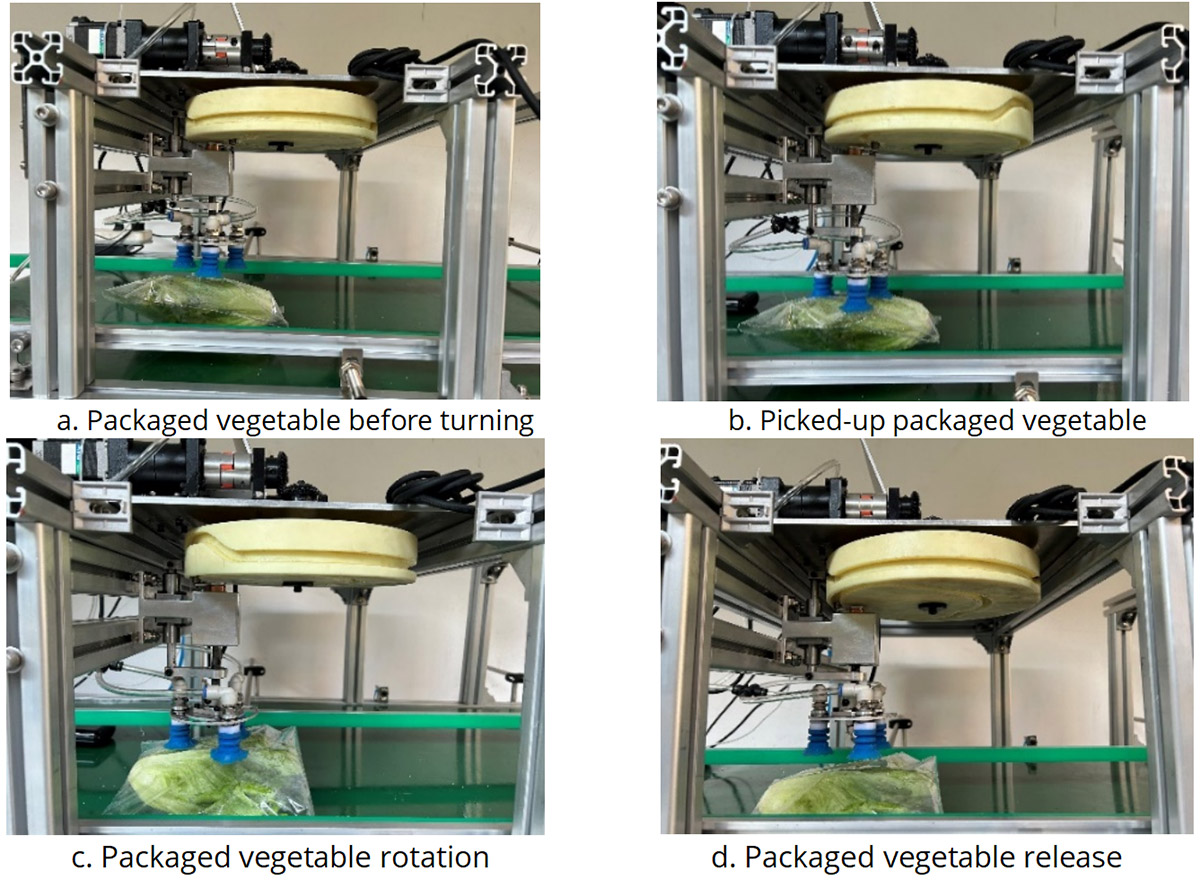
Plant factories, as agricultural production systems characterized by high yield, efficient resource utilization, and advanced mechanization, have attracted increasing global attention. Packaging finished vegetables is a critical pre-shipment operation in plant-factory production, and its automation and intelligent control remain urgent research needs. In vegetable-packaging line, an orientation-adjustment mechanism is required to correct the posture of packaged vegetables so that the boxing mechanism can place them neatly in turnover boxes. The operation of this mechanism depends on accurate identification of vegetable orientation. In this study, packaged vegetables produced in a plant factory were selected as the research object. Their postures on a conveyor belt were simulated, and images were acquired for orientation recognition. Multiple image features and classifiers were compared, and suitable texture features and classifiers were selected to identify the orientation of packaged vegetables. A translating-oscillating compound cam mechanism was designed according to the motion requirements for flipping packaged vegetables. The design process included determination of the follower motion law, generation of the cam profile curve, establishment of the cam model, and optimization of the structural parameters through a human-computer interaction framework. A prototype was then fabricated and assembled, and tests were conducted to verify the accuracy of the visual recognition system and the feasibility of the steering mechanism. The results showed that the GA-SVM classifier achieved a maximum accuracy of 97.90% with the fused HOG and GLCM features. The average accuracy of the recognition model was 95.27%, and the success rate of the steering mechanism was 94.67%. Both the recognition and steering performances were satisfactory. The proposed orientation-identification method and turning mechanism for packaged vegetables in plant factories were successfully implemented, providing a technical basis for unmanned plant-factory production lines.
Graphical Abstract
Keywords
Data Availability Statement
Funding
Conflicts of Interest
AI Use Statement
Ethical Approval and Consent to Participate
References
- Tian, Z., Ma, W., Yang, Q., & Duan, F. (2022). Application status and challenges of machine vision in plant factory—A review. Information Processing in Agriculture, 9(2), 195-211.
[CrossRef] [Google Scholar] - Ares, G., Ha, B., & Jaeger, S. R. (2021). Consumer attitudes to vertical farming (indoor plant factory with artificial lighting) in China, Singapore, UK, and USA: A multi-method study. Food Research International, 150, 110811.
[CrossRef] [Google Scholar] - Giannakourou, M. C., & Tsironi, T. N. (2021). Application of processing and packaging hurdles for fresh-cut fruits and vegetables preservation. Foods, 10(4), 830.
[CrossRef] [Google Scholar] - Wang, T., Chen, B., Zhang, Z., Li, H., & Zhang, M. (2022). Applications of machine vision in agricultural robot navigation: A review. Computers and Electronics in Agriculture, 198, 107085.
[CrossRef] [Google Scholar] - Chen, Y. R., Chao, K., & Kim, M. S. (2002). Machine vision technology for agricultural applications. Computers and electronics in Agriculture, 36(2-3), 173-191.
[CrossRef] [Google Scholar] - Kok, E., & Chen, C. (2024). Occluded apples orientation estimator based on deep learning model for robotic harvesting. Computers and Electronics in Agriculture, 219, 108781.
[CrossRef] [Google Scholar] - Wang, Z., Jin, L., Wang, S., & Xu, H. (2022). Apple stem/calyx real-time recognition using YOLO-v5 algorithm for fruit automatic loading system. Postharvest Biology and Technology, 185, 111808.
[CrossRef] [Google Scholar] - Lin, J., Holmes, M., Vinson, R., Ge, C., Pogoda, F. C., Mahon, L., ... & Tao, Y. (2017). Design and testing of an automated high-throughput computer vision guided waterjet knife strawberry calyx removal machine. Journal of Food Engineering, 211, 30-38.
[CrossRef] [Google Scholar] - Yang, M., Lyu, H., Zhao, Y., Sun, Y., Pan, H., Sun, Q., ... & Yang, H. (2023). Delivery of pollen to forsythia flower pistils autonomously and precisely using a robot arm. Computers and Electronics in Agriculture, 214, 108274.
[CrossRef] [Google Scholar] - Hao, Y., Wang, Q., & Zhang, S. (2021). Online accurate detection of soluble solids content in navel orange assisted by automatic orientation correction device. Infrared Physics & Technology, 118, 103871.
[CrossRef] [Google Scholar] - Lai, Q., Wang, Y., Tan, Y., & Sun, W. (2024). Design and experiment of Panax notoginseng root orientation transplanting device based on YOLOv5s. Frontiers in Plant Science, 15, 1325420.
[CrossRef] [Google Scholar] - Zhou, J., Zhang, P., Wei, M., Liu, W., Shi, J., Tan, Y., & Hu, J. (2026). Deep Learning-Based Recognition of Arch-Back Direction in Bare-Root Strawberry Seedlings for Mechanized Transplanting. Agriculture, 16(6), 657.
[CrossRef] [Google Scholar] - Jin, Y., Wang, J., Chen, J., Song, Z., Zhang, R., & Zhou, R. (2024). Design and experiment for flexible clamping and conveying device for green leafy vegetable orderly harvester. Agriculture, 14(6), 967.
[CrossRef] [Google Scholar] - WAN, P., HUANG, Y., WANG, R., LI, M., XIAO, C., & WU, W. (2023). Design and experiments of the machine vision-based body orientation arrangement convey device for the Scomber japonicus. Transactions of the Chinese Society of Agricultural Engineering, 39(14), 271-282.
[CrossRef] [Google Scholar] - Hou, J. L., Tian, L., Li, T. H., Niu, Z. R., & Li, Y. H. (2020). Design and experiment of test bench for garlic bulbil adjustment and seeding based on bilateral image identification. Transactions of the CSAE, 36(1), 50-58. https://dx.doi.org/10.11975/j.issn.1002-6819.2020.01.006
[Google Scholar] - Chen, J., Yu, C., Yao, K., Zhou, Y., & Zhou, B. (2022). Design and experiment of a garlic orientation and orderly conveying device based on machine vision. Agriculture, 12(8), 1077.
[CrossRef] [Google Scholar] - Zhang, L., Zhang, Z., Wu, C., & Sun, L. (2022). Segmentation algorithm for overlap recognition of seedling lettuce and weeds based on SVM and image blocking. Computers and Electronics in Agriculture, 201, 107284.
[CrossRef] [Google Scholar] - Taha, M. F., Mao, H., Zhang, Z., Elmasry, G., Awad, M. A., Abdalla, A., ... & Elsherbiny, O. (2025). Emerging technologies for precision crop management towards agriculture 5.0: A comprehensive overview. Agriculture, 15(6), 582.
[CrossRef] [Google Scholar] - Howley, T., Madden, M. G., O’Connell, M. L., & Ryder, A. G. (2005, December). The effect of principal component analysis on machine learning accuracy with high dimensional spectral data. In International Conference on Innovative Techniques and Applications of Artificial Intelligence (pp. 209-222). London: Springer London.
[CrossRef] [Google Scholar] - Pozo-Palacios, J., Fulbright, N. J., Voth, J. A., & Van de Ven, J. D. (2023). Comparison of forward and inverse cam generation methods for the design of cam-linkage mechanisms. Mechanism and Machine Theory, 190, 105465.
[CrossRef] [Google Scholar] - Wang, Y., Zhang, X., Ma, G., Du, X., Shaheen, N., & Mao, H. (2021). Recognition of weeds at asparagus fields using multi-feature fusion and backpropagation neural network. International Journal of Agricultural and Biological Engineering, 14(4), 190-198.
[CrossRef] [Google Scholar]
Cite This Article
TY  - JOUR
AU  - Zhang, Zhien
AU  - Chen, Weiwei
AU  - Huang, Huichan
AU  - Dai, Shenyuan
PY  - 2026
DA  - 2026/06/29
TI  - Design and Experiments of a Machine Vision-Based Directional Arrangement Device for Packaged Vegetables
JO  - Digital Intelligence in Agriculture
T2  - Digital Intelligence in Agriculture
JF  - Digital Intelligence in Agriculture
VL  - 2
IS  - 2
SP  - 103
EP  - 113
DO  - 10.62762/DIA.2026.219926
UR  - https://www.icck.org/article/abs/DIA.2026.219926
KW  - machine vision
KW  - plant factory
KW  - mechanism design
KW  - head-tail orientation
KW  - prototype testbed
AB  - Plant factories, as agricultural production systems characterized by high yield, efficient resource utilization, and advanced mechanization, have attracted increasing global attention. Packaging finished vegetables is a critical pre-shipment operation in plant-factory production, and its automation and intelligent control remain urgent research needs. In vegetable-packaging line, an orientation-adjustment mechanism is required to correct the posture of packaged vegetables so that the boxing mechanism can place them neatly in turnover boxes. The operation of this mechanism depends on accurate identification of vegetable orientation. In this study, packaged vegetables produced in a plant factory were selected as the research object. Their postures on a conveyor belt were simulated, and images were acquired for orientation recognition. Multiple image features and classifiers were compared, and suitable texture features and classifiers were selected to identify the orientation of packaged vegetables. A translating-oscillating compound cam mechanism was designed according to the motion requirements for flipping packaged vegetables. The design process included determination of the follower motion law, generation of the cam profile curve, establishment of the cam model, and optimization of the structural parameters through a human-computer interaction framework. A prototype was then fabricated and assembled, and tests were conducted to verify the accuracy of the visual recognition system and the feasibility of the steering mechanism. The results showed that the GA-SVM classifier achieved a maximum accuracy of 97.90% with the fused HOG and GLCM features. The average accuracy of the recognition model was 95.27%, and the success rate of the steering mechanism was 94.67%. Both the recognition and steering performances were satisfactory. The proposed orientation-identification method and turning mechanism for packaged vegetables in plant factories were successfully implemented, providing a technical basis for unmanned plant-factory production lines.
SN  - 3069-3187
PB  - Institute of Central Computation and Knowledge
LA  - English
ER  -
@article{Zhang2026Design,
  author = {Zhien Zhang and Weiwei Chen and Huichan Huang and Shenyuan Dai},
  title = {Design and Experiments of a Machine Vision-Based Directional Arrangement Device for Packaged Vegetables},
  journal = {Digital Intelligence in Agriculture},
  year = {2026},
  volume = {2},
  number = {2},
  pages = {103-113},
  doi = {10.62762/DIA.2026.219926},
  url = {https://www.icck.org/article/abs/DIA.2026.219926},
  abstract = {Plant factories, as agricultural production systems characterized by high yield, efficient resource utilization, and advanced mechanization, have attracted increasing global attention. Packaging finished vegetables is a critical pre-shipment operation in plant-factory production, and its automation and intelligent control remain urgent research needs. In vegetable-packaging line, an orientation-adjustment mechanism is required to correct the posture of packaged vegetables so that the boxing mechanism can place them neatly in turnover boxes. The operation of this mechanism depends on accurate identification of vegetable orientation. In this study, packaged vegetables produced in a plant factory were selected as the research object. Their postures on a conveyor belt were simulated, and images were acquired for orientation recognition. Multiple image features and classifiers were compared, and suitable texture features and classifiers were selected to identify the orientation of packaged vegetables. A translating-oscillating compound cam mechanism was designed according to the motion requirements for flipping packaged vegetables. The design process included determination of the follower motion law, generation of the cam profile curve, establishment of the cam model, and optimization of the structural parameters through a human-computer interaction framework. A prototype was then fabricated and assembled, and tests were conducted to verify the accuracy of the visual recognition system and the feasibility of the steering mechanism. The results showed that the GA-SVM classifier achieved a maximum accuracy of 97.90\% with the fused HOG and GLCM features. The average accuracy of the recognition model was 95.27\%, and the success rate of the steering mechanism was 94.67\%. Both the recognition and steering performances were satisfactory. The proposed orientation-identification method and turning mechanism for packaged vegetables in plant factories were successfully implemented, providing a technical basis for unmanned plant-factory production lines.},
  keywords = {machine vision, plant factory, mechanism design, head-tail orientation, prototype testbed},
  issn = {3069-3187},
  publisher = {Institute of Central Computation and Knowledge}
}
Article Metrics
Publisher's Note
ICCK stays neutral with regard to jurisdictional claims in published maps and institutional affiliations.
Rights and Permissions
 Copyright © 2026 by the Author(s). Published by Institute of Central Computation and Knowledge. This article is an open access article distributed under the terms and conditions of the Creative Commons Attribution (CC BY) license (https://creativecommons.org/licenses/by/4.0/), which permits use, sharing, adaptation, distribution and reproduction in any medium or format, as long as you give appropriate credit to the original author(s) and the source, provide a link to the Creative Commons licence, and indicate if changes were made.

