


A Big Data-Driven Hybrid Ensemble Learning Framework for Crop Yield Prediction in Low-Productivity Districts



Article Information
Abstract
Low-productivity agricultural belts in India face the compounding realities of land fragmentation, erratic weather, and heterogeneous soils, which together limit harvest outcomes. Precision agriculture and big data analytics together offer an innovative solution that turns large volumes of heterogeneous data into actionable agronomic intelligence. This study proposes a big-data-driven crop yield prediction (CYP) framework tailored to low-productivity districts in India. The architecture combines soil and climatic analytics with data warehousing, machine learning (four base regressors and voting-based hybrid ensembles), and a preprocessing pipeline designed for compatibility with distributed computing frameworks such as Apache Spark, together with SHAP-based explainability for interpreting the model's predictions. The framework provides accurate, district-level yield forecasting to support context-sensitive agronomic decision-making. The paper reports the predictive performance achieved, discusses implementation challenges, and outlines a future research agenda for data-driven agricultural reform in India.
Graphical Abstract
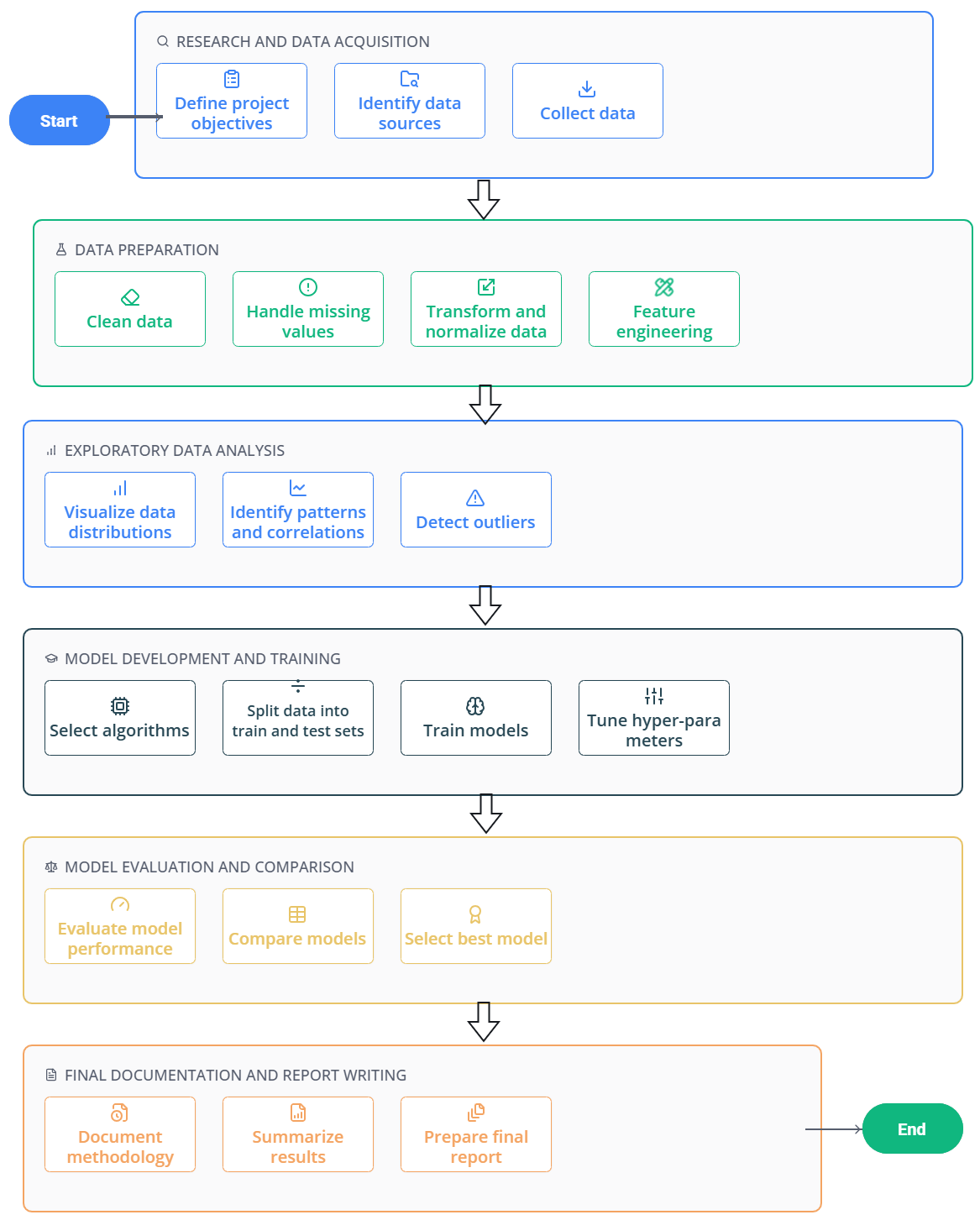
Keywords
Data Availability Statement
Funding
Conflicts of Interest
AI Use Statement
Ethical Approval and Consent to Participate
References
- Hernández Hernández, G. C., Gómez Gómez, J., & Jiménez-Cabas, J. (2025). Predictive models based on artificial intelligence to estimate crop yield: A literature review. Agriculture, 15(23), 2438.
[CrossRef] [Google Scholar] - Saha, S., Kucher, O. D., Utkina, A. O., & Rebouh, N. Y. (2025). Precision agriculture for improving crop yield predictions: a literature review. Frontiers in Agronomy, 7, 1566201.
[CrossRef] [Google Scholar] - Ahmed, F. U., Das, A., & Zubair, M. (2024, March). A machine learning approach for crop yield and disease prediction integrating soil nutrition and weather factors. In 2024 international conference on advances in computing, communication, electrical, and smart systems (iCACCESS) (pp. 1-6). IEEE.
[CrossRef] [Google Scholar] - Patil, P., Athavale, P., Bothara, M., Tambolkar, S., & More, A. (2023). Crop Selection and Yield Prediction using Machine Learning Approach. Current Agriculture Research Journal, 11(3), 968. https://dx.doi.org/10.12944/CARJ.11.3.26
[Google Scholar] - Lou, Z., Lu, X., & Li, S. (2024). Yield prediction of winter wheat at different growth stages based on machine learning. Agronomy, 14(8), 1834.
[CrossRef] [Google Scholar] - Xu, H., Yin, H., Liu, Y., Wang, B., Song, H., Zheng, Z., ... & Wang, S. (2024). Regional winter wheat yield prediction and variable importance analysis based on multisource environmental data. Agronomy, 14(8), 1623.
[CrossRef] [Google Scholar] - Nosratabadi, S., Imre, F., Szell, K., Ardabili, S., Beszedes, B., & Mosavi, A. (2020). Hybrid machine learning models for crop yield prediction. arXiv preprint arXiv:2005.04155.
[CrossRef] [Google Scholar] - Khaki, S., & Wang, L. (2019). Crop yield prediction using deep neural networks. Frontiers in Plant Science, 10, 621.
[CrossRef] [Google Scholar] - Subramaniam, L. K., & Marimuthu, R. (2024). Crop yield prediction using effective deep learning and dimensionality reduction approaches for Indian regional crops. e-Prime-Advances in Electrical Engineering, Electronics and Energy, 8, 100611.
[CrossRef] [Google Scholar] - Wang, Y., Zhang, Q., Yu, F., Zhang, N., Zhang, X., Li, Y., Wang, M., & Zhang, J. (2024). Progress in research on deep learning-based crop yield prediction. Agronomy, 14(10), 2264.
[CrossRef] [Google Scholar] - Fan, J., Bai, J., Li, Z., Ortiz-Bobea, A., & Gomes, C. P. (2022, June). A GNN-RNN approach for harnessing geospatial and temporal information: application to crop yield prediction. In Proceedings of the AAAI conference on artificial intelligence (Vol. 36, No. 11, pp. 11873-11881).
[CrossRef] [Google Scholar] - Miranda, M., Charfuelan, M., & Dengel, A. (2024). Exploring physics-informed neural networks for crop yield loss forecasting. arXiv preprint arXiv:2501.00502.
[CrossRef] [Google Scholar] - Ngo, V. M., Le-Khac, N. A., & Kechadi, M. (2018). An efficient data warehouse for crop yield prediction. arXiv preprint arXiv:1807.00035.
[CrossRef] [Google Scholar] - Knapen, R., de Wit, A., Buyukkaya, E., Petrou, P., Paudel, D., Janssen, S., & Athanasiadis, I. (2025). Efficient and scalable crop growth simulations using standard big data and distributed computing technologies. Computers and Electronics in Agriculture, 236, 110392.
[CrossRef] [Google Scholar] - Wolfert, S., Ge, L., Verdouw, C., & Bogaardt, M. J. (2017). Big data in smart farming–a review. Agricultural Systems, 153, 69-80.
[CrossRef] [Google Scholar] - Kammerlander, C., Kolb, V., Luegmair, M., Scheermann, L., Schmailzl, M., Seufert, M., ... & Schön, T. (2025). Machine learning models for soil parameter prediction based on satellite, weather, clay and yield data. arXiv preprint arXiv:2503.22276.
[CrossRef] [Google Scholar] - Talaat, F. M. (2023). Crop yield prediction algorithm (CYPA) in precision agriculture based on IoT techniques and climate changes. Neural Computing and Applications, 35(23), 17281-17292.
[CrossRef] [Google Scholar] - Surana, R., & Khandelwal, R. (2024). Crop yield prediction using machine learning: A pragmatic approach.
[CrossRef] [Google Scholar] - SB, S. H., & Rawat, S. (2026). Crop Yield Prediction Using Different Techniques of Machine Learning for Prayagraj Region. International Journal of Environment and Climate Change, 16(2), 386-397. https://hal.science/hal-05511932/
[Google Scholar] - Lundberg, S. M., & Lee, S. I. (2017). A unified approach to interpreting model predictions. Advances in Neural Information Processing Systems, 30, 4765-4774.
[Google Scholar]
Cite This Article
TY  - JOUR
AU  - Singh, Somya
AU  - Gupta, Yogesh Kumar
PY  - 2026
DA  - 2026/09/22
TI  - A Big Data-Driven Hybrid Ensemble Learning Framework for Crop Yield Prediction in Low-Productivity Districts
JO  - Digital Intelligence in Agriculture
T2  - Digital Intelligence in Agriculture
JF  - Digital Intelligence in Agriculture
VL  - 2
IS  - 3
SP  - 158
EP  - 167
DO  - 10.62762/DIA.2026.295683
UR  - https://www.icck.org/article/abs/DIA.2026.295683
KW  - crop yield prediction (CYP)
KW  - machine learning (ML)
KW  - ensemble learning
KW  - big data
KW  - precision agriculture
KW  - explainable AI (SHAP)
AB  - Low-productivity agricultural belts in India face the compounding realities of land fragmentation, erratic weather, and heterogeneous soils, which together limit harvest outcomes. Precision agriculture and big data analytics together offer an innovative solution that turns large volumes of heterogeneous data into actionable agronomic intelligence. This study proposes a big-data-driven crop yield prediction (CYP) framework tailored to low-productivity districts in India. The architecture combines soil and climatic analytics with data warehousing, machine learning (four base regressors and voting-based hybrid ensembles), and a preprocessing pipeline designed for compatibility with distributed computing frameworks such as Apache Spark, together with SHAP-based explainability for interpreting the model's predictions. The framework provides accurate, district-level yield forecasting to support context-sensitive agronomic decision-making. The paper reports the predictive performance achieved, discusses implementation challenges, and outlines a future research agenda for data-driven agricultural reform in India.
SN  - 3069-3187
PB  - Institute of Central Computation and Knowledge
LA  - English
ER  -
@article{Singh2026A,
  author = {Somya Singh and Yogesh Kumar Gupta},
  title = {A Big Data-Driven Hybrid Ensemble Learning Framework for Crop Yield Prediction in Low-Productivity Districts},
  journal = {Digital Intelligence in Agriculture},
  year = {2026},
  volume = {2},
  number = {3},
  pages = {158-167},
  doi = {10.62762/DIA.2026.295683},
  url = {https://www.icck.org/article/abs/DIA.2026.295683},
  abstract = {Low-productivity agricultural belts in India face the compounding realities of land fragmentation, erratic weather, and heterogeneous soils, which together limit harvest outcomes. Precision agriculture and big data analytics together offer an innovative solution that turns large volumes of heterogeneous data into actionable agronomic intelligence. This study proposes a big-data-driven crop yield prediction (CYP) framework tailored to low-productivity districts in India. The architecture combines soil and climatic analytics with data warehousing, machine learning (four base regressors and voting-based hybrid ensembles), and a preprocessing pipeline designed for compatibility with distributed computing frameworks such as Apache Spark, together with SHAP-based explainability for interpreting the model's predictions. The framework provides accurate, district-level yield forecasting to support context-sensitive agronomic decision-making. The paper reports the predictive performance achieved, discusses implementation challenges, and outlines a future research agenda for data-driven agricultural reform in India.},
  keywords = {crop yield prediction (CYP), machine learning (ML), ensemble learning, big data, precision agriculture, explainable AI (SHAP)},
  issn = {3069-3187},
  publisher = {Institute of Central Computation and Knowledge}
}
Article Metrics
Publisher's Note
ICCK stays neutral with regard to jurisdictional claims in published maps and institutional affiliations.
Rights and Permissions
 Copyright © 2026 by the Author(s). Published by Institute of Central Computation and Knowledge. This article is an open access article distributed under the terms and conditions of the Creative Commons Attribution (CC BY) license (https://creativecommons.org/licenses/by/4.0/), which permits use, sharing, adaptation, distribution and reproduction in any medium or format, as long as you give appropriate credit to the original author(s) and the source, provide a link to the Creative Commons licence, and indicate if changes were made.

