


ATR-FTIR Spectral Characteristics and Their Application to the Classification of Cultivated Karst Soils in Shilin County


Article Information
Abstract
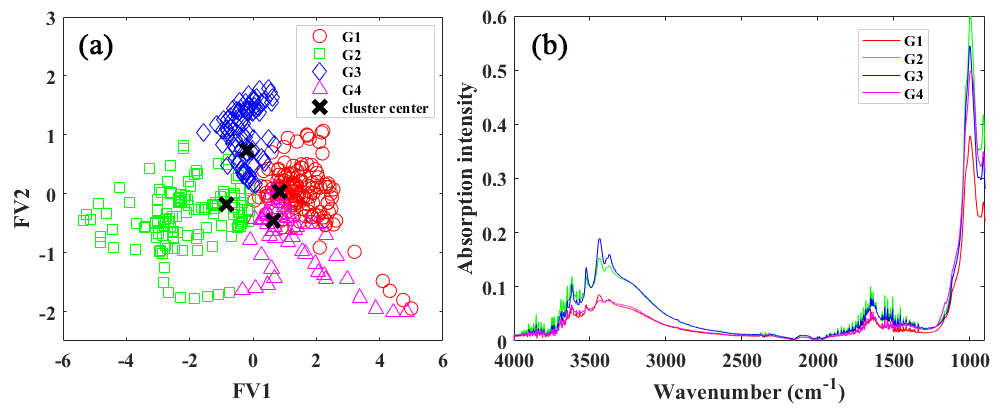
To enable rapid, non-destructive analysis and functional classification of karst calcareous soils in Shilin County, Kunming, this study acquired mid-infrared attenuated total reflectance Fourier-transform infrared (ATR-FTIR) spectra in the 4000-900\cmi{} range from 409 soil samples. After standardized preprocessing, the samples were preliminarily partitioned into four spectral groups by K-means clustering, and a partial least squares discriminant analysis (PLS-DA) model was constructed. Variable importance in projection (VIP) scores were further used to identify key spectral features distinguishing the classes. The spectra were dominated by peaks at 3620, 1650, and 1020\cmi{}, and no obvious calcite absorption at $\sim$1430\cmi{} was observed, suggesting strong carbonate leaching (decalcification weathering). K-means clustering divided the samples into four groups (G1--G4), interpreted from their spectral features as organic matter-mineral impoverished, mineral-dominated, organic matter-mineral enriched, and organic matter impoverished types, respectively, possibly reflecting spectral differentiation along a rocky desertification gradient. The PLS-DA model achieved an overall accuracy of 93.9% under nested cross-validation, with precision and recall exceeding 92% for G1--G3. VIP analysis identified the silicate skeleton region, the organic matter/water region, and the hydroxyl region as key bands, suggesting that gradients in clay mineral, organic matter, and bound water contents contribute most to spectral differentiation. These findings indicate that ATR-FTIR spectroscopy has potential for rapid, non-destructive classification of karst calcareous soils and can provide a technical pathway for soil survey and rocky desertification monitoring.
Graphical Abstract
Keywords
Data Availability Statement
Funding
Conflicts of Interest
AI Use Statement
Ethical Approval and Consent to Participate
References
- Jiang, Z., Lian, Y., & Qin, X. (2014). Rocky desertification in Southwest China: Impacts, causes, and restoration. Earth-Science Reviews, 132, 1-12.
[CrossRef] [Google Scholar] - Wu, Q., Zheng, W., Rao, C., Wang, E., & Yan, W. (2022). Soil quality assessment and management in karst rocky desertification ecosystem of Southwest China. Forests, 13(9), 1513.
[CrossRef] [Google Scholar] - Zhang, J. Y., Dai, M. H., Wang, L. C., Zeng, C. F., & Su, W. C. (2016). The challenge and future of rocky desertification control in karst areas in southwest China. Solid Earth, 7(1), 83-91.
[CrossRef] [Google Scholar] - Beckford, H. O., Chu, H., Song, C., Chang, C., & Ji, H. (2021). Geochemical characteristics and behaviour of elements during weathering and pedogenesis over karst area in Yunnan–Guizhou Plateau, southwestern China. Environmental Earth Sciences, 80(2), 61.
[CrossRef] [Google Scholar] - Margenot, A. J., Parikh, S. J., & Calderón, F. J. (2023). Fourier‐transform infrared spectroscopy for soil organic matter analysis. Soil Science Society of America Journal, 87(6), 1503-1528.
[CrossRef] [Google Scholar] - Soriano-Disla, J. M., Janik, L. J., Viscarra Rossel, R. A., Macdonald, L. M., & McLaughlin, M. J. (2014). The performance of visible, near-, and mid-infrared reflectance spectroscopy for prediction of soil physical, chemical, and biological properties. Applied spectroscopy reviews, 49(2), 139-186.
[CrossRef] [Google Scholar] - Tinti, A., Tugnoli, V., Bonora, S., & Francioso, O. (2015). Recent applications of vibrational mid-infrared (IR) spectroscopy for studying soil components: A review. Journal of Central European Agriculture, 16(1), 1-22.
[CrossRef] [Google Scholar] - Solomon, D., Lehmann, J., Kinyangi, J., Liang, B., & Schäfer, T. (2005). Carbon K‐edge NEXAFS and FTIR‐ATR spectroscopic investigation of organic carbon speciation in soils. Soil Science Society of America Journal, 69(1), 107-119.
[CrossRef] [Google Scholar] - Madejová, J. (2003). FTIR techniques in clay mineral studies. Vibrational spectroscopy, 31(1), 1-10.
[CrossRef] [Google Scholar] - Nguyen, T. T., Janik, L. J., & Raupach, M. (1991). Diffuse reflectance infrared Fourier transform (DRIFT) spectroscopy in soil studies. Australian Journal of Soil Research, 29(1), 49-67.
[CrossRef] [Google Scholar] - Li, S., Shen, X., Shen, X., Cheng, J., Xu, D., Makar, R. S., ... & Shi, Z. (2025). Improving the accuracy of soil classification by using Vis--NIR, MIR, and their spectra fusion. Remote Sensing, 17(9), 1524.
[CrossRef] [Google Scholar] - Lee, L. C., Liong, C. Y., & Jemain, A. A. (2018). Partial least squares-discriminant analysis (PLS-DA) for classification of high-dimensional (HD) data: A review of contemporary practice strategies and knowledge gaps. Analyst, 143(15), 3526-3539.
[CrossRef] [Google Scholar] - Xie, H., Zhao, J., Wang, Q., Sui, Y., Wang, J., Yang, X., ... & Liang, C. (2015). Soil type recognition as improved by genetic algorithm-based variable selection using near infrared spectroscopy and partial least squares discriminant analysis. Scientific reports, 5(1), 10930.
[CrossRef] [Google Scholar] - Maynard, J. J., & Johnson, M. G. (2018). Applying fingerprint FTIR spectroscopy and chemometrics to assess soil ecosystem disturbance and recovery. Journal of Soil and Water Conservation, 73(4), 443-451.
[CrossRef] [Google Scholar] - Madejova, J., & Komadel, P. (2001). Baseline studies of the clay minerals society source clays: infrared methods. Clays and clay minerals, 49(5), 410-432.
[CrossRef] [Google Scholar] - Wang, X., Huang, X., Xiong, K., Hu, J., Zhang, Z., & Zhang, J. (2021). Mechanism and evolution of soil organic carbon coupling with rocky desertification in south China karst. Forests, 13(1), 28.
[CrossRef] [Google Scholar] - Rossel, R. V., Behrens, T., Ben-Dor, E., Brown, D. J., Demattê, J. A. M., Shepherd, K. D., ... & Ji, W. (2016). A global spectral library to characterize the world's soil. Earth-Science Reviews, 155, 198-230.
[CrossRef] [Google Scholar] - Sangwan, P., Nimi, C., Nain, T., Singh, R., & Sharma, N. (2024). Discrimination of soil samples collected from Haryana (India) using non-destructive ATR-FTIR spectroscopy coupled with multivariate statistical analysis. Indian Journal of Science and Technology, 17(11), 1087-1096.
[CrossRef] [Google Scholar] - Seybold, C. A., Ferguson, R., Wysocki, D., Bailey, S., Anderson, J., Nester, B., ... & Thomas, P. (2019). Application of mid‐infrared spectroscopy in soil survey. Soil Science Society of America Journal, 83(6), 1746-1759.
[CrossRef] [Google Scholar] - Nocita, M., Stevens, A., van Wesemael, B., Aitkenhead, M., Bachmann, M., Barthès, B., ... & Wetterlind, J. (2015). Soil spectroscopy: an alternative to wet chemistry for soil monitoring. Advances in agronomy, 132, 139-159.
[CrossRef] [Google Scholar] - Reeves, J. B., McCarty, G. W., & Reeves, V. B. (2001). Mid-infrared diffuse reflectance spectroscopy for the quantitative analysis of agricultural soils. Journal of agricultural and food chemistry, 49(2), 766-772.
[CrossRef] [Google Scholar] - Linker, R., Shmulevich, I., Kenny, A., & Shaviv, A. (2005). Soil identification and chemometrics for direct determination of nitrate in soils using FTIR-ATR mid-infrared spectroscopy. Chemosphere, 61(5), 652-658.
[CrossRef] [Google Scholar] - Margenot, A. J., Parikh, S. J., & Calderón, F. J. (2019). Improving infrared spectroscopy characterization of soil organic matter with spectral subtractions. JoVE (Journal of Visualized Experiments), (143), e57464. https://dx.doi.org/10.3791/57464
[Google Scholar] - Savitzky, A., & Golay, M. J. (1964). Smoothing and differentiation of data by simplified least squares procedures. Analytical chemistry, 36(8), 1627-1639.
[CrossRef] [Google Scholar] - Barnes, R. J., Dhanoa, M. S., & Lister, S. J. (1989). Standard normal variate transformation and de-trending of near-infrared diffuse reflectance spectra. Applied spectroscopy, 43(5), 772-777.
[CrossRef] [Google Scholar] - Jolliffe, I. T., & Cadima, J. (2016). Principal component analysis: a review and recent developments. Philosophical transactions. Series A, Mathematical, physical, and engineering sciences, 374(2065), 20150202.
[CrossRef] [Google Scholar] - Wang, J., Liu, T., Zhang, J., Yuan, H., & Acquah, G. E. (2022). Spectral variable selection for estimation of soil organic carbon content using mid‐infrared spectroscopy. European Journal of Soil Science, 73(4), e13267.
[CrossRef] [Google Scholar] - Wold, S., Sjöström, M., & Eriksson, L. (2001). PLS-regression: a basic tool of chemometrics. Chemometrics and intelligent laboratory systems, 58(2), 109-130.
[CrossRef] [Google Scholar] - Sokolova, M., & Lapalme, G. (2009). A systematic analysis of performance measures for classification tasks. Information processing & management, 45(4), 427-437.
[CrossRef] [Google Scholar] - He, H., & Garcia, E. A. (2009). Learning from imbalanced data. IEEE Transactions on knowledge and data engineering, 21(9), 1263-1284.
[CrossRef] [Google Scholar] - Artz, R. R., Chapman, S. J., Robertson, A. J., Potts, J. M., Laggoun-Défarge, F., Gogo, S., ... & Francez, A. J. (2008). FTIR spectroscopy can be used as a screening tool for organic matter quality in regenerating cutover peatlands. Soil Biology and Biochemistry, 40(2), 515-527.
[CrossRef] [Google Scholar] - Haberhauer, G., Rafferty, B., Strebl, F., & Gerzabek, M. H. (1998). Comparison of the composition of forest soil litter derived from three different sites at various decompositional stages using FTIR spectroscopy. Geoderma, 83(3-4), 331-342.
[CrossRef] [Google Scholar] - Demyan, M. S., Rasche, F., Schulz, E., Breulmann, M., Müller, T., & Cadisch, G. (2012). Use of specific peaks obtained by diffuse reflectance Fourier transform mid‐infrared spectroscopy to study the composition of organic matter in a Haplic Chernozem. European Journal of Soil Science, 63(2), 189-199.
[CrossRef] [Google Scholar] - Stuart, B. H. (2004). Infrared Spectroscopy: Fundamentals and Applications. Chichester, UK: John Wiley & Sons.
[CrossRef] [Google Scholar] - Lu, Y., Wang, Y., Chen, Y., Song, N., Wang, Q., Liu, M., & Guan, X. (2026). Nonlinear Responses of Vegetation and Soil Properties to Rock Desertification Gradients in Qingzhen, China. Land, 15(3), 499.
[CrossRef] [Google Scholar] - Huang, Y., Zhou, Z., Tang, Q., Huang, D., Li, B., & Luo, Y. (2026). Karst Rocky Desertification in Southwest China: Remote Sensing Progress, Critical Challenges, and Future Pathways. Applied Sciences, 16(13), 6459.
[CrossRef] [Google Scholar] - Dai, G., Sun, H., Wang, B., Huang, C., Wang, W., Yao, Y., ... & Zhang, Z. (2021). Assessment of karst rocky desertification from the local to regional scale based on unmanned aerial vehicle images: A case‐study of Shilin County, Yunnan Province, China. Land Degradation & Development, 32(18), 5253-5266.
[CrossRef] [Google Scholar] - Wu, M., Huang, Y., Zhao, X., Jin, J., & Ruan, Y. (2024). Effects of different spectral processing methods on soil organic matter prediction based on VNIR-SWIR spectroscopy in karst areas, Southwest China. Journal of Soils and Sediments, 24(2), 914-927.
[CrossRef] [Google Scholar] - Ramirez-Lopez, L., Behrens, T., Schmidt, K., Stevens, A., Demattê, J. A. M., & Scholten, T. (2013). The spectrum-based learner: A new local approach for modeling soil vis–NIR spectra of complex datasets. Geoderma, 195, 268-279.
[CrossRef] [Google Scholar] - Miao, Y., Wang, H., Huang, X., Liu, K., Sun, Q., Meng, L., & Xu, D. (2024). Soil organic carbon prediction based on Vis–NIR spectral classification data using GWPCA–FCM algorithm. Sensors, 24(15), 4930.
[CrossRef] [Google Scholar] - Ge, Y., Thomasson, J. A., & Morgan, C. L. (2014). Mid-infrared attenuated total reflectance spectroscopy for soil carbon and particle size determination. Geoderma, 213, 57-63.
[CrossRef] [Google Scholar] - Cécillon, L., Barthès, B. G., Gomez, C., Ertlen, D., Génot, V., Hedde, M., ... & Brun, J. J. (2009). Assessment and monitoring of soil quality using near‐infrared reflectance spectroscopy (NIRS). European Journal of Soil Science, 60(5), 770-784.
[CrossRef] [Google Scholar] - Grinand, C., Barthès, B. G., Brunet, D., Kouakoua, E., Arrouays, D., Jolivet, C., ... & Bernoux, M. (2012). Prediction of soil organic and inorganic carbon contents at a national scale (France) using mid‐infrared reflectance spectroscopy (MIRS). European Journal of Soil Science, 63(2), 141-151.
[CrossRef] [Google Scholar]
Cite This Article
TY  - JOUR
AU  - Yang, Xing
AU  - Jiang, Bixia
AU  - He, Yanjie
AU  - Yue, Rui
AU  - Bao, Ruiqian
AU  - Lv, Gaoqiang
AU  - Ma, Fei
AU  - Du, Changwen
PY  - 2026
DA  - 2026/09/24
TI  - ATR-FTIR Spectral Characteristics and Their Application to the Classification of Cultivated Karst Soils in Shilin County
JO  - Digital Intelligence in Agriculture
T2  - Digital Intelligence in Agriculture
JF  - Digital Intelligence in Agriculture
VL  - 2
IS  - 3
SP  - 179
EP  - 190
DO  - 10.62762/DIA.2026.518539
UR  - https://www.icck.org/article/abs/DIA.2026.518539
KW  - Karst calcareous soil
KW  - spectral characteristics
KW  - soil classification
KW  - ATR-FTIR
KW  - PLS-DA
AB  - To enable rapid, non-destructive analysis and functional classification of karst calcareous soils in Shilin County, Kunming, this study acquired mid-infrared attenuated total reflectance Fourier-transform infrared (ATR-FTIR) spectra in the 4000-900\cmi{} range from 409 soil samples. After standardized preprocessing, the samples were preliminarily partitioned into four spectral groups by K-means clustering, and a partial least squares discriminant analysis (PLS-DA) model was constructed. Variable importance in projection (VIP) scores were further used to identify key spectral features distinguishing the classes. The spectra were dominated by peaks at 3620, 1650, and 1020\cmi{}, and no obvious calcite absorption at $\sim$1430\cmi{} was observed, suggesting strong carbonate leaching (decalcification weathering). K-means clustering divided the samples into four groups (G1--G4), interpreted from their spectral features as organic matter-mineral impoverished, mineral-dominated, organic matter-mineral enriched, and organic matter impoverished types, respectively, possibly reflecting spectral differentiation along a rocky desertification gradient. The PLS-DA model achieved an overall accuracy of 93.9% under nested cross-validation, with precision and recall exceeding 92% for G1--G3. VIP analysis identified the silicate skeleton region, the organic matter/water region, and the hydroxyl region as key bands, suggesting that gradients in clay mineral, organic matter, and bound water contents contribute most to spectral differentiation. These findings indicate that ATR-FTIR spectroscopy has potential for rapid, non-destructive classification of karst calcareous soils and can provide a technical pathway for soil survey and rocky desertification monitoring.
SN  - 3069-3187
PB  - Institute of Central Computation and Knowledge
LA  - English
ER  -
@article{Yang2026ATRFTIR,
  author = {Xing Yang and Bixia Jiang and Yanjie He and Rui Yue and Ruiqian Bao and Gaoqiang Lv and Fei Ma and Changwen Du},
  title = {ATR-FTIR Spectral Characteristics and Their Application to the Classification of Cultivated Karst Soils in Shilin County},
  journal = {Digital Intelligence in Agriculture},
  year = {2026},
  volume = {2},
  number = {3},
  pages = {179-190},
  doi = {10.62762/DIA.2026.518539},
  url = {https://www.icck.org/article/abs/DIA.2026.518539},
  abstract = {To enable rapid, non-destructive analysis and functional classification of karst calcareous soils in Shilin County, Kunming, this study acquired mid-infrared attenuated total reflectance Fourier-transform infrared (ATR-FTIR) spectra in the 4000-900\cmi{} range from 409 soil samples. After standardized preprocessing, the samples were preliminarily partitioned into four spectral groups by K-means clustering, and a partial least squares discriminant analysis (PLS-DA) model was constructed. Variable importance in projection (VIP) scores were further used to identify key spectral features distinguishing the classes. The spectra were dominated by peaks at 3620, 1650, and 1020\cmi{}, and no obvious calcite absorption at \$\sim\$1430\cmi{} was observed, suggesting strong carbonate leaching (decalcification weathering). K-means clustering divided the samples into four groups (G1--G4), interpreted from their spectral features as organic matter-mineral impoverished, mineral-dominated, organic matter-mineral enriched, and organic matter impoverished types, respectively, possibly reflecting spectral differentiation along a rocky desertification gradient. The PLS-DA model achieved an overall accuracy of 93.9\% under nested cross-validation, with precision and recall exceeding 92\% for G1--G3. VIP analysis identified the silicate skeleton region, the organic matter/water region, and the hydroxyl region as key bands, suggesting that gradients in clay mineral, organic matter, and bound water contents contribute most to spectral differentiation. These findings indicate that ATR-FTIR spectroscopy has potential for rapid, non-destructive classification of karst calcareous soils and can provide a technical pathway for soil survey and rocky desertification monitoring.},
  keywords = {Karst calcareous soil, spectral characteristics, soil classification, ATR-FTIR, PLS-DA},
  issn = {3069-3187},
  publisher = {Institute of Central Computation and Knowledge}
}
Article Metrics
Publisher's Note
ICCK stays neutral with regard to jurisdictional claims in published maps and institutional affiliations.
Rights and Permissions
 Copyright © 2026 by the Author(s). Published by Institute of Central Computation and Knowledge. This article is an open access article distributed under the terms and conditions of the Creative Commons Attribution (CC BY) license (https://creativecommons.org/licenses/by/4.0/), which permits use, sharing, adaptation, distribution and reproduction in any medium or format, as long as you give appropriate credit to the original author(s) and the source, provide a link to the Creative Commons licence, and indicate if changes were made.

