


Model-Based Design and Evaluation of a Multi-Variable Hybrid Predictive Control Loop for Precision Fertigation Using Multi-Sensor Data Fusion



Article Information
Abstract
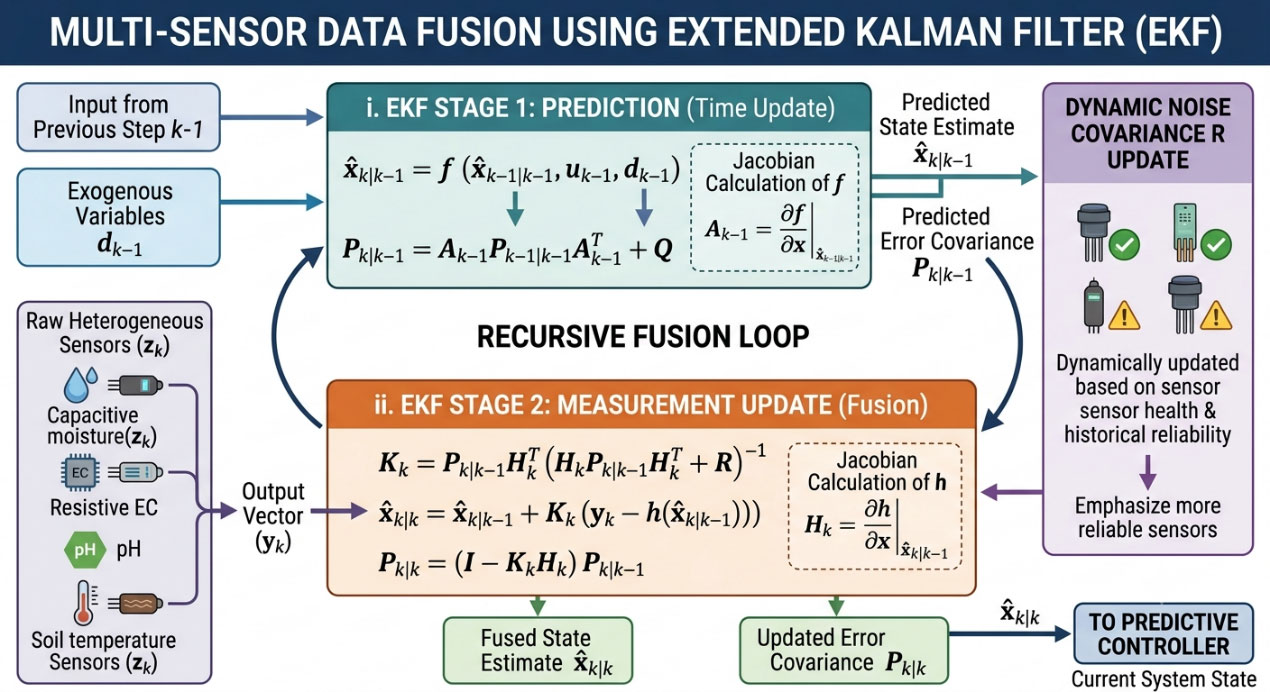
Efficient water and nutrient management remains a major challenge in modern agriculture due to rising fertilizer costs, global water scarcity, and environmental concerns such as groundwater contamination from nutrient leaching. Conventional fertigation typically relies on uniform application rates that neglect spatial and temporal root-zone variability, resulting in inefficient resource utilization. To address these limitations, this study proposes and evaluates an automated Multi-Variable Hybrid Predictive Control (HPC) framework for precision fertigation. The system captures the highly nonlinear dynamics of rapid soil moisture changes and slower nutrient transport using a multi-variable state-space model that combines continuous physical processes with discrete control logic, including pump scheduling and fertilizer injection. The predictive controller is enhanced by an Extended Kalman Filter (EKF)-based Multi-Sensor Data Fusion (MSDF) framework, which mitigates measurement noise and sensor drift from capacitive moisture and electrical conductivity (EC) sensors through adaptive covariance estimation, providing reliable root-zone state estimates. A 30-day closed-loop MATLAB simulation demonstrates robust tracking performance and disturbance rejection. Following the receding horizon strategy, the controller suspended irrigation and fertilization during rainfall events, effectively utilizing natural precipitation and eliminating the risk of groundwater nutrient leaching during precipitation events. Compared with conventional uniform fertigation, the proposed approach achieved a 25% reduction in water use and a 30% reduction in fertilizer consumption. Overall, the proposed framework provides an effective solution for improving resource-use efficiency while supporting environmentally sustainable precision agriculture.
Graphical Abstract
Keywords
Data Availability Statement
Funding
Conflicts of Interest
AI Use Statement
Ethical Approval and Consent to Participate
References
- Fereres, E., & Soriano, M. A. (2007). Deficit irrigation for reducing agricultural water use. Journal of experimental botany, 58(2), 147-159.
[CrossRef] [Google Scholar] - Bwambale, E., Abagale, F. K., & Anornu, G. K. (2022). Smart irrigation monitoring and control strategies for improving water use efficiency in precision agriculture: A review. Agricultural Water Management, 260, 107324.
[CrossRef] [Google Scholar] - Li, J., Inanaga, S., Li, Z., & Eneji, A. E. (2005). Optimizing irrigation scheduling for winter wheat in the North China Plain. Agricultural water management, 76(1), 8-23.
[CrossRef] [Google Scholar] - Abioye, A. E., Abidin, M. S. Z., Mahmud, M. S. A., Buyamin, S., Mohammed, O. O., Otuoze, A. O., ... & Mayowa, A. (2023). Model based predictive control strategy for water saving drip irrigation. Smart Agricultural Technology, 4, 100179.
[CrossRef] [Google Scholar] - Vereecken, H., Huisman, J. A., Bogena, H., Vanderborght, J., Vrugt, J. A., & Hopmans, J. W. (2008). On the value of soil moisture measurements in vadose zone hydrology: A review. Water resources research, 44(4).
[CrossRef] [Google Scholar] - Nahar, J., Liu, S., Mao, Y., Liu, J., & Shah, S. L. (2019). Closed-loop scheduling and control for precision irrigation. Industrial & Engineering Chemistry Research, 58(26), 11485-11497.
[CrossRef] [Google Scholar] - Abioye, E. A., Abidin, M. S. Z., Mahmud, M. S. A., Buyamin, S., Ijike, O. D., Otuoze, A. O., ... & Olajide, O. M. (2023). A data-driven Kalman filter-PID controller for fibrous capillary irrigation. Smart Agricultural Technology, 3, 100085.
[CrossRef] [Google Scholar] - Jones, H. G. (2004). Irrigation scheduling: advantages and pitfalls of plant-based methods. Journal of experimental botany, 55(407), 2427-2436.
[CrossRef] [Google Scholar] - Mayne, D. Q., Rawlings, J. B., Rao, C. V., & Scokaert, P. O. (2000). Constrained model predictive control: Stability and optimality. Automatica, 36(6), 789-814.
[CrossRef] [Google Scholar] - McCarthy, A. C., Hancock, N. H., & Raine, S. R. (2010). VARIwise: A general-purpose adaptive control simulation framework for spatially and temporally varied irrigation at sub-field scale. Computers and Electronics in Agriculture, 70(1), 117-128.
[CrossRef] [Google Scholar] - Agyeman, B. T., Bo, S., Sahoo, S. R., Yin, X., Liu, J., & Shah, S. L. (2021). Soil moisture map construction by sequential data assimilation using an extended Kalman filter. Journal of Hydrology, 598, 126425.
[CrossRef] [Google Scholar] - Park, Y., Shamma, J. S., & Harmon, T. C. (2009). A Receding Horizon Control algorithm for adaptive management of soil moisture and chemical levels during irrigation. Environmental Modelling & Software, 24(9), 1112-1121.
[CrossRef] [Google Scholar] - Incrocci, L., Massa, D., & Pardossi, A. (2017). New trends in the fertigation management of irrigated vegetable crops. Horticulturae, 3(2), 37.
[CrossRef] [Google Scholar] - Bemporad, A., & Morari, M. (1999). Control of systems integrating logic, dynamics, and constraints. Automatica, 35(3), 407-427.
[CrossRef] [Google Scholar] - Castrignanò, A., Buttafuoco, G., Quarto, R., Vitti, C., Langella, G., Terribile, F., & Venezia, A. (2017). A combined approach of sensor data fusion and multivariate geostatistics for delineation of homogeneous zones in an agricultural field. Sensors, 17(12), 2794.
[CrossRef] [Google Scholar] - Bogena, H. R., Huisman, J. A., Oberdörster, C., & Vereecken, H. (2007). Evaluation of a low-cost soil water content sensor for wireless network applications. Journal of hydrology, 344(1-2), 32-42.
[CrossRef] [Google Scholar] - Srbinovska, M., Gavrovski, C., Dimcev, V., Krkoleva, A., & Borozan, V. (2015). Environmental parameters monitoring in precision agriculture using wireless sensor networks. Journal of cleaner production, 88, 297-307.
[CrossRef] [Google Scholar] - Bwambale, E., Abagale, F. K., & Anornu, G. K. (2023). Data-driven model predictive control for precision irrigation management. Smart Agricultural Technology, 3, 100074.
[CrossRef] [Google Scholar] - Cáceres Rodríguez, G. B., Millán Gata, P., Pereira Martín, M., & Lozano, D. (2021). Smart farm irrigation: Model predictive control for economic optimal irrigation in agriculture. Agronomy, 11(9), 1810.
[CrossRef] [Google Scholar] - Delgoda, D., Malano, H., Saleem, S. K., & Halgamuge, M. N. (2016). Irrigation control based on model predictive control (MPC): Formulation of theory and validation using weather forecast data and AQUACROP model. Environmental Modelling & Software, 78, 40-53.
[CrossRef] [Google Scholar] - Mao, Y., Liu, S., Nahar, J., Liu, J., & Ding, F. (2018). Soil moisture regulation of agro-hydrological systems using zone model predictive control. Computers and Electronics in Agriculture, 154, 239-247.
[CrossRef] [Google Scholar] - Barbedo, J. G. A. (2022). Data fusion in agriculture: resolving ambiguities and closing data gaps. Sensors, 22(6), 2285.
[CrossRef] [Google Scholar] - Armando, E. J., Hanyurwimfura, D., Gatera, O., Kim, K. S., & Nduwumuremyi, A. (2025). Evaluation of advanced Kalman filter on real-time agricultural soil parameters through an IoT resources-constrained device. Scientific Reports, 15(1), 20829.
[CrossRef] [Google Scholar] - Agyeman, B. T., Naouri, M., Appels, W., Liu, J., & Shah, S. L. (2023). Integrating machine learning paradigms and mixed-integer model predictive control for irrigation scheduling. arXiv preprint arXiv:2306.08715.
[CrossRef] [Google Scholar]
Cite This Article
TY  - JOUR
AU  - Effiom, Samuel Oliver
AU  - Anyin, Paul Betiang
AU  - Ugbong, Emmanuel Akomaye
PY  - 2026
DA  - 2026/08/24
TI  - Model-Based Design and Evaluation of a Multi-Variable Hybrid Predictive Control Loop for Precision Fertigation Using Multi-Sensor Data Fusion
JO  - Digital Intelligence in Agriculture
T2  - Digital Intelligence in Agriculture
JF  - Digital Intelligence in Agriculture
VL  - 2
IS  - 2
SP  - 114
EP  - 125
DO  - 10.62762/DIA.2026.947445
UR  - https://www.icck.org/article/abs/DIA.2026.947445
KW  - precision fertigation
KW  - hybrid predictive control
KW  - multi-sensor data fusion
KW  - extended Kalman filter
KW  - mixed-integer optimization
AB  - Efficient water and nutrient management remains a major challenge in modern agriculture due to rising fertilizer costs, global water scarcity, and environmental concerns such as groundwater contamination from nutrient leaching. Conventional fertigation typically relies on uniform application rates that neglect spatial and temporal root-zone variability, resulting in inefficient resource utilization. To address these limitations, this study proposes and evaluates an automated Multi-Variable Hybrid Predictive Control (HPC) framework for precision fertigation. The system captures the highly nonlinear dynamics of rapid soil moisture changes and slower nutrient transport using a multi-variable state-space model that combines continuous physical processes with discrete control logic, including pump scheduling and fertilizer injection. The predictive controller is enhanced by an Extended Kalman Filter (EKF)-based Multi-Sensor Data Fusion (MSDF) framework, which mitigates measurement noise and sensor drift from capacitive moisture and electrical conductivity (EC) sensors through adaptive covariance estimation, providing reliable root-zone state estimates. A 30-day closed-loop MATLAB simulation demonstrates robust tracking performance and disturbance rejection. Following the receding horizon strategy, the controller suspended irrigation and fertilization during rainfall events, effectively utilizing natural precipitation and eliminating the risk of groundwater nutrient leaching during precipitation events. Compared with conventional uniform fertigation, the proposed approach achieved a 25% reduction in water use and a 30% reduction in fertilizer consumption. Overall, the proposed framework provides an effective solution for improving resource-use efficiency while supporting environmentally sustainable precision agriculture.
SN  - 3069-3187
PB  - Institute of Central Computation and Knowledge
LA  - English
ER  -
@article{Effiom2026ModelBased,
  author = {Samuel Oliver Effiom and Paul Betiang Anyin and Emmanuel Akomaye Ugbong},
  title = {Model-Based Design and Evaluation of a Multi-Variable Hybrid Predictive Control Loop for Precision Fertigation Using Multi-Sensor Data Fusion},
  journal = {Digital Intelligence in Agriculture},
  year = {2026},
  volume = {2},
  number = {2},
  pages = {114-125},
  doi = {10.62762/DIA.2026.947445},
  url = {https://www.icck.org/article/abs/DIA.2026.947445},
  abstract = {Efficient water and nutrient management remains a major challenge in modern agriculture due to rising fertilizer costs, global water scarcity, and environmental concerns such as groundwater contamination from nutrient leaching. Conventional fertigation typically relies on uniform application rates that neglect spatial and temporal root-zone variability, resulting in inefficient resource utilization. To address these limitations, this study proposes and evaluates an automated Multi-Variable Hybrid Predictive Control (HPC) framework for precision fertigation. The system captures the highly nonlinear dynamics of rapid soil moisture changes and slower nutrient transport using a multi-variable state-space model that combines continuous physical processes with discrete control logic, including pump scheduling and fertilizer injection. The predictive controller is enhanced by an Extended Kalman Filter (EKF)-based Multi-Sensor Data Fusion (MSDF) framework, which mitigates measurement noise and sensor drift from capacitive moisture and electrical conductivity (EC) sensors through adaptive covariance estimation, providing reliable root-zone state estimates. A 30-day closed-loop MATLAB simulation demonstrates robust tracking performance and disturbance rejection. Following the receding horizon strategy, the controller suspended irrigation and fertilization during rainfall events, effectively utilizing natural precipitation and eliminating the risk of groundwater nutrient leaching during precipitation events. Compared with conventional uniform fertigation, the proposed approach achieved a 25\% reduction in water use and a 30\% reduction in fertilizer consumption. Overall, the proposed framework provides an effective solution for improving resource-use efficiency while supporting environmentally sustainable precision agriculture.},
  keywords = {precision fertigation, hybrid predictive control, multi-sensor data fusion, extended Kalman filter, mixed-integer optimization},
  issn = {3069-3187},
  publisher = {Institute of Central Computation and Knowledge}
}
Article Metrics
Publisher's Note
ICCK stays neutral with regard to jurisdictional claims in published maps and institutional affiliations.
Rights and Permissions
 Copyright © 2026 by the Author(s). Published by Institute of Central Computation and Knowledge. This article is an open access article distributed under the terms and conditions of the Creative Commons Attribution (CC BY) license (https://creativecommons.org/licenses/by/4.0/), which permits use, sharing, adaptation, distribution and reproduction in any medium or format, as long as you give appropriate credit to the original author(s) and the source, provide a link to the Creative Commons licence, and indicate if changes were made.

