

Effects of Wall Speed Ratio and Magnetic Field on MHD Mixed Convection of CuO-Water Nanofluid in a Square Cavity



Article Information
Abstract
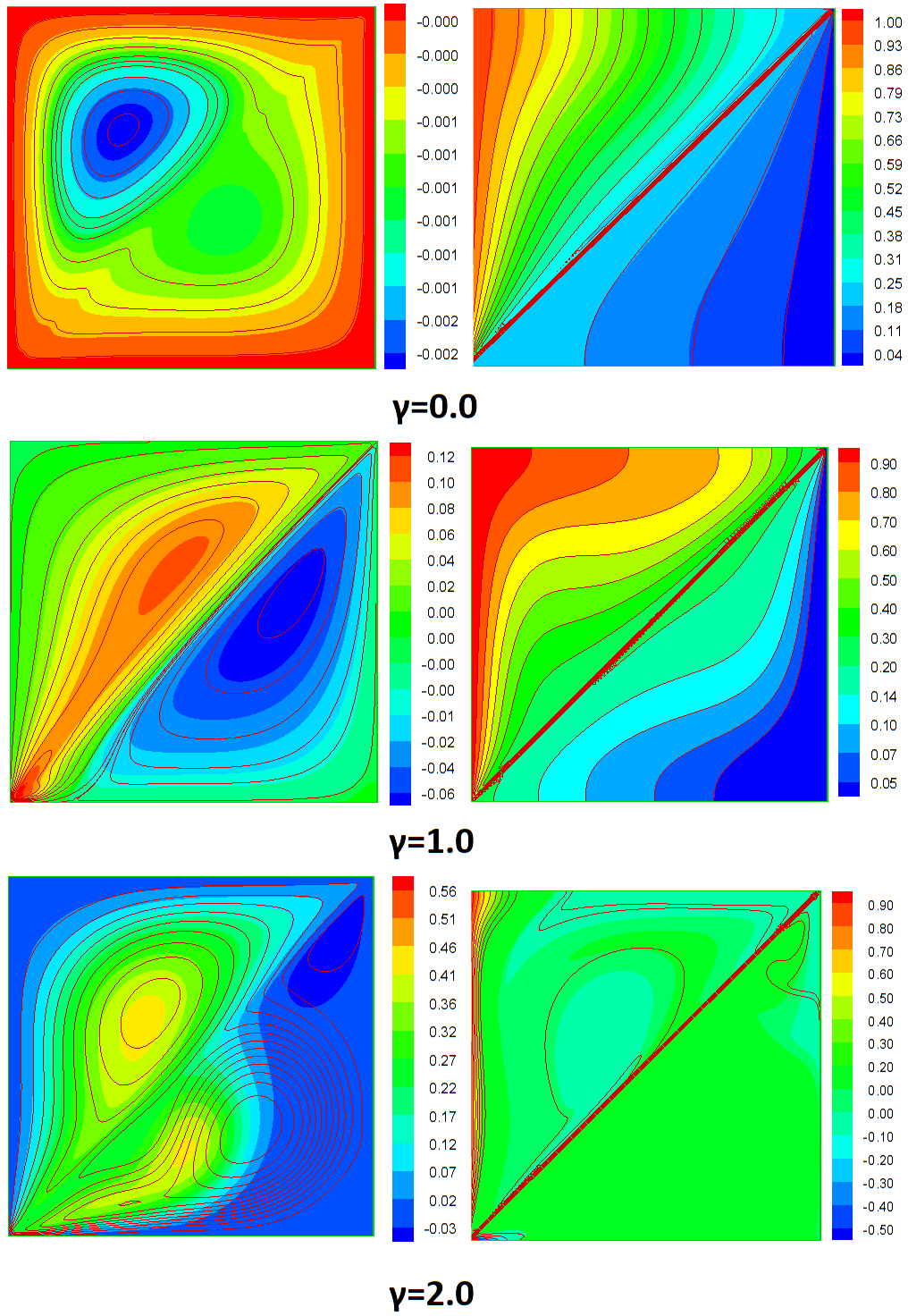
The effect of wall speed ratios on magnetohydrodynamic (MHD) mixed convective flow in a square cavity filled with CuO-water nanofluid, incorporating a diagonally moving heated/cooled wall, is examined. The governing equations, which account for magnetic field effects, buoyancy forces, and nanoparticle concentration, are solved numerically using the finite volume method with the SIMPLE algorithm. The study investigates the effects of wall speed ratios ($\gamma$ = 0, 1, 2), Richardson numbers (Ri = 0.1, 1, 10), Hartmann numbers (Ha = 0, 10, 25, 50), and nanoparticle volume fractions ($\phi$ = 0.0, 0.05) on flow behavior and convective heat transfer within the cavity. The results demonstrate that the wall speed ratio strongly influences streamline patterns and heat transfer. Increasing the wall speed ratio ($\gamma$ = 0--2) enhances heat transfer by up to 476% at low Ri, while nanoparticle addition improves it by 11–18%. In contrast, increasing the Hartmann number (Ha = 0–50) suppresses convection and reduces heat transfer by 8–16% due to magnetic damping. These findings identify optimal wall speed ratios for maximizing thermal performance, highlighting the importance of tailored flow control strategies in MHD nanofluid engineering applications. These findings have significant implications for thermal management design in applications such as heat exchangers, electronic cooling systems, and energy storage devices.
Graphical Abstract
Keywords
Data Availability Statement
Funding
Conflicts of Interest
AI Use Statement
Ethical Approval and Consent to Participate
References
- Selimefendigil, F., & Öztop, H. F. (2014). Numerical study of MHD mixed convection in a nanofluid filled lid driven square enclosure with a rotating cylinder. International journal of heat and mass transfer, 78, 741-754.
[CrossRef] [Google Scholar] - Gibanov, N. S., Sheremet, M. A., Oztop, H. F., & Abu-Hamdeh, N. (2017). Effect of uniform inclined magnetic field on mixed convection in a lid-driven cavity having a horizontal porous layer saturated with a ferrofluid. International Journal of Heat and Mass Transfer, 114, 1086-1097.
[CrossRef] [Google Scholar] - Alsabery, A. I., Ismael, M. A., Chamkha, A. J., & Hashim, I. (2019). Effects of two-phase nanofluid model on MHD mixed convection in a lid-driven cavity in the presence of conductive inner block and corner heater. Journal of Thermal Analysis and Calorimetry, 135(1), 729-750.
[CrossRef] [Google Scholar] - Begum, A. S., Sarhan, N. M., Shomurotova, S., & Khan, M. I. (2026). Computational study of magnetohydrodynamic mixed convective flow in a nanofluid-filled cavity with diagonally moving lid. Numerical Heat Transfer, Part A: Applications, 87(1), 2368753.
[CrossRef] [Google Scholar] - Selimefendigil, F., & Öztop, H. F. (2018). Modeling and optimization of MHD mixed convection in a lid-driven trapezoidal cavity filled with alumina–water nanofluid: effects of electrical conductivity models. International Journal of Mechanical Sciences, 136, 264-278.
[CrossRef] [Google Scholar] - Nithyadevi, N., Begum, A. S., Oztop, H. F., & Abu-Hamdeh, N. (2017). Mixed convection analysis in heat transfer enhancement of a nanofluid filled porous enclosure with various wall speed ratios. International Journal of Heat and Mass Transfer, 113, 716-729.
[CrossRef] [Google Scholar] - Bahoum, A., Hattab, M. El., & Hammami, Y. El. (2025). Numerical Investigation of Mixed MHD convection in a lid-driven cubic cavity with a hybrid nanofluid. Thermal Science, 29(4), 2713–2728.
[CrossRef] [Google Scholar] - Toghraie, D. (2020). Numerical simulation on MHD mixed convection of Cu-water nanofluid in a trapezoidal lid-driven cavity. International Journal of Applied Electromagnetics and Mechanics, 62(4), 683-710.
[CrossRef] [Google Scholar] - Hosseinzadeh, K., Roghani, S., Mogharrebi, A. R., Asadi, A., & Ganji, D. D. (2021). Optimization of hybrid nanoparticles with mixture fluid flow in an octagonal porous medium by effect of radiation and magnetic field. Journal of Thermal Analysis and Calorimetry, 143(2), 1413-1424.
[CrossRef] [Google Scholar] - Oztop, H. F., Al-Salem, K., & Pop, I. (2011). MHD mixed convection in a lid-driven cavity with corner heater. International Journal of Heat and Mass Transfer, 54(15-16), 3494-3504.
[CrossRef] [Google Scholar] - Hussain, S., Mehmood, K., & Sagheer, M. (2016). MHD mixed convection and entropy generation of water–alumina nanofluid flow in a double lid driven cavity with discrete heating. Journal of Magnetism and Magnetic Materials, 419, 140-155.
[CrossRef] [Google Scholar] - Shah, I. A., Bilal, S., Asjad, M. I., & Tag-ElDin, E. M. (2022). Convective Heat and Mass Transport in Casson Fluid Flow in Curved Corrugated Cavity with Inclined Magnetic Field. Micromachines 2022, 13, 1624.
[CrossRef] [Google Scholar] - Mehmood, K., Hussain, S., & Sagheer, M. (2017). Numerical simulation of MHD mixed convection in alumina–water nanofluid filled square porous cavity using KKL model: Effects of non-linear thermal radiation and inclined magnetic field. Journal of Molecular Liquids, 238, 485-498.
[CrossRef] [Google Scholar] - Hussain, S., Ahmad, S., Mehmood, K., & Sagheer, M. (2017). Effects of inclination angle on mixed convective nanofluid flow in a double lid-driven cavity with discrete heat sources. International Journal of Heat and Mass Transfer, 106, 847-860.
[CrossRef] [Google Scholar] - Kattimani, P., Sollapur, S. B., Kedia, A., Singh, K., & Sarris, I. E. (2026). The role of high-oscillating magnetic field dynamics in nanofluid flow. Nano, 21(07), 2550101.
[CrossRef] [Google Scholar] - Asghar, A., Chandio, A. F., Shah, Z., Vrinceanu, N., Deebani, W., Shutaywi, M., & Lund, L. A. (2023). Magnetized mixed convection hybrid nanofluid with effect of heat generation/absorption and velocity slip condition. Heliyon, 9(2).
[CrossRef] [Google Scholar] - Sivasankaran, S., Malleswaran, A., Lee, J., & Sundar, P. (2011). Hydro-magnetic combined convection in a lid-driven cavity with sinusoidal boundary conditions on both sidewalls. International Journal of Heat and Mass Transfer, 54(1-3), 512-525.
[CrossRef] [Google Scholar] - Sheikholeslami, M., Bandpy, M. G., Ellahi, R., & Zeeshan, A. (2014). Simulation of MHD CuO–water nanofluid flow and convective heat transfer considering Lorentz forces. Journal of Magnetism and Magnetic Materials, 369, 69-80.
[CrossRef] [Google Scholar] - Elshehabey, H. M., & Ahmed, S. E. (2015). MHD mixed convection in a lid-driven cavity filled by a nanofluid with sinusoidal temperature distribution on the both vertical walls using Buongiorno’s nanofluid model. International Journal of Heat and Mass Transfer, 88, 181-202.
[CrossRef] [Google Scholar] - Begum, A. S., Nithyadevi, N., Öztop, H. F., & Al-Salem, K. (2017). Numerical simulation of MHD mixed convection in a nanofluid filled non-Darcy porous enclosure. International Journal of Mechanical Sciences, 130, 154-166.
[CrossRef] [Google Scholar] - Nithyadevi, N., & Begum, A. S. (2018). Numerical study on the effect of magnetic field in a porous enclosure using nanofluid with mid-horizontal moving lid: Brinkman-Forchheimer extended darcy model. Journal of Porous Media, 21(5), 457–470.
[CrossRef] [Google Scholar] - Taamneh, Y., & Bataineh, K. (2017). Mixed Convection Heat Transfer in a Square Lid-Driven Cavity Filled with Al$_2$O$_3$-Water Nanofluid. Journal of Mechanical Engineering/Strojniški Vestnik, 63(6), 383.
[CrossRef] [Google Scholar] - Chowdhury, K., & Alim, M. A. (2023). Mixed Convection in a Double Lid‐Driven Wavy Shaped Cavity Filled with Nanofluid Subject to Magnetic Field and Internal Heat Source. Journal of Applied Mathematics, 2023(1), 7117186.
[CrossRef] [Google Scholar] - Hanif, H., Shafie, S., & Jagun, Z. T. (2024). Maximizing thermal efficiency of a cavity using hybrid nanofluid. Journal of Cleaner Production, 441, 141089.
[CrossRef] [Google Scholar] - Sarlak, R., Abed, A. M., Akbari, O. A., Marzban, A., Baghaei, S., & Bayat, M. (2023). Numerical investigation of natural convection heat transfer of water/SWCNT nanofluid flow in a triangular cavity with cold fluid injection. Progress in Nuclear Energy, 155, 104513.
[CrossRef] [Google Scholar] - Chamkha, A. J., & Abu-Nada, E. (2012). Mixed convection flow in single- and double-lid driven square cavities filled with water-Al2O3 nanofluid: effects of viscosity models. European Journal of Mechanics - B/Fluids, 36, 82–96.
[CrossRef] [Google Scholar] - Nazir, M. W., Javed, T., Ali, N., & Nazeer, M. (2024). Effects of radiative heat flux and heat generation on magnetohydrodynamics natural convection flow of nanofluid inside a porous triangular cavity with thermal boundary conditions. Numerical Methods for Partial Differential Equations, 40(2), e22768.
[CrossRef] [Google Scholar] - Qureshi, M. A., Hussain, S., & Sadiq, M. A. (2021). Numerical simulations of MHD mixed convection of hybrid nanofluid flow in a horizontal channel with cavity: Impact on heat transfer and hydrodynamic forces. Case Studies in Thermal Engineering, 27, 101321.
[CrossRef] [Google Scholar] - Gowthaman, D., Ali, A. B., Begum, A. S., Jayasimman, I. P., Al-Harbi, F. F., Jameel, M., ... & Ali, S. (2025). Shear-and buoyancy-dominated heat transfer: Influence of plate speed and nanoparticles. International Communications in Heat and Mass Transfer, 169, 109787.
[CrossRef] [Google Scholar] - Selimefendigil, F., Öztop, H. F., & Chamkha, A. J. (2016). MHD mixed convection and entropy generation of nanofluid filled lid driven cavity under the influence of inclined magnetic fields imposed to its upper and lower diagonal triangular domains. Journal of Magnetism and Magnetic Materials, 406, 266-281.
[CrossRef] [Google Scholar] - Abu-Nada, E., & Oztop, H. F. (2009). Effects of inclination angle on natural convection in enclosures filled with Cu–water nanofluid. International journal of heat and fluid flow, 30(4), 669-678.
[CrossRef] [Google Scholar] - Sheremet, M. A., & Pop, I. (2015). Mixed convection in a lid-driven square cavity filled by a nanofluid: Buongiorno's mathematical model. Applied Mathematics and Computation, 266, 792-808.
[CrossRef] [Google Scholar] - Koo, J., & Kleinstreuer, C. (2005). Laminar nanofluid flow in microheat-sinks. International journal of heat and mass transfer, 48(13), 2652-2661.
[CrossRef] [Google Scholar] - Garnett, J. M. (1904). Colours in metal glasses and in metallic films. Philosophical Transactions of the Royal Society of London. Series A, Containing Papers of a Mathematical or Physical Character, 385-420. https://www.jstor.org/stable/90866
[Google Scholar] - Vajjha, R. S., & Das, D. K. (2009). Experimental determination of thermal conductivity of three nanofluids and development of new correlations. International journal of heat and mass transfer, 52(21-22), 4675-4682.
[CrossRef] [Google Scholar] - Patankar, S. V. (1980). Numerical Heat Transfer and Fluid Flow. Hemisphere Publishing Corporation.
[CrossRef] [Google Scholar] - Jmai, R., Ben-Beya, B., & Lili, T. (2016). Numerical analysis of mixed convection at various walls speed ratios in two-sided lid-driven cavity partially heated and filled with nanofluid. Journal of Molecular Liquids, 221, 691-713.
[CrossRef] [Google Scholar] - Kefayati, G. R., Gorji-Bandpy, M., Sajjadi, H., & Ganji, D. D. (2012). Lattice Boltzmann simulation of MHD mixed convection in a lid-driven square cavity with linearly heated wall. Scientia Iranica, 19(4), 1053-1065.
[CrossRef] [Google Scholar]
Cite This Article
TY  - JOUR
AU  - Begum, A. Shamadhani
AU  - Gowda, R. J. Punith
AU  - Chauhan, Mahendrasinh R.
AU  - Khan, Muhammad Ijaz
PY  - 2026
DA  - 2026/08/13
TI  - Effects of Wall Speed Ratio and Magnetic Field on MHD Mixed Convection of CuO-Water Nanofluid in a Square Cavity
JO  - International Journal of Thermo-Fluid Systems and Sustainable Energy
T2  - International Journal of Thermo-Fluid Systems and Sustainable Energy
JF  - International Journal of Thermo-Fluid Systems and Sustainable Energy
VL  - 2
IS  - 3
SP  - 101
EP  - 116
DO  - 10.62762/IJTSSE.2026.135135
UR  - https://www.icck.org/article/abs/IJTSSE.2026.135135
KW  - diagonally moving wall
KW  - magnetohydrodynamics (MHD)
KW  - mixed convection
KW  - nanofluid
KW  - cavity
AB  - The effect of wall speed ratios on magnetohydrodynamic (MHD) mixed convective flow in a square cavity filled with CuO-water nanofluid, incorporating a diagonally moving heated/cooled wall, is examined. The governing equations, which account for magnetic field effects, buoyancy forces, and nanoparticle concentration, are solved numerically using the finite volume method with the SIMPLE algorithm. The study investigates the effects of wall speed ratios ($\gamma$ = 0, 1, 2), Richardson numbers (Ri = 0.1, 1, 10), Hartmann numbers (Ha = 0, 10, 25, 50), and nanoparticle volume fractions ($\phi$ = 0.0, 0.05) on flow behavior and convective heat transfer within the cavity. The results demonstrate that the wall speed ratio strongly influences streamline patterns and heat transfer. Increasing the wall speed ratio ($\gamma$ = 0--2) enhances heat transfer by up to 476% at low Ri, while nanoparticle addition improves it by 11–18%. In contrast, increasing the Hartmann number (Ha = 0–50) suppresses convection and reduces heat transfer by 8–16% due to magnetic damping. These findings identify optimal wall speed ratios for maximizing thermal performance, highlighting the importance of tailored flow control strategies in MHD nanofluid engineering applications. These findings have significant implications for thermal management design in applications such as heat exchangers, electronic cooling systems, and energy storage devices.
SN  - 3069-1877
PB  - Institute of Central Computation and Knowledge
LA  - English
ER  -
@article{Begum2026Effects,
  author = {A. Shamadhani Begum and R. J. Punith Gowda and Mahendrasinh R. Chauhan and Muhammad Ijaz Khan},
  title = {Effects of Wall Speed Ratio and Magnetic Field on MHD Mixed Convection of CuO-Water Nanofluid in a Square Cavity},
  journal = {International Journal of Thermo-Fluid Systems and Sustainable Energy},
  year = {2026},
  volume = {2},
  number = {3},
  pages = {101-116},
  doi = {10.62762/IJTSSE.2026.135135},
  url = {https://www.icck.org/article/abs/IJTSSE.2026.135135},
  abstract = {The effect of wall speed ratios on magnetohydrodynamic (MHD) mixed convective flow in a square cavity filled with CuO-water nanofluid, incorporating a diagonally moving heated/cooled wall, is examined. The governing equations, which account for magnetic field effects, buoyancy forces, and nanoparticle concentration, are solved numerically using the finite volume method with the SIMPLE algorithm. The study investigates the effects of wall speed ratios (\$\gamma\$ = 0, 1, 2), Richardson numbers (Ri = 0.1, 1, 10), Hartmann numbers (Ha = 0, 10, 25, 50), and nanoparticle volume fractions (\$\phi\$ = 0.0, 0.05) on flow behavior and convective heat transfer within the cavity. The results demonstrate that the wall speed ratio strongly influences streamline patterns and heat transfer. Increasing the wall speed ratio (\$\gamma\$ = 0--2) enhances heat transfer by up to 476\% at low Ri, while nanoparticle addition improves it by 11–18\%. In contrast, increasing the Hartmann number (Ha = 0–50) suppresses convection and reduces heat transfer by 8–16\% due to magnetic damping. These findings identify optimal wall speed ratios for maximizing thermal performance, highlighting the importance of tailored flow control strategies in MHD nanofluid engineering applications. These findings have significant implications for thermal management design in applications such as heat exchangers, electronic cooling systems, and energy storage devices.},
  keywords = {diagonally moving wall, magnetohydrodynamics (MHD), mixed convection, nanofluid, cavity},
  issn = {3069-1877},
  publisher = {Institute of Central Computation and Knowledge}
}
Article Metrics
Publisher's Note
ICCK stays neutral with regard to jurisdictional claims in published maps and institutional affiliations.
Rights and Permissions
 Copyright © 2026 by the Author(s). Published by Institute of Central Computation and Knowledge. This article is an open access article distributed under the terms and conditions of the Creative Commons Attribution (CC BY) license (https://creativecommons.org/licenses/by/4.0/), which permits use, sharing, adaptation, distribution and reproduction in any medium or format, as long as you give appropriate credit to the original author(s) and the source, provide a link to the Creative Commons licence, and indicate if changes were made.


Portico
