

Multiphysics CFD and Electrochemical Assessment of Silicon Carbide (SiC) Heat Exchangers for Corrosive Waste-heat Recovery in Process Industries


Article Information
Abstract
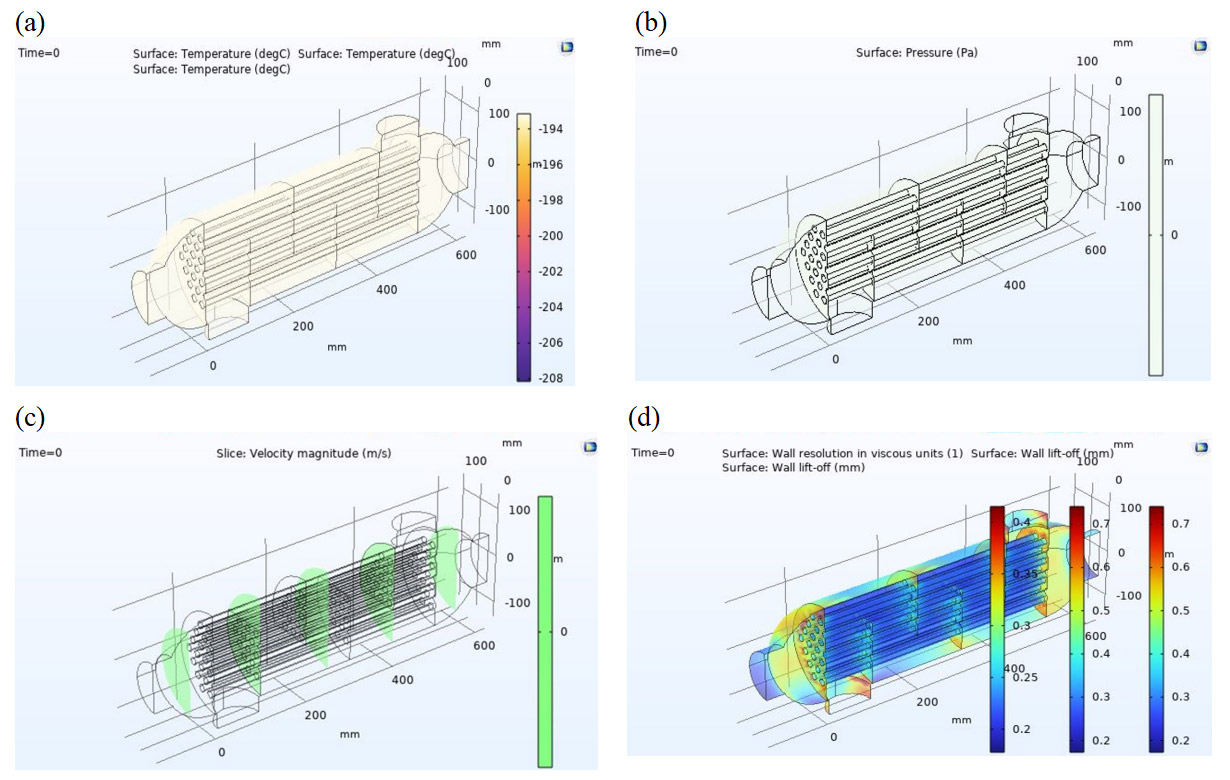
Corrosive waste-heat recovery systems suffer material degradation, performance loss and high maintenance when conventional metallic heat exchangers face chloride-, carbonate- and sulfur-bearing condensates. This study presents a multiphysics CFD-electrochemical assessment of silicon carbide (SiC) for heat exchangers, via a 3D shell-and-tube model in COMSOL Multiphysics coupling turbulent flow, conjugate heat transfer, species transport and electrochemical corrosion. The thermal model considered high-pressure ammonia (tube side) and pressurized water (shell side); the corrosion model represented a flue-gas condensate/electrolyte containing Cl\(^-\), NH\(_4^+\), HCO\(_3^-\), CO\(_3^{2-}\), HSO\(_3^-\)/SO\(_4^{2-}\) and NO\(_3^-\) at the wetted surface, with electrochemical behavior resolved via secondary/tertiary current-distribution (Nernst–Planck/Butler–Volmer) formulations. Base-case results gave heat-transfer coefficients of 620 vs. 420 W m\(^{-2}\) K\(^{-1}\) (47.6% improvement), a pressure-drop reduction from 2.63 to 1.92 Pa, and a thermal–hydraulic performance factor of 1.64 (SiC vs. stainless steel). Electrochemical simulations predicted lower localized current density and corrosion flux for SiC than stainless steel under the same electrolyte chemistry, though as model-based comparative indicators rather than validated corrosion rates. Sensitivity screening showed SiC thermal conductivity, wall roughness, electrolyte conductivity and chloride concentration affect the magnitude of improvement, though the base-case trend remained favorable. The study offers a verified, literature-benchmarked framework for preliminary material screening, identifying experimental corrosion testing, temperature-dependent properties and thermo-electrochemical coupling as next steps before industrial adoption.
Graphical Abstract
Keywords
Data Availability Statement
Funding
Conflicts of Interest
AI Use Statement
Ethical Approval and Consent to Participate
References
- Maghrabi, A. M., Song, J., & Markides, C. N. (2023). How can industrial heat decarbonisation be accelerated through energy efficiency?. Applied Thermal Engineering, 233, 121092.
[CrossRef] [Google Scholar] - Thiel, G. P., & Stark, A. K. (2021). To decarbonize industry, we must decarbonize heat. Joule, 5(3), 531-550.
[CrossRef] [Google Scholar] - Sundaramoorthy, S., Kamath, D., Nimbalkar, S., Price, C., Wenning, T., & Cresko, J. (2023). Energy efficiency as a foundational technology pillar for industrial decarbonization. Sustainability, 15(12), 9487.
[CrossRef] [Google Scholar] - Ononogbo, C., Nwosu, E. C., Nwakuba, N. R., Nwaji, G. N., Nwufo, O. C., Chukwuezie, O. C., ... & Anyanwu, E. E. (2023). Opportunities of waste heat recovery from various sources: Review of technologies and implementation. Heliyon, 9(2).
[CrossRef] [Google Scholar] - Castro Oliveira, M., Iten, M., Cruz, P. L., & Monteiro, H. (2020). Review on energy efficiency progresses, technologies and strategies in the ceramic sector focusing on waste heat recovery. Energies, 13(22), 6096.
[CrossRef] [Google Scholar] - Rajski, K., & Danielewicz, J. (2023). Heat transfer and heat recovery systems. Energies, 16(7), 3258.
[CrossRef] [Google Scholar] - Mondal, S., & De, S. (2026). An overview of waste heat recovery equipment and technologies: fundamentals and design aspects. Waste Heat Recovery, Its Utilization and Performance Assessment, 1-26.
[CrossRef] [Google Scholar] - Marzouk, S. A., Abou Al-Sood, M. M., El-Said, E. M., Younes, M. M., & El-Fakharany, M. K. (2023). A comprehensive review of methods of heat transfer enhancement in shell and tube heat exchangers. Journal of Thermal Analysis and Calorimetry, 148(15), 7539-7578.
[CrossRef] [Google Scholar] - Saha, S., & Hasan, N. (2024). Numerical evaluation of thermohydraulic parameters for diverse configurations of shell-and-tube heat exchanger. Results in Engineering, 23, 102509.
[CrossRef] [Google Scholar] - Shah, R. K., Thonon, B. E. N. F. O. R. A. D. O., & Benforado, D. M. (2000). Opportunities for heat exchanger applications in environmental systems. Applied Thermal Engineering, 20(7), 631-650.
[CrossRef] [Google Scholar] - Qiao, J., Wang, Q., Na, E., Wen, X., Liang, Z., & Zhang, Y. (2025). RECENT PROGRESS IN WASTE HEAT RECOVERY TECHNOLOGY FOR BOILER FLUE GAS. Therm. Sci, 29(6), 4453-4471.
[CrossRef] [Google Scholar] - Khudhur, D. A., Tuan Abdullah, T. A., & Norazahar, N. (2022). A review of safety issues and risk assessment of industrial ammonia refrigeration system. ACS Chemical Health & Safety, 29(5), 394-404.
[CrossRef] [Google Scholar] - Jaafar, M. N., Rosli, M. I., Nordin, D., & Buhari, J. (2025). Systematic literature review on the risk assessment of ammonia refrigeration systems in the food industry. Journal of Loss Prevention in the Process Industries, 96, 105629.
[CrossRef] [Google Scholar] - Benzarti, Z., Arrousse, N., Serra, R., Cruz, S., Bastos, A., Tedim, J., ... & Carvalho, S. (2025). Copper corrosion mechanisms, influencing factors, and mitigation strategies for water circuits of heat exchangers: Critical review and current advances. Corrosion Reviews, 43(4), 429-455.
[CrossRef] [Google Scholar] - Ali, M., Ul-Hamid, A., Alhems, L. M., & Saeed, A. (2020). Review of common failures in heat exchangers–Part I: Mechanical and elevated temperature failures. Engineering Failure Analysis, 109, 104396.
[CrossRef] [Google Scholar] - Ali, M., Ul-Hamid, A., Khan, T., Bake, A., Butt, H., Bamidele, O. E., & Saeed, A. (2021). Corrosion-related failures in heat exchangers. Corrosion Reviews, 39(6), 519-546.
[CrossRef] [Google Scholar] - Fu, L., Liu, P., & Li, G. (2017). Numerical Investigation on the Low Temperature Corrosion Characteristics of Flue Gas Heat Exchanger. Journal of Failure Analysis and Prevention, 17(6), 1164-1173.
[CrossRef] [Google Scholar] - Panahi, H., Eslami, A., Golozar, M. A., & Laleh, A. A. (2020). An investigation on corrosion failure of a shell-and-tube heat exchanger in a natural gas treating plant. Engineering Failure Analysis, 118, 104918.
[CrossRef] [Google Scholar] - Isah, A., Sodiki, J. I., & Barinyima, N. (2019). Performance assessment of shell and tube heat exchangers in an ammonia plant. European Journal of Engineering and Technology Research, 4(3), 37-44.
[CrossRef] [Google Scholar] - Nicacio, J. A. P., Oliveira, F. C., & Dumont, M. R. (2024). Failure analysis and electrochemical testing of ammonium chloride corrosion in a heat exchanger in a diesel hydrotreating unit of a petroleum refinery. Engineering Failure Analysis, 156, 107758.
[CrossRef] [Google Scholar] - Francolle de Almeida, C., Saget, M., Delaplace, G., Jimenez, M., Fierro, V., & Celzard, A. (2023). Innovative fouling-resistant materials for industrial heat exchangers: a review. Reviews in Chemical Engineering, 39(1), 71-104.
[CrossRef] [Google Scholar] - Al Assaf, A. H., Ahmed, A., Mahaftha, D. M., Amhamed, A. I., Alrebei, O. F., & Jarrah, B. A. (2024). NH 3-H 2-Working Fluid-based Shell and Tube Heat Exchanger and the H 2 O-to-H 2 O Helical Heat Exchanger: A Novel Integration to Ammonia Production Plants. Jordan Journal of Mechanical & Industrial Engineering, 18(2).
[CrossRef] [Google Scholar] - Esabunor, T., Ikpeseni, S. C., Ekpu, M., Sada, S., & Orugba, H. O. (2025). Corrosion resistance of mild steel welded joints: Electrochemical analysis in five different environmental media. Nigerian Journal of Technology, 44(1), 29-38.
[CrossRef] [Google Scholar] - Estupiñán-Campos, J., Quitiaquez, W., Nieto-Londoño, C., & Quitiaquez, P. (2024). Numerical simulation of the heat transfer inside a shell and tube heat exchanger considering different variations in the geometric parameters of the design. Energies, 17(3), 691.
[CrossRef] [Google Scholar] - Treccani, L. (2023). Introduction to ceramic materials. Surface‐functionalized ceramics: for biotechnological and environmental applications, 1-46.
[CrossRef] [Google Scholar] - Fend, T., Völker, W., Miebach, R., Smirnova, O., Gonsior, D., Schöllgen, D., & Rietbrock, P. (2011). Experimental investigation of compact silicon carbide heat exchangers for high temperatures. International Journal of heat and mass transfer, 54(19-20), 4175-4181.
[CrossRef] [Google Scholar] - Cramer, C. L., Lara‐Curzio, E., Elliott, A. M., Aguirre, T. G., Yoon, B., Fricke, B. A., ... & Nawaz, K. (2024). Material selection and manufacturing for high‐temperature heat exchangers: Review of state‐of‐the‐art development, opportunities, and challenges. International Journal of Ceramic Engineering & Science, 6(5), e10230.
[CrossRef] [Google Scholar] - Pelanconi, M., Zavattoni, S., Cornolti, L., Puragliesi, R., Arrivabeni, E., Ferrari, L., ... & Ortona, A. (2021). Application of ceramic lattice structures to design compact, high temperature heat exchangers: material and architecture selection. Materials, 14(12), 3225.
[CrossRef] [Google Scholar] - Sommers, A., Wang, Q., Han, X., T'Joen, C., Park, Y., & Jacobi, A. (2010). Ceramics and ceramic matrix composites for heat exchangers in advanced thermal systems—A review. Applied Thermal Engineering, 30(11-12), 1277-1291.
[CrossRef] [Google Scholar] - Alfarawi, S. (2020). Evaluation of hydro-thermal shell-side performance in a shell-and-tube heat exchanger: CFD approach. Journal of Advanced Research in Fluid Mechanics and Thermal Sciences, 66(1), 104-119. https://www.researchgate.net/publication/339527306
[Google Scholar] - Rahman, M. S. (2024). Computational fluid dynamics for predicting and controlling fluid flow in industrial equipment. European Journal of Advances in Engineering and Technology, 11(9), 1-9. https://www.researchgate.net/publication/384233737
[Google Scholar] - Łach, Ł., & Svyetlichnyy, D. (2025). Advances in numerical modeling for heat transfer and thermal management: a review of computational approaches and environmental impacts. Energies, 18(5), 1302.
[CrossRef] [Google Scholar] - Kiaghadi, M., Keshvarinia, M., & Sheikholeslami, M. (2025). Modeling, simulation, and artificial intelligence: a convergence in heat transfer systems. In Revolutionizing Heat Transfer (pp. 201-222). Elsevier.
[CrossRef] [Google Scholar] - Janoske, U., & Seifritz, S. (2024). Modelling of multi-species thin film flows based on the transport of ions including conjugate heat transfer applied to corrosion testing. Progress in Computational Fluid Dynamics, an International Journal, 24(5), 255-265.
[CrossRef] [Google Scholar] - Tang, S. Z., Wang, F. L., Ren, Q., & He, Y. L. (2017). Fouling characteristics analysis and morphology prediction of heat exchangers with a particulate fouling model considering deposition and removal mechanisms. Fuel, 203, 725-738.
[CrossRef] [Google Scholar] - Ben-Mansour, R., El-Ferik, S., Al-Naser, M., Qureshi, B. A., Eltoum, M. A. M., Abuelyamen, A., ... & Ben Mansour, R. (2023). Experimental/numerical investigation and prediction of fouling in multiphase flow heat exchangers: a review. Energies, 16(6), 2812.
[CrossRef] [Google Scholar] - Aslami, H., Nakisa, M., & Esmaeili, H. (2025). Investigating the effect of nanocoating on fouling in the plate heat exchanger: a computational fluid dynamics study. Biofouling, 41(10), 1023-1037.
[CrossRef] [Google Scholar] - Thekdi, A., Nimbalkar, S. U., Sundaramoorthy, S., Armstrong, K. O., Taylor, A., Gritton, J. E., ... & Cresko, J. (2021). Technology assessment on low-temperature waste heat recovery in industry (No. ORNL/TM-2021/2150). Oak Ridge National Laboratory (ORNL), Oak Ridge, TN (United States).
[CrossRef] [Google Scholar] - Kakaç, S., Liu, H., & Pramuanjaroenkij, A. (2002). Heat exchangers: selection, rating, and thermal design. CRC press.
[CrossRef] [Google Scholar] - Edreis, E., & Petrov, A. (2020, November). Types of heat exchangers in industry, their advantages and disadvantages, and the study of their parameters. In IOP conference series: materials science and engineering (Vol. 963, No. 1, p. 012027). IOP Publishing.
[CrossRef] [Google Scholar] - Zečević, N. (2021). Advancement of process control system in ammonia production (Doctoral dissertation, Sveučilište u Zagrebu, Sveučilište u Zagrebu Fakultet kemijskog inženjerstva i tehnologije). https://urn.nsk.hr/urn:nbn:hr:149:358922
[Google Scholar] - Zhang, J., Zhao, Y., Li, Y., & Zhang, F. (2021). Analysis of multiphase flow and heat and mass transfer for ammonium chloride crystallization of the high-pressure heat exchanger in hydrogenation unit. Materials, 14(24), 7754.
[CrossRef] [Google Scholar] - Sahin, K. B., Ozturk, M., Sahin, M., & Erdogdu, F. (2025). Computational analysis of single-shell-pass shell-and-tube heat exchangers with novel curved baffles and various tube layouts. Innovative Food Science & Emerging Technologies, 104243.
[CrossRef] [Google Scholar] - Thomas, J., Banda, M., Du, W., Yu, W., Chuang, A., France, D. M., & Singh, D. (2022). Development of a silicon carbide ceramic based counter-flow heat exchanger by binder jetting and liquid silicon infiltration for concentrating solar power. Ceramics International, 48(16), 22975-22984.
[CrossRef] [Google Scholar] - Yu, L., Hao, S., Nong, X., Cao, X., Zhang, C., Liu, Y., ... & Jiang, Y. (2021). Comparative Study on the Corrosion Resistance of 6061Al and SiC3D/6061Al Composite in a Chloride Environment. Materials, 14(24), 7730.
[CrossRef] [Google Scholar] - Lamm, B. W., Koyanagi, T., Lee, J. J., Keiser, J. R., Gietl, H., & Katoh, Y. (2025). Corrosion characteristics of silicon carbide fiber-reinforced composites in beryllium-bearing molten fluoride salt. Corrosion Science, 244, 112635.
[CrossRef] [Google Scholar] - ASTM International. (2020). Standard specification for seamless carbon steel pipe for high-temperature service (ASTM A106). ASTM International. https://store.astm.org/a0106_a0106m-19a.html
[Google Scholar] - Callister, W. D., Jr., & Rethwisch, D. G. (2020). Materials Science and Engineering: An Introduction. Wiley.
[CrossRef] [Google Scholar] - Shackelford, J. F. (1988). Introduction to Materials Science for Engineers. Internet Archive. https://arks.org/ark:/13960/t3dz88v7x
[Google Scholar] - Ezuber, H., & Zakir Hossain, S. M. (2023). A review of corrosion failures in shell and tube heat exchangers: roots and advanced counteractive. Heat and Mass Transfer, 59(6), 971-987.
[CrossRef] [Google Scholar] - Al-Mazeedi, H. A., Al-Wakaa, B., & Ravindranath, K. (2021). Window-type rupture of carbon steel pipe in a hydroprocessing plant of a petroleum refinery due to ammonium bisulfide corrosion. Engineering Failure Analysis, 120, 105089.
[CrossRef] [Google Scholar] - Speight, J. G. (2016). Environmental Organic Chemistry for Engineers. Butterworth-Heinemann.
[Google Scholar] - Zuo, W., Zhang, X., & Li, Y. (2020). Review of flue gas acid dew-point and related low temperature corrosion. Journal of the Energy Institute, 93(4), 1666-1677.
[CrossRef] [Google Scholar] - Mavi, A., & Chinyoka, T. (2023). Finite volume computational analysis of the heat transfer characteristic in a double-cylinder counter-flow heat exchanger with viscoelastic fluids. Defect and Diffusion Forum, 424, 19–43.
[CrossRef] [Google Scholar] - Seddiq, M., Maerefat, M., & Mirzaei, M. (2014). Modeling of heat transfer at the fluid–solid interface by lattice Boltzmann method. International Journal of Thermal Sciences, 75, 28-35.
[CrossRef] [Google Scholar] - Lemmon, E. W., Bell, I. H., Huber, M. L., & McLinden, M. O. (2018). NIST standard reference database 23: REFPROP, Version 10.0. Gaithersburg: National Institute of Standards and Technology. https://www.nist.gov/srd/refprop
[Google Scholar] - Richerson, D. W., & Lee, W. E. (2018). Modern ceramic engineering: properties, processing, and use in design. CRC press.
[CrossRef] [Google Scholar] - Taylor, C. D. (2015). Corrosion informatics: an integrated approach to modelling corrosion. Corrosion Engineering, Science and Technology, 50(7), 490-508.
[CrossRef] [Google Scholar] - Castillo-Robles, J. M., de Freitas Martins, E., Ordejón, P., & Cole, I. (2024). Molecular modeling applied to corrosion inhibition: a critical review. npj Materials Degradation, 8(1), 72.
[CrossRef] [Google Scholar] - Illes, B., Medgyes, B., Dušek, K., Bušek, D., Skwarek, A., & Geczy, A. (2022). Numerical simulation of electrochemical migration of Cu based on the Nernst-Plank equation. International Journal of Heat and Mass Transfer, 184, 122268.
[CrossRef] [Google Scholar] - Uzdenova, A. M. (2024). Modeling of Ion Transport in a Three-Layer System with an Ion-Exchange Membrane Based on the Nernst–Planck and Displacement Current Equations. Membranes and Membrane Technologies, 6(1), 1-8.
[CrossRef] [Google Scholar] - Lewis, M. T., & Hickey, J. P. (2023). Conjugate heat transfer in high-speed external flows: A review. Journal of Thermophysics and Heat Transfer, 37(4), 697-712.
[CrossRef] [Google Scholar] - Xu, L. Y., & Cheng, Y. F. (2013). Development of a finite element model for simulation and prediction of mechanoelectrochemical effect of pipeline corrosion. Corrosion Science, 73, 150-160.
[CrossRef] [Google Scholar] - Jin, H. Z., Gu, Y., & Ou, G. F. (2021). Corrosion risk analysis of tube-and-shell heat exchangers and design of outlet temperature control system. Petroleum Science, 18(4), 1219-1229.
[CrossRef] [Google Scholar] - He, L., Wang, Y., Zhang, Q., Li, X., Xu, Y., & Huang, Y. (2023). Electrochemical study on the macro-cell corrosion of pipeline steel partially covered by different kinds of mineral deposits. ACS omega, 8(46), 44013-44029.
[CrossRef] [Google Scholar] - Sridhar, N. (2017). Local corrosion chemistry—a review. Corrosion, 73(1), 18–30.
[CrossRef] [Google Scholar] - Alexiadis, N., Fuchs, A., Troßmann, T., Bösing, I., Thöming, J., & La Mantia, F. (2025). Modeling and simulation of passive film formation and breakdown in chloride ion containing electrolytes–A Point Defect Model extension. Corrosion Science, 256, 113166.
[CrossRef] [Google Scholar] - Yang, J., Ma, L., Bock, J., Jacobi, A. M., & Liu, W. (2014). A comparison of four numerical modeling approaches for enhanced shell-and-tube heat exchangers with experimental validation. Applied Thermal Engineering, 65(1-2), 369-383.
[CrossRef] [Google Scholar] - Jaugstetter, M., Blanc, N., Kratz, M., & Tschulik, K. (2022). Electrochemistry under confinement. Chemical Society Reviews, 51(7), 2491-2543.
[CrossRef] [Google Scholar] - Mani, A., & Wang, K. M. (2020). Electroconvection near electrochemical interfaces: Experiments, modeling, and computation. Annual review of fluid mechanics, 52(1), 509-529.
[CrossRef] [Google Scholar] - Effiom, P. C., Effiom, S. O., Evareh, J. E., & Odu, P. O. (2024). Corrosion control in pipelines from carbon-II-oxide enhanced oil recovery (CO2–EOR). Nigeria Journal of Engineering Research Unicross, 2(2), 66-75. https://www.researchgate.net/publication/384256997
[Google Scholar] - Chen, D., Zhang, H., Zhao, G., Zhu, Z., Yang, J., He, J., ... & Zhu, Z. (2024). Investigating the corrosion resistance of different SiC crystal types: from energy sectors to advanced applications. Langmuir, 40(24), 12322-12342.
[CrossRef] [Google Scholar] - Gateman, S. M. (2020). Investigating Corrosion of Simple and Complex Metallic Materials Using Macro and Micro Electrochemical Techniques. McGill University (Canada). https://www.proquest.com/openview/75210a4596be5a25916668aa7fd21f9b/1
[Google Scholar] - Rahman, M. A. (2024). Enhancing reliability in shell and tube heat exchangers: establishing plugging criteria for tube wall loss and estimating remaining useful life. Journal of Failure Analysis and Prevention, 24(3), 1083-1095.
[CrossRef] [Google Scholar] - Newman, J., & Balsara, N. P. (2021). Electrochemical systems. John Wiley & Sons.
[Google Scholar] - Olsson, C. O., & Landolt, D. (2003). Passive films on stainless steels—chemistry, structure and growth. Electrochimica acta, 48(9), 1093-1104.
[CrossRef] [Google Scholar] - Gießgen, T., Mittelbach, A., Höche, D., Zheludkevich, M., & Kainer, K. U. (2019). Enhanced predictive corrosion modeling with implicit corrosion products. Materials and Corrosion, 70(12), 2247-2255.
[CrossRef] [Google Scholar] - Biscay, N., Henry, L., Adschiri, T., Yoshimura, M., & Aymonier, C. (2021). Behavior of silicon carbide materials under dry to hydrothermal conditions. Nanomaterials, 11(5), 1351.
[CrossRef] [Google Scholar] - Zhang, B., Wang, J., Wu, B., Guo, X. W., Wang, Y. J., Chen, D., ... & Ma, X. L. (2018). Unmasking chloride attack on the passive film of metals. Nature communications, 9(1), 2559.
[CrossRef] [Google Scholar] - Velukumar, V., Sekar, S. D., & Mothilal, T. (2026). CFD and experimental study of cyclone heat exchanger performance: NTU-effectiveness analysis. Applied Thermal Engineering, 129590.
[CrossRef] [Google Scholar] - Al‐Haidari, S. R., & Al‐Obaidi, A. R. (2025). Assessment improvement of heat performance and hydraulic thermal flow in a three‐dimensional tube equipped with different turbulator corrugated arrangements. Heat Transfer, 54(4), 2594-2608.
[CrossRef] [Google Scholar] - Sun, X., Srinivasan, J., Kelly, R. G., & Duddu, R. (2021). Numerical investigation of critical electrochemical factors for pitting corrosion using a multi-species reactive transport model. Corrosion Science, 179, 109130.
[CrossRef] [Google Scholar] - Nešić, S. (2007). Key issues related to modelling of internal corrosion of oil and gas pipelines–A review. Corrosion science, 49(12), 4308-4338.
[CrossRef] [Google Scholar] - Hu, S. M., Wang, S. H., & Yang, Z. G. (2015). Failure analysis on unexpected wall thinning of heat-exchange tubes in ammonia evaporators. Case Studies in Engineering Failure Analysis, 3, 52-61.
[CrossRef] [Google Scholar] - Nesic, S., Postlethwaite, J., & Olsen, S. (1996). An electrochemical model for prediction of corrosion of mild steel in aqueous carbon dioxide solutions. Corrosion, 52(4), 280-294.
[CrossRef] [Google Scholar] - Bard, A. J., Faulkner, L. R., & White, H. S. (2022). Electrochemical methods: fundamentals and applications. John Wiley & Sons.
[Google Scholar] - Revie, R. W., & Uhlig, H. H. (2025). Corrosion and corrosion control. John Wiley & Sons.
[Google Scholar] - Hou, T. K., Kazi, S. N., Mahat, A. B., Teng, C. B., Al-Shamma’a, A., & Shaw, A. (2017). Industrial heat exchanger: operation and maintenance to minimize fouling and corrosion. Heat Exchangers-Advanced Features and Applications, 1(9), 193-207.
[CrossRef] [Google Scholar] - Song, C., Liu, Z., Babaei, M., Liu, R., & Hou, G. (2024). Mitigating low-temperature corrosion in flue-gas heat exchangers for improving thermal storage efficiency in geothermal power plants. Thermal Science and Engineering Progress, 52, 102673.
[CrossRef] [Google Scholar] - Laycock, N. J., & Newman, R. C. (1997). Localised dissolution kinetics, salt films and pitting potentials. Corrosion science, 39(10-11), 1771-1790.
[CrossRef] [Google Scholar] - Li, T., Wu, J., & Frankel, G. S. (2021). Localized corrosion: Passive film breakdown vs. Pit growth stability, Part VI: Pit dissolution kinetics of different alloys and a model for pitting and repassivation potentials. Corrosion Science, 182, 109277.
[CrossRef] [Google Scholar] - Strehblow, H. H., & Marcus, P. (1995). Mechanisms of pitting corrosion. Corrosion mechanisms in theory and practice, 3, 349-393. https://www.taylorfrancis.com/chapters/edit/10.1201/9780203909188-10
[Google Scholar] - Gaudet, G. T., Mo, W. T., Hatton, T. A., Tester, J. W., Tilly, J., Isaacs, H. S., & Newman, R. C. (1986). Mass transfer and electrochemical kinetic interactions in localized pitting corrosion. AIChE journal, 32(6), 949-958.
[CrossRef] [Google Scholar] - Frankel, G. S. (1998). Pitting corrosion of metals: a review of the critical factors. Journal of the Electrochemical society, 145(6), 2186-2198.
[CrossRef] [Google Scholar] - Linter, B. R., & Burstein, G. T. (1999). Reactions of pipeline steels in carbon dioxide solutions. Corrosion science, 41(1), 117-139.
[CrossRef] [Google Scholar] - Pistorius, P. C., & Burstein, G. T. (1992). Metastable pitting corrosion of stainless steel and the transition to stability. Philosophical transactions of the royal society of London. Series A: Physical and Engineering Sciences, 341(1662), 531-559.
[CrossRef] [Google Scholar]
Cite This Article
TY  - JOUR
AU  - Effiom, Samuel Oliver
AU  - Enoh, Maria Kaka Etete
AU  - Akpan, Ukeme Enoh
AU  - Effiom, Precious-Chibuzo
AU  - Abam, Fidelis Ibiang
PY  - 2026
DA  - 2026/06/16
TI  - Multiphysics CFD and Electrochemical Assessment of Silicon Carbide (SiC) Heat Exchangers for Corrosive Waste-heat Recovery in Process Industries
JO  - International Journal of Thermo-Fluid Systems and Sustainable Energy
T2  - International Journal of Thermo-Fluid Systems and Sustainable Energy
JF  - International Journal of Thermo-Fluid Systems and Sustainable Energy
VL  - 2
IS  - 2
SP  - 81
EP  - 100
DO  - 10.62762/IJTSSE.2026.236790
UR  - https://www.icck.org/article/abs/IJTSSE.2026.236790
KW  - Silicon carbide
KW  - CFD
KW  - electrochemical corrosion
KW  - waste-heat recovery
KW  - shell-and-tube heat exchanger
KW  - Nernst–Planck transport
AB  - Corrosive waste-heat recovery systems suffer material degradation, performance loss and high maintenance when conventional metallic heat exchangers face chloride-, carbonate- and sulfur-bearing condensates. This study presents a multiphysics CFD-electrochemical assessment of silicon carbide (SiC) for heat exchangers, via a 3D shell-and-tube model in COMSOL Multiphysics coupling turbulent flow, conjugate heat transfer, species transport and electrochemical corrosion. The thermal model considered high-pressure ammonia (tube side) and pressurized water (shell side); the corrosion model represented a flue-gas condensate/electrolyte containing Cl\(^-\), NH\(_4^+\), HCO\(_3^-\), CO\(_3^{2-}\), HSO\(_3^-\)/SO\(_4^{2-}\) and NO\(_3^-\) at the wetted surface, with electrochemical behavior resolved via secondary/tertiary current-distribution (Nernst–Planck/Butler–Volmer) formulations. Base-case results gave heat-transfer coefficients of 620 vs. 420 W m\(^{-2}\) K\(^{-1}\) (47.6% improvement), a pressure-drop reduction from 2.63 to 1.92 Pa, and a thermal–hydraulic performance factor of 1.64 (SiC vs. stainless steel). Electrochemical simulations predicted lower localized current density and corrosion flux for SiC than stainless steel under the same electrolyte chemistry, though as model-based comparative indicators rather than validated corrosion rates. Sensitivity screening showed SiC thermal conductivity, wall roughness, electrolyte conductivity and chloride concentration affect the magnitude of improvement, though the base-case trend remained favorable. The study offers a verified, literature-benchmarked framework for preliminary material screening, identifying experimental corrosion testing, temperature-dependent properties and thermo-electrochemical coupling as next steps before industrial adoption.
SN  - 3069-1877
PB  - Institute of Central Computation and Knowledge
LA  - English
ER  -
@article{Effiom2026Multiphysi,
  author = {Samuel Oliver Effiom and Maria Kaka Etete Enoh and Ukeme Enoh Akpan and Precious-Chibuzo Effiom and Fidelis Ibiang Abam},
  title = {Multiphysics CFD and Electrochemical Assessment of Silicon Carbide (SiC) Heat Exchangers for Corrosive Waste-heat Recovery in Process Industries},
  journal = {International Journal of Thermo-Fluid Systems and Sustainable Energy},
  year = {2026},
  volume = {2},
  number = {2},
  pages = {81-100},
  doi = {10.62762/IJTSSE.2026.236790},
  url = {https://www.icck.org/article/abs/IJTSSE.2026.236790},
  abstract = {Corrosive waste-heat recovery systems suffer material degradation, performance loss and high maintenance when conventional metallic heat exchangers face chloride-, carbonate- and sulfur-bearing condensates. This study presents a multiphysics CFD-electrochemical assessment of silicon carbide (SiC) for heat exchangers, via a 3D shell-and-tube model in COMSOL Multiphysics coupling turbulent flow, conjugate heat transfer, species transport and electrochemical corrosion. The thermal model considered high-pressure ammonia (tube side) and pressurized water (shell side); the corrosion model represented a flue-gas condensate/electrolyte containing Cl\(^-\), NH\(\_4^+\), HCO\(\_3^-\), CO\(\_3^{2-}\), HSO\(\_3^-\)/SO\(\_4^{2-}\) and NO\(\_3^-\) at the wetted surface, with electrochemical behavior resolved via secondary/tertiary current-distribution (Nernst–Planck/Butler–Volmer) formulations. Base-case results gave heat-transfer coefficients of 620 vs. 420 W m\(^{-2}\) K\(^{-1}\) (47.6\% improvement), a pressure-drop reduction from 2.63 to 1.92 Pa, and a thermal–hydraulic performance factor of 1.64 (SiC vs. stainless steel). Electrochemical simulations predicted lower localized current density and corrosion flux for SiC than stainless steel under the same electrolyte chemistry, though as model-based comparative indicators rather than validated corrosion rates. Sensitivity screening showed SiC thermal conductivity, wall roughness, electrolyte conductivity and chloride concentration affect the magnitude of improvement, though the base-case trend remained favorable. The study offers a verified, literature-benchmarked framework for preliminary material screening, identifying experimental corrosion testing, temperature-dependent properties and thermo-electrochemical coupling as next steps before industrial adoption.},
  keywords = {Silicon carbide, CFD, electrochemical corrosion, waste-heat recovery, shell-and-tube heat exchanger, Nernst–Planck transport},
  issn = {3069-1877},
  publisher = {Institute of Central Computation and Knowledge}
}
Article Metrics
Publisher's Note
ICCK stays neutral with regard to jurisdictional claims in published maps and institutional affiliations.
Rights and Permissions
 Copyright © 2026 by the Author(s). Published by Institute of Central Computation and Knowledge. This article is an open access article distributed under the terms and conditions of the Creative Commons Attribution (CC BY) license (https://creativecommons.org/licenses/by/4.0/), which permits use, sharing, adaptation, distribution and reproduction in any medium or format, as long as you give appropriate credit to the original author(s) and the source, provide a link to the Creative Commons licence, and indicate if changes were made.


Portico
