

Phase, Microstructure and Dielectric Properties of Sodium Bismuth Titanate Based Ceramics


Article Information
Abstract
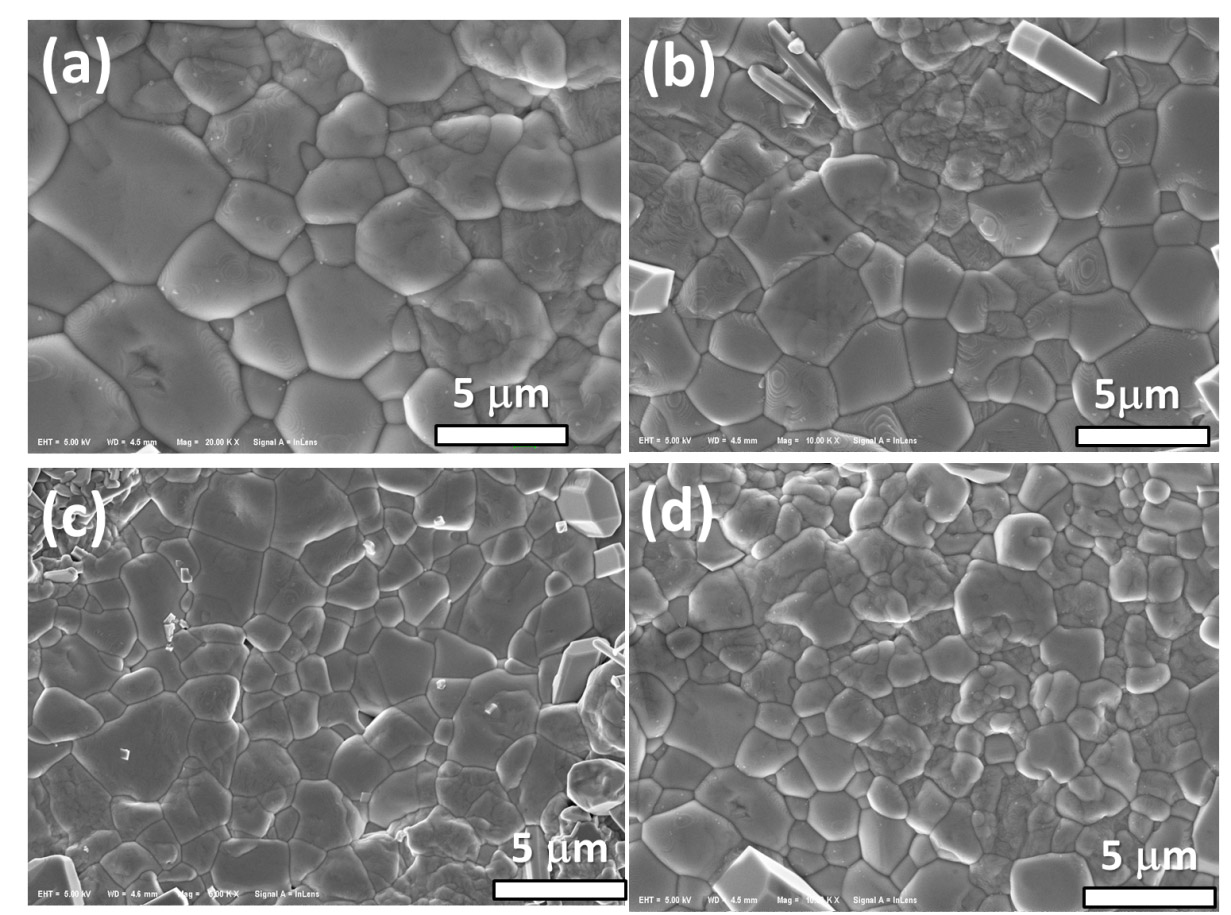
In this study, ceramics in the 0.90Na$_{0.5}$Bi$_{0.5-x}$La$_{x}$TiO$_{3}$--0.03NaNbO$_{3}$ --0.07 Ba(Zr$_{0.2}$ Ti$_{0.8}$)O$_{3}$ series (where $x = 0.00, 0.03,$ $ 0.05, 0.07$) were processed via a solid-state reaction method. The phase, microstructural features, and dielectric properties, particularly the dielectric constant and dielectric loss, were studied using X-ray diffraction (XRD), scanning electron microscopy (SEM), and dielectric spectroscopic techniques, respectively. XRD analysis revealed a single perovskite phase, while SEM analysis showed a dense microstructure with reduced grain size as the $x$ content increased. The increase in doping content enhanced the relaxor characteristics, which consequently reduced the dielectric loss to below 0.05 for $x = 0.07$.
Graphical Abstract
Keywords
Data Availability Statement
Funding
Conflicts of Interest
AI Use Statement
Ethical Approval and Consent to Participate
References
- Xu, Y. (2013). Ferroelectric materials and their applications. Elsevier.
[Google Scholar] - Zhou, X., Xue, G., Luo, H., Bowen, C. R., & Zhang, D. (2021). Phase structure and properties of sodium bismuth titanate lead-free piezoelectric ceramics. Progress in Materials Science, 122, 100836.
[CrossRef] [Google Scholar] - Bobic, J. D., Petrovic, M. M. V., & Stojanovic, B. D. (2018). Review of the most common relaxor ferroelectrics and their applications. In Magnetic, ferroelectric, and multiferroic metal oxides (pp. 233-249). Elsevier.
[CrossRef] [Google Scholar] - Li, F., Zhang, S., Damjanovic, D., Chen, L. Q., & Shrout, T. R. (2018). Local structural heterogeneity and electromechanical responses of ferroelectrics: learning from relaxor ferroelectrics. Advanced Functional Materials, 28(37), 1801504.
[CrossRef] [Google Scholar] - Rehman, M. U., Manan, A., Uzair, M., Amer, M., Khan, M. A., Ullah, S. W., ... & Shah, H. U. (2023). Enhanced energy storage performance of MnO2-modified 0.92 BaTiO3–0.08 Bi (Mg0. 5Ce0. 5) O3 ceramics for capacitor applications. ACS Applied Electronic Materials, 5(8), 4564-4575.
[CrossRef] [Google Scholar] - Ahn, C. W., Hong, C. H., Choi, B. Y., Kim, H. P., Han, H. S., Hwang, Y., ... & Kim, I. W. (2016). A brief review on relaxor ferroelectrics and selected issues in lead-free relaxors. Journal of the Korean Physical Society, 68(12), 1481-1494.
[CrossRef] [Google Scholar] - Shvartsman, V. V., & Lupascu, D. C. (2012). Lead‐free relaxor ferroelectrics. Journal of the American Ceramic Society, 95(1), 1-26.
[CrossRef] [Google Scholar] - Swain, S., Kar, S. K., & Kumar, P. (2015). Dielectric, optical, piezoelectric and ferroelectric studies of NBT–BT ceramics near MPB. Ceramics International, 41(9), 10710-10717.
[CrossRef] [Google Scholar] - Isupov, V. A., Smolenskii, G. A., Agranovskaya, A. I., & Krainik, N. N. (1961). New ferroelectrics of complex composition. Sov. Phys.-Solid State, 2, 2651-2654.
[Google Scholar] - Smolenskii, G. A., Isupov, V. A., Agranovskaya, A. I., & Popov, S. N. (1961). Ferroelectrics with diffuse phase transitions. Soviet Physics-Solid State, 2(11), 2584-2594.
[Google Scholar] - Panda, P. K. (2009). Environmental friendly lead-free piezoelectric materials. Journal of materials science, 44(19), 5049-5062.
[CrossRef] [Google Scholar] - Ranjan, R. (2020). Na 1/2 Bi 1/2 TiO$_3$-based lead-free piezoceramics. Current Science, 118(10), 1507-1519. https://www.jstor.org/stable/27138777
[Google Scholar] - Liu, G., Hu, L., Wang, Y., Wang, Z., Yu, L., Lv, J., ... & Yan, Y. (2020). Investigation of electrical and electric energy storage properties of La-doped Na0. 3 Sr0. 4Bi0. 3TiO3 based Pb-free ceramics. Ceramics International, 46(11), 19375-19384.
[CrossRef] [Google Scholar] - Ullah, A., Yao, Z., Liu, H., Hao, H., Manan, A., Ullah, A., ... & Alresheedi, F. (2021). Improved energy storage properties of La0. 33NbO3 modified 0.94 Bi0. 5Na0. 5TiO3-0.06 BaTiO3 ceramic system. Applied Physics A, 127(2), 150.
[CrossRef] [Google Scholar] - Sasaki, A., Chiba, T., Mamiya, Y., & Otsuki, E. (1999). Dielectric and piezoelectric properties of (Bi0. 5Na0. 5) TiO3–(Bi0. 5K0. 5) TiO3 systems. Japanese Journal of Applied Physics, 38(9S), 5564.
[CrossRef] [Google Scholar] - Shannon, R. D. (1976). Revised effective ionic radii and systematic studies of interatomic distances in halides and chalcogenides. Foundations of Crystallography, 32(5), 751-767.
[CrossRef] [Google Scholar] - Zhou, C., Liu, X., Li, W., & Yuan, C. (2009). Structure and piezoelectric properties of Bi0. 5Na0. 5TiO3–Bi0. 5K0. 5TiO3–BiFeO3 lead-free piezoelectric ceramics. Materials Chemistry and Physics, 114(2-3), 832-836.
[CrossRef] [Google Scholar] - Aksel, E., & Jones, J. L. (2010). Advances in lead-free piezoelectric materials for sensors and actuators. Sensors, 10(3), 1935-1954.
[CrossRef] [Google Scholar]
Cite This Article
TY  - JOUR
AU  - Shah, Afzal
AU  - Naz, Shakeela
AU  - Faisal, Shah
AU  - Iqbal, Qaisar
AU  - Abdullah, Sher
AU  - Manan, Abdul
PY  - 2026
DA  - 2026/06/29
TI  - Phase, Microstructure and Dielectric Properties of Sodium Bismuth Titanate Based Ceramics
JO  - Journal of Advanced Electronic Materials
T2  - Journal of Advanced Electronic Materials
JF  - Journal of Advanced Electronic Materials
VL  - 2
IS  - 2
SP  - 64
EP  - 68
DO  - 10.62762/JAEM.2026.298040
UR  - https://www.icck.org/article/abs/JAEM.2026.298040
KW  - solid-state reactions
KW  - relaxor behavior
KW  - dielectric characteristics
AB  - In this study, ceramics in the 0.90Na$_{0.5}$Bi$_{0.5-x}$La$_{x}$TiO$_{3}$--0.03NaNbO$_{3}$ --0.07 Ba(Zr$_{0.2}$ Ti$_{0.8}$)O$_{3}$ series (where $x = 0.00, 0.03,$ $ 0.05, 0.07$) were processed via a solid-state reaction method. The phase, microstructural features, and dielectric properties, particularly the dielectric constant and dielectric loss, were studied using X-ray diffraction (XRD), scanning electron microscopy (SEM), and dielectric spectroscopic techniques, respectively. XRD analysis revealed a single perovskite phase, while SEM analysis showed a dense microstructure with reduced grain size as the $x$ content increased. The increase in doping content enhanced the relaxor characteristics, which consequently reduced the dielectric loss to below 0.05 for $x = 0.07$.
SN  - 3070-5649
PB  - Institute of Central Computation and Knowledge
LA  - English
ER  -
@article{Shah2026Phase,
  author = {Afzal Shah and Shakeela Naz and Shah Faisal and Qaisar Iqbal and Sher Abdullah and Abdul Manan},
  title = {Phase, Microstructure and Dielectric Properties of Sodium Bismuth Titanate Based Ceramics},
  journal = {Journal of Advanced Electronic Materials},
  year = {2026},
  volume = {2},
  number = {2},
  pages = {64-68},
  doi = {10.62762/JAEM.2026.298040},
  url = {https://www.icck.org/article/abs/JAEM.2026.298040},
  abstract = {In this study, ceramics in the 0.90Na\$\_{0.5}\$Bi\$\_{0.5-x}\$La\$\_{x}\$TiO\$\_{3}\$--0.03NaNbO\$\_{3}\$ --0.07 Ba(Zr\$\_{0.2}\$ Ti\$\_{0.8}\$)O\$\_{3}\$ series (where \$x = 0.00, 0.03,\$ \$ 0.05, 0.07\$) were processed via a solid-state reaction method. The phase, microstructural features, and dielectric properties, particularly the dielectric constant and dielectric loss, were studied using X-ray diffraction (XRD), scanning electron microscopy (SEM), and dielectric spectroscopic techniques, respectively. XRD analysis revealed a single perovskite phase, while SEM analysis showed a dense microstructure with reduced grain size as the \$x\$ content increased. The increase in doping content enhanced the relaxor characteristics, which consequently reduced the dielectric loss to below 0.05 for \$x = 0.07\$.},
  keywords = {solid-state reactions, relaxor behavior, dielectric characteristics},
  issn = {3070-5649},
  publisher = {Institute of Central Computation and Knowledge}
}
Article Metrics
Publisher's Note
ICCK stays neutral with regard to jurisdictional claims in published maps and institutional affiliations.
Rights and Permissions
 Copyright © 2026 by the Author(s). Published by Institute of Central Computation and Knowledge. This article is an open access article distributed under the terms and conditions of the Creative Commons Attribution (CC BY) license (https://creativecommons.org/licenses/by/4.0/), which permits use, sharing, adaptation, distribution and reproduction in any medium or format, as long as you give appropriate credit to the original author(s) and the source, provide a link to the Creative Commons licence, and indicate if changes were made.

Portico
