

Thermal Conversion of Cobalt Based Hexacyanoferrates into Derived Cobalt Oxides for Supercapacitor Applications


Article Information
Abstract
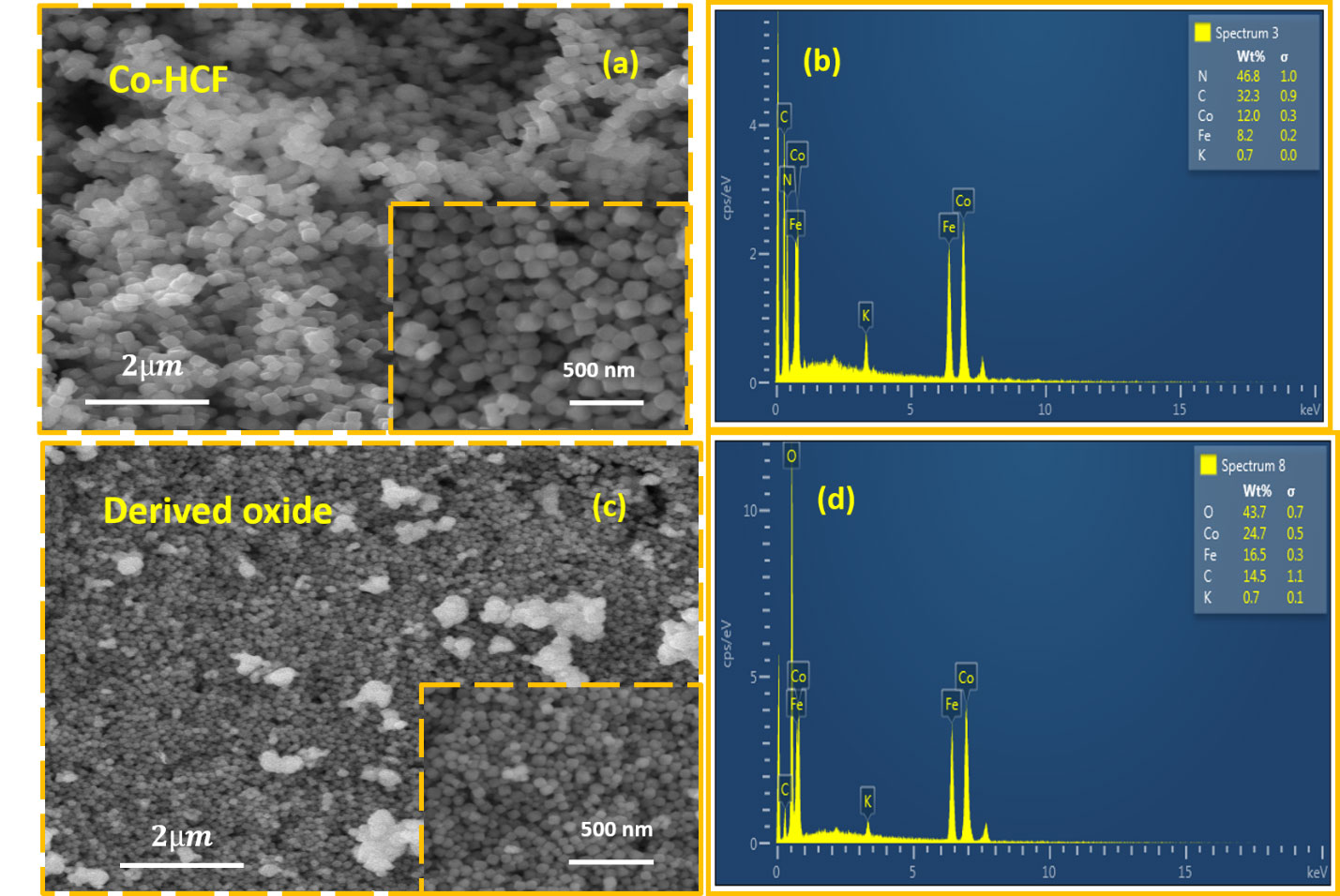
We report the synthesis of cobalt-based hexacyanoferrate (Co-HCF) via a simple co-precipitation method and its subsequent conversion to a derived oxide through thermal treatment. Comprehensive characterization was performed using X-ray diffraction (XRD), Fourier transform infrared spectroscopy (FTIR), scanning electron microscopy (SEM), and energy-dispersive X-ray spectroscopy (EDX). XRD confirms the cubic crystal structure corresponding well to the JCPDS card no. 00-024-0327. FTIR confirms the presence of functional groups in Co-HCF, while the annealing process results in the complete removal of the cyanide ligands, yielding the derived oxide. SEM and EDX analyses confirm the cubic morphology and elemental composition of the prepared samples. Furthermore, electrochemical evaluation using cyclic voltammetry (CV) revealed that Co-HCF delivered a higher specific capacitance (\(C_s\)) of \SI{624}{\farad\per\gram} at \SI{5}{\milli\volt\per\second}, highlighting pseudocapacitive behavior due to its open framework structure and abundant redox-active cobalt centers. In contrast, the annealed sample exhibited comparatively lower \(C_s\) of \SI{143}{\farad\per\gram} under identical conditions, attributed to the partial collapse of the open HCF channels. This work demonstrates a controlled conversion route from Co-HCF to derived oxide, offering a promising pathway for next-generation supercapacitors (SCs) and sustainable energy storage technologies.
Graphical Abstract
Keywords
Data Availability Statement
Funding
Conflicts of Interest
AI Use Statement
Ethical Approval and Consent to Participate
References
- Kumar, N., Kim, S. B., Lee, S. Y., & Park, S. J. (2022). Recent advanced supercapacitor: a review of storage mechanisms, electrode materials, modification, and perspectives. Nanomaterials, 12(20), 3708.
[CrossRef] [Google Scholar] - Lim, J. M., Jang, Y. S., Van T. Nguyen, H., Kim, J. S., Yoon, Y., Park, B. J., ... & Doo, S. G. (2023). Advances in high-voltage supercapacitors for energy storage systems: materials and electrolyte tailoring to implementation. Nanoscale Advances, 5(3), 615-626.
[CrossRef] [Google Scholar] - Lakshmi, K. S., & Vedhanarayanan, B. (2023). High-performance supercapacitors: a comprehensive review on paradigm shift of conventional energy storage devices. Batteries, 9(4), 202.
[CrossRef] [Google Scholar] - Koohi-Fayegh, S., & Rosen, M. A. (2020). A review of energy storage types, applications and recent developments. Journal of energy storage, 27, 101047.
[CrossRef] [Google Scholar] - Thuy, V. V., Hieu, N. S., & Thu, T. V. (2024). Novel mixed nickel/cobalt hexacyanoferrate microcubes with synergistic effects for aqueous hybrid supercapacitors. Dalton Transactions, 53(42), 17333-17342.
[CrossRef] [Google Scholar] - Du, X., Ren, H., Liang, J., & Wu, W. (2025). Prussian blue and its analogues for flexible electrochemical energy storage: from materials to devices. Applied Physics Reviews, 12(2).
[CrossRef] [Google Scholar] - Choi, C., Ashby, D. S., Butts, D. M., DeBlock, R. H., Wei, Q., Lau, J., & Dunn, B. (2020). Achieving high energy density and high power density with pseudocapacitive materials. Nature Reviews Materials, 5(1), 5-19.
[CrossRef] [Google Scholar] - Zhu, X., Tao, H., & Li, M. (2020). Co-precipitation synthesis of nickel cobalt hexacyanoferrate for binder-free high-performance supercapacitor electrodes. International Journal of Hydrogen Energy, 45(28), 14452-14460.
[CrossRef] [Google Scholar] - Kim, J., Yi, S. H., Li, L., Thu, T. V., & Chun, S. E. (2022). Effect of valence state of cobalt in cobalt hexacyanoferrate coprecipitated at different temperatures on electrochemical behavior. International Journal of Energy Research, 46(15), 22717-22729.
[CrossRef] [Google Scholar] - Samyn, L. M., Lessa, T. S., Babu, R. S., Kalaivani, A., Barbosa, T. M., & De Barros, A. L. F. (2023). High-performance flexible supercapacitors based on potassium nickel (ii) hexacyanoferrates (iii) nanoparticles on carbon cloth as an electrode material. Materials Advances, 4(16), 3654-3661.
[CrossRef] [Google Scholar] - Shao, Y., El-Kady, M. F., Sun, J., Li, Y., Zhang, Q., Zhu, M., ... & Kaner, R. B. (2018). Design and mechanisms of asymmetric supercapacitors. Chemical reviews, 118(18), 9233-9280.
[CrossRef] [Google Scholar] - González, A., Goikolea, E., Barrena, J. A., & Mysyk, R. (2016). Review on supercapacitors: Technologies and materials. Renewable and sustainable energy reviews, 58, 1189-1206.
[CrossRef] [Google Scholar] - Conway, B. E., Birss, V., & Wojtowicz, J. (1997). The role and utilization of pseudocapacitance for energy storage by supercapacitors. Journal of power sources, 66(1-2), 1-14.
[CrossRef] [Google Scholar] - Khan, K., Shah, M. Z. U., Aziz, U., Hayat, K., Sajjad, M., Ahmad, I., ... & Shah, A. (2022). Development of 1.6 V hybrid supercapacitor based on ZnO nanorods/MnO2 nanowires for next-generation electrochemical energy storage. Journal of Electroanalytical Chemistry, 922, 116753.
[CrossRef] [Google Scholar] - Chen, R., Yu, M., Sahu, R. P., Puri, I. K., & Zhitomirsky, I. (2020). The development of pseudocapacitor electrodes and devices with high active mass loading. Advanced Energy Materials, 10(20), 1903848.
[CrossRef] [Google Scholar] - Costentin, C., & Savéant, J. M. (2019). Energy storage: pseudocapacitance in prospect. Chemical Science, 10(22), 5656-5666.
[CrossRef] [Google Scholar] - Liang, R., Du, Y., Xiao, P., Cheng, J., Yuan, S., Chen, Y., ... & Chen, J. (2021). Transition metal oxide electrode materials for supercapacitors: a review of recent developments. Nanomaterials, 11(5), 1248.
[CrossRef] [Google Scholar] - An, C., Wang, Y., Jiao, L., & Yuan, H. (2016). Mesoporous Ni@ C hybrids for a high energy aqueous asymmetric supercapacitor device. Journal of Materials Chemistry A, 4(24), 9670-9676.
[CrossRef] [Google Scholar] - Rauf, M., Shah, S. S., Shah, S. K., Shah, S. N. A., Haq, T. U., Shah, J., ... & Hayat, K. (2022). Facile hydrothermal synthesis of zinc sulfide nanowires for high-performance asymmetric supercapacitor. Journal of Saudi Chemical Society, 26(4), 1-13.
[CrossRef] [Google Scholar] - Nasrullah, Wisal, W., Bibi, F., Shah, S. K., Ullah, J., Rauf, M., ... & Hayat, K. (2026). Electrospun SnO2/Co3O4 Core--Shell Nanofibers Decorated with ZnO for High Performance Asymmetric Supercapacitors. Journal of Inorganic and Organometallic Polymers and Materials, 1-17.
[CrossRef] [Google Scholar] - Bibi, F., Ahmad, I., Shah, S. S., Shah, J., Samreen, A., Shah, S. K., ... & Hayat, K. (2025). Facile and sustainable fabrication of TiO2/Co3O4 core-shell fiber electrodes for enhanced electrochemical performance in asymmetric supercapacitors. Materials Research Bulletin, 113843.
[CrossRef] [Google Scholar] - Rehman, Z. U., Ullah, J., Anum, K., Hayat, K., Shah, S. K., & Gunnella, R. (2026). Viability of Co$_3$O$_4$/TiO$_2$ Composite as Electrode Materials for Supercapacitor and efficient OER/HER Electrocatalysis. Materials Research Bulletin, 114204.
[CrossRef] [Google Scholar] - Jiang, H., Chen, J., Shi, Y., Chen, P., Tang, X., Jiang, W., ... & Wu, G. (2022). A wearable all-solid-state supercapacitor with extremely high stability based on 2D Co-HCF/GO. Applied Surface Science, 586, 152739.
[CrossRef] [Google Scholar] - Al Kiey, S. A., & Abdelhamid, H. N. (2022). Metal-organic frameworks (MOFs)-derived Co3O4@ N-doped carbon as an electrode materials for supercapacitor. Journal of Energy Storage, 55, 105449.
[CrossRef] [Google Scholar] - Shah, M. Z. U., Shah, J., Hayat, K., Shah, S. K., Hussain, I., Khan, A. U., ... & Shah, A. (2024). Optimizing performance: achieving high capacitance and cycling durability in alkaline electrolyte with SnO2/SnSe|| AC/KOH-based aqueous hybrid supercapacitor. Journal of Energy Storage, 75, 109662.
[CrossRef] [Google Scholar] - Kumar, R., Soam, A., & Sahajwalla, V. (2021). Carbon coated cobalt oxide (CC-CO3O4) as electrode material for supercapacitor applications. Materials Advances, 2(9), 2918-2923.
[CrossRef] [Google Scholar] - Zeng, X., Yang, B., Li, X., & Yu, R. (2017). Three-dimensional hollow CoS2 nanoframes fabricated by anion replacement and their enhanced pseudocapacitive performances. Electrochimica Acta, 240, 341-349.
[CrossRef] [Google Scholar] - Villalva‐Mejorada, D. I., Acevedo‐Peña, P., Leyva‐Porras, C., Rodríguez‐Hernández, J., & Reguera, E. (2022). Mixed cobalt--zinc hexacyanoferrate hollow micro--cubes for a high--voltage hybrid supercapacitor. International Journal of Energy Research, 46(15), 23310-23325.
[CrossRef] [Google Scholar] - Sadiq, A., Shah, S. K., Ullah, A., Ahmad, I., Ullah, J., Usman, M., ... & Gunnella, R. (2026). Exploring cobalt-based Prussian blue analogue for sustainable energy storage and biomedical applications. Electrochimica Acta, 148725.
[CrossRef] [Google Scholar] - Gaikwad, P., Tiwari, N., Kamat, R., Mane, S. M., & Kulkarni, S. B. (2024). A comprehensive review on the progress of transition metal oxides materials as a supercapacitor electrode. Materials Science and Engineering: B, 307, 117544.
[CrossRef] [Google Scholar] - Cui, D., Wang, R., Qian, C., Shen, H., Xia, J., Sun, K., ... & Bao, W. (2023). Achieving high performance electrode for energy storage with advanced prussian blue-drived nanocomposites---a review. Materials, 16(4), 1430.
[CrossRef] [Google Scholar] - Baumann, A. E., Burns, D. A., Liu, B., & Thoi, V. S. (2019). Metal-organic framework functionalization and design strategies for advanced electrochemical energy storage devices. Communications Chemistry, 2(1), 86.
[CrossRef] [Google Scholar] - Bhoite, A. A., Patil, K. V., Redekar, R. S., Jang, J. H., Sawant, V. A., & Tarwal, N. L. (2023). Recent advances in Metal-Organic Framework (MOF) derived metal oxides and their composites with carbon for energy storage applications. Journal of Energy Storage, 72, 108557.
[CrossRef] [Google Scholar] - Zhou, L., Li, C., Liu, X., Zhu, Y., Wu, Y., & Van Ree, T. (2018). Metal oxides in supercapacitors. In Metal oxides in energy technologies (pp. 169-203). Elsevier.
[CrossRef] [Google Scholar] - Moradi, M., Afkhami, A., Madrakian, T., & Moazami, H. R. (2022). Hydrothermal synthesis of nanocages of Mn-Co Prussian blue analogue and charge storage investigation of the derived Mn-Co oxide@/rGO composites. FlatChem, 32, 100350.
[CrossRef] [Google Scholar] - Du, W., Bai, Y. L., Xu, J., Zhao, H., Zhang, L., Li, X., & Zhang, J. (2018). Advanced metal-organic frameworks (MOFs) and their derived electrode materials for supercapacitors. Journal of Power Sources, 402, 281-295.
[CrossRef] [Google Scholar] - Goda, E. S., Lee, S., Sohail, M., & Yoon, K. R. (2020). Prussian blue and its analogues as advanced supercapacitor electrodes. Journal of Energy Chemistry, 50, 206-229.
[CrossRef] [Google Scholar] - Nai, J., & Lou, X. W. (2019). Hollow structures based on prussian blue and its analogs for electrochemical energy storage and conversion. Advanced Materials, 31(38), 1706825.
[CrossRef] [Google Scholar] - Xiong, C., Zhang, Y., Zheng, C., Yin, Y., Xiong, Q., Zhao, M., & Wang, B. (2024). Fabrication of metal-organic framework@ cellulose nanofibers/reduced graphene oxide-Vitrimer composite electrode materials with shape memory for supercapacitors. Electrochimica Acta, 493, 144373.
[CrossRef] [Google Scholar] - Zhang, Y., Xiong, C., Xiong, Q., Xiong, Q., Zhao, M., Wang, B., ... & Ni, Y. (2025). Ni, Co bimetallic MOF of dual‐controlled by micro‐morphology and unit cell structure for biomass‐based self‐supporting energy storage device. Rare Metals, 44(11), 8536-8547.
[CrossRef] [Google Scholar] - Kitchamsetti, N. (2023). A review on recent advances in Prussian blue, its analogues, and their derived materials as electrodes for high performance supercapacitors. Journal of Energy Storage, 73, 108958.
[CrossRef] [Google Scholar] - Wei, Y., Zheng, M., Zhu, W., & Pang, H. (2023). Hollow structures Prussian blue, its analogs, and their derivatives: Synthesis and electrochemical energy‐related applications. Carbon Neutralization, 2(3), 271-299.
[CrossRef] [Google Scholar] - Liang, J., Tian, B., Zhang, X., Jiang, C., He, D., & Wu, W. (2023). Surface-defect engineering of a nickel hexacyanoferrate material for high-performance printed flexible supercapacitors. Journal of Materials Chemistry A, 11(7), 3493-3503.
[CrossRef] [Google Scholar] - Lin, Y., Zhang, L., Xiong, Y., Wei, T., & Fan, Z. (2020). Toward the design of high‐performance supercapacitors by prussian blue, its analogues and their derivatives. Energy & Environmental Materials, 3(3), 323-345.
[CrossRef] [Google Scholar] - Fu, X., Ren, L., Tian, H., Sun, Z., Jin, Y., Wang, D., ... & Yang, H. (2024). Facile synthesis of cryogenically controlled cobalt-nickel-based Prussian blue analogues for high-performance symmetric supercapacitors. Journal of Alloys and Compounds, 992, 174606.
[CrossRef] [Google Scholar] - Arunkumar, K., Kamalakkannan, D., Kamalarajan, P., Chanthirasekaran, K., Kumaran, S., & Basha, C. Z. (2026). Boosting the electrochemical performance of cobalt hexacyanoferrate via sulfur-doped reduced graphene oxide hybridization. Ionics, 32(3), 3593-3609.
[CrossRef] [Google Scholar] - Kanimozhi, S. N., Roy, S., Alswieleh, A. M., Subbiah, J., & Sambandam, A. (2024). Zinc tailored cobalt Prussian blue analogue (PBA) as a prospective candidate for supercapacitor applications. ACS Applied Electronic Materials, 6(11), 7799-7808.
[CrossRef] [Google Scholar] - Lu, C., Yang, Y., Li, S., & Zhu, M. (2024). Nanosheet floral clusters of Fe-doped Co3O4 for high-performance supercapacitors. Materials Chemistry Frontiers, 8(10), 2282-2292.
[CrossRef] [Google Scholar] - Ju, H., Yang, J., Guo, X., Lang, H., Wang, S., Pu, C., ... & Han, W. (2024). Prussian blue analogue-derived Co3O4/Fe2O3 with a partially hollow and octahedral structure for high-performance supercapacitors. Dalton Transactions, 53(6), 2626-2634.
[CrossRef] [Google Scholar] - Song, X., Song, S., Wang, D., & Zhang, H. (2021). Prussian blue analogs and their derived nanomaterials for electrochemical energy storage and electrocatalysis. Small Methods, 5(4), 2001000.
[CrossRef] [Google Scholar] - Hurlbutt, K., Wheeler, S., Capone, I., & Pasta, M. (2018). Prussian blue analogs as battery materials. Joule, 2(10), 1950-1960.
[CrossRef] [Google Scholar] - Ju, H., Liu, X. D., Tao, C. Y., Yang, F., Liu, X. L., Luo, X., & Zhang, L. (2021). Prussian blue analogue derived low-crystalline Mn2O3/Co3O4 as high-performance supercapacitor electrode. Journal of Alloys and Compounds, 856, 157134.
[CrossRef] [Google Scholar] - Hu, B., Jiang, J., Wang, P., Cheng, H., Li, D., Zhou, Z., ... & Li, Z. (2025). Prussian-blue-analogue-derived Ag@ Co3O4 and Bi2O3@ BiFeO3 nanostructures as battery-type electrodes for high-performance asymmetric supercapacitor. ACS Applied Nano Materials, 8(1), 720-732.
[CrossRef] [Google Scholar] - Mohammadi, S., Targholi, E., & Mousavi-Khoshdel, S. M. (2021). Metal--organic framework-derived cobalt hydroxide microparticles as supercapacitor electrode materials. Journal of the Iranian Chemical Society, 18(8), 2115-2122.
[CrossRef] [Google Scholar] - Bao, Y., Chen, G., Zhu, X., Zou, P., Yang, Q., Yuan, S., & Chen, C. (2025). Encapsulation of cobalt-iron Prussian blue analog nanocubes using a redox polymer for advanced supercapacitor cathode materials. Journal of Colloid and Interface Science, 697, 137975.
[CrossRef] [Google Scholar] - Fayaz, M., Lai, W., Li, J., Chen, W., Luo, X., Wang, Z., ... & Chen, Y. (2024). Prussian blue analogues and their derived materials for electrochemical energy storage: Promises and Challenges. Materials Research Bulletin, 170, 112593.
[CrossRef] [Google Scholar] - Garcia, M. F., Arzuza, L. C., Neves, G. A., Loureiro, F. J., Morales, M. A., Macedo, D. A., ... & Menezes, R. R. (2025). Structure and morphological properties of cobalt-oxide-based (Co3O4) materials as electrodes for supercapacitors: a brief review. Materials, 18(2), 413.
[CrossRef] [Google Scholar] - Janani, G., Park, S., Surendran, S., Lim, Y., Moon, D. J., Jeong, G. H., ... & Sim, U. (2025). Strategic insights into Prussian Blue Analogues-based catalysts: Design and regulation for enhanced electrochemical energy storage and conversion. Next Materials, 9, 100930.
[CrossRef] [Google Scholar] - Ullah, A., Sadiq, A., Usman, M., Ahmad, I., Sher, A., Rehman, G., ... & Gunnella, R. (2025). Facile synthesis of zinc-based Prussian blue analogue (Zn-PBAs) for supercapacitor and biomedical applications. Sustainable Materials and Technologies, 44, e01357.
[CrossRef] [Google Scholar] - Abdullin, K. A., Gabdullin, M. T., Kalkozova, Z. K., Nurbolat, S. T., & Mirzaeian, M. (2022). Efficient recovery annealing of the pseudocapacitive electrode with a high loading of cobalt oxide nanoparticles for hybrid supercapacitor applications. Nanomaterials, 12(20), 3669.
[CrossRef] [Google Scholar] - Ashfaq, H. T., Asghar, M. A., Nisar, T., Wagner, V., Mansoor, M. A., Haider, A., & Ali, S. (2023). Electrochemical synthesis of Co-, Ni-and NiCo-based hexacyanocobaltates as efficient electrocatalysts for water oxidation studies. Inorganic Chemistry Communications, 154, 110916.
[CrossRef] [Google Scholar] - Agilandeswari, K., & Rubankumar, A. (2016). Synthesis, characterization, optical, and magnetic properties of Co3O4 nanoparticles by quick precipitation. Synthesis and Reactivity in Inorganic, Metal-Organic, and Nano-Metal Chemistry, 46(4), 502-506.
[CrossRef] [Google Scholar] - Zhu, P., Li, X., Yao, H., & Pang, H. (2020). Hollow cobalt-iron prussian blue analogue nanocubes for high-performance supercapacitors. Journal of Energy Storage, 31, 101544.
[CrossRef] [Google Scholar] - Liu, Y., Hu, X., He, H., Li, J., Dong, H., Shearing, P. R., ... & Brett, D. J. (2023). Polyaniline--Cobalt Hexacyanoferrate Composites as High‐Performance Cathodes for Zn‐Ion Hybrid Supercapacitor. Energy Technology, 11(11), 2201368.
[CrossRef] [Google Scholar] - Pires, B. M., Nunes, W. G., Freitas, B. G., Oliveira, F. E. R., Katic, V., Rodella, C. B., ... & Zanin, H. (2021). Characterization of porous cobalt hexacyanoferrate and activated carbon electrodes under dynamic polarization conditions in a sodium-ion pseudocapacitor. Journal of energy chemistry, 54, 53-62.
[CrossRef] [Google Scholar] - Carvalho, C. L., Silva, A. T., Macedo, L. J., Luz, R. A., Neto, J. M. M., & Cantanhêde, W. (2015). New hybrid nanomaterial based on self-assembly of cyclodextrins and cobalt prussian blue analogue nanocubes. International Journal of Molecular Sciences, 16(7), 14594-14607.
[CrossRef] [Google Scholar] - Zhao, C., Chen, Q., Jiang, L., Liu, Z., Liao, X., Qi, Y., & Chen, W. (2025). Hierarchical porous co-Mn Hexacyanoferrate for advanced aqueous sodium-ion hybrid supercapacitors. Journal of The Electrochemical Society, 172(1), 010517.
[CrossRef] [Google Scholar] - Siddiqa, S. F., Ullah, A., Shah, S. K., Ullah, J., Ahmad, I., Rauf, M., ... & Gunnella, R. (2026). Structural engineering of Cobalt Prussian blue analogues for enhanced electrochemical and electrocatalytic performance. Journal of Energy Storage, 177, 123486.
[CrossRef] [Google Scholar] - Zhao, F., Wang, Y., Xu, X., Liu, Y., Song, R., Lu, G., & Li, Y. (2014). Cobalt hexacyanoferrate nanoparticles as a high-rate and ultra-stable supercapacitor electrode material. ACS applied materials & interfaces, 6(14), 11007-11012.
[CrossRef] [Google Scholar] - Pervez, S., & Iqbal, M. Z. (2023). Capacitive and Diffusive Contributions in Supercapacitors and Batteries: A Critique of b‐Value and the v--v1/2 Model. Small, 19(48), 2305059.
[CrossRef] [Google Scholar] - Lether, F. G., & Wenston, P. R. (1987). An algorithm for the numerical evaluation of the reversible Randles-Sevcik function. Computers & chemistry, 11(3), 179-183.
[CrossRef] [Google Scholar] - Rafique, A., Naeem, U., Marques, A., Ferreira, I., Rizwan, S., & Baptista, A. C. (2025). Understanding the capacitive and diffusion-controlled behavior of electrophoretically deposited V2CTx on carbon yarn as a potential anode for asymmetric devices. ACS omega, 10(8), 7621.
[CrossRef] [Google Scholar]
Cite This Article
TY  - JOUR
AU  - Shah, Laiba
AU  - Siddiqa, Syeda Farahat
AU  - Ullah, Javid
AU  - Ullah, Atta
AU  - Sadiq, Adnan
AU  - Ahmad, Ibrar
AU  - Hayat, Khizar
AU  - Shah, Said Karim
PY  - 2026
DA  - 2026/08/14
TI  - Thermal Conversion of Cobalt Based Hexacyanoferrates into Derived Cobalt Oxides for Supercapacitor Applications
JO  - Journal of Advanced Electronic Materials
T2  - Journal of Advanced Electronic Materials
JF  - Journal of Advanced Electronic Materials
VL  - 2
IS  - 3
SP  - 89
EP  - 100
DO  - 10.62762/JAEM.2026.780043
UR  - https://www.icck.org/article/abs/JAEM.2026.780043
KW  - cobalt hexacyanoferrates
KW  - thermal conversion
KW  - derived oxides
KW  - pseudocapacitor
KW  - cyclic voltammetry
KW  - kinetics
AB  - We report the synthesis of cobalt-based hexacyanoferrate (Co-HCF) via a simple co-precipitation method and its subsequent conversion to a derived oxide through thermal treatment. Comprehensive characterization was performed using X-ray diffraction (XRD), Fourier transform infrared spectroscopy (FTIR), scanning electron microscopy (SEM), and energy-dispersive X-ray spectroscopy (EDX). XRD confirms the cubic crystal structure corresponding well to the JCPDS card no. 00-024-0327. FTIR confirms the presence of functional groups in Co-HCF, while the annealing process results in the complete removal of the cyanide ligands, yielding the derived oxide. SEM and EDX analyses confirm the cubic morphology and elemental composition of the prepared samples. Furthermore, electrochemical evaluation using cyclic voltammetry (CV) revealed that Co-HCF delivered a higher specific capacitance (\(C_s\)) of \SI{624}{\farad\per\gram} at \SI{5}{\milli\volt\per\second}, highlighting pseudocapacitive behavior due to its open framework structure and abundant redox-active cobalt centers. In contrast, the annealed sample exhibited comparatively lower \(C_s\) of \SI{143}{\farad\per\gram} under identical conditions, attributed to the partial collapse of the open HCF channels. This work demonstrates a controlled conversion route from Co-HCF to derived oxide, offering a promising pathway for next-generation supercapacitors (SCs) and sustainable energy storage technologies.
SN  - 3070-5649
PB  - Institute of Central Computation and Knowledge
LA  - English
ER  -
@article{Shah2026Thermal,
  author = {Laiba Shah and Syeda Farahat Siddiqa and Javid Ullah and Atta Ullah and Adnan Sadiq and Ibrar Ahmad and Khizar Hayat and Said Karim Shah},
  title = {Thermal Conversion of Cobalt Based Hexacyanoferrates into Derived Cobalt Oxides for Supercapacitor Applications},
  journal = {Journal of Advanced Electronic Materials},
  year = {2026},
  volume = {2},
  number = {3},
  pages = {89-100},
  doi = {10.62762/JAEM.2026.780043},
  url = {https://www.icck.org/article/abs/JAEM.2026.780043},
  abstract = {We report the synthesis of cobalt-based hexacyanoferrate (Co-HCF) via a simple co-precipitation method and its subsequent conversion to a derived oxide through thermal treatment. Comprehensive characterization was performed using X-ray diffraction (XRD), Fourier transform infrared spectroscopy (FTIR), scanning electron microscopy (SEM), and energy-dispersive X-ray spectroscopy (EDX). XRD confirms the cubic crystal structure corresponding well to the JCPDS card no. 00-024-0327. FTIR confirms the presence of functional groups in Co-HCF, while the annealing process results in the complete removal of the cyanide ligands, yielding the derived oxide. SEM and EDX analyses confirm the cubic morphology and elemental composition of the prepared samples. Furthermore, electrochemical evaluation using cyclic voltammetry (CV) revealed that Co-HCF delivered a higher specific capacitance (\(C\_s\)) of \SI{624}{\farad\per\gram} at \SI{5}{\milli\volt\per\second}, highlighting pseudocapacitive behavior due to its open framework structure and abundant redox-active cobalt centers. In contrast, the annealed sample exhibited comparatively lower \(C\_s\) of \SI{143}{\farad\per\gram} under identical conditions, attributed to the partial collapse of the open HCF channels. This work demonstrates a controlled conversion route from Co-HCF to derived oxide, offering a promising pathway for next-generation supercapacitors (SCs) and sustainable energy storage technologies.},
  keywords = {cobalt hexacyanoferrates, thermal conversion, derived oxides, pseudocapacitor, cyclic voltammetry, kinetics},
  issn = {3070-5649},
  publisher = {Institute of Central Computation and Knowledge}
}
Article Metrics
Publisher's Note
ICCK stays neutral with regard to jurisdictional claims in published maps and institutional affiliations.
Rights and Permissions
 Copyright © 2026 by the Author(s). Published by Institute of Central Computation and Knowledge. This article is an open access article distributed under the terms and conditions of the Creative Commons Attribution (CC BY) license (https://creativecommons.org/licenses/by/4.0/), which permits use, sharing, adaptation, distribution and reproduction in any medium or format, as long as you give appropriate credit to the original author(s) and the source, provide a link to the Creative Commons licence, and indicate if changes were made.


Portico
