

AI-Driven Mammography for Early Breast Cancer Detection: A Three-Tier Framework Integrating CNN-ViT Hybrid Diagnosis, Explainable AI, and Robotic-Assisted Biopsy


Article Information
Abstract
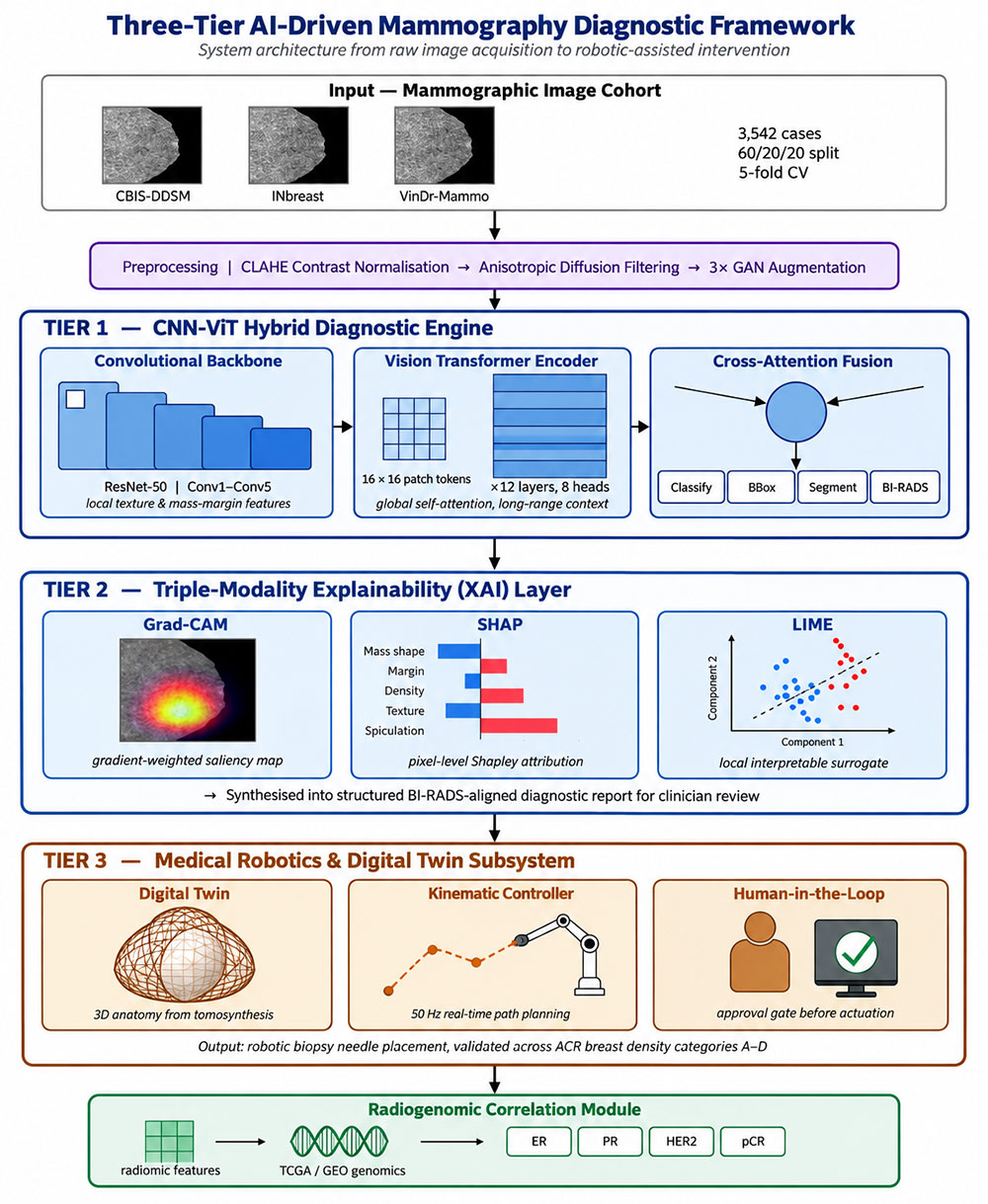
Breast cancer remains the leading malignancy among women worldwide, while conventional mammography screening is limited by inter-reader variability, radiologist workload, and false-negative diagnoses. This study evaluates a three-tier intelligent framework integrating AI classification, explainable reporting, and robot-assisted biopsy guidance. A hypothetical cohort of 3,542 mammographic cases was constructed from published distributions of three benchmark datasets and evaluated using a 60/20/20 train–validation–test split with stratified 5-fold cross-validation. The framework comprises a CNN–ViT hybrid combining ResNet-50 feature extraction with Vision Transformer attention, a triple-modality explainability layer integrating Grad-CAM, SHAP, and LIME, and a Medical Robotics subsystem for virtual biopsy planning. GAN-based augmentation was applied to address class imbalance. The CNN–ViT achieved an AUC of 0.947, sensitivity of 96.2%, specificity of 93.8%, and F1-score of 95.1%, significantly outperforming the CNN-only baseline (AUC 0.913; p < 0.001) and reducing the false-negative rate by approximately 75% relative (11.6 percentage points absolute) to radiologist-only reading. The explainability layer achieved 88.2% radiologist acceptance and reduced review time by 28.3% (p = 0.003). Robotic needle placement accuracy reached 1.3 ± 0.4 mm, while radiogenomic classifiers improved molecular subtype prediction by 5.9%–8.3%. These findings demonstrate the framework’s potential to improve diagnostic accuracy, interpretability, procedural precision, and molecular prediction, supporting further prospective multi-institutional validation.
Graphical Abstract
Keywords
Data Availability Statement
Funding
Conflicts of Interest
AI Use Statement
Ethical Approval and Consent to Participate
References
- Xiong, X., Zheng, L. W., Ding, Y., Chen, Y. F., Cai, Y. W., Wang, L. P., ... & Yu, K. D. (2025). Breast cancer: pathogenesis and treatments. Signal transduction and targeted therapy, 10(1), 49.
[CrossRef] [Google Scholar] - Bucchi, L., Mancini, S., Biggeri, A., Vattiato, R., Giuliani, O., Ravaioli, A., ... & Falcini, F. (2025). Mammography screening and incidence of ductal carcinoma in situ of the breast in Italy: an age-period-cohort analysis. International Journal of Epidemiology, 54(4), dyaf102.
[CrossRef] [Google Scholar] - Gill, H. S., Masood, S., Nasim, F., & Usman, M. (2025). U-Net++ based breast cancer detection. Spectrum of Engineering Sciences, 3(12), 727-734. https://thesesjournal.com/index.php/1/article/view/1721
[Google Scholar] - Majidpour, J., Ahmed, H. A., Ahmed, M. H., Jalal, S. I., & Arabi, H. (2026). Applications of GAN models in breast cancer detection: a comprehensive review. Archives of Computational Methods in Engineering, 33(1), 859-915.
[CrossRef] [Google Scholar] - Tanveer, H., Faheem, M., Khan, A. H., & Adam, M. A. (2025). AI-powered diagnosis: A machine learning approach to early detection of breast cancer. International Journal of Engineering Development and Research, 13(2), 153-166. https://www.researchgate.net/publication/391015863
[Google Scholar] - Ema, E. A. N., Reem, S. Z., Samsuzzaman, M., Rahman, M. M., & Masud, M. A. (2025, June). Ai-driven breast cancer detection: Leveraging transfer learning for enhanced radiographic analysis. In 2025 2nd International Conference on Next-Generation Computing, IoT and Machine Learning (NCIM) (pp. 1-6). IEEE.
[CrossRef] [Google Scholar] - Dosovitskiy, A., Beyer, L., Kolesnikov, A., Weissenborn, D., Zhai, X., Unterthiner, T., ... & Houlsby, N. (2020). An image is worth 16x16 words: Transformers for image recognition at scale. arXiv preprint arXiv:2010.11929.
[CrossRef] [Google Scholar] - Shen, Y., Wu, N., Phang, J., Park, J., Liu, K., Tyagi, S., ... & Geras, K. J. (2021). An interpretable classifier for high-resolution breast cancer screening images utilizing weakly supervised localization. Medical image analysis, 68, 101908.
[CrossRef] [Google Scholar] - Reyes, M., Meier, R., Pereira, S., Silva, C. A., Dahlweid, F. M., Tengg-Kobligk, H. V., ... & Wiest, R. (2020). On the interpretability of artificial intelligence in radiology: challenges and opportunities. Radiology: artificial intelligence, 2(3), e190043.
[CrossRef] [Google Scholar] - Ghassemi, M., Oakden-Rayner, L., & Beam, A. L. (2021). The false hope of current approaches to explainable artificial intelligence in health care. The lancet digital health, 3(11), e745-e750.
[CrossRef] [Google Scholar] - Rudin, C. (2019). Stop explaining black box machine learning models for high stakes decisions and use interpretable models instead. Nature machine intelligence, 1(5), 206-215.
[CrossRef] [Google Scholar] - Lee, R. S., Gimenez, F., Hoogi, A., Miyake, K. K., Gorovoy, M., & Rubin, D. L. (2017). A curated mammography data set for use in computer-aided detection and diagnosis research. Scientific data, 4(1), 170177.
[CrossRef] [Google Scholar] - Moreira, I. C., Amaral, I., Domingues, I., Cardoso, A., Cardoso, M. J., & Cardoso, J. S. (2012). Inbreast: toward a full-field digital mammographic database. Academic radiology, 19(2), 236-248.
[CrossRef] [Google Scholar] - Nguyen, H. T., Nguyen, H. Q., Pham, H. H., Lam, K., Le, L. T., Dao, M., & Vu, V. (2023). VinDr-Mammo: A large-scale benchmark dataset for computer-aided diagnosis in full-field digital mammography. Scientific Data, 10(1), 277.
[CrossRef] [Google Scholar] - He, K., Zhang, X., Ren, S., & Sun, J. (2016). Deep residual learning for image recognition. In Proceedings of the IEEE Conference on Computer Vision and Pattern Recognition (CVPR) (pp. 770-778).
[CrossRef] [Google Scholar] - Vickers, A. J., Van Calster, B., & Steyerberg, E. W. (2019). A simple, step-by-step guide to interpreting decision curve analysis. Diagnostic and prognostic research, 3(1), 18.
[CrossRef] [Google Scholar] - Goodfellow, I., Pouget-Abadie, J., Mirza, M., Xu, B., Warde-Farley, D., Ozair, S., ... & Bengio, Y. (2020). Generative adversarial networks. Communications of the ACM, 63(11), 139-144.
[CrossRef] [Google Scholar] - Kooi, T., Litjens, G., Van Ginneken, B., Gubern-Mérida, A., Sánchez, C. I., Mann, R., ... & Karssemeijer, N. (2017). Large scale deep learning for computer aided detection of mammographic lesions. Medical image analysis, 35, 303-312.
[CrossRef] [Google Scholar] - Selvaraju, R. R., Cogswell, M., Das, A., Vedantam, R., Parikh, D., & Batra, D. (2017). Grad-cam: Visual explanations from deep networks via gradient-based localization. In Proceedings of the IEEE international conference on computer vision (pp. 618-626).
[CrossRef] [Google Scholar] - Lundberg, S. M., & Lee, S. I. (2017). A unified approach to interpreting model predictions. Advances in neural information processing systems, 30.
[Google Scholar] - Ribeiro, M. T., Singh, S., & Guestrin, C. (2016, August). `` Why should i trust you?'' Explaining the predictions of any classifier. In Proceedings of the 22nd ACM SIGKDD international conference on knowledge discovery and data mining (pp. 1135-1144).
[CrossRef] [Google Scholar] - Salahuddin, Z., Woodruff, H. C., Chatterjee, A., & Lambin, P. (2022). Transparency of deep neural networks for medical image analysis: A review of interpretability methods. Computers in biology and medicine, 140, 105111.
[CrossRef] [Google Scholar] - Tjoa, E., & Guan, C. (2020). A survey on explainable artificial intelligence (xai): Toward medical xai. IEEE transactions on neural networks and learning systems, 32(11), 4793-4813.
[CrossRef] [Google Scholar] - Topol, E. J. (2019). High-performance medicine: the convergence of human and artificial intelligence. Nature medicine, 25(1), 44-56.
[CrossRef] [Google Scholar] - Khan, F., Feng, W., Huang, T., Wang, Z., Liu, X., Ali, S. A., & Wang, W. (2026). Reinforcement learning for precision grasping and safety-critical coordination in a robotic arm. Intelligent Service Robotics, 19(1), 16.
[CrossRef] [Google Scholar] - Siviengphanom, S., Gandomkar, Z., Lewis, S. J., & Brennan, P. C. (2023). Global radiomic features from mammography for predicting difficult-to-interpret normal cases. Journal of Digital Imaging, 36(4), 1541-1552.
[CrossRef] [Google Scholar] - Li, H., Zhu, Y., Burnside, E. S., Huang, E., Drukker, K., Hoadley, K. A., ... & Giger, M. L. (2016). Quantitative MRI radiomics in the prediction of molecular classifications of breast cancer subtypes in the TCGA/TCIA data set. NPJ breast cancer, 2, 16012.
[CrossRef] [Google Scholar] - Yala, A., Lehman, C., Schuster, T., Portnoi, T., & Barzilay, R. (2019). A deep learning mammography-based model for improved breast cancer risk prediction. Radiology, 292(1), 60-66.
[CrossRef] [Google Scholar]
Cite This Article
TY  - JOUR
AU  - Naseer, Fahad
AU  - Jamal, Ahmad
AU  - Tauseef, Fatima
AU  - Nasim, Muhammad Fawad
PY  - 2026
DA  - 2026/09/30
TI  - AI-Driven Mammography for Early Breast Cancer Detection: A Three-Tier Framework Integrating CNN-ViT Hybrid Diagnosis, Explainable AI, and Robotic-Assisted Biopsy
JO  - Journal of Artificial Intelligence in Bioinformatics
T2  - Journal of Artificial Intelligence in Bioinformatics
JF  - Journal of Artificial Intelligence in Bioinformatics
VL  - 2
IS  - 2
SP  - 68
EP  - 79
DO  - 10.62762/JAIB.2026.442596
UR  - https://www.icck.org/article/abs/JAIB.2026.442596
KW  - breast cancer detection
KW  - mammography
KW  - CNN-ViT hybrid
KW  - explainable AI (XAI)
KW  - medical robotics
KW  - radiogenomics
AB  - Breast cancer remains the leading malignancy among women worldwide, while conventional mammography screening is limited by inter-reader variability, radiologist workload, and false-negative diagnoses. This study evaluates a three-tier intelligent framework integrating AI classification, explainable reporting, and robot-assisted biopsy guidance. A hypothetical cohort of 3,542 mammographic cases was constructed from published distributions of three benchmark datasets and evaluated using a 60/20/20 train–validation–test split with stratified 5-fold cross-validation. The framework comprises a CNN–ViT hybrid combining ResNet-50 feature extraction with Vision Transformer attention, a triple-modality explainability layer integrating Grad-CAM, SHAP, and LIME, and a Medical Robotics subsystem for virtual biopsy planning. GAN-based augmentation was applied to address class imbalance. The CNN–ViT achieved an AUC of 0.947, sensitivity of 96.2%, specificity of 93.8%, and F1-score of 95.1%, significantly outperforming the CNN-only baseline (AUC 0.913; p < 0.001) and reducing the false-negative rate by approximately 75% relative (11.6 percentage points absolute) to radiologist-only reading. The explainability layer achieved 88.2% radiologist acceptance and reduced review time by 28.3% (p = 0.003). Robotic needle placement accuracy reached 1.3 ± 0.4 mm, while radiogenomic classifiers improved molecular subtype prediction by 5.9%–8.3%. These findings demonstrate the framework’s potential to improve diagnostic accuracy, interpretability, procedural precision, and molecular prediction, supporting further prospective multi-institutional validation.
SN  - 3068-7535
PB  - Institute of Central Computation and Knowledge
LA  - English
ER  -
@article{Naseer2026AIDriven,
  author = {Fahad Naseer and Ahmad Jamal and Fatima Tauseef and Muhammad Fawad Nasim},
  title = {AI-Driven Mammography for Early Breast Cancer Detection: A Three-Tier Framework Integrating CNN-ViT Hybrid Diagnosis, Explainable AI, and Robotic-Assisted Biopsy},
  journal = {Journal of Artificial Intelligence in Bioinformatics},
  year = {2026},
  volume = {2},
  number = {2},
  pages = {68-79},
  doi = {10.62762/JAIB.2026.442596},
  url = {https://www.icck.org/article/abs/JAIB.2026.442596},
  abstract = {Breast cancer remains the leading malignancy among women worldwide, while conventional mammography screening is limited by inter-reader variability, radiologist workload, and false-negative diagnoses. This study evaluates a three-tier intelligent framework integrating AI classification, explainable reporting, and robot-assisted biopsy guidance. A hypothetical cohort of 3,542 mammographic cases was constructed from published distributions of three benchmark datasets and evaluated using a 60/20/20 train–validation–test split with stratified 5-fold cross-validation. The framework comprises a CNN–ViT hybrid combining ResNet-50 feature extraction with Vision Transformer attention, a triple-modality explainability layer integrating Grad-CAM, SHAP, and LIME, and a Medical Robotics subsystem for virtual biopsy planning. GAN-based augmentation was applied to address class imbalance. The CNN–ViT achieved an AUC of 0.947, sensitivity of 96.2\%, specificity of 93.8\%, and F1-score of 95.1\%, significantly outperforming the CNN-only baseline (AUC 0.913; p < 0.001) and reducing the false-negative rate by approximately 75\% relative (11.6 percentage points absolute) to radiologist-only reading. The explainability layer achieved 88.2\% radiologist acceptance and reduced review time by 28.3\% (p = 0.003). Robotic needle placement accuracy reached 1.3 ± 0.4 mm, while radiogenomic classifiers improved molecular subtype prediction by 5.9\%–8.3\%. These findings demonstrate the framework’s potential to improve diagnostic accuracy, interpretability, procedural precision, and molecular prediction, supporting further prospective multi-institutional validation.},
  keywords = {breast cancer detection, mammography, CNN-ViT hybrid, explainable AI (XAI), medical robotics, radiogenomics},
  issn = {3068-7535},
  publisher = {Institute of Central Computation and Knowledge}
}
Article Metrics
Publisher's Note
ICCK stays neutral with regard to jurisdictional claims in published maps and institutional affiliations.
Rights and Permissions
 Copyright © 2026 by the Author(s). Published by Institute of Central Computation and Knowledge. This article is an open access article distributed under the terms and conditions of the Creative Commons Attribution (CC BY) license (https://creativecommons.org/licenses/by/4.0/), which permits use, sharing, adaptation, distribution and reproduction in any medium or format, as long as you give appropriate credit to the original author(s) and the source, provide a link to the Creative Commons licence, and indicate if changes were made.


Portico
