

Transition-Metal Doping and Biaxial Strain Tune Magnetism and Electronic Structure in Two-Dimensional GaN: A First-Principles Study



Article Information
Abstract
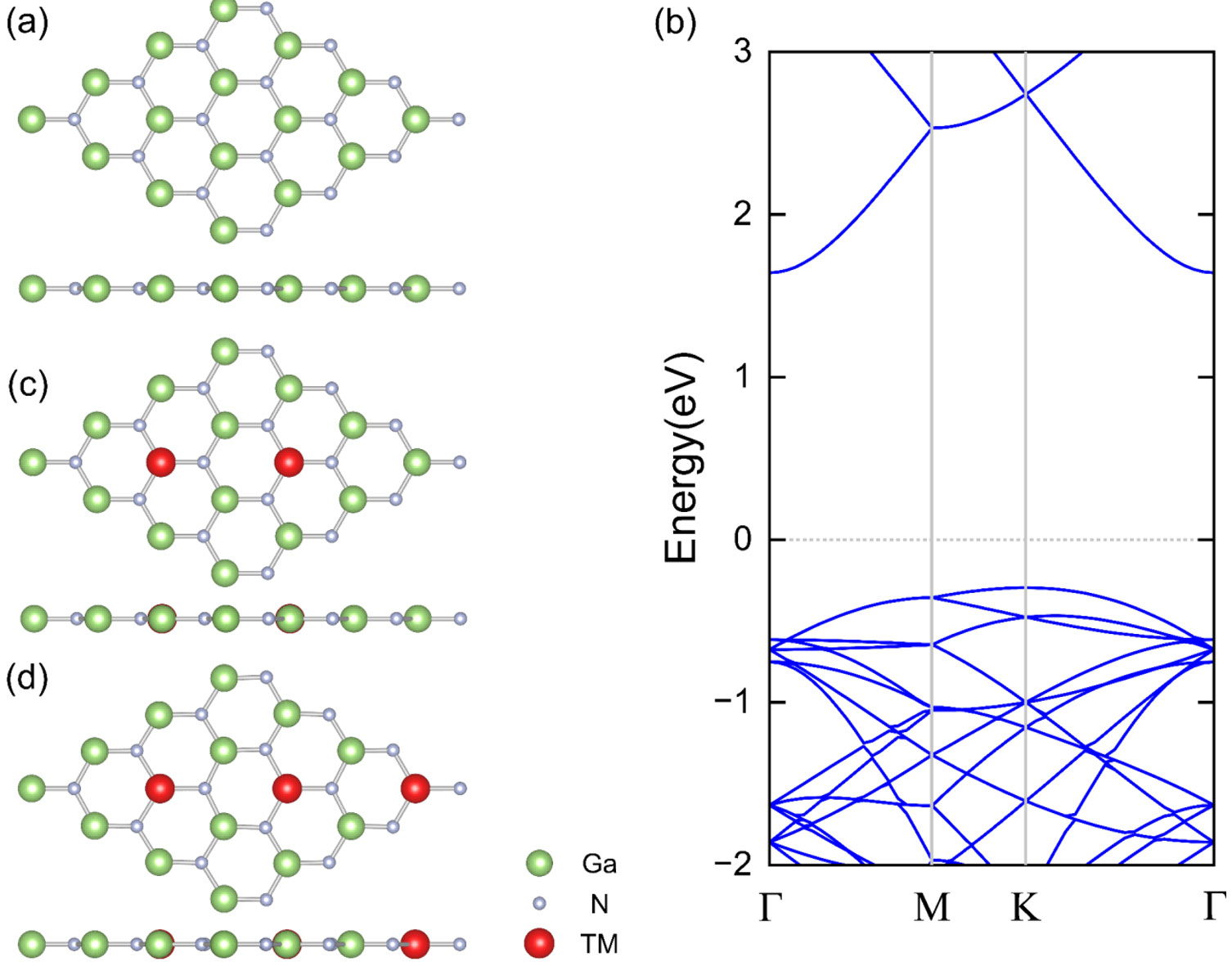
Pristine two-dimensional (2D) GaN is non-magnetic, which limits its direct use in semiconductor spintronics. Here, first-principles calculations were used to screen 3d transition-metal substitution (TM = Sc-Zn) at 6.25 at.% and 9.375 at.% and to evaluate biaxial strain from \(-3%\) to \(3%\). Co substitution produced the most favorable magnetic semiconductor response among the screened dopants. The two concentrations yielded magnetic moments of \(8.00\) and \(12.00\) \(\mu_B\) per supercell and band gaps of \(0.80\) and \(0.55\) eV, respectively. Biaxial strain preserved the magnetic order while tuning the band gaps. In the \(6.25\) at.% Co-doped system, the gap reached \(0.89\) eV at \(2%\) tensile strain and became direct at \(3%\) tensile strain. These calculations identify Co substitution and moderate biaxial strain as a promising theoretical route for tuning the magnetic and electronic properties of monolayer GaN.
Graphical Abstract
Keywords
Data Availability Statement
Funding
Conflicts of Interest
AI Use Statement
Ethical Approval and Consent to Participate
References
- Bhatti, S., Sbiaa, R., Hirohata, A., Ohno, H., Fukami, S., & Piramanayagam, S. N. (2017). Spintronics based random access memory: a review. Materials today, 20(9), 530-548.
[CrossRef] [Google Scholar] - Gupta, R., Bouard, C., Kammerbauer, F., Ledesma-Martin, J. O., Bose, A., Kononenko, I., ... & Kläui, M. (2025). Harnessing orbital Hall effect in spin-orbit torque MRAM. Nature Communications, 16(1), 130.
[CrossRef] [Google Scholar] - Ghising, P., Biswas, C., & Lee, Y. H. (2023). Graphene spin valves for spin logic devices. Advanced Materials, 35(23), 2209137.
[CrossRef] [Google Scholar] - Li, M., Li, C., Xu, X., Wang, M., Zhu, Z., Meng, K., ... & Jiang, Y. (2023). An ultrathin flexible programmable spin logic device based on spin–orbit torque. Nano Letters, 23(9), 3818-3825.
[CrossRef] [Google Scholar] - Ahn, E. C. (2020). 2D materials for spintronic devices. npj 2D Materials and Applications, 4(1), 17.
[CrossRef] [Google Scholar] - Meng, K., Li, M., Guo, L., Zhang, R., Guo, A., Liu, M., ... & Sun, X. (2025). Room‐Temperature Organic Spintronic Devices with Wide Range Magnetocurrent Tuning and Multifunctionality via Electro‐Optical Compensation Strategy. Advanced Materials, 37(11), 2417995.
[CrossRef] [Google Scholar] - González, V. H., Litvinenko, A., Kumar, A., Khymyn, R., & Åkerman, J. (2024). Spintronic devices as next-generation computation accelerators. Current Opinion in Solid State and Materials Science, 31, 101173.
[CrossRef] [Google Scholar] - Mi, M., Xiao, H., Yu, L., Zhang, Y., Wang, Y., Cao, Q., & Wang, Y. (2023). Two-dimensional magnetic materials for spintronic devices. Materials Today Nano, 24, 100408.
[CrossRef] [Google Scholar] - Chen, B., Zeng, M., Khoo, K. H., Das, D., Fong, X., Fukami, S., ... & Ter Lim, S. (2023). Spintronic devices for high-density memory and neuromorphic computing–A review. Materials Today, 70, 193-217.
[CrossRef] [Google Scholar] - Li, B., Xing, T., Zhong, M., Huang, L., Lei, N., Zhang, J., ... & Wei, Z. (2017). A two-dimensional Fe-doped SnS2 magnetic semiconductor. Nature communications, 8(1), 1958.
[CrossRef] [Google Scholar] - Liu, Y., Duan, X., Huang, Y., & Duan, X. (2018). Two-dimensional transistors beyond graphene and TMDCs. Chemical Society Reviews, 47(16), 6388-6409.
[CrossRef] [Google Scholar] - Li, Y., Huang, S., Peng, S., Jia, H., Pang, J., Ibarlucea, B., ... & Cuniberti, G. (2023). Toward smart sensing by MXene. Small, 19(14), 2206126.
[CrossRef] [Google Scholar] - Solangi, N. H., Karri, R. R., Mazari, S. A., Mubarak, N. M., Jatoi, A. S., Malafaia, G., & Azad, A. K. (2023). MXene as emerging material for photocatalytic degradation of environmental pollutants. Coordination Chemistry Reviews, 477, 214965.
[CrossRef] [Google Scholar] - Wang, J., Ma, F., Liang, W., & Sun, M. (2017). Electrical properties and applications of graphene, hexagonal boron nitride (h-BN), and graphene/h-BN heterostructures. Materials Today Physics, 2, 6-34.
[CrossRef] [Google Scholar] - Cao, Z., Zhang, H., Song, B., Xiong, D., Tao, S., Deng, W., ... & Ji, X. (2023). Angstrom‐level ionic sieve 2D‐MOF membrane for high power aqueous zinc anode. Advanced Functional Materials, 33(28), 2300339.
[CrossRef] [Google Scholar] - Lin, Y. C., Torsi, R., Younas, R., Hinkle, C. L., Rigosi, A., Hill, H. M., ... & Robinson, J. A. (2023). Recent advances in 2D material theory, synthesis, properties, and applications. ACS nano, 17(11), 9694.
[CrossRef] [Google Scholar] - Cao, W., Jiang, J., Xie, X., Pal, A., Chu, J. H., Kang, J., & Banerjee, K. (2018). 2-D layered materials for next-generation electronics: Opportunities and challenges. IEEE Transactions on Electron Devices, 65(10), 4109-4121.
[CrossRef] [Google Scholar] - Zhang, X., Hou, L., Ciesielski, A., & Samorì, P. (2016). 2D materials beyond graphene for high‐performance energy storage applications. Advanced Energy Materials, 6(23), 1600671.
[CrossRef] [Google Scholar] - Gao, L. (2017). Flexible device applications of 2D semiconductors. Small, 13(35), 1603994.
[CrossRef] [Google Scholar] - Yu, S., Wu, X., Wang, Y., Guo, X., & Tong, L. (2017). 2D materials for optical modulation: challenges and opportunities. Advanced Materials, 29(14), 1606128.
[CrossRef] [Google Scholar] - Chen, L. X., Chen, Z. W., Jiang, M., Lu, Z., Gao, C., Cai, G., & Singh, C. V. (2021). Insights on the dual role of two-dimensional materials as catalysts and supports for energy and environmental catalysis. Journal of Materials Chemistry A, 9(4), 2018-2042.
[CrossRef] [Google Scholar] - Zhang, F., Li, C., Li, Z., Dong, L., & Zhao, J. (2023). Recent progress in three-terminal artificial synapses based on 2D materials: from mechanisms to applications. Microsystems & Nanoengineering, 9(1), 16.
[CrossRef] [Google Scholar] - Wen, X., Lei, B., Zhang, L., & Lu, H. (2025). Tuning of the Electronic and Magnetic Properties of GaN Monolayers via Doping with Lanthanide Atoms and by Applying Biaxial Strain. Nanomaterials, 15(17), 1331.
[CrossRef] [Google Scholar] - Chen, Y., Liu, J., Liu, K., Si, J., Ding, Y., Li, L., ... & Fu, L. (2019). GaN in different dimensionalities: Properties, synthesis, and applications. Materials Science and Engineering: R: Reports, 138, 60-84.
[CrossRef] [Google Scholar] - Al Balushi, Z. Y., Wang, K., Ghosh, R. K., Vilá, R. A., Eichfeld, S. M., Caldwell, J. D., ... & Robinson, J. A. (2016). Two-dimensional gallium nitride realized via graphene encapsulation. Nature materials, 15(11), 1166-1171.
[CrossRef] [Google Scholar] - Sanders, N., Bayerl, D., Shi, G., Mengle, K. A., & Kioupakis, E. (2017). Electronic and optical properties of two-dimensional GaN from first-principles. Nano letters, 17(12), 7345-7349.
[CrossRef] [Google Scholar] - Wang, Z., Wang, G., Liu, X., Wang, S., Wang, T., Zhang, S., ... & Zhang, L. (2021). Two-dimensional wide band-gap nitride semiconductor GaN and AlN materials: properties, fabrication and applications. Journal of Materials Chemistry C, 9(48), 17201-17232.
[CrossRef] [Google Scholar] - Kecik, D., Onen, A., Konuk, M., Gürbüz, E., Ersan, F., Cahangirov, S., ... & Ciraci, S. (2018). Fundamentals, progress, and future directions of nitride-based semiconductors and their composites in two-dimensional limit: A first-principles perspective to recent synthesis. Applied Physics Reviews, 5(1).
[CrossRef] [Google Scholar] - Onen, A., Kecik, D., Durgun, E., & Ciraci, S. (2016). GaN: From three-to two-dimensional single-layer crystal and its multilayer van der Waals solids. Physical Review B, 93(8), 085431.
[CrossRef] [Google Scholar] - Kadioglu, Y., Ersan, F., Kecik, D., Aktürk, O. Ü., Aktürk, E., & Ciraci, S. (2018). Chemical and substitutional doping, and anti-site and vacancy formation in monolayer AlN and GaN. Physical Chemistry Chemical Physics, 20(23), 16077-16091.
[CrossRef] [Google Scholar] - Zhao, Q., Xiong, Z., Qin, Z., Chen, L., Wu, N., & Li, X. (2016). Tuning magnetism of monolayer GaN by vacancy and nonmagnetic chemical doping. Journal of Physics and Chemistry of Solids, 91, 1-6.
[CrossRef] [Google Scholar] - Jin, X. W., Xie, Y., Han, W., Chen, Z. Y., Xiao, X. S., Hao, J. Y., ... & Song, Y. L. (2024). Biaxial strain-modulated power conversion efficiency, electronic structures, and optical properties of type-II MoS2/BC6N vdW heterostructure: A density functional theory study. Materials Today Communications, 40, 110012.
[CrossRef] [Google Scholar] - Li, X., Liu, M., Guo, M., Niu, C., He, H., Liu, Z., ... & Sui, J. (2023). Tailoring band structure and Ge precipitates through Er and Sb/Bi co-doping to realize high thermoelectric performance in GeTe. Chemical Engineering Journal, 474, 145820.
[CrossRef] [Google Scholar] - Wang, J., Guan, L., Yuan, S., Zhang, J., Zhao, C., Hu, X., ... & He, Y. (2023). Greatly boosted photocatalytic N2-to-NH3 conversion by bismuth doping in CdMoO4: Band structure engineering and N2 adsorption modification. Separation and Purification Technology, 314, 123554.
[CrossRef] [Google Scholar] - Wang, K., Yang, S., Ren, K., Wei, Y., Liu, H., & Zhang, G. (2026). Phonons regulate covalency: a new way to modulate the magnetism and Curie temperature of CrI3. Physical Chemistry Chemical Physics, 28(18), 11363-11369.
[CrossRef] [Google Scholar] - Guo-Xiang, C., Xiao-Bo, F., Si-Qi, L., & Jian-Min, Z. (2019). First-principles study of magnetic properties of alkali metals and alkaline earth metals doped two-dimensional GaN materials. Acta Physica Sinica, 68(23), 237303.
[CrossRef] [Google Scholar] - Liu, P., Peng, Y., Huang, Q., Zhou, Z., Shao, C., Guo, Y., & Han, R. (2023). First-principles investigates on the electronic structure and magnetic properties of V-, Cr-, Mn-doped two-dimensional Ga\(_2\)O\(_3\). Physics Letters A, 491, 129211.
[CrossRef] [Google Scholar] - Aldbea, F. W., Vázquez Vázquez, C., Othman, U. A., Sharma, A., Boukhachemd, A., Mailoude, O. M., ... & Singh, P. K. (2024). Structural and optical properties of Iodine doped zinc oxide nanoparticles. Journal of Materials Science: Materials in Electronics, 35(7), 459.
[CrossRef] [Google Scholar] - Hafner, J. (2008). Ab‐initio simulations of materials using VASP: Density‐functional theory and beyond. Journal of computational chemistry, 29(13), 2044-2078.
[CrossRef] [Google Scholar] - Blöchl, P. E. (1994). Projector augmented-wave method. Physical review B, 50(24), 17953.
[CrossRef] [Google Scholar] - Perdew, J. P., Burke, K., & Ernzerhof, M. (1996). Generalized gradient approximation made simple. Physical review letters, 77(18), 3865.
[CrossRef] [Google Scholar] - Hussain, F., Cai, Y. Q., Khan, M. J. I., Imran, M., Rashid, M., Ullah, H., ... & Ahmad, S. A. (2015). Enhanced ferromagnetic properties of Cu doped two-dimensional GaN monolayer. International Journal of Modern Physics C, 26(01), 1550009.
[CrossRef] [Google Scholar] - Qin, Z., Qin, G., Zuo, X., Xiong, Z., & Hu, M. (2017). Orbitally driven low thermal conductivity of monolayer gallium nitride (GaN) with planar honeycomb structure: a comparative study. Nanoscale, 9(12), 4295-4309.
[CrossRef] [Google Scholar] - Van de Walle, C. G., & Neugebauer, J. (2004). First-principles calculations for defects and impurities: Applications to III-nitrides. Journal of applied physics, 95(8), 3851-3879.
[CrossRef] [Google Scholar] - Zhang, S. B., & Northrup, J. E. (1991). Chemical potential dependence of defect formation energies in GaAs: Application to Ga self-diffusion. Physical review letters, 67(17), 2339.
[CrossRef] [Google Scholar] - Jiang, J., Feng, W., Wen, Y., Yin, L., Wang, H., Feng, X., ... & He, J. (2023). Tuning 2D magnetism in cobalt monoxide nanosheets via in situ nickel‐doping. Advanced Materials, 35(22), 2301668.
[CrossRef] [Google Scholar] - Li, J., & Liu, H. (2018). Magnetism investigation of GaN monolayer doped with group VIII B transition metals. Journal of Materials Science, 53(23), 15986-15994.
[CrossRef] [Google Scholar]
Cite This Article
TY  - JOUR
AU  - Luo, Yi
AU  - He, Weiye
AU  - Xu, Jilin
AU  - Zuo, Lijie
AU  - Shang, Feng
AU  - Feng, Wen
AU  - Ma, Qianyi
PY  - 2026
DA  - 2026/08/17
TI  - Transition-Metal Doping and Biaxial Strain Tune Magnetism and Electronic Structure in Two-Dimensional GaN: A First-Principles Study
JO  - Journal of Advanced Materials Research
T2  - Journal of Advanced Materials Research
JF  - Journal of Advanced Materials Research
VL  - 2
IS  - 3
SP  - 236
EP  - 250
DO  - 10.62762/JAMR.2026.353789
UR  - https://www.icck.org/article/abs/JAMR.2026.353789
KW  - two-dimensional GaN
KW  - transition-metal doping
KW  - biaxial strain
KW  - semiconductor spintronic devices
KW  - first-principles calculations
AB  - Pristine two-dimensional (2D) GaN is non-magnetic, which limits its direct use in semiconductor spintronics. Here, first-principles calculations were used to screen 3d transition-metal substitution (TM = Sc-Zn) at 6.25 at.% and 9.375 at.% and to evaluate biaxial strain from \(-3%\) to \(3%\). Co substitution produced the most favorable magnetic semiconductor response among the screened dopants. The two concentrations yielded magnetic moments of \(8.00\) and \(12.00\) \(\mu_B\) per supercell and band gaps of \(0.80\) and \(0.55\) eV, respectively. Biaxial strain preserved the magnetic order while tuning the band gaps. In the \(6.25\) at.% Co-doped system, the gap reached \(0.89\) eV at \(2%\) tensile strain and became direct at \(3%\) tensile strain. These calculations identify Co substitution and moderate biaxial strain as a promising theoretical route for tuning the magnetic and electronic properties of monolayer GaN.
SN  - 3070-5851
PB  - Institute of Central Computation and Knowledge
LA  - English
ER  -
@article{Luo2026Transition,
  author = {Yi Luo and Weiye He and Jilin Xu and Lijie Zuo and Feng Shang and Wen Feng and Qianyi Ma},
  title = {Transition-Metal Doping and Biaxial Strain Tune Magnetism and Electronic Structure in Two-Dimensional GaN: A First-Principles Study},
  journal = {Journal of Advanced Materials Research},
  year = {2026},
  volume = {2},
  number = {3},
  pages = {236-250},
  doi = {10.62762/JAMR.2026.353789},
  url = {https://www.icck.org/article/abs/JAMR.2026.353789},
  abstract = {Pristine two-dimensional (2D) GaN is non-magnetic, which limits its direct use in semiconductor spintronics. Here, first-principles calculations were used to screen 3d transition-metal substitution (TM = Sc-Zn) at 6.25 at.\% and 9.375 at.\% and to evaluate biaxial strain from \(-3\%\) to \(3\%\). Co substitution produced the most favorable magnetic semiconductor response among the screened dopants. The two concentrations yielded magnetic moments of \(8.00\) and \(12.00\) \(\mu\_B\) per supercell and band gaps of \(0.80\) and \(0.55\) eV, respectively. Biaxial strain preserved the magnetic order while tuning the band gaps. In the \(6.25\) at.\% Co-doped system, the gap reached \(0.89\) eV at \(2\%\) tensile strain and became direct at \(3\%\) tensile strain. These calculations identify Co substitution and moderate biaxial strain as a promising theoretical route for tuning the magnetic and electronic properties of monolayer GaN.},
  keywords = {two-dimensional GaN, transition-metal doping, biaxial strain, semiconductor spintronic devices, first-principles calculations},
  issn = {3070-5851},
  publisher = {Institute of Central Computation and Knowledge}
}
Article Metrics
Publisher's Note
ICCK stays neutral with regard to jurisdictional claims in published maps and institutional affiliations.
Rights and Permissions
 Copyright © 2026 by the Author(s). Published by Institute of Central Computation and Knowledge. This article is an open access article distributed under the terms and conditions of the Creative Commons Attribution (CC BY) license (https://creativecommons.org/licenses/by/4.0/), which permits use, sharing, adaptation, distribution and reproduction in any medium or format, as long as you give appropriate credit to the original author(s) and the source, provide a link to the Creative Commons licence, and indicate if changes were made.


Portico
