

Coupling Mechanisms of Qualitative-Quantitative and Macro-Micro Analyses for Helium Reservoir Characteristics in Northern Huazhou Area, Weihe Basin


Article Information
Abstract
The North Huazhou area in Weihe Basin, a transition zone between the Ordos Block and Qinling Orogenic Belt, hosts multiple Cenozoic reservoirs critical for helium, geothermal, and tight oil/gas exploration. Based on Well H1 core, logging, and laboratory data, multi-scale analyses of the Sanmen, Zhangjiapo, Lantian-Bahe Formations, and Gaoling Group reveal significant lithological differentiations: the Zhangjiapo Formation is a medium-porosity, medium-permeability reservoir, whereas the Lantian-Bahe Formation exhibits low porosity and permeability. X-ray diffraction confirms dominant siliceous minerals with clay fluctuations reflecting strong hydrodynamic environments. Moderately strong velocity ($D_{\mathrm{v}} = 55.53%$) and acid sensitivity ($D_{\mathrm{ac}} = 57.68%$) necessitate reservoir-protective development strategies. The Lantian-Bahe gas-water zone (76.5\,m, 20.6%) displays dominant positive rhythms macroscopically, while residual intergranular and dissolution pores with sheet-like and necked throats restrict fluid flow microscopically. Noble gas isotopes ($^{4}\mathrm{He}/^{20}\mathrm{Ne} = 37{,}164$) confirm anomalous $^{4}\mathrm{He}$ from uranium-rich Qinling granites. A ``multi-source supply--fault transport--exsolution enrichment'' model is proposed, whereby coal-type gas drives helium exsolution from pore-fracture waters into the free gas phase. The Gaoling Group and Lantian-Bahe Formation are identified as primary targets, providing a geological basis for helium evaluation and multi-energy development in Weihe Basin.
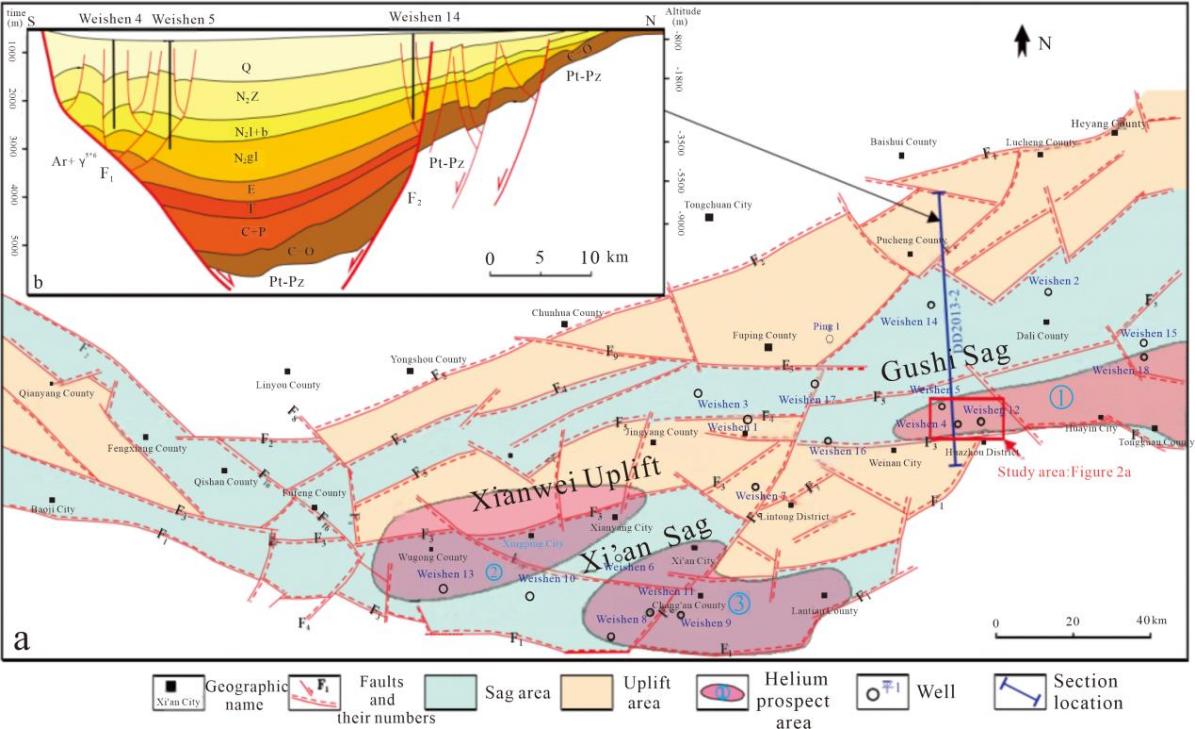
Graphical Abstract
Keywords
Data Availability Statement
Funding
Conflicts of Interest
AI Use Statement
Ethical Approval and Consent to Participate
References
- Yuhong, Z. M. L. W. L., Xiaochen, L. Z. Z. Q. W., & Meng, L. (2019). Residual stratigraphic distribution and hydrocarbon significance of Upper Paleozoic in Weihe Basin and its adjacent area. Chinese Journal of Geology, 54(2), 423-433.
[CrossRef] [Google Scholar] - Zhang, J., Guoxin, L. I., Chengzao, J. I. A., & Qun, Z. H. A. O. (2025). Natural gas types and coal-rock gas classification in the whole petroleum system of coal measures. Petroleum Exploration and Development, 52(4), 894-906.
[CrossRef] [Google Scholar] - Wei, L. S. L. Z. S., Guozhi, D. B. L. Z. W., & Wen, Y. Z. H. (2011). Basic geological features of superimposed basin and hydrocarbon accumulation in Sichuan Basin, China. Chinese Journal of Geology, 46(01), 233-257.
[Google Scholar] - Lu, J., Rao, S., Hu, S., Huang, S., Zhang, Q., Li, W., & Yang, Y. (2024). Cenozoic tectono-thermal evolution of the Weihe Basin, Central China. International Geology Review, 66(18), 3225-3241.
[CrossRef] [Google Scholar] - Liu, Z., Bai, Y., & Zhou, L. (2016). Basin structure and hydrocarbon accumulation conditions of the Weihe Basin. Experimental Petroleum Geology, 38(5), 584-591.
[CrossRef] [Google Scholar] - Yao, Y., Liu, D., & Yan, T. (2014). Geological and hydrogeological controls on the accumulation of coalbed methane in the Weibei field, southeastern Ordos Basin. International Journal of Coal Geology, 121, 148-159.
[CrossRef] [Google Scholar] - Yao, Y., Liu, D., Tang, D., Tang, S., Che, Y., & Huang, W. (2009). Preliminary evaluation of the coalbed methane production potential and its geological controls in the Weibei Coalfield, Southeastern Ordos Basin, China. International Journal of Coal Geology, 78(1), 1-15.
[CrossRef] [Google Scholar] - ZHANG, Y., REN, Z., XING, G., QI, K., & XIA, Y. (2023). Characteristics of Neogene thermal reservoir in Weihe Basin. Geological Bulletin of China, 42(11), 1993-2005.
[CrossRef] [Google Scholar] - Zhou, B., Zhang, Y., & Kuang, J. (2024). Historical earthquake records in the Weihe Basin, central China and new insights for geothermal genesis. Frontiers in Earth Science, 12, 1287450.
[CrossRef] [Google Scholar] - Zhang, W., Li, Y., Zhao, F., Han, W., Li, Y., Wang, Y., ... & Zhou, Z. (2019). Using noble gases to trace groundwater evolution and assess helium accumulation in Weihe Basin, central China. Geochimica et Cosmochimica Acta, 251, 229-246.
[CrossRef] [Google Scholar] - Wang, P., Huang, Z., Mi, N., Xu, M., Wang, L., Li, H., ... & Mao, X. (2014). Crustal structure beneath the Weihe Graben in central China: Evidence for the tectonic regime transformation in the Cenozoic. Journal of Asian Earth Sciences, 81, 105-114.
[CrossRef] [Google Scholar] - Li, Y., Gao, G., & Wang, X. (2019). Characteristics of newly discovered crude oil in Weihe Basin and its petroleum geological significance. Oil & Gas Geology, 40(2), 346-353.
[CrossRef] [Google Scholar] - An, Z., Zhang, P., Vogel, H., Song, Y., Dodson, J., Wiersberg, T., ... & Sun, Y. (2020). Scientific drilling workshop on the Weihe Basin Drilling Project (WBDP): Cenozoic tectonic–monsoon interactions. Scientific Drilling, 28, 63-73.
[CrossRef] [Google Scholar] - CAI, X., LI, Q., & ZHANG, Y. (2025). Coupling Relationship between Neogene Tectonism and Sedimenta-tion and Its Controlling of Helium Accumulation in Huazhou Exploration Area, Gushi Sag, Weihe Basin. Northwestern Ge-ology, 58(5), 11-23.
[CrossRef] [Google Scholar] - Xia, Y. (2007). The sedimentary characteristics of Cenozoic in Weihe Basin and its relationship with tectonics (Master's thesis). Chang'an University, Xi'an, China.
[CrossRef] [Google Scholar] - Li, W., & Feng, X. (2023). Discovery of the Qinghe fault, the inner part of the Weihe graben, central China, and its geological significance. Frontiers in Earth Science, 11, 1127897.
[CrossRef] [Google Scholar] - Chai, G., Shi, Y., Du, S., Wei, Y., Zhang, Z., Guo, C. A., & Sun, T. (2020). Sensitivity evaluation and influencing factors analysis of tight sandstone reservoirs: a case study of the Chang-8 reservoir in Yanchi Area of Ordos Basin. Acta Scientiarum Naturalium Universitatis Pekinensis, 56(2), 253-261.
[CrossRef] [Google Scholar] - Lai, J., Wang, G., Wang, Z., Chen, J., Pang, X., Wang, S., ... & Fan, X. (2018). A review on pore structure characterization in tight sandstones. Earth-Science Reviews, 177, 436-457.
[CrossRef] [Google Scholar] - Wang, L., Zhao, N., Sima, L., Meng, F., & Guo, Y. (2018). Pore structure characterization of the tight reservoir: systematic integration of mercury injection and nuclear magnetic resonance. Energy & Fuels, 32(7), 7471-7484.
[CrossRef] [Google Scholar] - Lai, J., Wang, G., Fan, Z., Chen, J., Wang, S., Zhou, Z., & Fan, X. (2016). Insight into the pore structure of tight sandstones using NMR and HPMI measurements. Energy & Fuels, 30(12), 10200-10214.
[CrossRef] [Google Scholar] - Worden, R. H., & Morad, S. (2000). Quartz cementation in oil field sandstones: a review of the key controversies. Quartz cementation in sandstones, 1-20.
[CrossRef] [Google Scholar] - Mingyang, L. I., Chengyin, L. I., & Lei, P. A. N. (2023). Characteristics and genesis of tight sandstone reservoirs of Middle Jurassic Lianggaoshan Formation in Fuling area, eastern Sichuan Basin. Natural Gas Geoscience, 35(7), 1150-1159. http://www.nggs.ac.cn/EN/PDF/10.11764/j.issn.1672-1926.2023.11.012
[Google Scholar] - Shijia, C. H. E. N., Junjie, L. E. I., Chun, L. I. U., Jingli, Y. A. O., Yong, L. I., Shixiang, L. I., ... & Zhenglu, X. I. A. O. (2019). Factors controlling the reservoir accumulation of Triassic Chang 6 Member in Jiyuan-Wuqi area, Ordos Basin, NW China. Petroleum Exploration and Development, 46(2), 253-264.
[CrossRef] [Google Scholar] - Zheng, Z. Y., Zuo, Y. H., Wen, H. G., Li, D. M., Luo, Y., Zhang, J. Z., ... & Zeng, J. C. (2023). Natural gas characteristics and gas-source comparisons of the lower triassic Feixianguan formation, Eastern Sichuan basin, China. Petroleum Science, 20(3), 1458-1470.
[CrossRef] [Google Scholar] - Wen, Z., Yu-hong, L., Li, W. A. N. G., Feng-hua, Z., Wei, H., & Chang-gui, S. (2018). The analysis of helium accumulation conditions and prediction of helium resource in Weihe Basin. Natural Gas Geoscience, 29(2), 236-244. http://www.nggs.ac.cn/EN/PDF/10.11764/j.issn.1672-1926.2017.12.002
[Google Scholar]
Cite This Article
TY  - JOUR
AU  - Cai, Xinlei
AU  - Li, Qianyi
AU  - Zhang, Yang
AU  - Li, Zheng
AU  - Zhang, Guoqiang
AU  - Fan, Mingpu
AU  - Shi, Shiling
AU  - Lv, Junbo
PY  - 2026
DA  - 2026/06/12
TI  - Coupling Mechanisms of Qualitative-Quantitative and Macro-Micro Analyses for Helium Reservoir Characteristics in Northern Huazhou Area, Weihe Basin
JO  - Journal of Geo-Energy and Environment
T2  - Journal of Geo-Energy and Environment
JF  - Journal of Geo-Energy and Environment
VL  - 2
IS  - 3
SP  - 185
EP  - 202
DO  - 10.62762/JGEE.2026.503413
UR  - https://www.icck.org/article/abs/JGEE.2026.503413
KW  - weihe basin
KW  - qualitative-quantitative evaluation
KW  - macro-micro
KW  - coupling mechanism
KW  - reservoir characteristics
AB  - The North Huazhou area in Weihe Basin, a transition zone between the Ordos Block and Qinling Orogenic Belt, hosts multiple Cenozoic reservoirs critical for helium, geothermal, and tight oil/gas exploration. Based on Well H1 core, logging, and laboratory data, multi-scale analyses of the Sanmen, Zhangjiapo, Lantian-Bahe Formations, and Gaoling Group reveal significant lithological differentiations: the Zhangjiapo Formation is a medium-porosity, medium-permeability reservoir, whereas the Lantian-Bahe Formation exhibits low porosity and permeability. X-ray diffraction confirms dominant siliceous minerals with clay fluctuations reflecting strong hydrodynamic environments. Moderately strong velocity ($D_{\mathrm{v}} = 55.53%$) and acid sensitivity ($D_{\mathrm{ac}} = 57.68%$) necessitate reservoir-protective development strategies. The Lantian-Bahe gas-water zone (76.5\,m, 20.6%) displays dominant positive rhythms macroscopically, while residual intergranular and dissolution pores with sheet-like and necked throats restrict fluid flow microscopically. Noble gas isotopes ($^{4}\mathrm{He}/^{20}\mathrm{Ne} = 37{,}164$) confirm anomalous $^{4}\mathrm{He}$ from uranium-rich Qinling granites. A ``multi-source supply--fault transport--exsolution enrichment'' model is proposed, whereby coal-type gas drives helium exsolution from pore-fracture waters into the free gas phase. The Gaoling Group and Lantian-Bahe Formation are identified as primary targets, providing a geological basis for helium evaluation and multi-energy development in Weihe Basin.
SN  - 3069-3268
PB  - Institute of Central Computation and Knowledge
LA  - English
ER  -
@article{Cai2026Coupling,
  author = {Xinlei Cai and Qianyi Li and Yang Zhang and Zheng Li and Guoqiang Zhang and Mingpu Fan and Shiling Shi and Junbo Lv},
  title = {Coupling Mechanisms of Qualitative-Quantitative and Macro-Micro Analyses for Helium Reservoir Characteristics in Northern Huazhou Area, Weihe Basin},
  journal = {Journal of Geo-Energy and Environment},
  year = {2026},
  volume = {2},
  number = {3},
  pages = {185-202},
  doi = {10.62762/JGEE.2026.503413},
  url = {https://www.icck.org/article/abs/JGEE.2026.503413},
  abstract = {The North Huazhou area in Weihe Basin, a transition zone between the Ordos Block and Qinling Orogenic Belt, hosts multiple Cenozoic reservoirs critical for helium, geothermal, and tight oil/gas exploration. Based on Well H1 core, logging, and laboratory data, multi-scale analyses of the Sanmen, Zhangjiapo, Lantian-Bahe Formations, and Gaoling Group reveal significant lithological differentiations: the Zhangjiapo Formation is a medium-porosity, medium-permeability reservoir, whereas the Lantian-Bahe Formation exhibits low porosity and permeability. X-ray diffraction confirms dominant siliceous minerals with clay fluctuations reflecting strong hydrodynamic environments. Moderately strong velocity (\$D\_{\mathrm{v}} = 55.53\%\$) and acid sensitivity (\$D\_{\mathrm{ac}} = 57.68\%\$) necessitate reservoir-protective development strategies. The Lantian-Bahe gas-water zone (76.5\,m, 20.6\%) displays dominant positive rhythms macroscopically, while residual intergranular and dissolution pores with sheet-like and necked throats restrict fluid flow microscopically. Noble gas isotopes (\$^{4}\mathrm{He}/^{20}\mathrm{Ne} = 37{,}164\$) confirm anomalous \$^{4}\mathrm{He}\$ from uranium-rich Qinling granites. A ``multi-source supply--fault transport--exsolution enrichment'' model is proposed, whereby coal-type gas drives helium exsolution from pore-fracture waters into the free gas phase. The Gaoling Group and Lantian-Bahe Formation are identified as primary targets, providing a geological basis for helium evaluation and multi-energy development in Weihe Basin.},
  keywords = {weihe basin, qualitative-quantitative evaluation, macro-micro, coupling mechanism, reservoir characteristics},
  issn = {3069-3268},
  publisher = {Institute of Central Computation and Knowledge}
}
Article Metrics
Publisher's Note
ICCK stays neutral with regard to jurisdictional claims in published maps and institutional affiliations.
Rights and Permissions
 Copyright © 2026 by the Author(s). Published by Institute of Central Computation and Knowledge. This article is an open access article distributed under the terms and conditions of the Creative Commons Attribution (CC BY) license (https://creativecommons.org/licenses/by/4.0/), which permits use, sharing, adaptation, distribution and reproduction in any medium or format, as long as you give appropriate credit to the original author(s) and the source, provide a link to the Creative Commons licence, and indicate if changes were made.


Portico
