
Intelligent Document Processing: From OCR to Multimodal Foundation Models—Architectures, Evidence, and Enterprise Integration




Article Information
Abstract
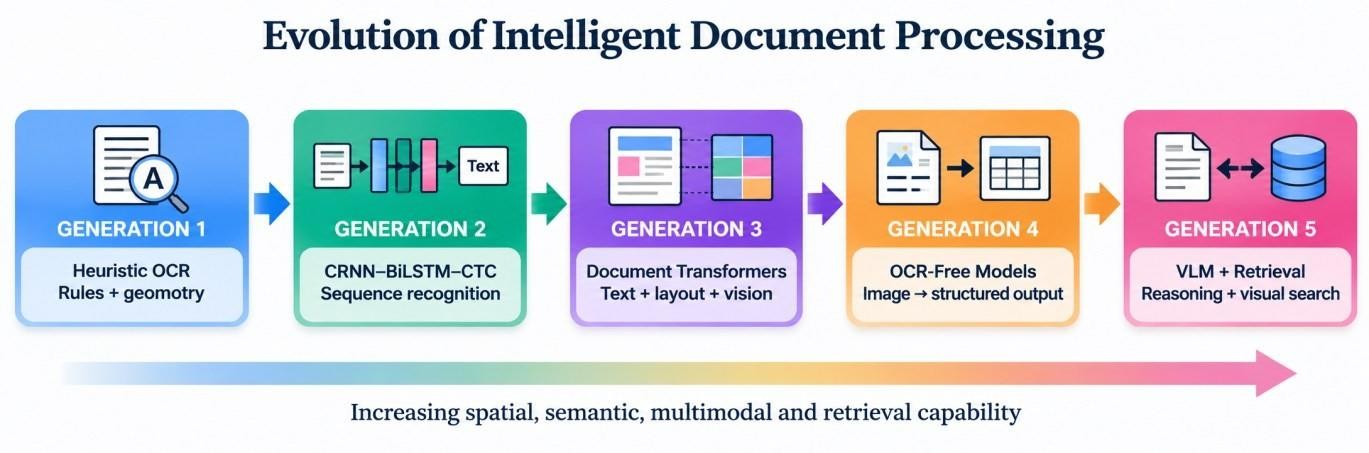
Intelligent document processing (IDP) integrates text recognition, document geometry, visual features, semantic interpretation, and information access to convert heterogeneous documents into machine-actionable information. This review examines the evolution from rule-based optical character recognition (OCR) and convolutional neural network (CNN)-recurrent sequence recognizers to layout-aware document transformers, OCR-free document models, vision-language foundation models, and visual retrieval systems. Rather than ranking architectures using metrics obtained from incompatible datasets and protocols, the review distinguishes four complementary capabilities: recognition, extraction, reasoning, and retrieval. It compares representative systems in terms of their input representations, learning objectives, strengths, limitations, and operational requirements. A structured narrative-review protocol is reported, including search sources, keywords, coverage period, and eligibility criteria. Quantitative claims are reported only when they can be traced to primary sources and compatible evaluation protocols. The review also examines industrial evidence with explicit source-quality qualifications and presents a transparent, assumption-based total-cost example. Finally, it discusses low-resource scripts, including recent reviews of handwritten and low-resource historical material, and identifies research priorities in reproducible benchmarking, evidence-grounded reasoning, privacy, and human oversight.
Graphical Abstract
Keywords
Data Availability Statement
Funding
Conflicts of Interest
AI Use Statement
Ethical Approval and Consent to Participate
References
- Smith, R. (2007). An overview of the Tesseract OCR engine. In Proceedings of the Ninth International Conference on Document Analysis and Recognition (ICDAR 2007) (Vol. 2, pp. 629-633). IEEE.
[CrossRef] [Google Scholar] - Shi, B., Bai, X., & Yao, C. (2017). An end-to-end trainable neural network for image-based sequence recognition and its application to scene text recognition. IEEE Transactions on Pattern Analysis and Machine Intelligence, 39(11), 2298-2304.
[CrossRef] [Google Scholar] - Xu, Y., Li, M., Cui, L., Huang, S., Wei, F., & Zhou, M. (2020). LayoutLM: Pre-training of text and layout for document image understanding. In Proceedings of the 26th ACM SIGKDD International Conference on Knowledge Discovery & Data Mining (pp. 1192-1200).
[CrossRef] [Google Scholar] - Xu, Y., Xu, Y., Lv, T., Cui, L., Wei, F., Wang, G., Lu, Y., Florencio, D., Zhang, C., Che, W., Zhang, M., & Zhou, L. (2021, August). LayoutLMv2: Multi-modal pre-training for visually-rich document understanding. In Proceedings of the 59th Annual Meeting of the Association for Computational Linguistics and the 11th International Joint Conference on Natural Language Processing (Volume 1: Long Papers) (pp. 2579-2591).
[CrossRef] [Google Scholar] - Huang, Y., Lv, T., Cui, L., Lu, Y., & Wei, F. (2022). LayoutLMv3: Pre-training for document AI with unified text and image masking. In Proceedings of the 30th ACM International Conference on Multimedia (pp. 4083-4091).
[CrossRef] [Google Scholar] - Hong, T., Kim, D., Ji, M., Hwang, W., Nam, D., & Park, S. (2022, June). BROS: A pre-trained language model focusing on text and layout for better key information extraction from documents. In Proceedings of the AAAI Conference on Artificial Intelligence (Vol. 36, No. 10, pp. 10767-10775).
[CrossRef] [Google Scholar] - Appalaraju, S., Jasani, B., Kota, B. U., Xie, Y., & Manmatha, R. (2021). DocFormer: End-to-end transformer for document understanding. In Proceedings of the IEEE/CVF International Conference on Computer Vision (ICCV) (pp. 993-1003).
[CrossRef] [Google Scholar] - Kim, G., Hong, T., Yim, M., Nam, J., Park, J., Yim, J., Hwang, W., Yun, S., Han, D., & Park, S. (2022, October). OCR-free document understanding transformer. In European Conference on Computer Vision (pp. 498-517). Cham: Springer Nature Switzerland.
[CrossRef] [Google Scholar] - Blecher, L., Cucurull Preixens, G., Scialom, T., & Stojnic, R. (2024, May). Nougat: Neural optical understanding for academic documents. In International Conference on Learning Representations.
[Google Scholar] - Lee, K., Joshi, M., Turc, I. R., Hu, H., Liu, F., Eisenschlos, J. M., Khandelwal, U., Shaw, P., Chang, M.-W., & Toutanova, K. (2023, July). Pix2Struct: Screenshot parsing as pretraining for visual language understanding. In International Conference on Machine Learning (pp. 18893-18912). PMLR. https://proceedings.mlr.press/v202/lee23g.html
[Google Scholar] - Mathew, M., Karatzas, D., & Jawahar, C. V. (2021). DocVQA: A dataset for VQA on document images. In Proceedings of the IEEE/CVF Winter Conference on Applications of Computer Vision (WACV) (pp. 2200-2209).
[CrossRef] [Google Scholar] - Wang, P., Bai, S., Tan, S., Wang, S., Fan, Z., Bai, J., Chen, K., Liu, X., Wang, J., Ge, W., Fan, Y., Dang, K., Du, M., Ren, X., Men, R., Liu, D., Zhou, C., Zhou, J., & Lin, J. (2024). Qwen2-VL: Enhancing vision-language model's perception of the world at any resolution. arXiv preprint arXiv:2409.12191.
[CrossRef] [Google Scholar] - OpenAI. (2024). GPT-4o system card. arXiv preprint arXiv:2410.21276.
[CrossRef] [Google Scholar] - Faysse, M., Sibille, H., Wu, T., Omrani, B., Viaud, G., Hudelot, C., & Colombo, P. (2025, April). ColPali: Efficient document retrieval with vision language models. In International Conference on Learning Representations.
[Google Scholar] - Google Cloud. (n.d.). Document AI documentation and pricing. Retrieved October 10, 2026, from https://cloud.google.com/document-ai/pricing
[Google Scholar] - Microsoft. (n.d.). Azure AI Document Intelligence pricing. Retrieved October 10, 2026, from https://azure.microsoft.com/pricing/details/ai-document-intelligence/
[Google Scholar] - Amazon Web Services. (n.d.). Amazon Textract pricing. Retrieved October 10, 2026, from https://aws.amazon.com/textract/pricing/
[Google Scholar] - Memon, J., Sami, M., Khan, R. A., & Uddin, M. (2020). Handwritten optical character recognition (OCR): A comprehensive systematic literature review (SLR). IEEE Access, 8, 142642-142668.
[CrossRef] [Google Scholar] - Balabayev, Z., Biloshchytska, S., Abdikenov, B., Zhaksylyk, T., Ayanbayev, B., & Rakishev, D. (2026). Navigating the digitization gap: An indirect evidence synthesis of AI methods for low-resource Chagatai manuscripts. Information, 17(7), 681.
[CrossRef] [Google Scholar] - Graves, A., Fernández, S., Gomez, F., & Schmidhuber, J. (2006, June). Connectionist temporal classification: labelling unsegmented sequence data with recurrent neural networks. In Proceedings of the 23rd international conference on Machine learning (pp. 369-376).
[CrossRef] [Google Scholar] - Khattab, O., & Zaharia, M. (2020, July). ColBERT: Efficient and effective passage search via contextualized late interaction over bert. In Proceedings of the 43rd International ACM SIGIR conference on research and development in Information Retrieval (pp. 39-48).
[CrossRef] [Google Scholar] - Guo, C., Pleiss, G., Sun, Y., & Weinberger, K. Q. (2017). On calibration of modern neural networks. In Proceedings of the 34th International Conference on Machine Learning, PMLR 70 (pp. 1321-1330). https://proceedings.mlr.press/v70/guo17a.html
[Google Scholar] - Ocrolus. (2025). Neighborhood Loans cuts processing time by 90\% with Ocrolus automation [Customer story]. Retrieved October 10, 2026, from https://www.ocrolus.com/customer-stories/neighborhood-loans-ai-lending-processing/
[Google Scholar] - JPMorgan Chase & Co. (2017). Annual Report 2016 (Letter to shareholders from M. Zames, Chief Operating Officer, pp. 47-51). https://www.jpmorganchase.com/content/dam/jpmc/jpmorgan-chase-and-co/investor-relations/documents/ar2016-lettertoshareholders.pdf
[Google Scholar]
Cite This Article
TY  - JOUR
AU  - Kumar, Atul
PY  - 2026
DA  - 2026/11/27
TI  - Intelligent Document Processing: From OCR to Multimodal Foundation Models—Architectures, Evidence, and Enterprise Integration
JO  - ICCK Journal of Image Analysis and Processing
T2  - ICCK Journal of Image Analysis and Processing
JF  - ICCK Journal of Image Analysis and Processing
VL  - 2
IS  - 4
SP  - 277
EP  - 294
DO  - 10.62762/JIAP.2026.875404
UR  - https://www.icck.org/article/abs/jiap.2026.875404
KW  - intelligent document processing
KW  - optical character recognition
KW  - document layout analysis
KW  - document transformers
KW  - vision-language models
KW  - multimodal AI
KW  - visual retrieval
KW  - human-in-the-loop
AB  - Intelligent document processing (IDP) integrates text recognition, document geometry, visual features, semantic interpretation, and information access to convert heterogeneous documents into machine-actionable information. This review examines the evolution from rule-based optical character recognition (OCR) and convolutional neural network (CNN)-recurrent sequence recognizers to layout-aware document transformers, OCR-free document models, vision-language foundation models, and visual retrieval systems. Rather than ranking architectures using metrics obtained from incompatible datasets and protocols, the review distinguishes four complementary capabilities: recognition, extraction, reasoning, and retrieval. It compares representative systems in terms of their input representations, learning objectives, strengths, limitations, and operational requirements. A structured narrative-review protocol is reported, including search sources, keywords, coverage period, and eligibility criteria. Quantitative claims are reported only when they can be traced to primary sources and compatible evaluation protocols. The review also examines industrial evidence with explicit source-quality qualifications and presents a transparent, assumption-based total-cost example. Finally, it discusses low-resource scripts, including recent reviews of handwritten and low-resource historical material, and identifies research priorities in reproducible benchmarking, evidence-grounded reasoning, privacy, and human oversight.
SN  - 3068-6679
PB  - Institute of Central Computation and Knowledge
LA  - English
ER  -
@article{Kumar2026Intelligen,
  author = {Atul Kumar},
  title = {Intelligent Document Processing: From OCR to Multimodal Foundation Models—Architectures, Evidence, and Enterprise Integration},
  journal = {ICCK Journal of Image Analysis and Processing},
  year = {2026},
  volume = {2},
  number = {4},
  pages = {277-294},
  doi = {10.62762/JIAP.2026.875404},
  url = {https://www.icck.org/article/abs/jiap.2026.875404},
  abstract = {Intelligent document processing (IDP) integrates text recognition, document geometry, visual features, semantic interpretation, and information access to convert heterogeneous documents into machine-actionable information. This review examines the evolution from rule-based optical character recognition (OCR) and convolutional neural network (CNN)-recurrent sequence recognizers to layout-aware document transformers, OCR-free document models, vision-language foundation models, and visual retrieval systems. Rather than ranking architectures using metrics obtained from incompatible datasets and protocols, the review distinguishes four complementary capabilities: recognition, extraction, reasoning, and retrieval. It compares representative systems in terms of their input representations, learning objectives, strengths, limitations, and operational requirements. A structured narrative-review protocol is reported, including search sources, keywords, coverage period, and eligibility criteria. Quantitative claims are reported only when they can be traced to primary sources and compatible evaluation protocols. The review also examines industrial evidence with explicit source-quality qualifications and presents a transparent, assumption-based total-cost example. Finally, it discusses low-resource scripts, including recent reviews of handwritten and low-resource historical material, and identifies research priorities in reproducible benchmarking, evidence-grounded reasoning, privacy, and human oversight.},
  keywords = {intelligent document processing, optical character recognition, document layout analysis, document transformers, vision-language models, multimodal AI, visual retrieval, human-in-the-loop},
  issn = {3068-6679},
  publisher = {Institute of Central Computation and Knowledge}
}
Article Metrics
Publisher's Note
ICCK stays neutral with regard to jurisdictional claims in published maps and institutional affiliations.
Rights and Permissions
 Copyright © 2026 by the Author(s). Published by Institute of Central Computation and Knowledge. This article is an open access article distributed under the terms and conditions of the Creative Commons Attribution (CC BY) license (https://creativecommons.org/licenses/by/4.0/), which permits use, sharing, adaptation, distribution and reproduction in any medium or format, as long as you give appropriate credit to the original author(s) and the source, provide a link to the Creative Commons licence, and indicate if changes were made.


Portico
