
Effect of Water Jet Peening on Fatigue Behavior of Inconel 718


Article Information
Abstract
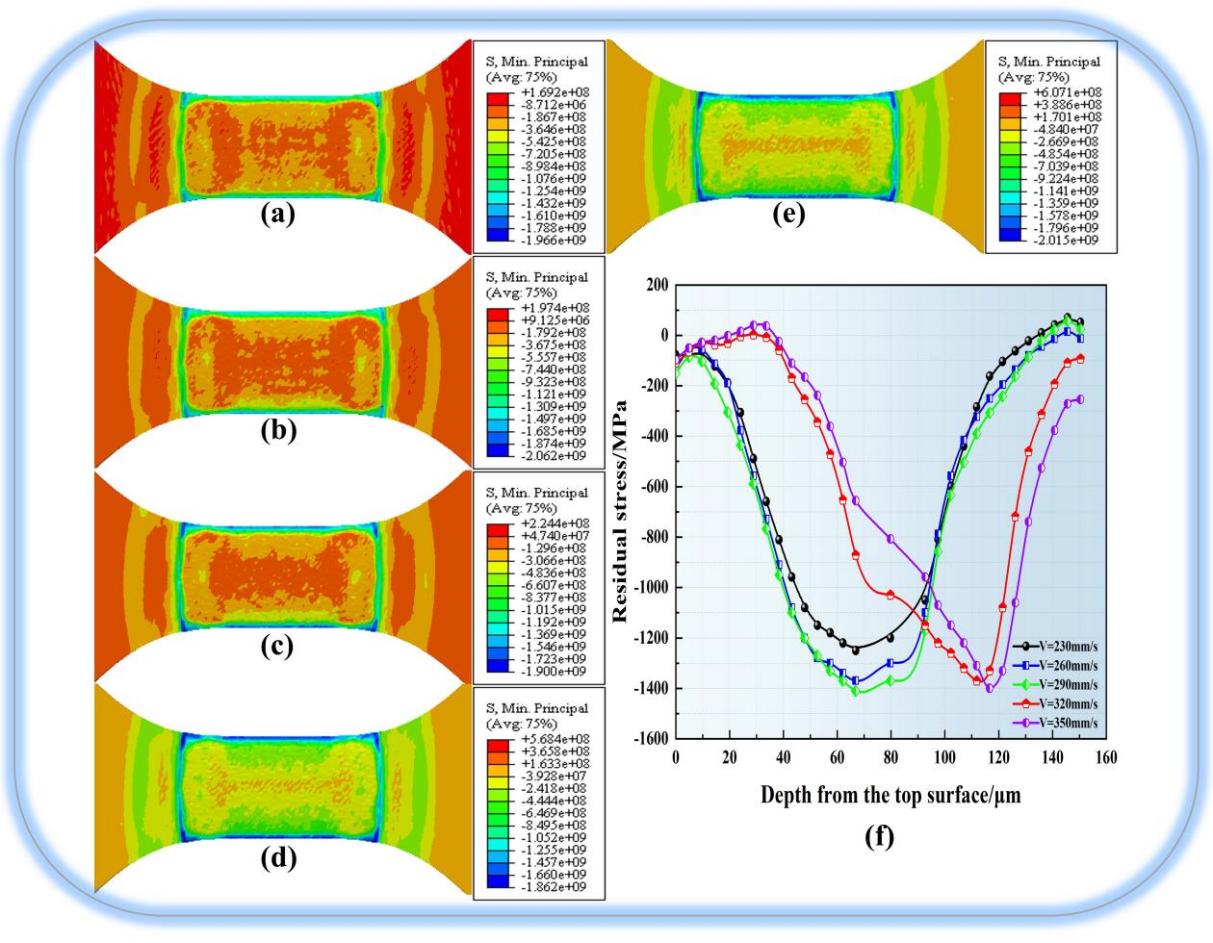
This study aims to elucidate the mechanisms governing residual stress formation and fatigue behavior in Inconel~718 subjected to water jet peening (WJP). A finite element model of the WJP process and a fatigue analysis model were developed using Abaqus and fe-safe, respectively. Particular attention was given to the residual stress, surface roughness, and fatigue life of WJP-treated Inconel~718. The results reveal that jet velocity exerts a dual effect on the strengthening response of Inconel~718. Jet velocity also strongly affects the fatigue resistance of specimens with thicknesses of 8 and 10~mm. However, once the jet velocity reaches 320~mm/s, the ability of WJP to induce compressive residual stress decreases, accompanied by deterioration of the surface morphology, which adversely affects fatigue behavior. Within the jet velocity range of 230--290~mm/s, the maximum compressive residual stress increases with increasing jet velocity. For specimens with thicknesses of 8, 10, and 12~mm, the differences in maximum compressive residual stress across this velocity range are approximately 170, 130, and 180~MPa, respectively. When the jet velocity is further increased to 320--350~mm/s, surface erosion reduces the effectiveness of compressive residual stress induction. The maximum compressive residual stress of the 8-mm-thick specimen falls slightly below that obtained at 290~mm/s, that of the 10-mm-thick specimen decreases by approximately 80~MPa from 320 to 350~mm/s, and that of the 12-mm-thick specimen treated at 320~mm/s is approximately 250~MPa lower than that obtained at 290~mm/s. The average surface roughness generally increases with increasing jet velocity. Surface cracks with depths of approximately 60--108~$\mu$m are observed in the 12-mm-thick specimens treated at 230--290~mm/s, whereas high-pressure WJP significantly suppresses subsequent crack propagation. The 8- and 10-mm-thick specimens exhibit superior fatigue resistance after WJP at 230--290~mm/s. Under an applied stress of 70~MPa, the maximum fatigue lives of the 8- and 10-mm-thick specimens reach 1{,}539{,}314 and 1{,}453{,}451 cycles, respectively. In contrast, the presence of surface cracks substantially reduces the fatigue lives of the 12-mm-thick specimens treated at 230--290~mm/s, for which the fatigue lives are 1{,}211{,}637, 1{,}111{,}250, and 1{,}296{,}931 cycles, respectively, under the same loading condition.
Graphical Abstract
Keywords
Data Availability Statement
Funding
Conflicts of Interest
AI Use Statement
Ethical Approval and Consent to Participate
References
- Zhang, D., Niu, W., Cao, X., & Liu, Z. (2015). Effect of standard heat treatment on the microstructure and mechanical properties of selective laser melting manufactured Inconel~718 superalloy. Materials Science and Engineering: A, 644, 32-40.
[CrossRef] [Google Scholar] - Tucho, W. M., Cuvillier, P., Sjolyst-Kverneland, A., & Hansen, V. (2017). Microstructure and hardness studies of Inconel 718 manufactured by selective laser melting before and after solution heat treatment. Materials Science and Engineering: A, 689, 220-232.
[CrossRef] [Google Scholar] - Thomas, A., El-Wahabi, M., Cabrera, J. M., & Prado, J. M. (2006). High temperature deformation of Inconel 718. Journal of Materials Processing Technology, 177(1-3), 469-472.
[CrossRef] [Google Scholar] - Chen, H., Ge, L., Liu, X., Tian, Z., Xu, B., & Hua, G. (2022). Effect of curvature of concave model on strengthening effect of 7050-T7451 aluminum alloy by laser shock. Applied Physics A, 128(8), 704.
[CrossRef] [Google Scholar] - Yin, F., Zhang, X., Chen, F., Hu, S., Ming, K., Zhao, J., ... & Wang, J. (2023). Understanding the microstructure refinement and mechanical strengthening of dual-phase high entropy alloy during ultrasonic shot peening. Materials & Design, 227, 111771.
[CrossRef] [Google Scholar] - Xu, X., Liu, D., Zhang, X., Liu, C., Liu, D., & Zhang, W. (2019). Influence of ultrasonic rolling on surface integrity and corrosion fatigue behavior of 7B50-T7751 aluminum alloy. International Journal of Fatigue, 125, 237-248.
[CrossRef] [Google Scholar] - Hutli, E., Nedeljkovic, M., & Bony\'{ar, A. (2018). Controlled modification of the surface morphology and roughness of stainless steel 316 by a high speed submerged cavitating water jet. Applied Surface Science, 458, 293-304.
[CrossRef] [Google Scholar] - Zhang, P., Yue, X., Wang, P., & Zhai, Y. (2022). Influence of SiC pellets water jet peening on the surface integrity of 7075-T6 aluminum alloy. Vacuum, 196, 110760.
[CrossRef] [Google Scholar] - Arola, D., McCain, M.~L., Kunaporn, S., & Ramulu, M. (2001). Waterjet and abrasive waterjet surface treatment of titanium: a comparison of surface texture and residual stress. Wear, 249(10-11), 943-950.
[CrossRef] [Google Scholar] - Sadasivam, B., Hizal, A., & Arola, D. (2009). Abrasive waterjet peening with elastic prestress: A parametric evaluation. International Journal of Machine Tools and Manufacture, 49(2), 134-141.
[CrossRef] [Google Scholar] - Mahmoudi, A.~H., Jamali, A.~M., Salahi, F., & Khajeian, A. (2021). Effects of water jet peening on residual stresses, roughness, and fatigue. Surface Engineering, 37(8), 972-981.
[CrossRef] [Google Scholar] - Azhari, A., Schindler, C., Godard, C., Gibmeier, J., & Kerscher, E. (2016). Effect of multiple passes treatment in waterjet peening on fatigue performance. Applied Surface Science, 388, 468-474.
[CrossRef] [Google Scholar] - Yao, S. L., Wang, G. Y., Yu, H., Wang, J., Li, K. S., Liu, S., ... & Tu, S. T. (2022). Influence of submerged micro-abrasive waterjet peening on surface integrity and fatigue performance of TA19 titanium alloy. International Journal of Fatigue, 164, 107076.
[CrossRef] [Google Scholar] - Chakkravarthy, V., Oliveira, J. P., Mahomed, A., Yu, N., Manojkumar, P., Lakshmanan, M., ... & Narayan, R. L. (2023). Effect of abrasive water jet peening on NaCl-induced hot corrosion behavior of Ti–6Al–4V. Vacuum, 210, 111872.
[CrossRef] [Google Scholar] - Zhang, P., Liu, Z., Yue, X., Wang, P., & Zhai, Y. (2022). Water jet impact damage mechanism and dynamic penetration energy absorption of 2A12 aluminum alloy. Vacuum, 206, 111532.
[CrossRef] [Google Scholar] - Zhang, P., Gao, Y., Zhang, J., Yue, X., Zhou, H., & Sun, Y. (2024). The influence mechanism of water jet peening on the fatigue crack growth behavior of 7075 aluminum alloy. International Journal of Fatigue, 187, 108429.
[CrossRef] [Google Scholar] - Rivero, A., Alberdi, A., Artaza, T., Mendia, L., & Lamikiz, A. (2018). Surface properties and fatigue failure analysis of alloy~718 surfaces milled by abrasive and plain waterjet. The International Journal of Advanced Manufacturing Technology, 94(5-8), 2929-2938.
[CrossRef] [Google Scholar] - Cano Salinas, L., Moussaoui, K., Hejjaji, A., Salem, M., Hor, A., & Zitoune, R. (2021). Influence of abrasive water jet parameters on the surface integrity of Inconel~718. The International Journal of Advanced Manufacturing Technology, 114(3-4), 997-1009.
[CrossRef] [Google Scholar] - Wan, L., Cai, J., Qian, Y., Wu, S., Kang, Y., & Li, D. (2024). Surface integrity and fatigue performance of Ti6Al4V alloy peened by sinking bead abrasive jet. Journal of Materials Research and Technology, 32, 3169-3180.
[CrossRef] [Google Scholar] - Kim, J. C., Cheong, S. K., & Noguchi, H. (2013). Evolution of residual stress redistribution associated with localized surface microcracking in shot-peened medium-carbon steel during fatigue test. International Journal of Fatigue, 55, 147-157.
[CrossRef] [Google Scholar] - Li, Z., Wang, X., Wang, J., Lu, Y., & Shoji, T. (2020). High cycle fatigue behavior and numerical evaluation of Alloy 690TT steam generator tube. International Journal of Fatigue, 137, 105662.
[CrossRef] [Google Scholar]
Cite This Article
TY  - JOUR
AU  - Li, Yixiao
AU  - Li, Hanwen
AU  - Nie, Yu
AU  - Zhou, Siyu
AU  - Tan, Yawen
AU  - Gao, Yeran
PY  - 2026
DA  - 2026/11/22
TI  - Effect of Water Jet Peening on Fatigue Behavior of Inconel 718
JO  - Journal of Materials Durability and Engineering
T2  - Journal of Materials Durability and Engineering
JF  - Journal of Materials Durability and Engineering
VL  - 2
IS  - 1
SP  - 14
EP  - 24
DO  - 10.62762/JMDE.2026.467192
UR  - https://www.icck.org/article/abs/jmde.2026.467192
KW  - water jet peening
KW  - fatigue behavior
KW  - surface roughness
KW  - residual stress
AB  - This study aims to elucidate the mechanisms governing residual stress formation and fatigue behavior in Inconel~718 subjected to water jet peening (WJP). A finite element model of the WJP process and a fatigue analysis model were developed using Abaqus and fe-safe, respectively. Particular attention was given to the residual stress, surface roughness, and fatigue life of WJP-treated Inconel~718. The results reveal that jet velocity exerts a dual effect on the strengthening response of Inconel~718. Jet velocity also strongly affects the fatigue resistance of specimens with thicknesses of 8 and 10~mm. However, once the jet velocity reaches 320~mm/s, the ability of WJP to induce compressive residual stress decreases, accompanied by deterioration of the surface morphology, which adversely affects fatigue behavior. Within the jet velocity range of 230--290~mm/s, the maximum compressive residual stress increases with increasing jet velocity. For specimens with thicknesses of 8, 10, and 12~mm, the differences in maximum compressive residual stress across this velocity range are approximately 170, 130, and 180~MPa, respectively. When the jet velocity is further increased to 320--350~mm/s, surface erosion reduces the effectiveness of compressive residual stress induction. The maximum compressive residual stress of the 8-mm-thick specimen falls slightly below that obtained at 290~mm/s, that of the 10-mm-thick specimen decreases by approximately 80~MPa from 320 to 350~mm/s, and that of the 12-mm-thick specimen treated at 320~mm/s is approximately 250~MPa lower than that obtained at 290~mm/s. The average surface roughness generally increases with increasing jet velocity. Surface cracks with depths of approximately 60--108~$\mu$m are observed in the 12-mm-thick specimens treated at 230--290~mm/s, whereas high-pressure WJP significantly suppresses subsequent crack propagation. The 8- and 10-mm-thick specimens exhibit superior fatigue resistance after WJP at 230--290~mm/s. Under an applied stress of 70~MPa, the maximum fatigue lives of the 8- and 10-mm-thick specimens reach 1{,}539{,}314 and 1{,}453{,}451 cycles, respectively. In contrast, the presence of surface cracks substantially reduces the fatigue lives of the 12-mm-thick specimens treated at 230--290~mm/s, for which the fatigue lives are 1{,}211{,}637, 1{,}111{,}250, and 1{,}296{,}931 cycles, respectively, under the same loading condition.
SN  - pending
PB  - Institute of Central Computation and Knowledge
LA  - English
ER  -
@article{Li2026Effect,
  author = {Yixiao Li and Hanwen Li and Yu Nie and Siyu Zhou and Yawen Tan and Yeran Gao},
  title = {Effect of Water Jet Peening on Fatigue Behavior of Inconel 718},
  journal = {Journal of Materials Durability and Engineering},
  year = {2026},
  volume = {2},
  number = {1},
  pages = {14-24},
  doi = {10.62762/JMDE.2026.467192},
  url = {https://www.icck.org/article/abs/jmde.2026.467192},
  abstract = {This study aims to elucidate the mechanisms governing residual stress formation and fatigue behavior in Inconel~718 subjected to water jet peening (WJP). A finite element model of the WJP process and a fatigue analysis model were developed using Abaqus and fe-safe, respectively. Particular attention was given to the residual stress, surface roughness, and fatigue life of WJP-treated Inconel~718. The results reveal that jet velocity exerts a dual effect on the strengthening response of Inconel~718. Jet velocity also strongly affects the fatigue resistance of specimens with thicknesses of 8 and 10~mm. However, once the jet velocity reaches 320~mm/s, the ability of WJP to induce compressive residual stress decreases, accompanied by deterioration of the surface morphology, which adversely affects fatigue behavior. Within the jet velocity range of 230--290~mm/s, the maximum compressive residual stress increases with increasing jet velocity. For specimens with thicknesses of 8, 10, and 12~mm, the differences in maximum compressive residual stress across this velocity range are approximately 170, 130, and 180~MPa, respectively. When the jet velocity is further increased to 320--350~mm/s, surface erosion reduces the effectiveness of compressive residual stress induction. The maximum compressive residual stress of the 8-mm-thick specimen falls slightly below that obtained at 290~mm/s, that of the 10-mm-thick specimen decreases by approximately 80~MPa from 320 to 350~mm/s, and that of the 12-mm-thick specimen treated at 320~mm/s is approximately 250~MPa lower than that obtained at 290~mm/s. The average surface roughness generally increases with increasing jet velocity. Surface cracks with depths of approximately 60--108~\$\mu\$m are observed in the 12-mm-thick specimens treated at 230--290~mm/s, whereas high-pressure WJP significantly suppresses subsequent crack propagation. The 8- and 10-mm-thick specimens exhibit superior fatigue resistance after WJP at 230--290~mm/s. Under an applied stress of 70~MPa, the maximum fatigue lives of the 8- and 10-mm-thick specimens reach 1{,}539{,}314 and 1{,}453{,}451 cycles, respectively. In contrast, the presence of surface cracks substantially reduces the fatigue lives of the 12-mm-thick specimens treated at 230--290~mm/s, for which the fatigue lives are 1{,}211{,}637, 1{,}111{,}250, and 1{,}296{,}931 cycles, respectively, under the same loading condition.},
  keywords = {water jet peening, fatigue behavior, surface roughness, residual stress},
  issn = {pending},
  publisher = {Institute of Central Computation and Knowledge}
}
Article Metrics
Publisher's Note
ICCK stays neutral with regard to jurisdictional claims in published maps and institutional affiliations.
Rights and Permissions
 Copyright © 2026 by the Author(s). Published by Institute of Central Computation and Knowledge. This article is an open access article distributed under the terms and conditions of the Creative Commons Attribution (CC BY) license (https://creativecommons.org/licenses/by/4.0/), which permits use, sharing, adaptation, distribution and reproduction in any medium or format, as long as you give appropriate credit to the original author(s) and the source, provide a link to the Creative Commons licence, and indicate if changes were made.


Portico
