

Formalism of a Treatment-Modulated Logistic Map for Breast Tumor Growth: Mathematical Formulation, Nonlinear Dynamics, and Clinically Inspired Simulation



Article Information
Abstract
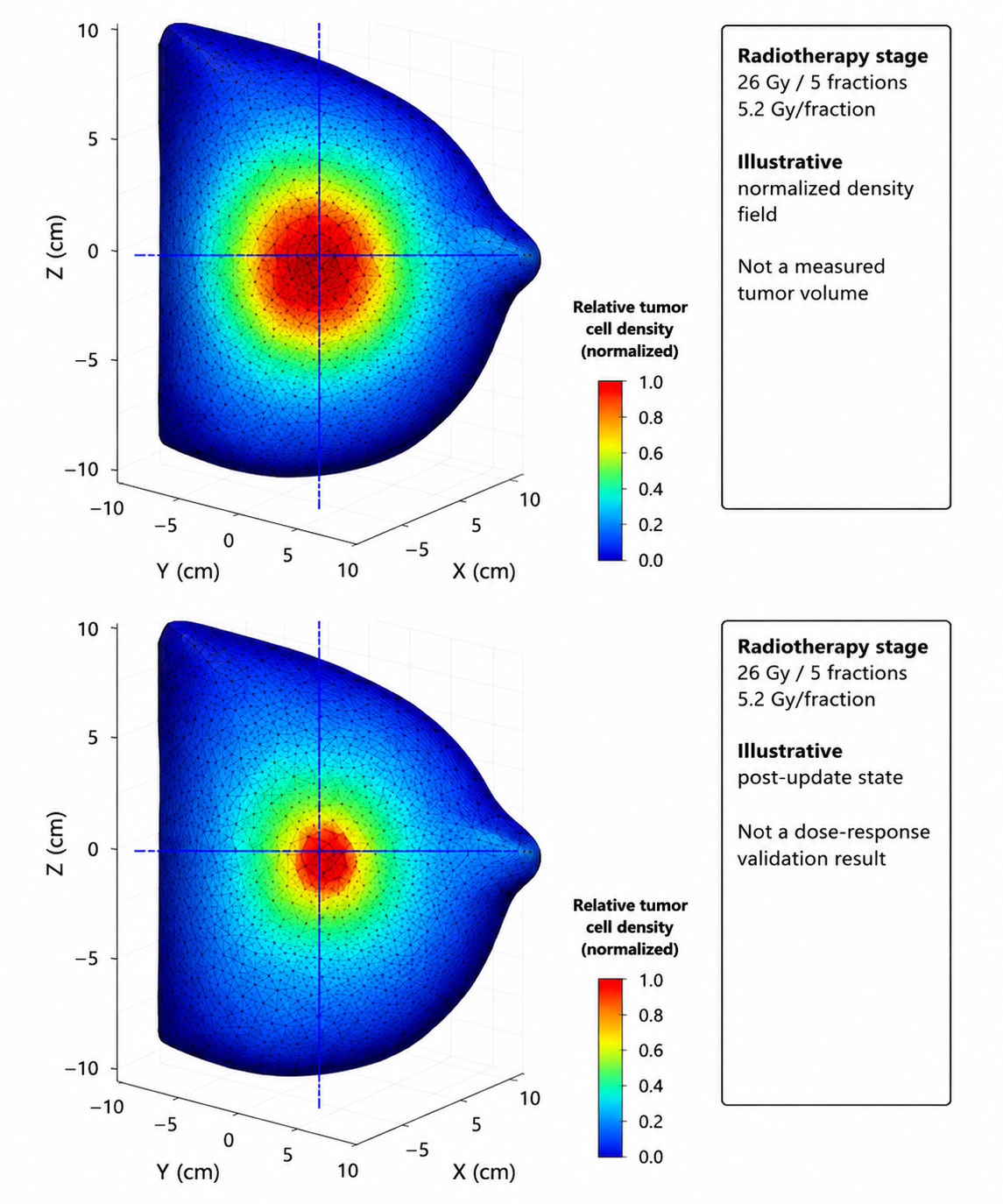
This study develops a treatment-modulated discrete framework for breast-tumor dynamics, emphasizing dimensional consistency, treatment dependence, and the distinction between scalar tumor burden and spatial tumor-density fields. Starting from the dimensional logistic growth law, treatment is introduced through a cycle-dependent survival factor. Normalization by the continuous carrying capacity $K_c$ yields the exact Euler update $y_{n+1}=S_n[y_n+g\Delta t_n y_n(1-y_n)]$, whereas the canonical non-autonomous map $x_{n+1}=r_nx_n(1-x_n)$, with $r_n=(1+g\Delta t_n)S_n$, is retained as a reduced nonlinear benchmark. This distinction prevents discretization-induced period-doubling and chaos from being interpreted as intrinsic tumor behavior. Invariance and cumulative extinction conditions are derived for non-autonomous sequences $\{r_n\}$, including the periodic product criterion. Radiotherapy is coupled through the linear-quadratic survival model and chemotherapy through an $E_{\max}$ exposure-response formulation. A published breast-cancer case provides the clinical treatment chronology, including chemotherapy and 26~Gy radiotherapy delivered in five fractions. Because longitudinal tumor measurements, voxel-level dose maps, pharmacokinetic data, and tumor-specific radiosensitivity parameters are unavailable, no patient-specific calibration or dose-response validation is claimed. Geant4 outputs are therefore used as clinically inspired spatial visualizations, with dose-to-survival coupling explicitly formulated. The framework also incorporates primitive-parameter uncertainty propagation and state-sensitivity analysis, providing a consistent basis for future patient-specific modeling.
Graphical Abstract
Keywords
Data Availability Statement
Funding
Conflicts of Interest
AI Use Statement
Ethical Approval and Consent to Participate
References
- Siegel, R. L., Kratzer, T. B., Giaquinto, A. N., Sung, H., & Jemal, A. (2025). Cancer statistics, 2025. CA: A Cancer Journal for Clinicians, 75(1), 10.
[CrossRef] [Google Scholar] - Kim, J., Harper, A., McCormack, V., Sung, H., Houssami, N., Morgan, E., ... & Fidler-Benaoudia, M. M. (2025). Global patterns and trends in breast cancer incidence and mortality across 185 countries. Nature medicine, 31(4), 1154-1162.
[CrossRef] [Google Scholar] - Atuegwu, N. C., Arlinghaus, L. R., Li, X., Chakravarthy, A. B., Abramson, V. G., Sanders, M. E., & Yankeelov, T. E. (2013). Parameterizing the logistic model of tumor growth by DW-MRI and DCE-MRI data to predict treatment response and changes in breast cancer cellularity during neoadjuvant chemotherapy. Translational oncology, 6(3), 256-264.
[CrossRef] [Google Scholar] - Pearl, R., & Reed, L. J. (1920). On the rate of growth of the population of the United States since 1790 and its mathematical representation. Proceedings of the national academy of sciences, 6(6), 275-288.
[CrossRef] [Google Scholar] - May, R. M. (1976). Simple mathematical models with very complicated dynamics. Nature, 261(5560), 459-467.
[CrossRef] [Google Scholar] - González Vázquez, A., & Villaverde, A. F. (2025). Analysing the structural identifiability and observability of mechanistic models of tumour growth. Bioengineering, 12(10), 1048.
[CrossRef] [Google Scholar] - Jiménez, R. P., & Hernandez, E. O. (2011). Tumour–host dynamics under radiotherapy. Chaos, solitons & fractals, 44(9), 685-692.
[CrossRef] [Google Scholar] - Zahid, M. U., Mohsin, N., Mohamed, A. S., Caudell, J. J., Harrison, L. B., Fuller, C. D., ... & Enderling, H. (2021). Forecasting individual patient response to radiation therapy in head and neck cancer with a dynamic carrying capacity model. International Journal of Radiation Oncology* Biology* Physics, 111(3), 693-704.
[CrossRef] [Google Scholar] - Hong, Y., Nixon, N., Cao, J. Q., & Lee, S. L. (2023). Case report: ultrahypofractionated palliative breast radiotherapy for a fungating invasive mammary carcinoma. Frontiers in Oncology, 13, 1171444.
[CrossRef] [Google Scholar] - Fowler, J. F. (1989). The linear-quadratic formula and progress in fractionated radiotherapy. The British Journal of Radiology, 62(740), 679-694.
[CrossRef] [Google Scholar] - Mould, D. R., Walz, A. C., Lave, T., Gibbs, J. P., & Frame, B. (2015). Developing exposure/response models for anticancer drug treatment: special considerations. CPT: pharmacometrics & systems pharmacology, 4(1), 12-27.
[CrossRef] [Google Scholar] - Mo, G., Gibbons, F., Schroeder, P., & Krzyzanski, W. (2014). Lifespan based pharmacokinetic-pharmacodynamic model of tumor growth inhibition by anticancer therapeutics. PLoS One, 9(10), e109747.
[CrossRef] [Google Scholar] - Agostinelli, S., Allison, J., Amako, K., Apostolakis, J., Araujo, H., Arce, P., \ldots\ & Zschiesche, D. (2003). Geant4---a simulation toolkit. Nuclear Instruments and Methods in Physics Research Section~A: Accelerators, Spectrometers, Detectors and Associated Equipment, 506(3), 250--303.
[CrossRef] [Google Scholar] - Burgos-Simón, C., Cortés, J. C., Martínez-Rodríguez, D., & Villanueva, R. J. (2020). Modeling breast tumor growth by a randomized logistic model: A computational approach to treat uncertainties via probability densities. The European Physical Journal Plus, 135(10), 826.
[CrossRef] [Google Scholar]
Cite This Article
TY  - JOUR
AU  - Farias, Matheus dos Santos
PY  - 2026
DA  - 2026/09/20
TI  - Formalism of a Treatment-Modulated Logistic Map for Breast Tumor Growth: Mathematical Formulation, Nonlinear Dynamics, and Clinically Inspired Simulation
JO  - Journal of Nonlinear Dynamics and Applications
T2  - Journal of Nonlinear Dynamics and Applications
JF  - Journal of Nonlinear Dynamics and Applications
VL  - 2
IS  - 3
SP  - 177
EP  - 191
DO  - 10.62762/JNDA.2026.825872
UR  - https://www.icck.org/article/abs/JNDA.2026.825872
KW  - logistic map
KW  - breast cancer
KW  - mathematical oncology
KW  - chemotherapy
KW  - radiotherapy
KW  - Geant4
KW  - nonlinear dynamics
KW  - Lyapunov exponent
KW  - bifurcation
KW  - treatment response
AB  - This study develops a treatment-modulated discrete framework for breast-tumor dynamics, emphasizing dimensional consistency, treatment dependence, and the distinction between scalar tumor burden and spatial tumor-density fields. Starting from the dimensional logistic growth law, treatment is introduced through a cycle-dependent survival factor. Normalization by the continuous carrying capacity $K_c$ yields the exact Euler update $y_{n+1}=S_n[y_n+g\Delta t_n y_n(1-y_n)]$, whereas the canonical non-autonomous map $x_{n+1}=r_nx_n(1-x_n)$, with $r_n=(1+g\Delta t_n)S_n$, is retained as a reduced nonlinear benchmark. This distinction prevents discretization-induced period-doubling and chaos from being interpreted as intrinsic tumor behavior. Invariance and cumulative extinction conditions are derived for non-autonomous sequences $\{r_n\}$, including the periodic product criterion. Radiotherapy is coupled through the linear-quadratic survival model and chemotherapy through an $E_{\max}$ exposure-response formulation. A published breast-cancer case provides the clinical treatment chronology, including chemotherapy and 26~Gy radiotherapy delivered in five fractions. Because longitudinal tumor measurements, voxel-level dose maps, pharmacokinetic data, and tumor-specific radiosensitivity parameters are unavailable, no patient-specific calibration or dose-response validation is claimed. Geant4 outputs are therefore used as clinically inspired spatial visualizations, with dose-to-survival coupling explicitly formulated. The framework also incorporates primitive-parameter uncertainty propagation and state-sensitivity analysis, providing a consistent basis for future patient-specific modeling.
SN  - 3069-6313
PB  - Institute of Central Computation and Knowledge
LA  - English
ER  -
@article{Farias2026Formalism,
  author = {Matheus dos Santos Farias},
  title = {Formalism of a Treatment-Modulated Logistic Map for Breast Tumor Growth: Mathematical Formulation, Nonlinear Dynamics, and Clinically Inspired Simulation},
  journal = {Journal of Nonlinear Dynamics and Applications},
  year = {2026},
  volume = {2},
  number = {3},
  pages = {177-191},
  doi = {10.62762/JNDA.2026.825872},
  url = {https://www.icck.org/article/abs/JNDA.2026.825872},
  abstract = {This study develops a treatment-modulated discrete framework for breast-tumor dynamics, emphasizing dimensional consistency, treatment dependence, and the distinction between scalar tumor burden and spatial tumor-density fields. Starting from the dimensional logistic growth law, treatment is introduced through a cycle-dependent survival factor. Normalization by the continuous carrying capacity \$K\_c\$ yields the exact Euler update \$y\_{n+1}=S\_n[y\_n+g\Delta t\_n y\_n(1-y\_n)]\$, whereas the canonical non-autonomous map \$x\_{n+1}=r\_nx\_n(1-x\_n)\$, with \$r\_n=(1+g\Delta t\_n)S\_n\$, is retained as a reduced nonlinear benchmark. This distinction prevents discretization-induced period-doubling and chaos from being interpreted as intrinsic tumor behavior. Invariance and cumulative extinction conditions are derived for non-autonomous sequences \$\{r\_n\}\$, including the periodic product criterion. Radiotherapy is coupled through the linear-quadratic survival model and chemotherapy through an \$E\_{\max}\$ exposure-response formulation. A published breast-cancer case provides the clinical treatment chronology, including chemotherapy and 26~Gy radiotherapy delivered in five fractions. Because longitudinal tumor measurements, voxel-level dose maps, pharmacokinetic data, and tumor-specific radiosensitivity parameters are unavailable, no patient-specific calibration or dose-response validation is claimed. Geant4 outputs are therefore used as clinically inspired spatial visualizations, with dose-to-survival coupling explicitly formulated. The framework also incorporates primitive-parameter uncertainty propagation and state-sensitivity analysis, providing a consistent basis for future patient-specific modeling.},
  keywords = {logistic map, breast cancer, mathematical oncology, chemotherapy, radiotherapy, Geant4, nonlinear dynamics, Lyapunov exponent, bifurcation, treatment response},
  issn = {3069-6313},
  publisher = {Institute of Central Computation and Knowledge}
}
Article Metrics
Publisher's Note
ICCK stays neutral with regard to jurisdictional claims in published maps and institutional affiliations.
Rights and Permissions


Portico
