

An Open-Source Fast Integral Transform Program for Quantum-Mechanical Wavefunction Propagation and Corresponding Eigenvalue and Eigenfunction Determination in one Spatial Dimension

Article Information
Abstract
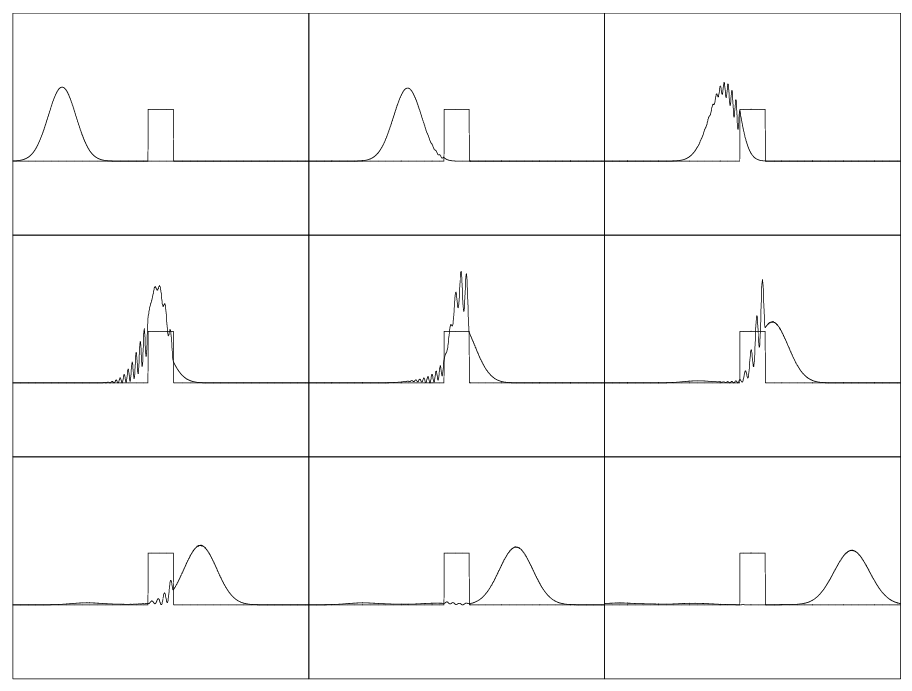
The underpinnings, usage, and capabilities of source code developed to simultaneously compute and display the temporal evolution of quantum-mechanical wavefunctions are described. This computation is done through direct numerical integration of Schrödinger's equation and is limited to one spatial dimension. The source code is freely downloadable for noncommercial, educational purposes. The Schrödinger equation's linearity in facilitating the computations along with important restrictions imposed by the algorithms employed are emphasized. Physical interpretations of the example systems treated are highlighted. Plenty of citations and footnotes are provided---both historical and pedagogical. The hope is that the source code will be valuable to both students and faculty involved with advanced undergraduate and beginning graduate quantum mechanics and quantum chemistry courses, and will be modified and used for their own~projects.
Graphical Abstract
Keywords
Data Availability Statement
Funding
Conflicts of Interest
AI Use Statement
Ethical Approval and Consent to Participate
References
- Heisenberg, W. (1925). Über quantentheoretische Umdeutung kinematischer und mechanischer Beziehungen. Zeitschrift für Physik, 33(1), 879-893.
[CrossRef] [Google Scholar] - Born, M., & Jordan, P. (1925). Zur quantenmechanik. Zeitschrift für Physik, 34(1), 858-888.
[CrossRef] [Google Scholar] - Born, M., Heisenberg, W., & Jordan, P. (1926). Zur quantenmechanik. II. Zeitschrift für Physik, 35(8), 557-615.
[CrossRef] [Google Scholar] - Dirac, P. A. M. (1925). The fundamental equations of quantum mechanics. Proceedings of the Royal Society of London. Series A, Containing Papers of a Mathematical and Physical Character, 109(752), 642-653.
[CrossRef] [Google Scholar] - Dirac, P. A. M. (1927). The physical interpretation of the quantum dynamics. Proceedings of the Royal Society of London. Series A, Containing Papers of a Mathematical and Physical Character, 113(765), 621-641.
[CrossRef] [Google Scholar] - Feynman, R. P. (1948). Space-time approach to non-relativistic quantum mechanics. Reviews of Modern Physics, 20(2), 367-387.
[CrossRef] [Google Scholar] - Feynman, R. P., & Hibbs, A. R. (2010). Quantum Mechanics and Path Integrals. Dover Publications.
[Google Scholar] - Schrödinger, E. (1926). Quantisierung als Eigenwertproblem. Annalen der Physik (Leipzig), 79, 361-76.
[CrossRef] [Google Scholar] - Schrödinger, E. (1926). Quantisierung als Eigenwertproblem. Annalen der Physik (Leipzig), 79, 489-527.
[CrossRef] [Google Scholar] - Schrödinger, E. (1926). Über das Verhältnis der Heisenberg-Born-Jordanshen Quantenmechanik zu der meinen. Annalen der Physik (Leipzig), 79, 734-56.
[CrossRef] [Google Scholar] - Schrödinger, E. (1926). Quantisierung als Eigenwertproblem. Annalen der Physik (Leipzig), 80, 437-90.
[CrossRef] [Google Scholar] - Schrödinger, E. (1926). Quantisierung als Eigenwertproblem. Annalen der Physik (Leipzig), 81, 109-39.
[CrossRef] [Google Scholar] - Eckart, C. (1926). Operator calculus and the solution of the equations of quantum dynamics. Physical Review, 28(4), 711-26.
[CrossRef] [Google Scholar] - Landau, L. D., & Lifshitz, E. M. (1977) Quantum Mechanics (Non-relativistic Theory). Pergamon Press. https://power1.pc.uec.ac.jp/~toru/notes/LandauLifshitz-QuantumMechanics.pdf
[Google Scholar] - Pauling, L., & Wilson, E. B. (1985). Introduction to Quantum Mechanics: with applications to chemistry. Courier Corporation.
[Google Scholar] - Blatt, J. M., & Weisskopf, V. F. (2012). Theoretical Nuclear Physics. Springer Science & Business Media.
[Google Scholar] - Newton, R. G. (2013). Scattering Theory of Waves and Particles. Springer Science & Business Media.
[Google Scholar] - Taylor, J. R. (2012). Scattering theory: the Quantum Theory of Nonrelativistic Collisions. Courier Corporation.
[Google Scholar] - Fleck Jr, J. A., Morris, J. R., & Feit, M. D. (1976). Time-dependent propagation of high energy laser beams through the atmosphere. Applied physics, 10(2), 129-160.
[CrossRef] [Google Scholar] - Feit, M. D., Fleck Jr, J. A., & Steiger, A. (1982). Solution of the Schrödinger equation by a spectral method. Journal of Computational Physics, 47(3), 412-433.
[CrossRef] [Google Scholar] - Feit, M. D., & Fleck Jr, J. A. (1983). Solution of the Schrödinger equation by a spectral method II: Vibrational energy levels of triatomic molecules. The Journal of Chemical Physics, 78(1), 301-308.
[CrossRef] [Google Scholar] - Feit, M. D., & Fleck Jr, J. A. (1984). Wave packet dynamics and chaos in the Hénon–Heiles system. The Journal of Chemical Physics, 80(6), 2578-2584.
[CrossRef] [Google Scholar] - Sweeney, C. J., & De Vries, P. L. (1989). Time‐dependent quantum‐mechanical scattering in two dimensions. Computers in Physics, 3(1), 49-54.
[CrossRef] [Google Scholar] - Dyson, F. J. (1949). The radiation theories of Tomonaga, Schwinger, and Feynman. Physical Review, 75(3), 486.
[CrossRef] [Google Scholar] - Bandrauk, A. D., & Shen, H. (1992). Higher order exponential split operator method for solving time-dependent Schrödinger equations. Canadian Journal of Chemistry, 70(2), 555-559.
[CrossRef] [Google Scholar] - Sakurai, J. J., & Napolitano, J. (2020). Modern quantum mechanics. Cambridge university press.
[Google Scholar] - Hardin, R. H. (1973). Application of the split‐step Fourier method to the numerical solution of nonlinear and variable coefficient wave equations. SIAM Rev., 15, 423.
[Google Scholar] - Baker, H. F. (1904). On functions of several variables. Proceedings of the London Mathematical Society, 2(1), 14-36.
[CrossRef] [Google Scholar] - Campbell, J. E. (1897). On a law of combination of operators (second paper). Proceedings of the London Mathematical Society, 1(1), 14-32.
[CrossRef] [Google Scholar] - Hausdorff, F. (1906). Die symbolische Exponentialformel in der Gruppentheorie. Ber. Verh. Kgl. Sä chs. Ges. Wiss. Leipzig., Math.-phys. Kl., 58, 19-48. https://cds.cern.ch/record/435181
[Google Scholar] - Trotter, H. F. (1959). On the product of semi-groups of operators. Proceedings of the American Mathematical Society, 10(4), 545-551.
[CrossRef] [Google Scholar] - Wilcox, R. M. (1967). Exponential operators and parameter differentiation in quantum physics. Journal of Mathematical Physics, 8(4), 962-982.
[CrossRef] [Google Scholar] - Veltman, M. (1994). Diagrammatica: the path to Feynman diagrams (No. 4). Cambridge University Press.
[Google Scholar] - Tannor, D. (2008). Introduction to quantum mechanics: a time-dependent perspective. MIT Press.
[Google Scholar] - Ruth, R. D. (2007). A Canonical Integration Technique. IEEE Transactions on Nuclear Science, 30(4), 2669-2671.
[CrossRef] [Google Scholar] - Hatano, N., & Suzuki, M. (2005). Finding exponential product formulas of higher orders. In Quantum annealing and other optimization methods (pp. 37-68). Berlin, Heidelberg: Springer Berlin Heidelberg.
[CrossRef] [Google Scholar] - Burden, R. L., Faires, J. D., & Burden, A. M. (2016). Numerical Analysis (10th ed.). Cengage Learning.
[Google Scholar] - Ziman, J. M. (1972). Principles of the Theory of Solids (2nd ed.). Cambridge University Press.
[Google Scholar] - Kittel, C., & Fong, C. Y. (1963). Quantum theory of solids (2nd ed.). New York: Wiley.
[CrossRef] [Google Scholar] - Churchill, R. V. (1972). Operational Mathematics (3rd ed.). McGraw-Hill.
[Google Scholar] - DeVries, P. L., & Hasbun, J. E. (2011). A First Course in Computational Physics (2nd ed.). Jones and Bartlett.
[Google Scholar] - Schiff, L. I. (1968). Quantum Mechanics (3rd ed.). McGraw-Hill.
[Google Scholar] - von Neumann, J. (2055). Mathematical Foundations of Quantum Mechanics: Princeton Univ. Press.
[CrossRef] [Google Scholar] - Baym, G. (1990). Lectures on Quantum Mechanics. Westview Press.
[Google Scholar] - Merzbacher, E. (1998). Quantum Mechanics (3rd ed.). John Wiley & Sons.
[Google Scholar] - Gottfried, K., & Yan, T. M. (2013). Quantum Mechanics: Fundamentals. Springer Science & Business Media.
[Google Scholar] - Jackson, J. D. (2006). Mathematics for quantum mechanics: an introductory survey of operators, eigenvalues, and linear vector spaces. Courier Corporation.
[Google Scholar] - Franklin, P. (1968). A Treatise on Advanced Calculus. Dover Publications.
[Google Scholar] - Bartle, R. G. (1976). The Elements of Real Analysis (2nd ed.). John Wiley & Sons.
[Google Scholar] - Halperin, I., & Schwartz, L. (1952). Introduction to the Theory of Distributions. University of Toronto Press.
[CrossRef] [Google Scholar] - Butkov, E. (1968). Mathematical Physics. Addison-Wesley Publishing Company.
[Google Scholar] - Hylleraas, E. A. (1970). Mathematical and Theoretical Physics (2 vols.). John Wiley & Sons. https://archive.org/details/mathematicaltheo0001hyll
[Google Scholar] - Dirac, P. A. M. (1981). The principles of quantum mechanics (No. 27). Oxford university press.
[Google Scholar] - Balakrishnan, V. (2003). All about the Dirac delta function (?). Resonance, 8(8), 48-58.
[CrossRef] [Google Scholar] - Harris, F. J. (1978). On the use of windows for harmonic analysis with the discrete Fourier transform. Proceedings of the IEEE, 66(1), 51-83.
[CrossRef] [Google Scholar] - Bevington, P. R., & Robinson, D. K. (2003). Data reduction and error analysis (Vol. 3). New York: McGraw-Hill. http://www.spy-hill.net/myers/vassar/201/notes/textalk.pdf
[Google Scholar] - Pang, T. (2006). An Introduction to Computational Physics (2nd ed.). Cambridge University Press.
[Google Scholar] - Feit, M. D., & Fleck Jr, J. A. (1980). Computation of mode properties in optical fiber waveguides by a propagating beam method. Applied Optics, 19(7), 1154-1164.
[CrossRef] [Google Scholar] - Swokowski, E. W. (1983). Calculus with Analytic Geometry (alt. ed.). Prindle, Weber & Schmidt.
[Google Scholar] - Zill, D. G. (1982). A First Course in Differential Equations with Applications (9th ed.). Prindle, Weber & Schmidt. https://ilkomitt.wordpress.com/wp-content/uploads/2016/01/dennis-g-zill_a-first-course-in-differential-equations-9th-ed.pdf
[Google Scholar] - Griffiths, D. J., & Schroeter, D. F. (2018). Introduction to quantum mechanics. Cambridge university press.
[Google Scholar] - Hamermesh, M. (1989). Group Theory and its Application to Physical Problems. Dover Publications.
[Google Scholar] - Tinkham, M. (2003). Group theory and quantum mechanics. Courier Corporation.
[Google Scholar] - Schatz, G. C., & Ratner, M. A. (2002). Quantum mechanics in chemistry.
[Google Scholar] - Pauli Jr, W. (1926). Über das Wasserstoffspektrum vom Standpunkt der neuen Quantenmechanik. Zeitschrift für Physik A Hadrons and NAuclei, 36(5), 336-363.
[CrossRef] [Google Scholar] - McIntosh, H. V. (1959). On accidental degeneracy in classical and quantum mechanics. American Journal of Physics, 27(9), 620-625.
[CrossRef] [Google Scholar] - Gauss, C. F. (1866). Nachlass: Theoria interpolationis methodo nova tractata. Carl Friedrich Gauss Werke, 3, 265-327. https://archive.org/details/werkecarlf03gausrich
[Google Scholar] - Danielson, G. C., & Lanczos, C. (1942). Some improvements in practical Fourier analysis and their application to X-ray scattering from liquids. Journal of the Franklin Institute, 233(5), 435-452.
[CrossRef] [Google Scholar] - Cooley, J. W., & Tukey, J. W. (1965). An algorithm for the machine calculation of complex Fourier series. Mathematics of computation, 19(90), 297-301.
[CrossRef] [Google Scholar] - Brigham, E. O. (1974). The Fast Fourier Transform. Prentice-Hall. https://archive.org/details/fastfouriertrans00brig
[Google Scholar] - Zonst, A. E. (2000). Understanding the FFT: A Tutorial on the Algorithm & Software for Laymen, Students, Technicians & Working Engineers (2nd rev. ed.). Citrus Press. https://archive.org/details/understandingfft0000zons
[Google Scholar] - Wyld, H. W. (1976). Mathematical Methods for Physics. W. A. Benjamin. https://inis.iaea.org/records/3q91n-bbn69
[Google Scholar] - Churchill, R. V., & Brown, J. W. (1984). Complex Variables and Applications (4th ed.). McGraw-Hill. https://archive.org/details/complexvariables0000jame/page/n1/mode/2up
[Google Scholar] - Nyquist, H. (1928). Certain topics in telegraph transmission theory. Transactions of the American Institute of Electrical Engineers, 47(2), 617-644.
[CrossRef] [Google Scholar] - Shannon, C. (1949). Communication in the Presence of Noise. Proceedings of the Institute of Radio Engineers, 37, 10-21.
[CrossRef] [Google Scholar] - Andrews, L. C., & Shivamoggi, B. K. (1988). Integral Transforms for Engineers and Applied Mathematicians. Macmillan. https://archive.org/details/integraltransfor0000andr_g3t2
[Google Scholar] - Landau, L. D., & Lifshitz, E. M. (1976). Mechanics (3rd ed.). Elsevier Butterworth-Heinemann. https://www.abebooks.com/COURSE-THEORETICAL-PHYSICS-VOLUME-MECHANICS-3ED/32436853333/bd
[Google Scholar] - Nuttall, A. H. (1981). Some Windows with Very Good Sidelobe Behavior. IEEE Transactions on Acoustics, Speech, and Signal Processing, 29, 84-91.
[CrossRef] [Google Scholar] - Press, W. H., Teukolsky, S. A., Vetterling, W. T., & Flannery, B. P. (1997). Numerical Recipes in Fortran 90: The Art of Parallel Scientific Computing (2nd ed., 2 vols.). Cambridge University Press. https://archive.org/details/numericalrecipes0000unse_k9a7
[Google Scholar] - Backus, J. (1998). The History of Fortran I, II, and III. IEEE Annals of the History of Computing, 20, 68-78.
[CrossRef] [Google Scholar] - Krill, P. (2024, May 6). Fortran popularity rises with numerical and scientific computing. InfoWorld. Retrieved from https://www.infoworld.com/article/2337114/fortran-popularity-rises-with-numerical-and-scientific-computing.html
[Google Scholar] - Hartree, D. R. (1928, January). The wave mechanics of an atom with a non-Coulomb central field. Part I. Theory and methods. In Mathematical Proceedings of the Cambridge Philosophical Society, 24(1), 89-110. Cambridge university press.
[CrossRef] [Google Scholar] - McWeeney, R. (1973). Natural Units in Atomic and Molecular Physics. Nature, 243(5), 196-198.
[CrossRef] [Google Scholar] - Liboff, R. I. (2003). Introductory Quantum Mechanics (4th ed.). Addison-Wesley. https://dn790006.ca.archive.org/0/items/LIBOFFIntroductoryQuantumMechanics/LIBOFF%20-%20Introductory%20Quantum%20Mechanics.pdf
[Google Scholar] - Goldberg, A., Schey, H. M., & Schwartz, J. L. (1967). Computer-generated motion pictures of one-dimensional quantum-mechanical transmission and reflection phenomena. American Journal of Physics, 35(3), 177-186.
[CrossRef] [Google Scholar] - McMurray, J., & Fay, R. C. (2001). Chemistry (3rd ed.). Prentice-Hall. https://archive.org/details/chemistry0000mcmu_l9v7
[Google Scholar] - Knight, R. D. (2013). Physics for Scientists and Engineers with Modern Physics (3rd ed.). Pearson Education.
[Google Scholar] - Schulz, G. J. (1973). Resonances in electron impact on diatomic molecules. Reviews of Modern Physics, 45(3), 378-486.
[CrossRef] [Google Scholar] - Biondi, M. A., Herzenberg, A., & Kuyatt, C. E. (1979). Resonances in atoms and molecules. Physics Today, 32(10), 44-49.
[CrossRef] [Google Scholar] - Wu, T. Y., & Ohmura, T. (2014). Quantum theory of scattering. Courier Corporation.
[Google Scholar] - Kane, G. (1993). Modern elementary particle physics. Cambridge Univ. Press. https://www.cambridge.org/us/universitypress/subjects/physics/particle-physics-and-nuclear-physics/modern-elementary-particle-physics-explaining-and-extending-standard-model-2nd-edition
[Google Scholar] - Arfken, G. B., Weber, H. J., & Harris, F. E. (2011). Mathematical methods for physicists: a comprehensive guide. Academic Press.
[CrossRef] [Google Scholar] - Brown, J. W., & Churchill, R. V. (2015). Fourier Series and Boundary Value Problems (8th ed.). McGraw-Hill Education Private Limited.
[Google Scholar] - Pitkanen, P. H. (1955). Rectangular potential well problem in quantum mechanics. American Journal of Physics, 23(2), 111-113.
[CrossRef] [Google Scholar] - Guest, P. (1972). Graphical solutions for the square well. American Journal of Physics, 40, 1175-1176.
[CrossRef] [Google Scholar] - Saxon, D. S. (2013). Elementary Quantum Mechanics. Dover Publications.
[Google Scholar] - de Alcantara Bonfim, O. F., & Griffiths, D. J. (2006). Exact and approximate energy spectrum for the finite square well and related potentials. American journal of physics, 74(1), 43-48.
[CrossRef] [Google Scholar] - Sternberg, S. (2019). A Mathematical Companion to Quantum Mechanics. Dover Publications.
[Google Scholar] - Reed, B. C. (2021). A guide to the literature of the finite rectangular well. American Journal of Physics, 89(5), 529-534.
[CrossRef] [Google Scholar] - Mott, H. F., & Massey, H. S. W. (1965). The Theory of Atomic Collisions (3rd ed.). Oxford University Press.
[Google Scholar] - Roman, P. (1965). Advanced Quantum Theory: An Outline of the Fundamental Ideas. Addison-Wesley. https://archive.org/details/advancedquantumt0000roma
[Google Scholar] - Noumerov, B. V. (1924). A method of extrapolation of perturbations. Monthly Notices of the Royal Astronomical Society, 84(6), 592-602.
[CrossRef] [Google Scholar] - Numerov, B. (1927). Note on the numerical integration of d2x/dt2= f (xt). Astronomische Nachrichten, 230(19), 359-364.
[CrossRef] [Google Scholar] - Koonin, S. E. (2018). Computational physics: Fortran version. CRC Press. https://archive.org/details/computationalphy0000koon
[Google Scholar] - Yariv, A. (1982). An Introduction to Theory and Applications of Quantum Mechanics. Dover Publications.
[Google Scholar] - Frankl, D. R. (1986). Electromagnetic Theory. Prentice-Hall.
[Google Scholar] - Jackson, J. D. (1999). Classical Electrodynamics (3rd ed.). John Wiley & Sons.
[CrossRef] [Google Scholar] - Messiah, A. (2014). Quantum mechanics. Courier Corporation.
[Google Scholar] - McTavish, J. P. (1982). Separable potentials and their momentum-energy dependence. Journal of Physics G: Nuclear Physics, 8(8), 1037-1048.
[CrossRef] [Google Scholar] - Born, M., & Oppenheimer, R. (1927). Zur quantentheorie der molekeln. Annalen der Physik (Leipzig), 389(20), 457-484.
[CrossRef] [Google Scholar] - Fowles, G. R. (1986). Analytical Mechanics (4th ed.). Saunders College Publishing. https://archive.org/details/analyticalmechan0000fowl_h7b9
[Google Scholar] - Goldstein, H., Poole, C., & Safko, J. (2002). Classical Mechanics (3rd ed.). Addison-Wesley. https://archive.org/details/HerbertGoldsteinCharlesPooleJohnSafkoClassicalMechanics3rdEd/page/n5/mode/2up
[Google Scholar] - Uhlenbeck, G. E., Ford, G. W., & Montroll, E. W. (1963). Lectures in Statistical Mechanics. American Mathematical Society. https://digitalcommons.rockefeller.edu/ru-authors/168/
[Google Scholar] - Sears, F. W., & Salinger, G. L. (1975). Thermodynamics, Kinetic Theory, and Statistical Thermodynamics (3rd ed.). Addison-Wesley. https://archive.org/details/thermodynamicski0000sear
[Google Scholar] - Huang, K. (1987). Statistical Mechanics (3rd ed.). John Wiley & Sons.
[Google Scholar] - Cohen-Tannoudji, C., Diu, B., & Laloë, F. (1977). Quantum Mechanics (2 vols.). John Wiley & Sons. https://www.wiley.com/en-us/Quantum+Mechanics%2C+Volume+1%3A+Basic+Concepts%2C+Tools%2C+and+Applications%2C+2nd+Edition-p-9783527822713
[Google Scholar] - Lenhard, J., Stephan, S., & Hasse, H. (2024). On the History of the Lennard‐Jones Potential. Annalen der Physik (Leipzig), 536(6), 2400115.
[CrossRef] [Google Scholar] - Levine, I. R. (2017). Quantum Chemistry (7th ed.). Pearson India Education Services Pvt. Ltd. http://macl-ustm.digitallibrary.co.in/handle/123456789/3252
[Google Scholar] - Morse, P. M. (1929). Diatomic molecules according to the wave mechanics. II. Vibrational levels. Physical review, 34(1), 57-64.
[CrossRef] [Google Scholar] - Pekeris, C. L. (1934). The Rotation-Vibration Coupling in Diatomic Molecules. Physical Review, 45(4), 98-103.
[CrossRef] [Google Scholar] - Girifalco, L. A., & Weizer, V. G. (1959). Application of the Morse potential function to cubic metals. Physical Review, 114(3), 687-690.
[CrossRef] [Google Scholar] - Schrödinger, E. (1940, January). A method of determining quantum-mechanical eigenvalues and eigenfunctions. In Proceedings of the Royal Irish Academy. Section A: Mathematical and Physical Sciences, 46(1), 9-16. https://www.jstor.org/stable/20490744
[Google Scholar] - Infeld, L., & Hull, T. E. (1951). The factorization method. Reviews of modern Physics, 23(1), 21-68.
[CrossRef] [Google Scholar] - Dong, S. H., Lemus, R., & Frank, A. (2002). Ladder operators for the Morse potential. International Journal of Quantum Chemistry, 86(5), 433-439.
[CrossRef] [Google Scholar] - Hecht, K. T. (2012). Quantum mechanics. Springer Science & Business Media.
[Google Scholar] - Konowalow, D. D., & Hirschfelder, J. O. (1961). Morse Potential Parameters for O–O, N–N, and N–O Interactions. The Physics of Fluids, 4(5), 637-642.
[CrossRef] [Google Scholar] - Rosen, B. (Ed.). (1970). Constantes Sélectionnées Données Spectroscopiques relatives aux Molécules Diatomiques. Pergamon Press. https://search.worldcat.org/title/2187305
[Google Scholar] - Huber, K. P., & Herzberg, G. (1979). Molecular Spectra and Molecular Structure IV. Constants of Diatomic Molecules. Van Nostrand Reinhold.
[CrossRef] [Google Scholar] - Shyn, T. W., & Sweeney, C. J. (1993). Vibrational-excitation cross sections of molecular oxygen by electron impact. Physical Review A, 48(2), 1214-1217.
[CrossRef] [Google Scholar] - Vemulapalli, G. K. (1993). Physical Chemistry. Prentice-Hall. https://archive.org/details/physicalchemistr0000vemu
[Google Scholar] - King, G. W. (1964). Spectroscopy and Molecular Structure. Holt, Rinehart, and Winston. https://www.semanticscholar.org/paper/Spectroscopy-and-Molecular-Structure-King/2ccbb5258bdbb14e9296c9130869cce98b4867c6
[Google Scholar] - Pilar, F. L. (2001). Elementary Quantum Chemistry (2nd ed.). Dover Publications.
[Google Scholar] - Poincaré, H. (1890). Sur le problème des trois corps et les équations de la dynamique. Acta Mathematica, 13(1), 1-270.
[CrossRef] [Google Scholar] - Bocchieri, P., & Loinger, A. (1957). Quantum Recurrence Theorem. Physical Review, 107(102), 337-8.
[CrossRef] [Google Scholar] - Percival, I. C. (1961). Almost periodicity and the quantal H theorem. Journal of Mathematical Physics, 2(2), 235-239.
[CrossRef] [Google Scholar] - Schulman, L. S. (1978). Note on the quantum recurrence theorem. Physical Review A, 18(5), 2379-2380.
[CrossRef] [Google Scholar] - Sewell, G. L. (2014). Quantum theory of collective phenomena. Courier Corporation.
[Google Scholar]
Cite This Article
TY  - JOUR
AU  - Sweeney, Christopher J.
PY  - 2026
DA  - 2026/05/27
TI  - An Open-Source Fast Integral Transform Program for Quantum-Mechanical Wavefunction Propagation and Corresponding Eigenvalue and Eigenfunction Determination in one Spatial Dimension
JO  - Journal of Numerical Simulations in Physics and Mathematics
T2  - Journal of Numerical Simulations in Physics and Mathematics
JF  - Journal of Numerical Simulations in Physics and Mathematics
VL  - 2
IS  - 1
SP  - 39
EP  - 58
DO  - 10.62762/JNSPM.2026.747031
UR  - https://www.icck.org/article/abs/JNSPM.2026.747031
KW  - Approximate solution of partial differential equations
KW  - Solution of Schrödinger's equation numerically using fast integral transforms
KW  - Visualization of wavefunction evolution in quantum mechanics and quantum chemistry
AB  - The underpinnings, usage, and capabilities of source code developed to simultaneously compute and display the temporal evolution of quantum-mechanical wavefunctions are described. This computation is done through direct numerical integration of Schrödinger's equation and is limited to one spatial dimension. The source code is freely downloadable for noncommercial, educational purposes. The Schrödinger equation's linearity in facilitating the computations along with important restrictions imposed by the algorithms employed are emphasized. Physical interpretations of the example systems treated are highlighted. Plenty of citations and footnotes are provided---both historical and pedagogical. The hope is that the source code will be valuable to both students and faculty involved with advanced undergraduate and beginning graduate quantum mechanics and quantum chemistry courses, and will be modified and used for their own~projects.
SN  - 3068-9082
PB  - Institute of Central Computation and Knowledge
LA  - English
ER  -
@article{Sweeney2026An,
  author = {Christopher J. Sweeney},
  title = {An Open-Source Fast Integral Transform Program for Quantum-Mechanical Wavefunction Propagation and Corresponding Eigenvalue and Eigenfunction Determination in one Spatial Dimension},
  journal = {Journal of Numerical Simulations in Physics and Mathematics},
  year = {2026},
  volume = {2},
  number = {1},
  pages = {39-58},
  doi = {10.62762/JNSPM.2026.747031},
  url = {https://www.icck.org/article/abs/JNSPM.2026.747031},
  abstract = {The underpinnings, usage, and capabilities of source code developed to simultaneously compute and display the temporal evolution of quantum-mechanical wavefunctions are described. This computation is done through direct numerical integration of Schrödinger's equation and is limited to one spatial dimension. The source code is freely downloadable for noncommercial, educational purposes. The Schrödinger equation's linearity in facilitating the computations along with important restrictions imposed by the algorithms employed are emphasized. Physical interpretations of the example systems treated are highlighted. Plenty of citations and footnotes are provided---both historical and pedagogical. The hope is that the source code will be valuable to both students and faculty involved with advanced undergraduate and beginning graduate quantum mechanics and quantum chemistry courses, and will be modified and used for their own~projects.},
  keywords = {Approximate solution of partial differential equations, Solution of Schrödinger's equation numerically using fast integral transforms, Visualization of wavefunction evolution in quantum mechanics and quantum chemistry},
  issn = {3068-9082},
  publisher = {Institute of Central Computation and Knowledge}
}
Article Metrics
Publisher's Note
ICCK stays neutral with regard to jurisdictional claims in published maps and institutional affiliations.
Rights and Permissions
 Copyright © 2026 by the Author(s). Published by Institute of Central Computation and Knowledge. This article is an open access article distributed under the terms and conditions of the Creative Commons Attribution (CC BY) license (https://creativecommons.org/licenses/by/4.0/), which permits use, sharing, adaptation, distribution and reproduction in any medium or format, as long as you give appropriate credit to the original author(s) and the source, provide a link to the Creative Commons licence, and indicate if changes were made.


Portico
