

Advances in Plant Electrical Signals for Plant Health Monitoring and Smart Agriculture




Article Information
Abstract
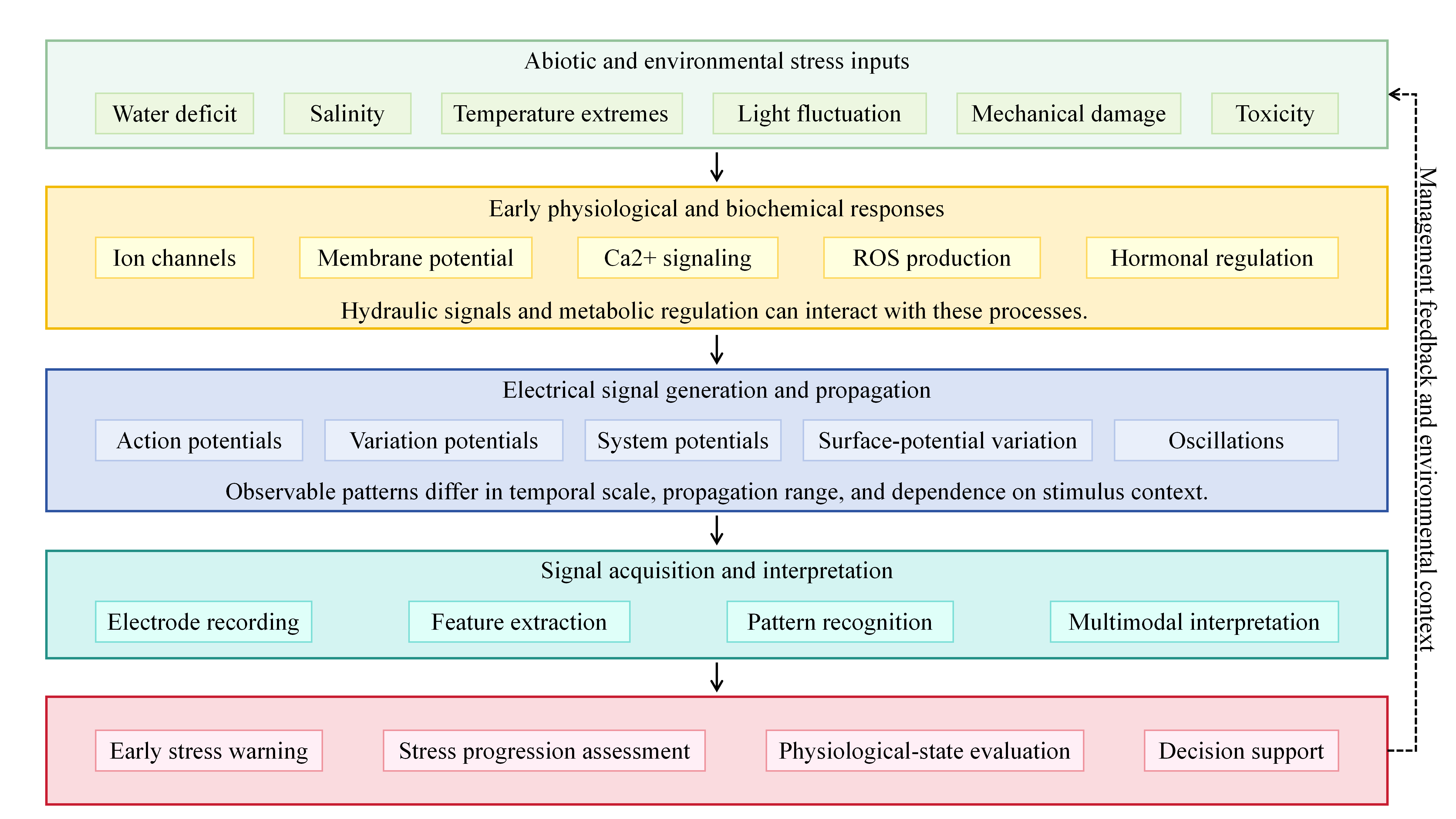
Plant electrical signals are fast electrophysiological responses to environmental stimuli, physiological regulation and stress. Because they often change before visible symptoms appear, they are attractive indicators for early plant-health monitoring and for sensing in precision agriculture. Research in this area has moved from recording single action potentials to analyzing the plant electrome, and now draws on flexible wearable electrodes, implantable and electrochemical sensors, machine learning, multi-source data fusion and edge-cloud computing. This review follows the technical chain from mechanism to application. We first summarize the physiological basis of the main signal types and how they relate to biotic and abiotic stress. We then compare acquisition technologies, including conventional electrodes, flexible wearable devices, microneedles and electrochemical sensors for biochemical markers. Next, we discuss preprocessing, multi-scale feature extraction, and recognition with conventional machine learning, deep learning and multi-source fusion. Finally, we examine applications in environmental sensing and stress identification and outline the remaining obstacles to field use. Most published results still come from laboratory or greenhouse studies with small datasets and non-standard protocols. Progress toward field deployment will depend on standardized acquisition and reporting, long-term sensor stability, cross-species and cross-site validation, open datasets, interpretable models and low-power edge inference. With these elements in place, plant electrical signals could serve as one component of decision-support systems for early warning and crop management.
Graphical Abstract
Keywords
Data Availability Statement
Funding
Conflicts of Interest
AI Use Statement
Ethical Approval and Consent to Participate
References
- Wang, R. (2024). Agricultural sensor: Research progress, challenges and perspectives. Smart Agriculture, 6(1), 1-17.
[CrossRef] [Google Scholar] - Sun, J., Tan, X., Li, X., Chen, J., Cai, S., Fan, Y., ... & Sun, S. (2026). A Review of On‐Site Detection Methods for Plant Health Based on Electrical Characteristics. Journal of Sensors, 2026(1), 7479434.
[CrossRef] [Google Scholar] - Steeneken, P. G., Kaiser, E., Verbiest, G. J., & ten Veldhuis, M. C. (2023). Sensors in agriculture: towards an Internet of Plants. Nature Reviews Methods Primers, 3(1), 60.
[CrossRef] [Google Scholar] - Yu, P., Teng, F., Zhu, W., Shen, C., Chen, Z., & Song, J. (2025). Cloud-edge-device collaborative computing in smart agriculture: Architectures, applications, and future perspectives. Frontiers in Plant Science, 16, 1668545.
[CrossRef] [Google Scholar] - Ghasemi, E., Ebrahimie, E., & Niazi, A. (2024). Machine learning for early detection of plant viruses: Analyzing post-infection electrical signal patterns. Smart Agricultural Technology, 9, 100668.
[CrossRef] [Google Scholar] - Matić, S., Masoero, G., Egidi, A., Francese, C., Capra, P. P., & Sosso, A. (2025). Electrical signalling in tomato-Oidium neolycopersici pathosystem for detection of powdery mildew. Computers and Electronics in Agriculture, 237, 110585.
[CrossRef] [Google Scholar] - Sun, B., Wu, S., Nie, X., Jia, L., Zhang, X., & Qian, J. (2025). Development of a Predictive Model Linking Electrical Characteristics to Semi-Lethal Temperature in Potted Apple Trees with Validation on Mature Specimens. Agronomy, 15(6), 1458.
[CrossRef] [Google Scholar] - Javed, Q., & Azeem, A. (2026). Electrobiological Signatures as Early Indicators of Plant Stress and Adaptation. Journal of Plant Electrobiology, 1(1), 58-73.
[CrossRef] [Google Scholar] - Kozlova, E., Yudina, L., Sukhova, E., & Sukhov, V. (2025). Analysis of electrome as a tool for plant monitoring: progress and perspectives. Plants, 14(10), 1500.
[CrossRef] [Google Scholar] - Doménech-Carbó, A. (2025). Plant Electrochemistry: Physiology and Applications. Boca Raton, FL: CRC Press. ISBN 978-1-032-69781-9.
[CrossRef] [Google Scholar] - Xie, R., Song, Y., Shi, X., Jia, L., & Liu, Z. (2026). Coupling mechanisms of electrophysiology and photosynthesis mediated by ion dynamics in high-voltage electrostatic field-regulated tomato seedling growth. Frontiers of Agricultural Science and Engineering, 13(4), 26668.
[CrossRef] [Google Scholar] - de Carvalho Oliveira, T. F., Costa, Á. V. L., Posso, D. A., Reissig, G. N., & Souza, G. M. (2025). Time dispersion analysis of features as a tool for investigating plant electrophysiology: A case study using moderate magnetic field in bean plants. Journal of Biological Physics, 51(1), 28.
[CrossRef] [Google Scholar] - Terral, O., Melikov, R., Lim, D. U., Dar, A. M., & Stavrinidou, E. (2026). Plant electrical signals: From scattered observations to functional understanding. Current opinion in plant biology, 93, 102954.
[CrossRef] [Google Scholar] - Yan, X., Pang, Y., Niu, K., Hu, B., Zhu, Z., Tan, Z., & Lei, H. (2025). Wearable sensors for plants: status and prospects. Biosensors, 15(1), 53.
[CrossRef] [Google Scholar] - Lee, G., Wei, Q., & Zhu, Y. (2021). Emerging wearable sensors for plant health monitoring. Advanced Functional Materials, 31(52), 2106475.
[CrossRef] [Google Scholar] - Yan, B., Zhang, F., Wang, M., Zhang, Y., & Fu, S. (2024). Flexible wearable sensors for crop monitoring: a review. Frontiers in Plant Science, 15, 1406074.
[CrossRef] [Google Scholar] - Yuan, J., Wang, H., Wang, S., He, X., Xing, J., Cui, S., ... & Li, W. (2026). Wearable and flexible sensor technologies for monitoring plant physiology and environmental conditions. Sensor Review, 1-16.
[CrossRef] [Google Scholar] - Zhou, J., Fan, P., Zhou, S., Pan, Y., & Ping, J. (2025). Machine learning-assisted implantable plant electrophysiology microneedle sensor for plant stress monitoring. Biosensors and Bioelectronics, 271, 117062.
[CrossRef] [Google Scholar] - Crichton, C. A., Sharpe, T., López-Pozo, M., Kabutz, H., Strand, E. J., Bruno, N., ... & Whiting, G. L. (2026). Long-term on-leaf monitoring of plant electrophysiology with printed adhesive gel bioelectrodes. Communications Engineering, 5(1), 86.
[CrossRef] [Google Scholar] - Qi, J., Yang, Y., Wang, Y., Wang, H., Wang, Q., Shi, Y., ... & Men, H. (2026). Spatial Optimization of Electrophysiological Signal Acquisition in Clivia Leaves Under a Controlled Leaf-Surface Salt-Treatment Model. Plants, 15(9), 1363.
[CrossRef] [Google Scholar] - Hosu, I. S., Fierăscu, R. C., & Fierăscu, I. (2026). Electrochemical (Bio) Sensors Based on Nanotechnologies for the Detection of Important Biomolecules in Plants and Plant-Related Samples: The Future of Smart and Precision Agriculture. Biosensors, 16(2), 107.
[CrossRef] [Google Scholar] - Coatsworth, P., Gonzalez-Macia, L., Collins, A. S. P., Bozkurt, T., & Güder, F. (2023). Continuous monitoring of chemical signals in plants under stress. Nature Reviews Chemistry, 7(1), 7-25.
[CrossRef] [Google Scholar] - Seddaoui, N., & Arduini, F. (2025). Recent advances in wearable and implantable electrochemical (bio) sensors for plant health monitoring. TrAC Trends in Analytical Chemistry, 191, 118336.
[CrossRef] [Google Scholar] - Zhou, S., Zhou, J., Pan, Y., Wu, Q., & Ping, J. (2024). Wearable electrochemical sensors for plant small-molecule detection. Trends in Plant Science, 29(2), 219-231.
[CrossRef] [Google Scholar] - Torre, M. Z. D. L., Sifuentes-Gallardo, C., González-Ramírez, E., Cruz-Dominguez, O., Ortega-Sigala, J., Díaz-Flórez, G., ... & Durán-Muñoz, H. (2025). Electrical Signal Characterization of Aloe vera Var. Chinensis Using Non-Parametric and Parametric Signal Analysis. Applied Sciences, 15(4), 1708.
[CrossRef] [Google Scholar] - Gu, J., Tian, F., Shi, J., & Tan, F. (2024). Noise reduction and analysis of leaf electrical signals of strap-leaved plants based on VMD-EWT. Computers and Electronics in Agriculture, 226, 109441.
[CrossRef] [Google Scholar] - Liu, Z., Tian, F., & Tan, F. (2025). Analysis of electrical signals in plant physiological responses: A multi-scale adaptive denoising method based on CEEMDAN-WST. Agriculture, 15(21), 2269.
[CrossRef] [Google Scholar] - Ren, Z., Tian, F., Wang, S., & Chen, S. (2025). Research on maize leaves surface action potential recognition method based on ResNet-18SE. Smart Agricultural Technology, 10, 100819.
[CrossRef] [Google Scholar] - Zhou, Z., Zhang, X., Zhang, C., & Shen, H. (2025). A 1DCNN-GRU Hybrid System on FPGA for Plant Electrical Signal Feature Classification. Applied Sciences, 15(21), 11446.
[CrossRef] [Google Scholar] - Wahid, A. M. A., Baihaqi, W. M., & Nambo, H. (2026). Transformer Adaptation for Plant Bioelectric Potential Classification: A Scoping Review and Analogical Transfer Framework. Smart Agricultural Technology, 102484.
[CrossRef] [Google Scholar] - Liu, C., Qi, J., Xia, X., Wang, Y., Wang, Q., Sun, L., & Men, H. (2025). Cross-individual electrophysiological signal recognition in Clivia biosensors via domain adaptation. Applied Soft Computing, 178, 113323.
[CrossRef] [Google Scholar] - Tran, D., Dutoit, F., Najdenovska, E., Wallbridge, N., Plummer, C., Mazza, M., ... & Camps, C. (2019). Electrophysiological assessment of plant status outside a Faraday cage using supervised machine learning. Scientific reports, 9(1), 17073.
[CrossRef] [Google Scholar] - Yeom, M. S., Lee, Y., Oh, H., Lee, E., & Oh, M. M. (2025). Applying machine learning for the classification of environmental conditions using plant electrical signals. Horticulture, Environment, and Biotechnology, 66(6), 1481-1490.
[CrossRef] [Google Scholar] - Aust, T., Buss, E., Mohr, F., & Hamann, H. (2025, March). Automated phytosensing: Ozone exposure classification based on plant electrical signals. In 2025 IEEE Symposia on Computational Intelligence for Energy, Transport and Environmental Sustainability (CIETES) (pp. 1-7). IEEE.
[CrossRef] [Google Scholar] - Buss, E., Aust, T., Hamburger, O., Karl Heck, C., & Hamann, H. (2025, March). Phytonode upgraded: Energy-efficient long-term environmental monitoring using phytosensing. In Future of Information and Communication Conference (pp. 119-138). Cham: Springer Nature Switzerland.
[CrossRef] [Google Scholar] - Najdenovska, E., Dutoit, F., Tran, D., Rochat, A., Vu, B., Mazza, M., ... & Raileanu, L. E. (2021). Identifying general stress in commercial tomatoes based on machine learning applied to plant electrophysiology. Applied Sciences, 11(12), 5640.
[CrossRef] [Google Scholar] - Simmi, F. Z., Dallagnol, L. J., Ferreira, A. S., Pereira, D. R., & Souza, G. M. (2020). Electrome alterations in a plant-pathogen system: Toward early diagnosis. Bioelectrochemistry, 133, 107493.
[CrossRef] [Google Scholar] - Zambrano-de la Torre, M., Olvera-Gonzalez, E., Záyago-Lau, E., Alaniz-Lumbreras, D., González-Ramírez, E., Sifuentes-Gallardo, C., ... & De la Rosa-Vargas, J. I. (2025). Detection of Lead Contamination Using Bioelectrical Signals of Aloe vera var. Chinensis: A Wavelet-Based and Explainable Machine Learning Approach. Applied Sciences, 15(17), 9319.
[CrossRef] [Google Scholar] - Zhang, S., Du, X., Zhang, B., Wu, Y., Yang, X., Hu, X., & Wu, C. (2025). Impedance-driven decoupling water–nitrogen stress in wheat: a parallel machine learning framework leveraging leaf electrophysiology. Agronomy, 15(7), 1612.
[CrossRef] [Google Scholar] - de Toledo, G. R., Reissig, G. N., Senko, L. G., Pereira, D. R., da Silva, A. F., & Souza, G. M. (2024). Common bean under different water availability reveals classifiable stimuli-specific signatures in plant electrome. Plant Signaling & Behavior, 19(1), 2333144.
[CrossRef] [Google Scholar] - Tran, D., Najdenovska, E., Dutoit, F., Plummer, C., Wallbridge, N., Mazza, M., ... & Raileanu, L. E. (2024). Advanced assessment of nutrient deficiencies in greenhouse with electrophysiological signals. Horticulture, Environment, and Biotechnology, 65(4), 567-580.
[CrossRef] [Google Scholar] - Garcia-Menchaca, L., Guerra-Sánchez, C., Tarchoun, N., Lebbihi, R., Cruz-Dominguez, O., Sifuentes-Gallardo, C., ... & Durán-Muñoz, H. (2025). Early-stage research to characterize the electrical signal of optically stimulated hydroponic strawberries using machine learning techniques. Engineering Proceedings, 87(1), 44.
[CrossRef] [Google Scholar] - Singh, H., Garg, D., Bar-On, L., Avni, A., & Shacham-Diamand, Y. (2026). Machine learning-based analysis of electrical impedance spectroscopy for predicting plant gravimetric dynamics. Computers and Electronics in Agriculture, 246, 111620.
[CrossRef] [Google Scholar] - Stolarz, M. (2025). Integration of plant electrophysiology and time-lapse video analysis via artificial intelligence for the advancement of precision agriculture. Sustainability, 17(12), 5614.
[CrossRef] [Google Scholar] - Shoaib, M., Khan, S. U., AbdelHameed, H., & Qahmash, A. (2025). Plant stress detection using multimodal imaging and machine learning: From leaf spectra to smartphone applications. Frontiers in Plant Science, 16, 1670593.
[CrossRef] [Google Scholar] - González I Juclà, D., Najdenovska, E., Dutoit, F., & Raileanu, L. E. (2023). Detecting stress caused by nitrogen deficit using deep learning techniques applied on plant electrophysiological data. Scientific Reports, 13(1), 9633.
[CrossRef] [Google Scholar]
Cite This Article
TY  - JOUR
AU  - Zhang, Xiaohui
AU  - Fu, Yingkai
AU  - Zhang, Chi
AU  - Yang, Jian
AU  - Zhai, Zeyu
PY  - 2026
DA  - 2026/10/26
TI  - Advances in Plant Electrical Signals for Plant Health Monitoring and Smart Agriculture
JO  - Journal of Plant Electrobiology
T2  - Journal of Plant Electrobiology
JF  - Journal of Plant Electrobiology
VL  - 2
IS  - 1
SP  - 1
EP  - 12
DO  - 10.62762/JPE.2026.825022
UR  - https://www.icck.org/article/abs/JPE.2026.825022
KW  - plant electrical signals
KW  - plant electrome
KW  - sensors
KW  - stress identification
KW  - smart agriculture
AB  - Plant electrical signals are fast electrophysiological responses to environmental stimuli, physiological regulation and stress. Because they often change before visible symptoms appear, they are attractive indicators for early plant-health monitoring and for sensing in precision agriculture. Research in this area has moved from recording single action potentials to analyzing the plant electrome, and now draws on flexible wearable electrodes, implantable and electrochemical sensors, machine learning, multi-source data fusion and edge-cloud computing. This review follows the technical chain from mechanism to application. We first summarize the physiological basis of the main signal types and how they relate to biotic and abiotic stress. We then compare acquisition technologies, including conventional electrodes, flexible wearable devices, microneedles and electrochemical sensors for biochemical markers. Next, we discuss preprocessing, multi-scale feature extraction, and recognition with conventional machine learning, deep learning and multi-source fusion. Finally, we examine applications in environmental sensing and stress identification and outline the remaining obstacles to field use. Most published results still come from laboratory or greenhouse studies with small datasets and non-standard protocols. Progress toward field deployment will depend on standardized acquisition and reporting, long-term sensor stability, cross-species and cross-site validation, open datasets, interpretable models and low-power edge inference. With these elements in place, plant electrical signals could serve as one component of decision-support systems for early warning and crop management.
SN  - 3071-6268
PB  - Institute of Central Computation and Knowledge
LA  - English
ER  -
@article{Zhang2026Advances,
  author = {Xiaohui Zhang and Yingkai Fu and Chi Zhang and Jian Yang and Zeyu Zhai},
  title = {Advances in Plant Electrical Signals for Plant Health Monitoring and Smart Agriculture},
  journal = {Journal of Plant Electrobiology},
  year = {2026},
  volume = {2},
  number = {1},
  pages = {1-12},
  doi = {10.62762/JPE.2026.825022},
  url = {https://www.icck.org/article/abs/JPE.2026.825022},
  abstract = {Plant electrical signals are fast electrophysiological responses to environmental stimuli, physiological regulation and stress. Because they often change before visible symptoms appear, they are attractive indicators for early plant-health monitoring and for sensing in precision agriculture. Research in this area has moved from recording single action potentials to analyzing the plant electrome, and now draws on flexible wearable electrodes, implantable and electrochemical sensors, machine learning, multi-source data fusion and edge-cloud computing. This review follows the technical chain from mechanism to application. We first summarize the physiological basis of the main signal types and how they relate to biotic and abiotic stress. We then compare acquisition technologies, including conventional electrodes, flexible wearable devices, microneedles and electrochemical sensors for biochemical markers. Next, we discuss preprocessing, multi-scale feature extraction, and recognition with conventional machine learning, deep learning and multi-source fusion. Finally, we examine applications in environmental sensing and stress identification and outline the remaining obstacles to field use. Most published results still come from laboratory or greenhouse studies with small datasets and non-standard protocols. Progress toward field deployment will depend on standardized acquisition and reporting, long-term sensor stability, cross-species and cross-site validation, open datasets, interpretable models and low-power edge inference. With these elements in place, plant electrical signals could serve as one component of decision-support systems for early warning and crop management.},
  keywords = {plant electrical signals, plant electrome, sensors, stress identification, smart agriculture},
  issn = {3071-6268},
  publisher = {Institute of Central Computation and Knowledge}
}
Article Metrics
Publisher's Note
ICCK stays neutral with regard to jurisdictional claims in published maps and institutional affiliations.
Rights and Permissions