


Salt Adaptation in Aegiceras Corniculatum: Electrophysiology, Gene Expression, and Energy Trade-Offs




Article Information
Abstract
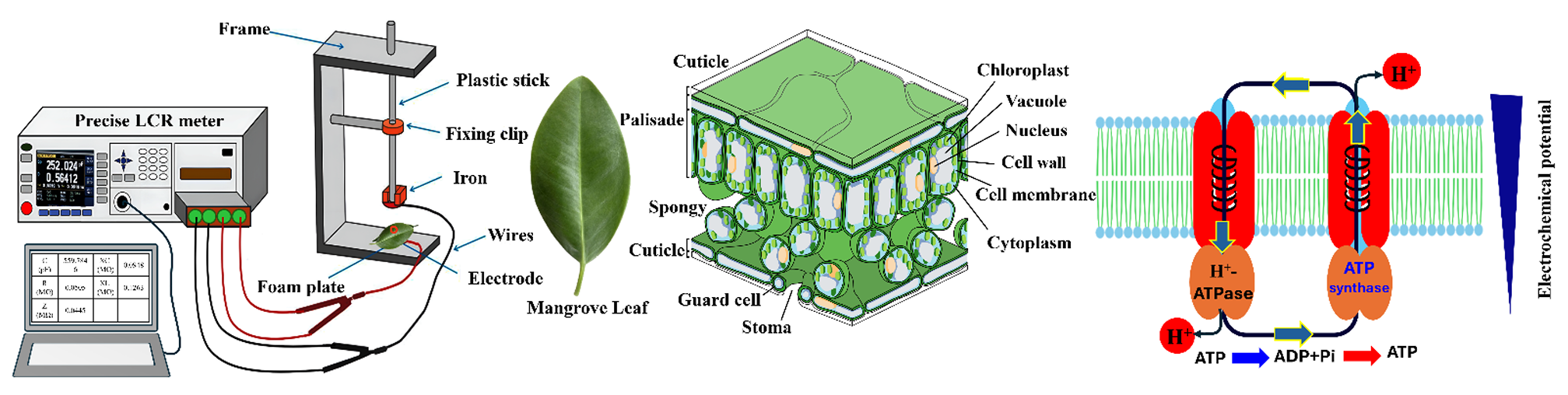
The integration of physical and chemical processes underpins life. Plant cells function as bioelectrical units, storing and converting energy through capacitive, inductive, and resistive properties. This study elucidates the electrophysiological and molecular mechanisms governing salt transport and energy allocation in Aegiceras corniculatum leaves under combined salinity-waterlogging stress (T1: 0.1 M NaCl + 2 h; T2: 0.2 M NaCl + 4 h; T3: 0.4 M NaCl + 6 h). Results demonstrate that leaf intracellular water-salt transport dynamics, coupled with salt-transport gene expression, coordinately regulate active/passive transport, vacuolar compartmentalization, cytoplasmic Na+ levels, and excretion. High salinity reduced salt excretion rate/capacity (LISTR/LISTC) and downregulated SOS1, while impairing water-holding capacity (LIWHC) and transport activities. Concurrent VHAc1 upregulation elevated vacuolar H+, inhibiting the Na+/H+ antiporter and compromising vacuolar salt sequestration. With increasing stress intensity, energy allocation shifted toward stress responses. Both electrical (internal) energy and ATP-derived chemical energy---originating from photosynthesis---jointly sustain plant vitality and adaptability; growth is primarily supported by internal energy, and adaptive differences dictate photosynthetic performance. This integrated analysis reveals how water-salt dynamics and molecular regulation confer salt tolerance in mangroves, offering insights crucial for coastal ecosystem resilience.
Graphical Abstract
Keywords
Data Availability Statement
Funding
Conflicts of Interest
AI Use Statement
Ethical Approval and Consent to Participate
References
- Osland, M. J., Chivoiu, B., Enwright, N. M., Thorne, K. M., Guntenspergen, G. R., Grace, J. B., & Swarzenzki, C. M. (2022). Migration and transformation of coastal wetlands in response to rising seas. Science Advances, 8(26).
[CrossRef] [Google Scholar] - Engels, J. G., Rink, F., & Jensen, K. (2011). Stress tolerance and biotic interactions determine plant zonation patterns in estuarine marshes during seedling emergence and early establishment. Journal of Ecology, 99(1), 277–287.
[CrossRef] [Google Scholar] - Islam, M. N., Bell, R. W., Barrett-Lennard, E. G., & Maniruzzaman, M. (2022). Growth and yield responses of sunflower to drainage in waterlogged saline soil are caused by changes in plant-water relations and ion concentrations in leaves. Plant and Soil, 479(1–2), 679–697.
[CrossRef] [Google Scholar] - Tahjib-Ul-Arif, M., Hasan, M. T., Rahman, M. A., Nuruzzaman, M., Rahman, A. M. S., Hasanuzzaman, M., & Brestic, M. (2023). Plant response to combined salinity and waterlogging stress: Current research progress and future prospects. Plant Stress, 7, 100137.
[CrossRef] [Google Scholar] - Zhang, Y., Liu, G., Dong, H., & Li, C. (2021). Waterlogging stress in cotton: Damage, adaptability, alleviation strategies, and mechanisms. Crop Journal, 9(2), 257–270.
[CrossRef] [Google Scholar] - Sandoval, M. N., Cirilo, A. G., Paytas, M. J., Zuil, S. G., & Izquierdo, N. G. (2024). Critical periods for waterlogging effects on yield and grain components in sunflower (Helianthus annuus), soybean (Glycine max) and sorghum (Sorghum bicolor): A comparative study. Journal of Agronomy and Crop Science, 210(5), e12765.
[CrossRef] [Google Scholar] - Zhang, R., Wang, Y., Hussain, S., Yang, S., Li, R., Liu, S., ... & Hou, H. (2022). Study on the effect of salt stress on yield and grain quality among different rice varieties. Frontiers in Plant Science, 13, 918460.
[CrossRef] [Google Scholar] - Foster, K. J., & Miklavcic, S. J. (2020). A comprehensive biophysical model of ion and water transport in plant roots. III. Quantifying the energy costs of ion transport in salt-stressed roots of Arabidopsis. Frontiers in Plant Science, 11, 865.
[CrossRef] [Google Scholar] - Takahashi, H., Abo, C., Suzuki, H., Romsuk, J., Oi, T., Yanagawa, A., ... & Nakazono, M. (2023). Triterpenoids in aerenchymatous phellem contribute to internal root aeration and waterlogging adaptability in soybeans. New Phytologist, 239(3), 936-948.
[CrossRef] [Google Scholar] - Craig Plett, D., & Møller, I. S. (2010). Na+ transport in glycophytic plants: what we know and would like to know. Plant, cell & environment, 33(4), 612-626.
[CrossRef] [Google Scholar] - Foster, K. J., & Miklavcic, S. J. (2015). Toward a biophysical understanding of the salt stress response of individual plant cells. Journal of Theoretical Biology, 385, 130–142.
[CrossRef] [Google Scholar] - Melkikh, A. V., & Sutormina, M. I. (2022). From leaves to roots: Biophysical models of transport of substances in plants. Progress in Biophysics and Molecular Biology, 169, 53-83.
[CrossRef] [Google Scholar] - Hasegawa, P. M. (2013). Sodium (Na+) homeostasis and salt tolerance of plants. Environmental and Experimental Botany, 92, 19–31.
[CrossRef] [Google Scholar] - Cubero‐Font, P., & De Angeli, A. (2021). Connecting vacuolar and plasma membrane transport networks. New Phytologist, 229(2), 755-762.
[CrossRef] [Google Scholar] - Chen, J., Xiong, D. Y., Wang, W. H., Hu, W. J., Simon, M., Xiao, Q., ... & Zheng, H. L. (2013). Nitric oxide mediates root K+/Na+ balance in a mangrove plant, Kandelia obovata, by enhancing the expression of AKT1-type K+ channel and Na+/H+ antiporter under high salinity. Plos one, 8(8), e71543.
[CrossRef] [Google Scholar] - Chi, B. J., Guo, Z. J., Wei, M. Y., Song, S. W., Zhong, Y. H., Liu, J. W., ... & Zheng, H. L. (2024). Structural, developmental and functional analyses of leaf salt glands of mangrove recretohalophyte Aegiceras corniculatum. Tree Physiology, 44(1), tpad123.
[CrossRef] [Google Scholar] - Guo, Z., Wei, M. Y., Zhong, Y. H., Wu, X., Chi, B. J., Li, J., ... & Zheng, H. L. (2023). Leaf sodium homeostasis controlled by salt gland is associated with salt tolerance in mangrove plant Avicennia marina. Tree Physiology, 43(5), 817-831.
[CrossRef] [Google Scholar] - Wegner, L. H., & Shabala, S. (2020). Biochemical pH clamp: the forgotten resource in membrane bioenergetics. New Phytologist, 225(1), 37-47.
[CrossRef] [Google Scholar] - Sun, C. C., Chan, F. C., Ahamad, A., & Yao, Y. H. (2023). Improved Natural Plant Electrophysiology Sensor Design for Phytosensing System. IEEE Transactions on Instrumentation and Measurement, 72, 1-10.
[CrossRef] [Google Scholar] - Sukhov, V., Sukhova, E., & Vodeneev, V. (2019). Long-distance electrical signals as a link between the local action of stressors and the systemic physiological responses in higher plants. Progress in Biophysics and Molecular Biology, 146, 63–84.
[CrossRef] [Google Scholar] - Lopes, A. M., & Machado, J. T. (2014). Fractional order models of leaves. Journal of Vibration and Control, 20(7), 998-1008.
[CrossRef] [Google Scholar] - Buch-Pedersen, M. J., Pedersen, B. P., Veierskov, B., Nissen, P., & Palmgren, M. G. (2009). Protons and how they are transported by proton pumps. Pflügers Archiv-European Journal of Physiology, 457(3), 573-579.
[CrossRef] [Google Scholar] - Hmidi, D., Muraya, F., Fizames, C., Véry, A. A., & Roelfsema, M. R. G. (2025). Potassium extrusion by plant cells: evolution from an emergency valve to a driver of long‐distance transport. New Phytologist, 245(1), 69-87.
[CrossRef] [Google Scholar] - Mohr, H., & Schopfer, P. (Eds.). (2012). Plant physiology. Springer Science & Business Media.
[Google Scholar] - Zhang, C., Wu, Y., Su, Y., Li, H., Fang, L., & Xing, D. (2021). Plant’s electrophysiological information manifests the composition and nutrient transport characteristics of membrane proteins. Plant Signaling & Behavior, 16(7), 1918867.
[CrossRef] [Google Scholar] - Duan, R., Xing, D., Chen, T., & Wu, Y. (2022). Effects of different inorganic nitrogen sources of Iris pseudacorus and Iris japonica on energy distribution, nitrogen, and phosphorus removal. HortScience, 57(6), 698-707.
[CrossRef] [Google Scholar] - Fromm, J., & Lautner, S. (2007). Electrical signals and their physiological significance in plants. Plant, cell & environment, 30(3), 249-257.
[CrossRef] [Google Scholar] - Geng, Y., Wu, R., Wee, C. W., Xie, F., Wei, X., Chan, P. M. Y., ... & Dinneny, J. R. (2013). A spatio-temporal understanding of growth regulation during the salt stress response in Arabidopsis. The Plant Cell, 25(6), 2132-2154.
[CrossRef] [Google Scholar] - Julkowska, M. M., & Testerink, C. (2015). Tuning plant signaling and growth to survive salt. Trends in Plant Science, 20(9), 586–594.
[CrossRef] [Google Scholar] - Qie, Y. D., Zhang, Q. W., McAdam, S. A., & Cao, K. F. (2024). Stomatal dynamics are regulated by leaf hydraulic traits and guard cell anatomy in nine true mangrove species. Plant Diversity, 46(3), 395-405.
[CrossRef] [Google Scholar] - Wang, X., & Lu, C. (2024). Exploring the fast-growing mechanism of Laguncularia racemosa from the perspective of leaf traits and ultrastructure. Aquatic Ecology, 58(2), 387–398.
[CrossRef] [Google Scholar] - Gupta, A., Shaw, B. P., & Roychoudhury, A. (2021). NHX1, HKT, and monovalent cation transporters regulate K+ and Na+ transport during abiotic stress. Transporters and Plant Osmotic Stress, 1–27. Academic Press.
[CrossRef] [Google Scholar] - Quintero, F. J., Blatt, M. R., & Pardo, J. M. (2000). Functional conservation between yeast and plant endosomal Na+/H+ antiporters. FEBS letters, 471(2-3), 224-228.
[CrossRef] [Google Scholar] - Bassil, E., Tajima, H., Liang, Y. C., Ohto, M. A., Ushijima, K., Nakano, R., ... & Blumwald, E. (2011). The Arabidopsis Na+/H+ antiporters NHX1 and NHX2 control vacuolar pH and K+ homeostasis to regulate growth, flower development, and reproduction. The Plant Cell, 23(9), 3482-3497.
[CrossRef] [Google Scholar] - Suzuki, N., Koussevitzky, S. H. A. I., Mittler, R. O. N., & Miller, G. A. D. (2012). ROS and redox signalling in the response of plants to abiotic stress. Plant, cell & environment, 35(2), 259-270.
[CrossRef] [Google Scholar] - Bandehagh, A., & Taylor, N. L. (2020). Can alternative metabolic pathways and shunts overcome salinity induced inhibition of central carbon metabolism in crops?. Frontiers in Plant Science, 11, 1072.
[CrossRef] [Google Scholar] - Silva, P., Façanha, A. R., Tavares, R. M., & Gerós, H. (2010). Role of tonoplast proton pumps and Na+/H+ antiport system in salt tolerance of Populus euphratica Oliv. Journal of Plant Growth Regulation, 29(1), 23-34.
[CrossRef] [Google Scholar] - Lang, T., Sun, H., Li, N., Lu, Y., Shen, Z., Jing, X., ... & Chen, S. (2014). Multiple signaling networks of extracellular ATP, hydrogen peroxide, calcium, and nitric oxide in the mediation of root ion fluxes in secretor and non-secretor mangroves under salt stress. Aquatic Botany, 119, 33-43.
[CrossRef] [Google Scholar] - Ouyang, X., Ma, J., Liu, Y., Li, P., Wei, R., Chen, Q., & Li, Y. (2023). Foliar cadmium uptake, transfer, and redistribution in Chili: A comparison of foliar and root uptake, metabolomic, and contribution. Journal of Hazardous Materials, 453, 131421.
[CrossRef] [Google Scholar] - Srikanth, S., Lum, S. K. Y., & Chen, Z. (2016). Mangrove root: adaptations and ecological importance. Trees, 30(2), 451-465.
[CrossRef] [Google Scholar] - Liu, H., An, X., Liu, X., Yang, S., Liu, Y., Wei, X., & Wang, J. (2024). Molecular mechanism of salinity and waterlogging tolerance in mangrove Kandelia Obovata. Frontiers in Plant Science, 15, 1354249.
[CrossRef] [Google Scholar] - Krauss, K. W., & Ball, M. C. (2013). On the halophytic nature of mangroves. Trees, 27(1), 7-11.
[CrossRef] [Google Scholar] - Gurovich, L. A., & Hermosilla, P. (2009). Electric signalling in fruit trees in response to water applications and light–darkness conditions. Journal of plant physiology, 166(3), 290-300.
[CrossRef] [Google Scholar] - Jócsák, I., Végvári, G., & Vozáry, E. (2019). Electrical impedance measurement on plants: a review with some insights to other fields. Theoretical and Experimental Plant Physiology, 31(3), 359-375.
[CrossRef] [Google Scholar] - Zhang, C., Wu, Y., Su, Y., Xing, D., Dai, Y., Wu, Y., & Fang, L. (2020). A plant’s electrical parameters indicate its physiological state: A study of intracellular water metabolism. Plants, 9(10), 1256.
[CrossRef] [Google Scholar] - Ali Solangi, K., Wu, Y., Xing, D., Ahmed Qureshi, W., Hussain Tunio, M., Ali Sheikh, S., & Shabbir, A. (2022). Can electrophysiological information reflect the response of mangrove species to salt stress? A case study of rewatering and Sodium nitroprusside application. Plant Signaling & Behavior, 17(1), 2073420.
[CrossRef] [Google Scholar] - Repo, T., Zhang, G. A. N. G., Ryyppö, A., & Rikala, R. (2000). The electrical impedance spectroscopy of Scots pine (Pinus sylvestris L.) shoots in relation to cold acclimation. Journal of Experimental Botany, 51(353), 2095-2107.
[CrossRef] [Google Scholar] - Barnuevo, A., & Asaeda, T. (2018). Integrating the ecophysiology and biochemical stress indicators into the paradigm of mangrove ecology and a rehabilitation blueprint. PLoS One, 13(8), e0202227.
[CrossRef] [Google Scholar] - Shabala, S., Bose, J., & Hedrich, R. (2014). Salt bladders: do they matter?. Trends in plant science, 19(11), 687-691.
[CrossRef] [Google Scholar] - Parida, A. K., & Jha, B. (2010). Salt tolerance mechanisms in mangroves: a review. Trees, 24(2), 199-217.
[CrossRef] [Google Scholar] - Munns, R., & Tester, M. (2008). Mechanisms of salinity tolerance. Annu. Rev. Plant Biol., 59(1), 651-681.
[CrossRef] [Google Scholar] - Flowers, T.J., & Colmer, T.D. (2015). Plant salt tolerance: adaptations in halophytes. Ann. Bot., 115(3), 327-331.
[CrossRef] [Google Scholar] - Carden, D. E., Walker, D. J., Flowers, T. J., & Miller, A. J. (2003). Single-cell measurements of the contributions of cytosolic Na+ and K+ to salt tolerance. Plant physiology, 131(2), 676-683.
[CrossRef] [Google Scholar] - Britto, D. T., & Kronzucker, H. J. (2009). Ussing’s conundrum and the search for transport mechanisms in plants. New Phytologist, 243–246.
[Google Scholar] - Kosová, K., Prášil, I. T., & Vítámvás, P. (2013). Protein contribution to plant salinity response and tolerance acquisition. International journal of molecular sciences, 14(4), 6757-6789.
[CrossRef] [Google Scholar] - Xu, Y., & Fu, X. (2022). Reprogramming of plant central metabolism in response to abiotic stresses: A metabolomics view. International Journal of Molecular Sciences, 23(10), 5716.
[CrossRef] [Google Scholar] - Rocha, A. G., & Vothknecht, U. C. (2012). The role of calcium in chloroplasts—an intriguing and unresolved puzzle. Protoplasma, 249(4), 957-966.
[CrossRef] [Google Scholar] - Jiang, B., Li, R., Shen, X., Zhang, Z., & Zhang, Y. (2022). Meta-analysis of mangrove salt-waterlogging tolerance and application strategies. Acta Scientiarum Naturalium Universitatis Pekinensis, 58(4), 687-699.
[CrossRef] [Google Scholar] - Ye, Y., Tam, N. F., Wong, Y. S., & Lu, C. Y. (2003). Growth and physiological responses of two mangrove species (Bruguiera gymnorrhiza and Kandelia candel) to waterlogging. Environmental and Experimental botany, 49(3), 209-221.
[CrossRef] [Google Scholar]
Cite This Article
TY  - JOUR
AU  - Wang, Jing
AU  - Aboueldahab, Mohamed
AU  - Wu, Yanyou
AU  - Xing, Deke
AU  - Zhang, Qian
PY  - 2026
DA  - 2026/02/12
TI  - Salt Adaptation in Aegiceras Corniculatum: Electrophysiology, Gene Expression, and Energy Trade-Offs
JO  - Journal of Plant Electrobiology
T2  - Journal of Plant Electrobiology
JF  - Journal of Plant Electrobiology
VL  - 1
IS  - 1
SP  - 7
EP  - 31
DO  - 10.62762/JPE.2025.184208
UR  - https://www.icck.org/article/abs/JPE.2025.184208
KW  - aegiceras corniculatum
KW  - salt active transport
KW  - internal energy
KW  - photosynthesis
KW  - climate change
AB  - The integration of physical and chemical processes underpins life. Plant cells function as bioelectrical units, storing and converting energy through capacitive, inductive, and resistive properties. This study elucidates the electrophysiological and molecular mechanisms governing salt transport and energy allocation in Aegiceras corniculatum leaves under combined salinity-waterlogging stress (T1: 0.1 M NaCl + 2 h; T2: 0.2 M NaCl + 4 h; T3: 0.4 M NaCl + 6 h). Results demonstrate that leaf intracellular water-salt transport dynamics, coupled with salt-transport gene expression, coordinately regulate active/passive transport, vacuolar compartmentalization, cytoplasmic Na+ levels, and excretion. High salinity reduced salt excretion rate/capacity (LISTR/LISTC) and downregulated SOS1, while impairing water-holding capacity (LIWHC) and transport activities. Concurrent VHAc1 upregulation elevated vacuolar H+, inhibiting the Na+/H+ antiporter and compromising vacuolar salt sequestration. With increasing stress intensity, energy allocation shifted toward stress responses. Both electrical (internal) energy and ATP-derived chemical energy---originating from photosynthesis---jointly sustain plant vitality and adaptability; growth is primarily supported by internal energy, and adaptive differences dictate photosynthetic performance. This integrated analysis reveals how water-salt dynamics and molecular regulation confer salt tolerance in mangroves, offering insights crucial for coastal ecosystem resilience.
SN  - 3071-6268
PB  - Institute of Central Computation and Knowledge
LA  - English
ER  -
@article{Wang2026Salt,
  author = {Jing Wang and Mohamed Aboueldahab and Yanyou Wu and Deke Xing and Qian Zhang},
  title = {Salt Adaptation in Aegiceras Corniculatum: Electrophysiology, Gene Expression, and Energy Trade-Offs},
  journal = {Journal of Plant Electrobiology},
  year = {2026},
  volume = {1},
  number = {1},
  pages = {7-31},
  doi = {10.62762/JPE.2025.184208},
  url = {https://www.icck.org/article/abs/JPE.2025.184208},
  abstract = {The integration of physical and chemical processes underpins life. Plant cells function as bioelectrical units, storing and converting energy through capacitive, inductive, and resistive properties. This study elucidates the electrophysiological and molecular mechanisms governing salt transport and energy allocation in Aegiceras corniculatum leaves under combined salinity-waterlogging stress (T1: 0.1 M NaCl + 2 h; T2: 0.2 M NaCl + 4 h; T3: 0.4 M NaCl + 6 h). Results demonstrate that leaf intracellular water-salt transport dynamics, coupled with salt-transport gene expression, coordinately regulate active/passive transport, vacuolar compartmentalization, cytoplasmic Na+ levels, and excretion. High salinity reduced salt excretion rate/capacity (LISTR/LISTC) and downregulated SOS1, while impairing water-holding capacity (LIWHC) and transport activities. Concurrent VHAc1 upregulation elevated vacuolar H+, inhibiting the Na+/H+ antiporter and compromising vacuolar salt sequestration. With increasing stress intensity, energy allocation shifted toward stress responses. Both electrical (internal) energy and ATP-derived chemical energy---originating from photosynthesis---jointly sustain plant vitality and adaptability; growth is primarily supported by internal energy, and adaptive differences dictate photosynthetic performance. This integrated analysis reveals how water-salt dynamics and molecular regulation confer salt tolerance in mangroves, offering insights crucial for coastal ecosystem resilience.},
  keywords = {aegiceras corniculatum, salt active transport, internal energy, photosynthesis, climate change},
  issn = {3071-6268},
  publisher = {Institute of Central Computation and Knowledge}
}
Article Metrics
Publisher's Note
ICCK stays neutral with regard to jurisdictional claims in published maps and institutional affiliations.
Rights and Permissions

